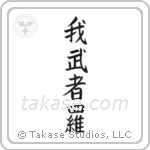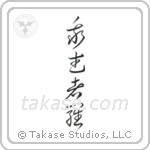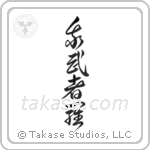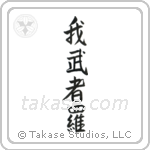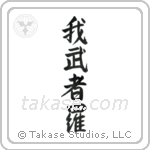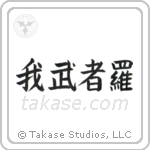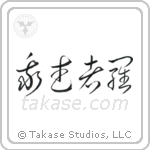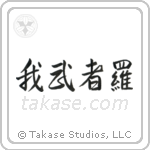

The four characters were chosen for their sounds and not their senses, which is why the word is usually written in kana: 武者 (musha), a warrior, was borrowed to write the middle of it, and 羅 (ra) writes the ending, so no character-by-character reading gives the meaning.
The word began as street slang for the hothead who rushes a fight, and its verdict has turned around: today it is said with admiration, of an all-out attack, of working flat out, of giving everything to one thing, the vocabulary of effort rather than of blame, and the characters on this design are the ones the dictionaries fixed for it a century ago.
Reckless is the exact English of the older sense, the one that keeps the reproach; headlong and all-out stand nearer the living word, and proceeding single-mindedly without regard to consequences is the honest middle. A person who wears it to say I go all out has the word Japanese means now.
We want you to be as happy with the meaning as you are with Master Takase's art. To learn more, visit Philology of 我武者羅.