

不言実行 · fugen jikkō · Action Before Words
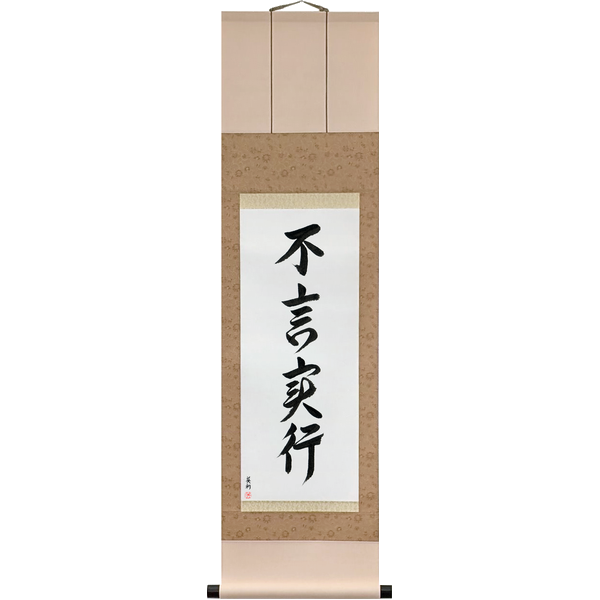
Sold as Action Before Words · Read fugen jikkō · Oldest witness a founding address of 1902, in which an oratory society attacks the cabinet of the day for practicing it · Made in Japan, about 1901, as a cabinet's watchword · Model the Analects: he acts before he speaks, and afterwards speaks according to his actions · Pair 有言実行, its pun, first in print in 1916.
The words
不言 is not saying: 老子's 不言之教, the teaching that uses no words, and the 史記's peach and plum trees that say nothing and still wear a path to their feet. 実行 is real doing, a word first found in an 1830s satire of the Confucians of Edo who wag empty tongues and have no real conduct in their persons. Put together they mean, in the dictionary's words, to do what should be done, in silence, without complaint or argument. The two words are Chinese; the four-character word is Japanese, and it is young.
A history, from the earliest witness
1840, China: the same four characters, meaning the opposite. The only pre-modern book in the National Diet Library's full-text index that contains the string is Chinese, an 1840 collection by the Qing official Li Yanzhang. His sentence complains that scholars for the most part do not speak of practical conduct and do not read the whole classics. There 不言 is the verb and 實行 its object; the words are a fragment of a sentence, not a phrase. Nothing older carries the word, in either language. [榕園全集, pid 2598944 koma 32, read by eye]
1901–1903. A cabinet's watchword, and its critics. The first Katsura cabinet took office in 1901. When Hara Takashi attacked it in the Diet in 1903 he said that at the founding of the present cabinet they announced 不言実行, to act without speaking; look at the record and they have spoken without acting. The oldest print of the word, a year earlier, is already an attack: the founding address of an oratory society says that the kind of 不言実行 practiced by the present cabinet, working in silence, "slow in speech and quick in action," is a thing not to be done in today's constitutional politics, which rests on public opinion. The quoted phrase is the Analects, and it is attached to the word in its first year. Three more books of 1903 say the same, one a manual of rhetoric warning that silence, few words and 不言実行 alone will not get through in today's world. [東洋雄弁会演説集 1902, pid 900479 koma 4; 第十七議会の顛末 1903, pid 784263 koma 16; both by eye]
1904–1909. The buzzword and the sect. Ōkuma Shigenobu, the most talkative politician of the age, sneered at the buzzword 不言実行: a man who talks may not be a doer, but there is no doer who does not talk; what they call 不言実行 is nothing but the excuse of a man with no opinions and no confidence. By 1909 a book of portraits of government men calls it a religion: 不言実行 is the mark of the Katsura cabinet, and Baron Hirata is the head temple of the 不言実行 sect; the world calls Marquis Katsura its founder, but it was the baron who converted him. The same year a Confucian scholar, annotating the Analects in Chinese, wrote that those who now preach 不言実行 only make the people doubt; where is the trust in that? [春汀全集 1909, pid 778039 koma 58; 政府部内人物評 1909, pid 778198 koma 14; both by eye]
1906–1915. The virtue. Tokutomi Sohō took the word up in 1906 with a caveat, what we should strive for is 不言実行, though 不言実行 does not mean absolute silence. In 1913 a manual for the spiritual education of soldiers gave conscripts a lesson on it: what you have resolved in your heart you carry out without saying so; what you are ordered you do exactly, in silence; said aloud it sounds like boasting; a soldier carries out orders at once and reasons are forbidden. The same year the essayist Ōmachi Keigetsu put the man who aims at great things is a man of 不言実行 into a calligraphy copybook, and from 1915 the county gazetteers praise their local worthies for the virtue of 不言実行. [実際的軍人精神教育要領 1913, pid 941757 koma 69, by eye]
1916. The pun. 有言実行, say it and do it, appears as the third term of a joke about three prime ministers: Katsura made 不言実行 his principle, Yamamoto neither spoke nor acted, and Ōkuma raised the ideal of 有言実行. By 1926 a lecturer could say that constitutional politics is politics of responsibility, which is to say 有言実行, and by 1938 the two were a pair: 不言実行 is to be honored, 有言実行 is to be done. [大正政界之裏面 1916, pid 936068 koma 57, by eye]
1935–1943. The word forgets its birth. The Library's curve rises from eleven books in 1900–04 to 466 in 1935–39, most of them in politics, the military, education, biography and ethics. In 1943 a poet could write that we have been taught 不言実行 since ancient times, of a word forty-one years old in print.
The sense across time
The dictionaries record one sense, the virtue: to do without announcing. The books record two, and they are the two sides of one argument that began the year the word did. For the barracks, the copybook and the commentators on the Analects, the word is the Master's own teaching: act first, and let your words follow; the gentleman is ashamed when his words outrun his deeds; I would prefer not to speak: does Heaven speak? The four seasons run their course. For the orators, for Hara and for Ōkuma, a government that will not speak is a government that need not answer, and 不言実行 is the silent man's excuse. A 1940 commentary reconciles the two in one line, and it is the best gloss the word has: 不言実行 prizes not the silence but the doing.
What is not a source
Not a Chinese idiom: the 1840 Chinese sentence uses the four characters to mean do not speak of practice. Not ancient: no Japanese book before 1902 carries it, and the first dictionary to list it, a 1906 kanji dictionary, gives it as a usage example under 実行. Not the Analects verbatim: the Analects supply the idea in four passages and the word 不言 in none of them. Not a samurai maxim: it was born in a cabinet and raised in a conscript's barracks.
The text in English
The word's first foreign twin in print is French, not English. A 1909 Japanese dictionary of foreign idioms glosses faire sans dire as 言はずして行ふ, 不言実行, to act without talking, and on the same page gives deeds, not words and the Italian deeds are male, words female without matching either to it. Two books of 1909–12 reach for the word to render Carlyle. The twentieth-century glosses: working in silence (斎藤, 1928); action before words, work before talk (研究社, whose example sentence is still political: what Japan needs most now is politicians who act rather than talk); deeds, not words (a proverb dictionary); actions speak louder than words (a sentence corpus). The catalogue's three glosses are these three, in that order. [英和双解熟語大辞典 1909, pid 990169 koma 857, by eye]
A reading
Sell it as a Meiji word with a Confucian spine. Action Before Words is the right lead, and the page should say where it comes from: the Master's answer to a talkative disciple, act first, then let your words follow. The birth in a cabinet is the story, and it is a good one for a scroll about resolve: the word was mocked as a buzzword by the best talker of the age and outlived the mockery because soldiers, teachers and calligraphers found it true. The sentence for the page is the 1940 one: not the silence, but the doing. The scroll's modern 実 is right for a reader today; the pre-war 實 is a real second design for the buyer who wants the Meiji look. 典, 2026-09-07.
How this was read
By eye: the template file; nine pages at the scan, from the 1840 Chinese book to the 1916 political one. By text at the address: the National Diet Library's full-text index on the word, pulled whole and classed by year and subject, and on its pun; the local harvest of that library for the dictionaries and the Analects commentaries; kotobank for eight entries; six Analects passages, three chapters of 老子 and the 史記 at ctext; the English through EDRDG and Weblio. Not read: the 1914 novel the 日国 cites; Katsura's own words; the 1909–1943 books quoted from OCR at their scans; the English dictionaries at their own pages. Every address is in the account.
References
Each witness is cited in the account above, at the frame or entry where it was read. A linked list follows when the record for this text is completed.