

力と名誉 · 頑張って · 夢実現 · 心の儘 · 運が向く · chikara to meiyo · ganbatte · yume jitsugen · kokoro no mama · un ga muku · Strength and Honor · Go For It · Realize Your Dreams · Follow Your Heart · Fortune Smiles
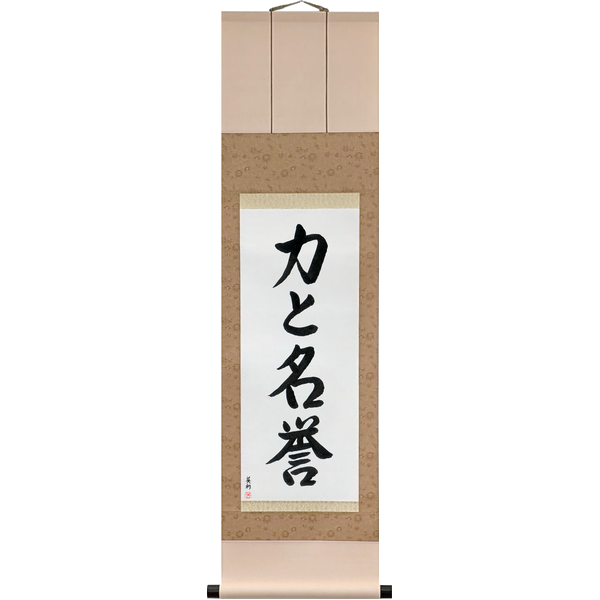
Sold as five scrolls on the motivational shelf · Read chikara to meiyo, ganbatte, yume jitsugen, kokoro no mama, un ga muku · What they are one line from a film that is older than the film, one cheer, one headline, one Heian idiom, one Edo idiom · Oldest witness 力と名誉 in Wesley translated, 1898; 頑張って in a Meiji novel, 1901; 夢実現 in 1918; 心の儘 in the 竹取物語; 運が向く in an 1823 kabuki · In the dictionaries two of the five as headwords (心のまま, 運が向く), three not · None Chinese · Signed 典, 2026-09-07.
The words
力と名誉 chikara to meiyo: 力 strength, in the 古事記 for the body and the 万葉集 for the spirit; 名誉 meiyo, a Heian word for renown of any kind (a strong thief is 名誉の大剛の者 in the 平治物語), whose sense as a person's honor, the one the scroll sells, the 日本国語大辞典 first finds in 久米邦武's account of the Iwakura mission, 1877. 頑張って ganbatte is the て-form of 頑張る, a verb written with borrowed characters: the dictionaries derive it from 眼張る, to fix the eyes on (1745), or from 我に張る, to stand on oneself, and its senses run from watching to planting oneself to insisting to enduring. 夢実現 yume jitsugen is 夢, dream in its twentieth-century sense of a hope, and 実現, a Meiji word for realization listed in the 哲学字彙 of 1884 and first cited from 漱石 in 1907. 心の儘 kokoro no mama is as the heart wills: まま, from まにま, the state as it is, and the 日本国語大辞典 heads the whole phrase, 心に思う通り。心まかせ。思う存分. 運が向く un ga muku is likewise a headword there, 好運がやってくる。状況が良い方に向く, luck comes one's way.
A history, from the earliest witness
力と名誉 has no Japanese life of its own. Of 192 books the Diet Library's index returns, 186 are other words ending in 力 (勢力と名譽, 權力と名譽, 金力と名譽, 實力と名譽), and the bare pairing appears only where a Western text is being translated: Wesley's notes on Luke in 1898, そが靈の力と名譽と樂みとは, the power and honor and joy of the spirit; Aristotle on Athens in 1902, 智德の値打に從つて力と名譽とを配置せり, distributed power and honor according to the worth of wisdom and virtue; Locke in 1910. The reverse 名誉と力 is Eucken, Homer and Milton in translation. 頑張って is a word of the twentieth century's first half. The persevere sense, which the 日本国語大辞典 first cites from a children's song of 1944, is in print by 1907: 漱石's cat watches a man 頑張つて居る in his opinion, and 黙雷's Zen talks say 一人でも頑張つて一陽來復の時節を待つのだ, hold on alone and wait for the year to turn. The index has the word in 18 books of 1900–1904, 404 of the 1910s, 983 of the 1920s, 1,781 of the 1930s, and the cheer 頑張れ in 797. 夢実現 is 夢の実現 with its particle dropped. The full phrase is in 181 books from 1904, when 堺利彦 rendered William Morris's News from Nowhere (其の樂しき夢の實現), then in Marden's 成功の基礎 of 1907 and the success literature that followed; the compressed form appears in three books, a Tolstoy letters volume of 1918, a 1943 life of 森恪 and 桑木彧雄's history of science of 1944, and in five more only as the tail of another word (靈夢, 迷夢, 甘夢). 心の儘 is Heian. The 竹取物語: 心の儘にもえせめず, he could not press her as he wished; the 源氏物語, 篝火, 御心のままに押したちて, and 常夏, 心のままにも折り取らぬを; the 今鏡, 御心のままに; and in the 太平記 it takes on license, 御心の侭に極侈, indulged himself at will, and 趙高が心の侭にぞ行ひける, Zhao Gao ran the state as he pleased. It is in a tea manual of 1686 (下火を心の侭に直し) and in 宣長, and the index has it in 5,670 books. 運が向く is Edo speech. The 日本国語大辞典's first citation is an 1823 kabuki, サア運が向いて来たわえ, there, my luck has turned; the index has 運の向く in 1883, 運が向いて in an 1891 rakugo transcript and in 1893 translations of Dumas and Lytton, and the bilingual dictionaries fixing the English: 井上十吉 in 1911, 運が向く, Luck is coming; 武信 in 1918, one's fortune changes for the better. 綺堂's Hanshichi says とんとん拍子に運が向いてきて. In all, 1,253 books have 運が向いて.
What is not a source
For 力と名誉, the Bible and the film are the English sources, not Japanese ones; the Japanese Bible renders Proverbs 31:25 as 力と尊貴とを衣とし, not 力と名誉. For 心の儘, the Chinese 心之所向 is a different phrase. For 頑張って, the 1809 kabuki that first writes 頑張 means keep an eye on, and is the spelling's witness, not the sense's.
The texts in English
Strength and honour are her clothing; and she shall rejoice in time to come, Proverbs 31:25 in the King James Version, is the old English pairing; the ngram has strength and honour at its height around 1806 and falling for two centuries, and the American spelling tripling only in the 2000s, when Maximus in Gladiator (2000) salutes his men with Strength and honor. The Japanese subtitle renders it 力と名誉を, by a 2012 viewer's report, and the house's rendering is the subtitle's. Go for it is an old verb phrase and a slogan only since about 1980, when its frequency quadruples; the subtitle corpus renders it 頑張れよ, ファイト, やれよ, 行け, and do your best, the page's second gloss, is the older dictionary equivalent of 頑張る. Realize your dreams is rare before 1980 and peaks in 2010; make your dreams come true is in print from 1895. Follow your heart rises tenfold after 1980; the subtitle corpus gives 自分の心に従え, 思うようにしなさい, and 心のまま is a description, as the heart wills, where the English is an instruction. Fortune smiles is Georgian English, highest in 1804 and a tenth of that by 1980; 斎藤和英 renders Fortune smiles on Japan's arms as 日本は武運めでたし. The house's five titles are Timothy L. Jackowski's, made for Takase Studios, and each keeps the sense; what a rendering must keep is named in the reading.
A reading
Five short texts, and the shelf's label is wrong about three of them in an interesting way. 力と名誉 is a translator's pairing, in Japanese as in English on the wall of a Roman general: two abstract nouns, the second of them Meiji in this sense, and no Japanese reader will take it for a proverb; the fuller truth is that it is Solomon's before it is Maximus's. 頑張って is a cheer, not a text, and its history is the verb's, from eyes to endurance; on a wall it is the word a dojo says. 夢実現 is a headline, 夢の実現 with its の dropped, and a Japanese reader reads it as a poster reads; that is a register, not a fault. 心の儘 is the one classical phrase here, a thousand years old, and it should be sold as one: it says as the heart wills, freedom, and in the old texts sometimes license, which is the edge a buyer should know. 運が向く is the truest match of the five, idiom for idiom, luck turning one's way in the voice of a kabuki rogue on one side and a Regency novel on the other. Romaji as on the pages: chikara to meiyo, ganbatte, yume jitsugen, kokoro no mama, un ga muku.
Notes
が marks the subject (superseded s77, 2026-09-08: the 運が向く page said object when read on 2026-09-07; 礎's wave 32 replaced it the same day and 照 measured s347 that the live page reads subject). The 頑張って page says a imperative form; 頑張って is the て-form used as a request, and the imperative is 頑張れ. 儘 on the 心の儘 scroll is the full glyph, which Edo print often writes 侭 and the dictionaries write in kana; all three are one word. The 名誉 of the scroll is 名譽 in every prewar witness. The backlog's coined class label fits none of these five: two are idioms, one a compression, one a cheer, one a translation.
How this was read
By eye: the five templates. By text at the address: the Diet Library's full-text index on each text and its variants, pulled whole where under 200 books and by classical facet or year where larger, the boundary artifacts named; four pages of the index at the page API for the real 力と名譽 witnesses; kotobank whole for the words and the two idiom headwords; Weblio on each side; ja and zh Wikisource by phrase; 箴言(文語訳) and the King James Proverbs at Wikisource; the Google Books ngram on sixteen English forms; a 2012 Yahoo!知恵袋 exchange for the subtitle; the Wayback index for the house's own record, which has four of the five designs on takase.com by January 2011 and 心の儘 first in 2019; the store files, ten live routes. Not read: the 日本国語大辞典 leaves themselves; the film and its Japanese disc; the 1823 kabuki; the OED on any of the five; the thousands of prewar 心の儘 and 頑張つて hits beyond the classical facet and the first decade; the house's own record of when any scroll was brushed. Every address is in the account.
References
- 古事記 下 (日国 力 ①) (712) — kotobank.jp/word/力 (精選版)
- 万葉集 17·3972 (日国 力 ②) (8C) — kotobank.jp/word/力 (精選版)
- 江談抄 五 (日国 名誉 ①) (c. 1111) — kotobank.jp/word/名誉 (精選版)
- 平治物語 中 (日国 名誉 ②) (c. 1220) — kotobank.jp/word/名誉 (精選版)
- 久米邦武 米欧回覧実記 一 (日国 名誉 ④, the *honor* sense) (1877) — kotobank.jp/word/名誉 (精選版)
- ジョン・ウェスレー 新約筌蹄 上 (tr.) (1898) — lab.ndl.go.jp/dl/api/page/825548_300 (OCR)
- 長谷川天渓 アリストートル (1902) — lab.ndl.go.jp/dl/api/page/809437_40 (OCR)
- ポール・モンロー 世界教育史要 (tr. 石田新太郎) (1910) — lab.ndl.go.jp/dl/api/page/809527_212 (OCR)
- ルドルフ・オイケン 大思想家の人生観 (tr. 安倍能成) (1912) — Lab index 949301 (snippet)
- ホオマア イリアード (tr. 馬場孤蝶) (1915) — Lab index 950222 (snippet)
- 箴言 31:25, 文語訳 (1887/1917 text) — ja.wikisource.org/wiki/箴言(文語訳)
- Proverbs 31:25, KJV (1611) — en.wikisource.org/wiki/Bible_(King_James)/Proverbs
- Gladiator, Maximus's line; Japanese subtitle 力と名誉を (2000 (subtitle reported 2012)) — detail.chiebukuro.yahoo.co.jp/qa/question_detail/q1484658174 (REPORTED; the disc not opened)
- 万葉集 4·490 (日国 いめ) (8C) — kotobank.jp/word/夢 (精選版)
- 古今和歌集 恋二·552 小野小町 (日国 夢 ①) (905–914) — kotobank.jp/word/夢 (精選版)
- 木下杢太郎 常長 四景 (日国 夢 ⑤, the aspiration sense) (1914) — kotobank.jp/word/夢 (精選版)
- 万葉集 1·8 (日国 かなう ①) (8C) — kotobank.jp/word/適う (精選版)
- 古今和歌集 離別·387 白女 (日国 かなう ②イ) (905–914) — kotobank.jp/word/適う (精選版)
- 落窪物語 四 (日国 かなう ②ロ, …がかなう) (late 10C) — kotobank.jp/word/適う (精選版)
- 徒然草 189 (日国 かなう ②ロ) (c. 1331) — kotobank.jp/word/適う (精選版)
- 狭衣物語 四之上 (c. 1070s (1600 print, 1913 and 1926 eds.)) — Lab index 2544518 · 1913586 · 1018121 (snippets, OCR)
- 東籬園瀬川路考 時雨の袖 (1825) — Lab index 8943099 (snippet, OCR)
- トルストイ 戦争と平和 (tr. 島村抱月) (1916) — Lab index 954325 (snippet, OCR); 馬場孤蝶's 1915 rendering writes 夢の協ふ (950223)
- 字通 叶 (—) — kotobank.jp/word/叶 (普及版 字通)
- ja.wikipedia DREAMS COME TRUE (band formed 1988 (recall for the year; the summary does not date it)) — ja.wikipedia.org/wiki/DREAMS_COME_TRUE (REST summary)
- 浄瑠璃 軍法富士見西行 (日国 眼張る ①) (1745) — kotobank.jp/word/眼張る (精選版)
- 歌舞伎 高麗大和皇白浪 (日国 眼張る ①, first 頑張 spelling) (1809) — kotobank.jp/word/眼張る (精選版)
- 落語 素人人力 三代目円遊 (日国 ④) (1893) — kotobank.jp/word/眼張る (精選版)
- 夏目漱石 吾輩ハ猫デアル 中 (1907) — Lab index 888726 (snippet, OCR)
- 竹田黙雷 黙雷禅話 (1907) — Lab index 823526 (snippet, OCR)
- 童謡 お山の杉の子 (日国 ⑤, the persevere sense) (1944) — kotobank.jp/word/眼張る (精選版)
- 太宰治 ヴィヨンの妻 (日国 ⑥) (1947) — kotobank.jp/word/眼張る (精選版)
- 改訂増補哲学字彙 (日国 実現) (1884) — kotobank.jp/word/実現 (精選版)
- 夏目漱石 虞美人草 一二 (日国 実現 初出) (1907) — kotobank.jp/word/実現 (精選版)
- ヰリアム・モリス 理想郷 (tr. 堺利彦) (1904) — Lab index 798702 (snippet, OCR)
- トルストイ書簡集 (石田三治) (1918) — Lab index 933065 (snippet, OCR)
- 山浦貫一 森恪 上 (1943) — Lab index 1908689 (snippet, OCR)
- 桑木彧雄 科学史考 (1944) — Lab index 1063016 (snippet, OCR)
- 日本書紀 神武即位前, 北野本室町時代訓 (日国 心のまま) (720) — kotobank.jp/word/心のまま (精選版)
- 竹取物語 (日国 心のまま; 群書類從 text at Wikisource) (late 9C–early 10C) — kotobank.jp/word/心のまま; ja.wikisource.org/wiki/竹とりの翁物語_(群書類從)
- 源氏物語 篝火 · 常夏 (c. 1008) — ja.wikisource.org/wiki/源氏物語/篝火 · /常夏
- 続世継 (今鏡) (c. 1170) — Lab index 2546534 (classical, snippet)
- 太平記 巻第十二 · 二十六 (14C) — ja.wikisource.org/wiki/太平記/巻第十二 · /巻第二十六
- 山田宗徧 茶道便蒙抄 (1686) — Lab index 2575277 (classical, snippet)
- 本居宣長 古事記傳 巻2 (1785) — Lab index 2545185 (classical, snippet)
- 台記 康治二年 (日国 運 ①) (1143) — kotobank.jp/word/運 (精選版)
- 大鏡 五 (日国 運 ②, 幸運) (early 12C) — kotobank.jp/word/運 (精選版)
- 歌舞伎 𢅻雑石尊贐 中幕 (日国 運が向く) (1823) — kotobank.jp/word/運が向く (精選版)
- 花笠文京 自由新話 (1883) — Lab index 886680 (snippet, OCR)
- 春錦亭柳桜 女煙草 (口演) (1891) — Lab index 891178 (snippet, OCR)
- 井上十吉 新訳和英辞典 (1911) — Lab index 870153 (snippet, OCR)
- 武信由太郎 武信和英大辞典 (1918) — Lab index 925665 (snippet, OCR)
- 斎藤和英大辞典 (via Weblio) (1928) — ejje.weblio.jp/sentence/content/"fortune smiles"
- 岡本綺堂 半七捕物帳 津の国屋 (1917–) — ja.wikisource.org/wiki/半七捕物帳_第一巻/津の国屋