

地水火風空 · chi sui ka fū kū · Earth, water, fire, wind, space
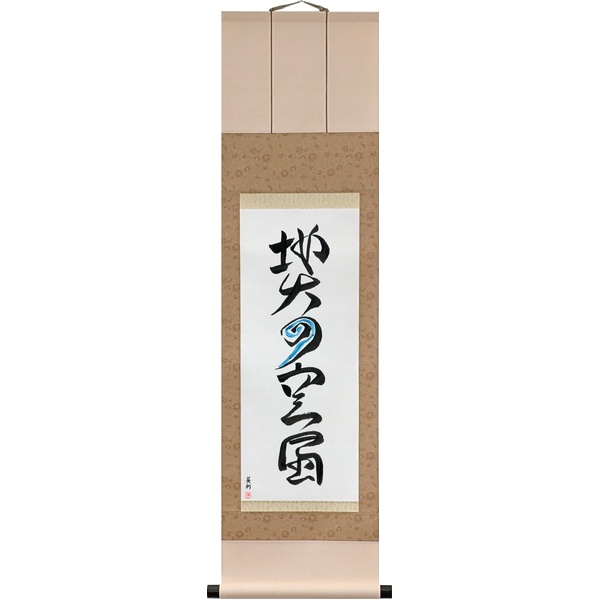
Sold as The Five Elements · Read chi sui ka fū kū · Oldest witness Kūkai, in a dedication of about 835, read in a printing of 1600; Musashi's five books at his own sentence, in a 1909 typeset · Sense the five great elements of Indian and Buddhist physics, of which everything is made; the fifth is space, not sky and not emptiness.
The words
Five characters that name the 五大, the five great elements, Sanskrit mahābhūta: 地 earth, 水 water, 火 fire, 風 wind, 空 space. The first four are the 四大 of Indian thought; the fifth was added to them, and 世界大百科事典 says what it is: 空大は物質の存在する場所を要素として数えたものである, space counted as an element, the place in which matter exists. That is the 空 of this set, Sanskrit ākāśa. It is not the sky, which is what the character means in ordinary Japanese and what the page's kun reading sora says, and it is not the Buddhist emptiness śūnyatā, which is written with the same character and is a different word. The readings of the set are the Sino-Japanese ones, ち・すい・か・ふう・くう; the kun readings the page also offers, mizu, hi, kaze, sora, are the characters' everyday readings and not the doctrine's. Esoteric Buddhism adds a sixth, 識, consciousness, to make the 六大, and the five-ring stupa, the 五輪塔 that stands in every Japanese graveyard, is the five stacked from the earth up.
A history, from the earliest witness
About 835. Kūkai, a dedicatory text for mandalas painted on behalf of the four benefactors, in the 性靈集, read in a printing of 1600. The first Japanese attestation 精選版日本国語大辞典 gives for 五大, in a text Kūkai signs as 弟子苾蒭空海. The dedication turns to everyone who helped, of every rank and every attitude, and then states the doctrine, in a run that crosses a leaf of the 1600 print: 合掌低頭護致見聞親疎恩 (the OCR of the leaf before, which reads 護致 where the 1893 typeset and 日国 read 讚毀) ‖ 怨五大所遍心識所在悟阿字於本初覺三寶於三密, those who joined their palms and bowed their heads, those who praised and those who slandered, who saw and who heard, the close and the distant, the grateful and the hostile: wherever the five elements pervade, there consciousness is; may they awaken to the letter A at the origin of all, and to the Three Jewels in the three mysteries. 五大所遍、心識所在: the five elements and consciousness are everywhere together, which is the esoteric six in one line. The 1600 printing breaks the sentence across a leaf, 親疎恩 at the end of one and 怨五大所遍 at the head of the next; the 1893 typeset carries it whole. [3][4]
Early Edo, a Tendai handbook of terms, 『天台圓宗四教五時西谷名目』. The five with the sixth, mapped onto the body for a student: 六果者地水火風空識也。地ハ人ノ肉身、水ハ人ノ血、火ハ人ノ気、風ハ人ノ息、空ハ鼻ノ穴、識ハ心也。仍テ人身云物無シ此地水火風空識可無正体物ヲ, the six fruits are earth, water, fire, wind, space and consciousness: earth is a person's flesh, water the blood, fire the warmth, wind the breath, space the nostrils, consciousness the mind; so what we call a person's body is nothing, and these six have no substance of their own. 空 as the nostrils is space in its plainest sense, the hollow through which the breath passes. The catalogue dates the print to the 寛永 era. [NDL pid 2532197, koma 13; OCR, which reads 士未六果者 … 地震人肉身水人血。火人ペ気風人息空鼻。穴。識心也 with the particles dropped and two characters misread; text at lab.ndl.go.jp/dl/api/page/2532197_13]
Early Edo, a divination manual, 『簠簋抄』. The five as the everyday frame of yin-yang lore: 五形ト者地水火風空也又五色也, the five forms are earth, water, fire, wind and space, and also the five colors; and in the second volume, 既ニ地水火風空ノ五大テ云時, when one speaks in terms of the five great elements, earth, water, fire, wind and space. A commonplace, which is what the five had become: the NDL's full-text search returns the string in more than 150 books of the classical facet alone. [NDL pid 2544460, koma 31, and pid 2544461, koma 51; OCR; text at lab.ndl.go.jp/dl/api/page/2544460_31 and …/2544461_51. Count at the NDL Lab full-text search, 2026-09-06]
1645. Miyamoto Musashi, 『五輪書』, the Book of the Earth and the Book of Space, read in the 1909 typeset of the 宮本武藏遺蹟顯彰會. The reason the page sells the five, at Musashi's own sentence. In the first book he explains the plan: 一此兵法の書五卷に仕立る事 五ツの道を分ち、一まき一まきにして其利を知らしめんが爲に、地水火風空として、五卷に書顯す也、地の卷に於ては兵法の道の大體、我一流の見…, on making this book of strategy in five scrolls: to divide the way into five and let each scroll teach its own advantage, I write it out in five scrolls as earth, water, fire, wind and space; in the scroll of earth, the outline of the way of strategy and my school's view…. The last book opens by saying what 空 is to a swordsman: 二刀一流の兵法の道、空の卷として書顯はす事、空と云心は物每のなき所、しれざる事を空と見たつる也、勿論空はなき也、有所を知りて無所を知る是則空也, writing the way of the two-sword school as the Book of Space: the meaning of 空 is the place where there is nothing; what cannot be known we take as 空; of course 空 is nothing; to know what is and thereby know what is not, that is 空. It closes 空有善無惡 智は有也 利は有也 道は有也 心は空也, space has good and no evil; wisdom is, advantage is, the way is, and the mind is space, and is dated 正保二年五月十二日 and addressed 新免武藏 to 寺尾孫之丞殿. Musashi's 空 is the Buddhist term worn as a swordsman's: not the sky, but the nothing that is known by knowing what is. The typeset also prints, at the head of the last book, the colophon of the copy it was set from, 寛文七年二月五日 寺尾夢世勝延 to 山本源介殿, a 1667 transmission; the book's editors say the original was in the hands of the 前田 family of 玉名 in Higo, and the dictionaries say no autograph survives, dating the work to the years 1643 to 1645. [NDL pid 992019, koma 101 (p. 155) and koma 141 (pp. 234–235); both read by eye at width 3600; text at lab.ndl.go.jp/dl/api/page/992019_101 and …/992019_141; the editors' note at koma 97, OCR. A second typeset, 『武術叢書』(国書刊行会 1915), has the same sentence in slightly different wording: NDL pid 945805, koma 128, OCR. Dates: kotobank.jp/word/五輪書-66594, 精選版日国 正保二年(一六四五)頃成立; 世界大百科 1643年(寛永20)から45年(正保2)5月 … 武蔵の自筆本が現存せず]
Today. デジタル大辞泉, 五大: 仏語。万物をつくる五つの要素。地・水・火・風・空の五大種, a Buddhist word: the five elements of which everything is made. ブリタニカ国際大百科事典 gives the lineage from the Indian schools through the Sarvāstivāda to esoteric Buddhism's six and the five-ring stupa: 密教ではこれらの5元素を哲学的形而上学的にとらえ,識と合せて,この6つが宇宙を構成する要素であるとする。五輪の塔はこの思想に基づく. [4]
The sense across time
One doctrine and two readings of its fifth word. From Kūkai to the dictionaries the five are the stuff of everything, and 空 among them is space, the place matter occupies, the hollow the breath goes through. Musashi takes the five as the names of his books and, in the last, reads 空 for a fighter: the nothing that is known by knowing what is. The page's void is Musashi's reading, and the English translations that made his book famous carried it; the doctrine's 空 is space. Both are right about their own text, and a history should say which is which.
What is not a source
The Chinese 五行, wood, fire, earth, metal and water, are a different five with a different logic of cycles and are not this set; the 簠簋抄 shows the two sets living side by side in one manual without merging. The five-ring stupa is a use of the doctrine, not its source. Musashi's book is the reason the buyer knows the five and not the reason they exist.
The term in English
No Meiji bilingual dictionary was opened for the term, and no English book on the shelf carries the five as a set.
1974. Victor Harris, A Book of Five Rings (Overlook Press), not opened. The English door through which most buyers meet the five, and the source, by report, of Ground, Water, Fire, Wind and Void as their names; the shelf holds only a bibliography entry for it, in Katō's History of Japanese Literature, vol. 2, and the book itself was not read. Whatever Harris wrote for 空 is his rendering of Musashi's 空, not of Kūkai's. [docs/research/papers/A-History-Of-Japanese-Literature-Volume-2_Kato-Macmillan-1983_2026-09-04.txt, the bibliography line only]
Today. The house title The Five Elements is fair; the house explanation's also meaning void for 空 is Musashi's sense and not the set's. A rendering of the five as a doctrine must give space for 空; a page that sells them as Musashi's five books may add void and say whose word it is. Romaji chi sui ka fū kū; the whole_designs row still carries fuu and kuu.
A reading
Five characters that need no argument and one that needs a sentence. The five are the doctrine in the order every source gives, the word for them is 五大, and the first Japanese to write them as a doctrine was Kūkai, in a dedication that says the elements and consciousness are everywhere together; I read that line in a print of 1600 and Musashi's plan of five books in a typeset of 1909, so both claims the page makes now stand on a leaf. The sentence the page needs is about 空: to the doctrine it is space, to Musashi it is the nothing known by knowing what is, and void belongs to the swordsman, not to the stupa. The Musashi fan the page is written for will want his book's last page, and the history gives it. Romaji chi sui ka fū kū. Signed, 典, 2026-09-06.
How this was read
By eye, at the National Diet Library page images at width 3600: the 1600 printing of the 性靈集 at the leaf, and the 1909 typeset of the 五輪書 at two leaves. By OCR at the local harvest: the preceding leaf of the 1600 print, the 1893 typeset, the Tendai handbook, the two volumes of the divination manual, the 1909 editors' note, the 1915 typeset. By text at the address: the kotobank pages for 五大 and for 五輪書. Not opened: any manuscript of the 五輪書, none being an autograph by the dictionaries' account; the 弘法大師全集 of 1911 for the Kūkai text in a scholarly edition; a canonical sutra or the 大日経 commentaries for the five as esoteric Buddhism holds them; Harris 1974 or any English translation of Musashi; the live product page. A leaf cited as pid P, koma N resolves as text at lab.ndl.go.jp/dl/api/page/P_N and as an image at dl.ndl.go.jp/api/iiif/P/R<N, seven digits>/full/3600,/0/default.jpg. The full apparatus, with every address, is in the account.
References
- The design (ours) (—) — cultural_works 471
- デジタル大辞泉 · 精選版日国, 五大 (current) — kotobank 65026
- 空海『性霊集』巻七, in the 1893 typeset (835頃 (text); 1893 (print)) — NDL pid 819438 koma 22, OCR zip ↩
- ブリタニカ (current) — kotobank 65026 ↩