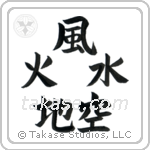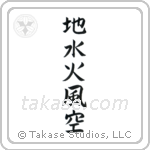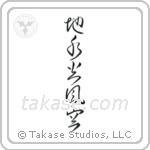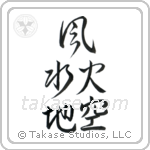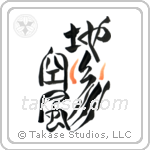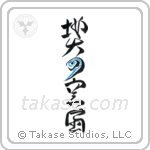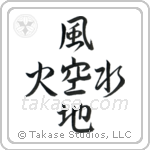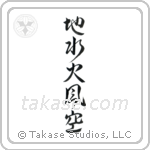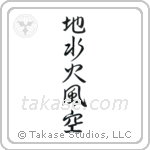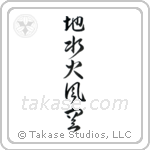

地水火風空 (chi sui ka fū kū)
地水火風空 (chi sui ka fū kū): earth, water, fire, wind, space. The five are the 五大 (godai), the five great elements of Indian and Buddhist physics, of which everything is made; the first four are the old four, and the fifth, 空, was added to them as the place in which matter exists. It is space, not the sky the character means in ordinary Japanese, and not the Buddhist emptiness written with the same character. The readings on the scroll are the Sino-Japanese ones; the everyday readings mizu, hi, kaze and sora are the characters' and not the doctrine's. The five-ring stupa in every Japanese graveyard is the five stacked from the earth up. The first Japanese to write them as a doctrine was Kūkai, in a dedication of about 835 that says the elements and consciousness are everywhere together. Miyamoto Musashi took the five as the names of the books of his Book of Five Rings of 1645, and in the last of them read 空 for a swordsman: the place where there is nothing, what is known by knowing what is. Void is Musashi's word for it; space is the doctrine's, and the five on this scroll carry both.
The Five Elements are most commonly known thanks to Miyamoto Musashi's The Book of Five Rings making this an excellent gift for the Miyamoto Musashi fan on your shopping list.
Verify: 地水火風空 in the Japanese-English Dictionary
Couldn't add to cart. Please try again.