

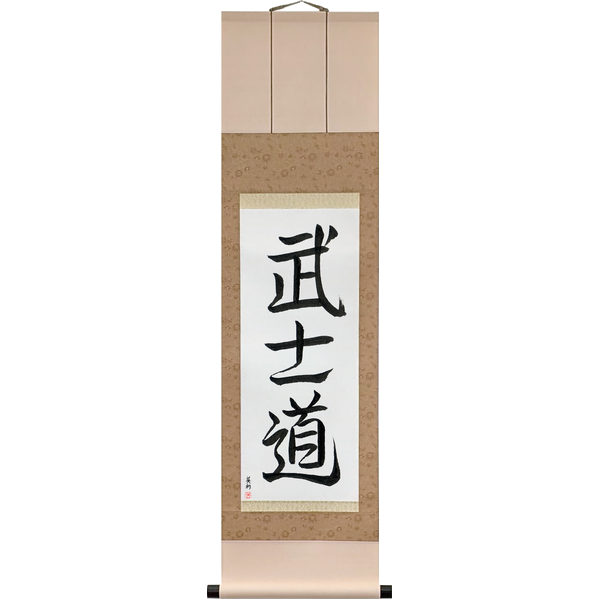
武士道 bushidō Way of the Warrior
This is a philological study of the word 武士道 (bushidō), following it from a military chronicle of the early seventeenth century through Edo fiction and the stage, the dictionaries and debates of Meiji, and into English.
Abstract
武士道 (bushidō), the way of the warrior, is first known from the 甲陽軍鑑, the military chronicle of the Takeda house, known in a manuscript copy with a colophon of 1621 and printed in 1656; there, and in the moral essays of 可笑記 of 1636, it names the conduct proper to a samurai, a thing a man could know or neglect. Through the Edo period it lived in fiction and on the stage as an idiom in which a samurai's honor stands or falls, 武士道が立たぬ, and it became common in print only in the 1880s, when that literature was set in type and when Meiji writers made the word the name of a national ethic. Nitobe Inazō 新渡戸稲造 carried the second sense into English in 1900 as chivalry, and Basil Hall Chamberlain answered in 1912 that it had been invented. Both lives are on the word, and this history holds them side by side.
Overview
The sense. A standard word, historical and ethical. デジタル大辞泉 defines it as 《日本の武士階級に発達した道徳。鎌倉時代から発達し、江戸時代に儒学思想と結合して完成した。忠誠・勇敢・犠牲・信義・廉恥・礼節・名誉・質素・情愛などを尊重した》, the morality that grew up among Japan's warrior class, developing from the Kamakura period and completed in the Edo period in union with Confucian thought; it honored loyalty, courage, sacrifice, good faith, a sense of shame, courtesy, honor, frugality and affection; 精選版 日本国語大辞典 gives its earliest example 《本より武士道不案内なれば》 from the 甲陽軍鑑, and 山川 日本史小辞典 adds that it became general as the word for samurai morality itself 《近代に入ってから》, only in the modern period [1]. The English word bushido is defined by Merriam-Webster as a feudal-military Japanese code of behavior valuing honor above life [2]. The word it was set beside in 1900, chivalry, has more senses than 武士道 covers: mounted men-at-arms, martial valor, gallant or distinguished gentlemen, the system, spirit, or customs of medieval knighthood, the qualities of the ideal knight [3]. 武士道 covers only the last two, and only by analogy; for the knights themselves and their service of God and of women Japanese has 騎士道 (kishidō), whose earliest example in the 精選版 日本国語大辞典 draws the line in 1907: 《日本人の武士道は西洋の騎士道の如く婦人を崇拝せぬ代りに》, the Japanese bushidō, instead of worshipping women as the chivalry of the West does [4].
The words. 武士 (bushi) is the warrior of the samurai class; 道 (dō, michi) is a way, as in 茶道 and 書道, the practice and the conduct proper to a calling. The reading is ぶしどう, in the old kana ぶしだう, as the Meiji dictionary heads it [5] and as an Edo print glosses it beside the characters [6]. The older and more common word in the 甲陽軍鑑 is 武道 (budō): a count of the whole work reported by Oleg Benesch finds 39 uses of 武士道 against 65 of 武道 [7]. The dictionaries name the older ways of saying the thing, もののふの道, 弓矢とる身の習, 侍道 [1], and the Confucian counter-term of the Edo period, 士道, which grounds the warrior's duty in the moral way rather than in readiness to die [1].
The text in English. The first bilingual dictionary known to carry the word, the third edition of Satow and Ishibashi's English-Japanese dictionary of 1904, gives it under Duty [8]. Inoue Jūkichi 井上十吉's Japanese-English dictionary of 1909 heads it The way of knighthood; chivalry; bushido [9], and Kenkyūsha's, edited by Takenobu Yoshitarō, keeps two senses apart, the Japanese code of the warrior and the Western knighthood and chivalry [10]. JMdict gives Bushido; samurai code of chivalry [11], and Merriam-Webster the feudal-military … code of behavior [2]. What each keeps and loses is the subject of the English section below.
The historical record
About 1621–1656, the 甲陽軍鑑, the military chronicle of the Takeda house. Attributed to Kōsaka Masanobu 高坂昌信 and compiled by Obata Kagenori 小幡景憲, it circulated in manuscript, one copy carrying a colophon of 1621, and was first printed in 1656 [12]. The line the 精選版 日本国語大辞典 cites as the word's earliest use stands in chapter 29, on messengers sent to the front who ride about uselessly when the enemy is far off, 本より武士道不案内なれは, being ignorant of bushidō to begin with [13][1]. In this book the word names what a warrior knows or does not know about fighting and conduct, and it is the rarer of two words for it [7].
1636, Joraishi 如儡子, 可笑記, moral essays. Dated by its author in 1636 and in print by 1642, it looks back on the age of war: 此五十年以前まてハ日本国中が合戦乃時分にて人乃子共芸学文せされとも。武士道かんようと心かけし故に, until fifty years ago the whole country was at war, and though children learned neither the arts nor letters, they set their hearts on bushidō as the one thing needful, and so [14]. Within a generation of the wars the word already carried nostalgia.
1685, Hishikawa Moronobu 菱川師宣, 〈大和絵〉古今武士道絵づくし, a picture book. Published in Edo by Urokogataya Sanzaemon 鱗形屋三左衛門, it is a book of scenes of famous warriors, Kiso Yoshinaka and Kumagai Naozane among them, and its title calls them bushidō past and present [15]. The word stands on the cover of a popular illustrated book.
1716, 葉隠, the dictated sayings of Yamamoto Tsunetomo 山本常朝. Taken down by Tashiro Tsuramoto 田代陣基 and finished about 1716, it holds the most quoted sentence in which the word appears, 武士道と云は、死ぬ事と見付たり, I have found that bushidō is dying [16][1]. The book was kept within the Saga domain, forbidden to be made public, and became widely read only from the middle of Meiji [16].
1744, Ejima Kiseki 江島其磧, 其磧諸国物語, a book of popular fiction. Printed in 1744, it tells of a man whose wife was killed: 妻女の敵をとらねば立ず。今夜中に右内が居る所をさがし討とめておきくに手向ずしては武士道たゝずと覚悟きはめ, unless he avenged his wife he could not stand; he made up his mind that unless he found where 右内 was that very night, cut him down and offered him to Okiku, his bushidō would not stand, the word glossed ぶしだう [6]. Here it is the idiom of the fiction and the stage: a samurai's honor, which a wrong leaves standing or fallen.
1826, Tsuruya Nanboku 鶴屋南北, 四谷怪談, as played in Osaka. The play opened in Edo in 1825 on a double bill with 仮名手本忠臣蔵, and the title いろは仮名四谷怪談 names the version revised for Osaka the next year [17]. In that text as printed in 1922, Iemon declines a new marriage while his wife's father lies unavenged, since if people said he had put his wife away for fear of the killer, 拙者武士道は相立たず, my bushidō would not stand, glossed ぶしだう [18]. The idiom is the same as Kiseki's, in the mouth of the most famous villain of the Edo stage.
1878, Obata Tokujirō 小幡篤次郎, preface to his translation of Mill's essays on religion. Signed 22 July 1878, it argues that Mill proved a morality could stand outside religion from one example only, ancient Greece, and that had Mill lived a few years longer he would have learned of teachings 漢土孔孟ノ教我武士道ノ如キ宗教外ニ大振シ世ヲ化シ人ヲ動スノ教, like the teaching of Confucius and Mencius in China and our bushidō, teachings outside religion that flourished, transformed the world and moved men [19]. This is the first known sentence to set the word beside a foreign ethical system and call it a morality of its own. It is Nitobe's argument, twenty-two years before Nitobe.
1882–1900, Edo literature in type. Among the books in the National Diet Library's digital collection, those carrying the word number between none and four a year from 1868 to 1881, sixteen in 1882, fifty-six in 1886, and eighty-five in 1896 [20]. Most of the books behind the step of 1882 are Edo tales and plays newly set in type, beginning with the 今古実録 series, and in them the word is still the idiom of honor standing or falling [20]. Benesch names the cause without the word: a surge in the popularity of Edo-period works such as the heroic epics A Treasury of Loyal Retainers and Nansō satomi hakkenden in the 1880s [21].
1888, Ozaki Yukio 尾崎行雄, dispatches from England. Benesch finds the modern discourse beginning with Ozaki's comments on bushidō as a potential counterpart to English chivalry and the English 'gentlemanship' that he idealized, in his dispatch to the Chōya shinbun of September 1888 [21]. From 1889 the army's field regulations, and from 1890 the history textbooks, use the word for the nation's inherited morality [20].
1896 and 1898, the Japanese dictionaries. 帝国大辞典 of 1896 uses the word to define another, under 弓箭: 「きゆうせんの道」といへば、武士道といふに同じく, to say the way of bow and arrow is the same as to say bushidō [22]. Ochiai Naobumi 落合直文's ことばの泉, whose preface is dated 25 June 1898, heads it ぶしだう: 武士道。臣の、君に對する道、又、士の、將に對する道、又、士と、士と對する道などの總稱。義を重んずる道德。, the way of a retainer toward his lord, of a warrior toward his general, and of warrior toward warrior, taken together; a morality that values righteousness [5].
What is not a source. 士道, the Confucian way of the warrior associated with Yamaga Sokō 山鹿素行, is a counter-term, not an earlier form [1]. The older expressions もののふの道 and 弓矢とる身の習 are other words for the warrior's way, not the word's ancestors [1]. European chivalry is Nitobe's comparison, and the Japanese for it is 騎士道 [4].
The word in English
1896, Nitobe, The Far East. In an English-language monthly published in Tokyo, February 1896: We cannot deny that we are a sensitive people. We have been so trained. Sensitiveness is a trait of samuraism, of bushidō, as Benesch quotes it [21]. Takenobu's English article The Bushido or 'Ways of Samurai' followed in the magazine 太陽 that August [21].
1898, Inoue Jūkichi, 普通和文英訳, a textbook of translation. A model passage has retainers answer their lord, ending 武士道立たず, and the English beside it reads The retainers unanimously answered: "It is really as you say. It would then be a blot upon our military honour." [23]. The first known English rendering of the Edo idiom is military honour, not a code.
1900, Nitobe Inazō, Bushido: The Soul of Japan. The Japanese word, which I have roughly rendered Chivalry, is, in the original, more expressive than Horsemanship. Bu-shi-do means literally Military-Knight-Ways— the ways which fighting nobles should observe in their daily life as well as in their vocation; in a word, the "Precepts of Knighthood," the noblesse oblige of the warrior class. And a page later: Bushido, then, is the code of moral principles which the knights were required or instructed to observe. It is not a written code [24]. Nitobe adds the equation with European knighthood and the word code, and says himself that no code was written.
1904, Satow and Ishibashi, An English-Japanese Dictionary of the Spoken Language, third edition. Under Duty, the line …… of the samurai, bushidō (武士道)., the dots standing for the headword [8]. The duty of the samurai, not his chivalry.
1909, Inoue Jūkichi, Inouye's Comprehensive Japanese-English Dictionary. Eleven years after he rendered the idiom as military honour, the same author heads the word Bushidō (武士道), n. The way of knighthood; chivalry; bushido., with the example 彼は武士道の鼓吹を以て畢生の事業とす, He is making it his life-work to stimulate bushido [9]. Nitobe's equation has become the dictionary's.
1912, Chamberlain, The Invention of a New Religion. As for Bushido, so modern a thing is it that neither Kaempfer, Siebold, Satow, nor Rein--all men knowing their Japan by heart--ever once allude to it in their voluminous writings. The cause of their silence is not far to seek: Bushido was unknown until a decade or two ago! THE VERY WORD APPEARS IN NO DICTIONARY, NATIVE OR FOREIGN, BEFORE THE YEAR 1900. [25]. The last sentence is an error: the Japanese dictionaries of 1896 and 1898 carry the word [22][5]. What Chamberlain says of the code, that it was not an institution of old Japan, is another matter, and the reading below takes it up.
1939, Kenkyūsha's New Japanese-English Dictionary, edited by Takenobu Yoshitarō. In the printing of 1939, reproduced in America in 1942: bushidō (武士道) n., under the label 日本の, Japanese, Bushidō; the code of the warrior, and under 西洋の, Western, the precepts of knighthood; the way of knighthood; chivalry, the words the precepts of set in the book's own brackets [10]. The editor who had written the English article of 1896 keeps the Japanese word and the European one apart.
Today. JMdict gives Bushido; samurai code of chivalry [11]. The design is sold as Way of the Warrior, which is this history's gloss, the two parts of the word read literally. A rendering should keep way, which the word has had from the start, and should say code and chivalry only knowing that they are the reading of 1900.
A reading
The word has two lives, and the scholarship divides according to which one it looks at. Chamberlain saw only the second and called it invented [25]. Kasaya Kazuhiko 笠谷和比古 reads the first as the mainstream of samurai thought: for him the 甲陽軍鑑 is the word's first occurrence, agreed by all [26], and until the middle of the eighteenth century bushidō existed in a form that struggled for supremacy with Confucianism, in Benesch's translation of him [7]. Benesch reads the same texts as a handful, calls the word an obscure literary term before the 1890s, and cites for its absence from Edo-period popular culture his own search of six of the most popular samurai stories, which found it in none, while granting that this does not preclude the appearance of the term bushidō in other, lesser-known works [21][7]. Saeki Shin'ichi 佐伯真一 reads the 甲陽軍鑑's bushidō as holding, among other things, a drive toward an anarchic freedom, the freedom to kill for revenge [27].
I read the first life as plainer than Kasaya's and wider than Benesch's. In the seventeenth century the word names the conduct proper to a samurai and his honor. It is not the name of a doctrine: the 甲陽軍鑑 uses 武道 more often [7], and the Confucian writers preferred 士道 [1]. But it was not confined to a few learned texts. It stood on the cover of Moronobu's picture book [15], and it was the idiom of Kiseki's fiction and of Nanboku's stage, where a man's bushidō stands or falls [6][18]. 四谷怪談 was first played on a double bill with 忠臣蔵, the play in which Benesch found no trace of the word [17][7]. Absence is too strong. Obscure is right for the word as the name of a code, because that is the second life, and it begins in Meiji. Obata's preface of 1878 already makes bushidō a morality to set beside Confucius and outside religion [19]; Ozaki sets it beside the English gentleman in 1888 [21]; the dictionaries take it up in 1896 and 1898 [22][5]; Nitobe gives it to English as chivalry in 1900 [24]. Chamberlain was wrong about the dictionaries and right that no code of that name had governed old Japan.
A buyer who hangs these three characters has both lives, and neither is false. Read as code of chivalry, the scroll carries the reading of 1900 and of the Meiji nation. Read as the way a warrior must keep, or his honor that must not fall, it carries the word as the Edo stage spoke it. I read it the second way, because that is what the word meant for the longer part of its history, and because it asks something of the person who hangs it rather than telling them what they already are.
Notes
- A manual on warfare by Ogasawara Sakuun 小笠原昨雲, whose postface is dated 1617, is recorded in the union catalogue under the other title 武士道功者書 [28]. The two printed copies at the National Archives of Japan are titled 当流軍法功者書 on their covers, and the postface itself names the book 功者書 and speaks of 武道之大綱, the outline of the martial way [29]. The title with 武士道 is not known from a copy of 1617, and the 甲陽軍鑑 remains the word's first known witness.
- Merriam-Webster dates the English word's first known use to 1898 [2]; Nitobe's use of February 1896 is earlier [21].
- Benesch writes the editor of Kenkyūsha's dictionary Takenobu Yūtarō [21]; the dictionary's own title page reads Yoshitarō [10].
- The union catalogue dates Moronobu's picture book 1684 and records the British Museum's copy as 1685, the date the Museum gives [15].
References
- 「武士道」, デジタル大辞泉, 精選版 日本国語大辞典, 改訂新版 世界大百科事典, 日本大百科全書 (ニッポニカ), 山川 日本史小辞典 改訂新版, at kotobank. https://kotobank.jp/word/武士道-124463
- "bushido", Merriam-Webster Dictionary. https://www.merriam-webster.com/dictionary/bushido
- "chivalry", Merriam-Webster Dictionary, senses 1–5. https://www.merriam-webster.com/dictionary/chivalry
- 「騎士道」, デジタル大辞泉, 精選版 日本国語大辞典, at kotobank. https://kotobank.jp/word/騎士道-473536
- 落合直文『ことばの泉 : 日本大辞典』, 大倉書店, 1898, preface dated 明治三十一年六月廿五日, scan 618. National Diet Library pid 862875. https://dl.ndl.go.jp/pid/862875/1/618
- 江島其磧『其磧諸国物語』, 5 vols., 菊屋喜兵衛, printed 延享元年 (1744), scan 49. National Diet Library pid 2533877. https://dl.ndl.go.jp/pid/2533877/1/49 · the work record at the 国書データベース: https://kokusho.nijl.ac.jp/work/149326
- Oleg Benesch, Bushido: The Creation of a Martial Ethic in Late Meiji Japan, PhD dissertation, University of British Columbia, 2011, pp. 6, 7 n. 20, 9–11. https://scholar.archive.org/work/skh5bg7rbvbspff33xgcvffige/access/wayback/https://open.library.ubc.ca/media/download/pdf/24/1.0071589/2
- Ernest Mason Satow and Ishibashi Masakata, An English-Japanese Dictionary of the Spoken Language, third edition, revised by E. M. Hobart-Hampden and H. G. Parlett, 1904, p. 262, s.v. Duty. Internet Archive englishjapanesed00satouoft. https://archive.org/details/englishjapanesed00satouoft
- Jukichi Inouye, Inouye's Comprehensive Japanese-English Dictionary, 三省堂, 1909, p. 130. Internet Archive inouyesjapanesee00inou. https://archive.org/details/inouyesjapanesee00inou
- Takenobu Yoshitarō, ed., Kenkyusha's New Japanese-English Dictionary, American edition, Harvard University Press, 1942, photolithographed from the printing of 1939, p. 128.
- 武士道, JMdict, at jisho.org. https://jisho.org/word/武士道
- 「甲陽軍鑑」, the work record, 国書データベース, 国文学研究資料館, with the 国書総目録 holdings (元和七奥書本; 明暦二版). https://kokusho.nijl.ac.jp/work/26528
- 『甲陽軍鑑』, 明暦二年 (1656) print, 巻十上, leaf 20 recto, the copy of the 鵜飼文庫, 国文学研究資料館, canvas 484. https://kokusho.nijl.ac.jp/biblio/200019217/484
- 如儡子『可笑記』, the author's colophon 寛永十三年 (1636), the copy of 関西大学, 国書データベース, canvases 156 and 245. https://kokusho.nijl.ac.jp/biblio/100388739/156 · the same passage in the National Diet Library copy, vol. 4, scan 22: https://dl.ndl.go.jp/pid/2554536/1/22
- Hishikawa Moronobu, 〈大和絵〉古今武士道絵づくし, Urokogataya Sanzaemon, Edo, 1685, British Museum 1929,1001,0.4. https://www.britishmuseum.org/collection/object/A_1929-1001-0-4 · the work record at the 国書データベース: https://kokusho.nijl.ac.jp/work/1104934
- 「葉隠」, 改訂新版 世界大百科事典, 日本大百科全書 (ニッポニカ), デジタル大辞泉, at kotobank. https://kotobank.jp/word/葉隠-113466
- 「東海道四谷怪談」, デジタル大辞泉, 精選版 日本国語大辞典, 改訂新版 世界大百科事典, at kotobank. https://kotobank.jp/word/東海道四谷怪談-103199
- 塚本哲三 編『脚本集』 下, 有朋堂書店, 1922, いろは仮名四谷怪談, scan 115. National Diet Library pid 970249. https://dl.ndl.go.jp/pid/970249/1/115
- ミル 著, 小幡篤次郎 訳『弥児氏宗教三論』, 丸家善七, translator's preface signed 明治十一年七月廿二日 (1878), scans 2–3. National Diet Library pid 815044. https://dl.ndl.go.jp/pid/815044/1/2
- National Diet Library Digital Collections, full-text search for 武士道 by year of publication, 1868–1900. https://lab.ndl.go.jp/dl/fulltext?keyword=武士道
- Oleg Benesch, Inventing the Way of the Samurai: Nationalism, Internationalism, and Bushidō in Modern Japan, Oxford University Press, 2014, pp. 4 and n. 8, 5, 44, 51, 83–84 and n. 31.
- 藤井乙男, 草野清民 編『帝国大辞典』, 三省堂, 1896, s.v. きゆうせん, scan 262. National Diet Library pid 2387590. https://dl.ndl.go.jp/pid/2387590/1/262
- 井上十吉『普通和文英訳』, 成美堂, 1898, scan 49. National Diet Library pid 870581. https://dl.ndl.go.jp/pid/870581/1/49
- Nitobe Inazō, Bushido: The Soul of Japan: An Exposition of Japanese Thought, first edition, Leeds & Biddle, Philadelphia, 1900, copyright 1899, pp. 3–4. Internet Archive bushidosouljapa00nitogoog. https://archive.org/details/bushidosouljapa00nitogoog
- Basil Hall Chamberlain, The Invention of a New Religion, Rationalist Press Association, London, 1912, at Project Gutenberg. https://www.gutenberg.org/files/2510/2510-h/2510-h.htm
- 笠谷和比古「武士道概念の史的展開」, 『日本研究』 35, 国際日本文化研究センター, 2007, pp. 231–274, p. 235. https://nichibun.repo.nii.ac.jp/record/574/files/nk35010.pdf
- 佐伯真一「「武士道」論と軍記物語研究 ―武士観の問題を中心に―」, 『軍記と語り物』 43, 軍記・語り物研究会, 2007, pp. 64–74, p. 73. https://doi.org/10.60342/gunkitokatarimono.43.0_64
- 「当流軍法功者書」, the work record, 国書データベース, 国文学研究資料館, with the other title 武士道功者書. https://kokusho.nijl.ac.jp/work/386890
- 小笠原昨雲『当流軍法功者書』, the copies of the 内閣文庫, National Archives of Japan, 189-0223 (postface 元和三年, scan 77) and 189-0222 (three volumes). https://www.digital.archives.go.jp/file/1237342 · https://www.digital.archives.go.jp/file/1237340