

知らぬが仏 · shiranu ga hotoke · Not knowing is Buddha
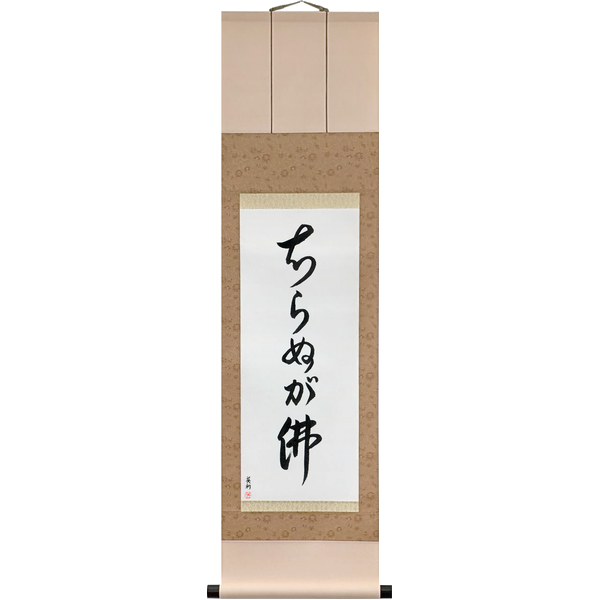
Sold as Not Knowing is Buddha · Read shiranu ga hotoke, as the catalogue has it · Oldest witness a haikai verse of 1638 that puns on the proverb, so the saying is older than that · Sense two, and both are in every dictionary: the one who does not know is as untroubled as a Buddha; and, more often, said with a smile of the one person in the room who does not know.
The words
知らぬ, shiranu, is the classical negative of shiru, to know: not knowing. が here is the particle that lets a whole clause stand as a subject, the same grammar as 見ぬが花, not seeing is the flower, and 聞くが花, hearing of it is the flower. So the sentence parses as the page parses it: not knowing is a Buddha, with the Buddha as the image of a calm nothing can disturb. 藤井乙男's 1910 dictionary says what kind of calm: 其心佛の慈悲忍辱なるが如し, his heart is like the Buddha's, compassionate and forbearing; a 1917 dictionary is drier, 一向無頓着なること, being wholly unconcerned. The word 仏, hotoke, also means a dead person in everyday Japanese, which every Meiji dictionary lists beside it, and an image, which is how one 1897 rendering into English took it. Nothing in the four words varies across the witnesses: the Edo 佛 and the modern 仏 are one character, and the kana spellings しらぬが仏 and しらぬがほとけ are the same sounds. What varies is the second half of the pair, which the design does not carry and which the next section shows.
A history, from the earliest witness
1638. 毛吹草, 松江重頼's haikai anthology, the fifth book, a verse by 重貞. ふみてもや雪にしらぬか仏のざ, treading on it in the snow, the henbit does not know, where 仏の座, hotoke no za, is the spring herb henbit, and its name is made to finish the proverb: しらぬが仏. A pun on a proverb is proof the proverb was current, so the saying is older than 1638, and no dated witness before it was found. This is the first citation the 精選版日本国語大辞典 gives and the one 藤井 gives, and it is cited here from them: a 1662 printing of the book was opened by eye at the leaves for New Year and for snow without finding the verse, and the leaves for the spring herbs, where a henbit pun would sit, were not opened. [kotobank.jp/word/知ぬが仏-2051502, the 日国 entry; text; the 1662 printing at kokusho.nijl.ac.jp/biblio/100306717, image, the verse not found in the columns read]
1686. 好色三代男, from 西鶴's circle. In prose, and already the second sense: しらぬが仏といひながら。人に上荷とらるゝ夫, not knowing is Buddha, as they say, but a husband whose wife is taken by another. The cuckold is the Buddha. [2]
1698. 新色五巻書. Paired with its mirror: かくすが秘密しらぬが仏, hiding it is the secret, not knowing is Buddha. [3]
1700. 世間用心記. しらぬがほとけ, all in kana, in a book of worldly cautions; the earliest hit for that spelling in the full-text search of the public-domain corpus. [the search's classical facet, OCR, without a leaf]
Edo. The いろはかるた, the し card. The proverb is on the card for し in the Edo set of proverb cards, and ことわざを知る辞典 describes the picture: a 地蔵 with a dragonfly settled on its head, the stone Buddha who does not know. Reported from the dictionary; no card was opened. [kotobank.jp/word/知らぬが仏-535942; text]
1864. The kabuki 処女翫浮名横櫛, known as 切られお富, the middle act. 然しおれが斯ういふ気になって居るのを知らぬが仏, but he has no idea I have made up my mind like this; not knowing is Buddha. The mocking sense, on stage, before Meiji; the 日国's second citation. [the 日国 entry on kotobank; text; the play not opened at its page]
1872 to 1917. The Japanese-English dictionaries, where the English equation was made. Hepburn's dictionary of 1872 does not have the proverb; the nearest thing under shiranu is shiranu ga mashi da, it is better not to know. In 1886 a phrase book of English idioms translated into Japanese gives Gray's line, Where ignorance is bliss, 'tis folly to be wise, with a Japanese paraphrase and no proverb. In 1894 a dictionary in Hepburn's lineage equates ignorance is bliss with a different Japanese proverb, 見ぬもの清し, what you do not see is clean. The first headword found is 1896, 知ラヌガ佛 in the 和英大辞典, its gloss cut off in the search return. In 1897 a conversation manual tries the literal first, (Happy is) the idol which knows nothing, and then gives Ignorance is bliss; from 1902 every dictionary opened gives Ignorance is bliss and nothing else. A Japanese dictionary of 1917 glosses it without any Buddha: if he knew the state of things he would be uncomfortable or angry, but since he does not, he is wholly unconcerned. [pids 993689, 903177 scan 379, 870191 scan 218, 903159, 871361 scan 173, 870192 scan 257, 870208 scan 188, 903029, 903157, 903158, 958671 scan 1021; all OCR]
1910. 藤井乙男, 諺語大辞典. 【知ラヌガ佛】知らざれば、不快にも感ぜず、腹立つこともなく、其心佛の慈悲忍辱なるが如し, if one does not know, one feels no displeasure and no anger, and one's heart is like the Buddha's, compassionate and forbearing. Then the 1638 verse, a line from a jōruri with the continuation 見ぬが花, a line from another with the three monkeys and a namu amida, a Ming proverb from the 耳談續纂, 聞則病、不聞是藥, to hear is sickness; not to hear is medicine, and a German proverb, Without knowledge, without sin. On the same page he lists the proverb's longer forms as headwords: 【知ラヌハ佛、見ヌガ神】, not knowing is Buddha, not seeing is a god, glossed not to know and not to see is better, since it does not trouble the heart; then 見ヌガ極樂, not seeing is paradise, and 見ヌガ心ニクシ, not seeing is the more alluring, each marked same as above. 藤井 hangs an English equivalent on his neighbors, Ignorance of the law excuses no one and The good man is the last who knows what's amiss at home, and gives this proverb German. [6]
Today. 精選版日本国語大辞典: 知れば腹も立ち、苦悩や面倒も起こるが、知らないから腹も立たず、心のひろい仏のようにしていられる。見ぬが仏。転じて、当人だけが知らないで平気でいるさまをあざけっていう語, if you knew you would be angry and troubled, but since you do not you are not, and can stay like a broad-hearted Buddha; by extension, a word that mocks the state of the one person who does not know and is unbothered. デジタル大辞泉 says the same in fewer words. ことわざを知る辞典: 平気でいるさまを皮肉に評していうことが多い, it is most often said ironically of someone who is unbothered because they have no idea of the situation they are in, with examples from 漱石 in 1902 and 石川達三 in 1956, the karuta card, 見ぬもの清し as kin, and Ignorance is bliss as the English. [kotobank.jp/word/知ぬが仏-2051502 and kotobank.jp/word/知らぬが仏-535942; text]
The sense across time
Two senses, and the witnesses carry both from the start. The kind one, which the page gives, is the proverb's face: to know is to suffer, and not to know is a Buddha's calm. It is the sense 藤井 chose to gloss in 1910, with the Buddha's compassion and forbearance, and the sense the Ming proverb and the German one match. The mocking one is the proverb's use. The first prose witness, in 1686, puts it in the mouth of a cuckold; the 1864 kabuki uses it of a man who does not know what has been decided about him; the 日国 marks it by extension and ことわざを知る辞典 says it is the common one. The karuta picture, a stone Jizō with a dragonfly on its head, holds both at once, which is why it is the right picture. What the English lineage did was choose the first sense and drop the second: Gray's line is a wish for the ignorant, and ignorance is bliss has never carried the smile.
What is not a source
The longer forms 藤井 lists, 知らぬは仏、見ぬが神, 見ぬが極楽 and 見ぬが心にくし, and the kin proverb 見ぬもの清し, are the same pattern of Japanese sentence and not the origin of this one; the design carries the first half alone, which is how the karuta and the dictionaries carry it. The Chinese 眼不見心不煩, what the eye does not see the heart is not vexed by, and the Korean 모르면 약이요, not knowing is medicine, which the dictionaries print beside it, are parallels; the Ming line 藤井 quotes is a parallel he found, not a source he claims. Gray's where ignorance is bliss is an English poem of 1747, attached to the proverb by Meiji lexicographers a century and a half later. No witness names an origin, and the form does not need one.
The text in English
The proverb reached English through the dictionaries and nowhere else, and the equation is Meiji. 1747. Thomas Gray, Ode on a Distant Prospect of Eton College. Thought would destroy their Paradise. / No more; where ignorance is bliss, / 'Tis folly to be wise. This is the line the Japanese dictionaries reached for, from 1897 on; it is about schoolboys who do not yet know what life will do to them. [en.wikisource.org/wiki/Ode_on_a_Distant_Prospect_of_Eton_College; text] 2004. Edward Trimnell, Tigers, Devils, and Fools: A Guide to Japanese Proverbs, Beechmont Crest, page 130. Shiranu ga hotoke. "Ignorance is bliss." You can't worry or feel regret over the things that you don't know about. What you don't know can't hurt you. The first sense only, and no literal rendering. [ISBN and ASIN not collected; read in the shelf's text layer, whose OCR has Hgnorance for Ignorance; a printed book, checkable by a reader who holds it] The proverb is not in David Galef's Even Monkeys Fall from Trees (Tuttle, 1987) or Even a Stone Buddha Can Talk (Tuttle, 2000), where Ignorance is bliss glosses a different proverb, 盲蛇に怖じず, the blind man does not fear the snake; nor in Guy Zona's Even Withered Trees Give Prosperity to the Mountain (1996); all three opened. Daniel Crump Buchanan's Japanese Proverbs and Sayings (1965) is locked behind digital rights on the shelf and was not opened.
Today. The house title, Not Knowing is Buddha, is the literal rendering, and the page gives ignorance is bliss as the idiom beside it, which is the right way round. What a rendering must keep: the Buddha, who is the whole picture; and room for the second sense, which no English idiom has, so a page has to say it in a sentence.
A reading
The design, the reading and the page's parse are sound, and the page's account is half the proverb's life, the serene half. The other half is the one a Japanese speaker hears first today and heard on the kabuki stage in 1864: the smile at the one person in the room who does not know. A page that says both, in two sentences, serves a buyer better than the kind one alone, because a buyer may be putting this on a wall for a reason, and should know what a Japanese guest will hear. The story is one sentence with a date: the proverb is old enough that in 1638 a haikai poet could pun on it with the name of a spring herb, and it has been on the し card of the Edo proverb karuta ever since, drawn as a stone Buddha with a dragonfly on its head. Signed, 典, 2026-09-05.
How this was read
By eye: the 1910 dictionary at the headword and its group, re-read on the day of writing; the 1662 毛吹草 at the leaves for New Year and snow, without the verse. By text at the address: the two kotobank pages; the 1686 and 1698 books at the National Diet Library's page API, confirmed by a second reader; the Meiji dictionaries by OCR from the archive; Gray at Wikisource; Trimnell, Galef and Zona in the shelf's text layers. Not opened: the 1638 verse at its own leaf, in any edition; the 1864 kabuki at its page; a karuta card; the 1686 and 1698 leaves by eye; the 1700 book at any leaf; Hepburn's third edition of 1886; the 耳談續纂 in Chinese; Buchanan. Every address in this history is a text address except the 1910 leaf, which has its page-API address beside it, and the 1662 book, which is an image; Trimnell is a printed book, checkable by a reader who holds it. The full apparatus, with every address, is in the account.
References
- 毛吹草 巻五 (重頼 編), 重貞's hokku (1638) — the 日国 and 藤井 1910, reported; the 1662 printing opened at the 元日 and 雪 leaves, verse not found
- 好色三代男 (未達) (1686) — pid 2544912 koma 9, by OCR ↩
- 新色五巻書 (1698) — pid 2546490 koma 15, by OCR ↩
- 世間用心記 (1700) — the lab's classical facet, by OCR
- 切られお富 (処女翫浮名横櫛), 中幕 (1864) — the 日国, reported
- 諺語大辞典 (1910) — pid 862766 scan 281, by eye ↩
- The catalogue and both live pages (2026) — cultural_works.csv:358