

心機一転 · shinki itten · The heart turns over
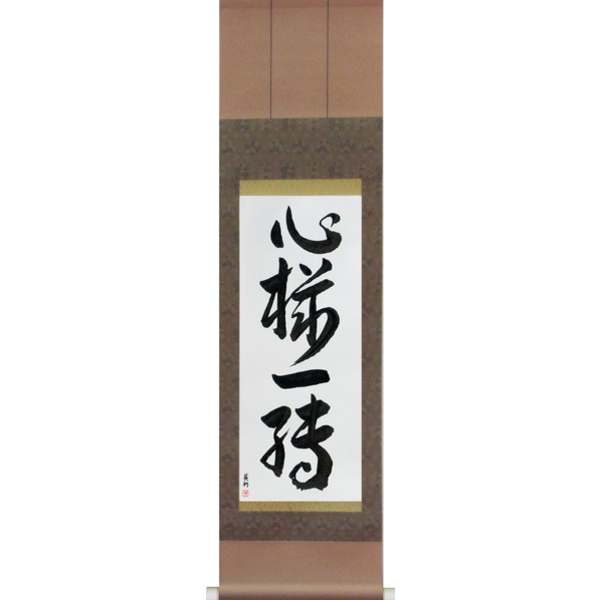
Sold as Complete Change of Mind · Read shinki itten; the catalogue writes shinkiitten · Oldest witness a novel of 1891, at the second a drowning woman decides to live; no classical source exists · Sense on some occasion, the whole set of the heart changes, and one starts afresh.
The words
心機, shinki, is the working of the mind, its spring: 心の働き。心の動き。気持ち in デジタル大辞泉, the mind; mental activity in a dictionary of 1909. 機 is the loom and the trigger, the mechanism that sets a thing in motion. The word is old in Sino-Japanese verse: the 精選版日本国語大辞典's first Japanese citation is a poem of about 1010 by 藤原公任, 浅深花錦織心機, the flowers, shallow and deep, weave a brocade on the mind's loom, and in the Heian collection 本朝文粹 a writer complains that a woman's poems 彌亂心機之緒, tangle the threads of the heart's loom. In Chinese the same two characters went another way: the Taiwan Ministry of Education dictionary gives 心思、計謀, scheming, calculation, with 紅樓夢's 心機又極深細 said of Wang Xifeng, and the reversed compound 機心 is 莊子's contriving heart. In Zen the word keeps that edge: 圜悟, commenting on 雲門, names 心機意識情想 three times as what a true word does not fall into. So a Japanese reader hears the mind's motion, a Chinese reader cunning, a Zen reader the discriminating mind; the Japanese word is built on the first. 一転, itten, is one turn, a complete change, an about-face. The dictionaries' definition keeps two things a translation must keep: an occasion, きっかけ, and a whole change of 気持ち, the set of the heart, not the reversal of a decision. The reading is settled beyond doubt, しんきいってん in 鷗外's own furigana and in a 1919 dictionary's headword; デジタル大辞泉 warns that 心気一転 is a misspelling, and the warning is needed, since 心気 is a different word. 転 is 轉 in every witness before 1946.
A history, from the earliest witness
1891, in book form 1892. 幸田露伴, いさなとり, chapter 84. A father, 彥右衞門, resolved to die, ties a great stone to his sash, takes his small son 新太郞 in his arms and leaps from the rock into the whirlpool. Heaven does not yet kill a man: the sash he had tied to die comes loose the instant he strikes the water, the current lifts him, 身は水力に押しあげられ、思はず浮びて再度また浮世の風に吹かれし刹那、狼狽愕く其中に心機一轉、ゑゝ死ぬまじと思ひし事やら思はずしてやら, his body was pushed up by the force of the water, and in the instant he floated, unbidden, and the wind of the floating world blew on him once more, startled and dismayed, his heart turned over: whether she thought "I will not die after all," or thought nothing at all. The furigana read しんき…てん. This is the 精選版日本国語大辞典's first citation, and the word's first use in print is the turn from death to life in a single second. [1]
1894. 北村透谷, on the monk 文覚's conversion. 渠の心機一轉の摸樣を論ずるの榮を得む, I would have the honor of describing the shape of his shinki itten; and two pages on, how long it takes: この境を過ぐるは心機一轉に缺くべからず、而してこの境は石火なり流星なり、數秒時間なり, to pass this threshold a turning of the heart is indispensable, and the threshold is a flint-spark, a shooting star, a few seconds. [2]
1894 to 1911. The Meiji essayists and comparative religionists. 高山樗牛 in 1899, on the mind returning from the ideal world to the phenomenal; 姉崎正治 on Paul on the road to Damascus, 心機一轉せり; 坪内逍遥 on Newman's conversion; 昇曙夢 in 1911 on Tolstoy's. The word becomes the Japanese for Christian conversion. [by OCR from the National Diet Library's full-text search; the leaves not opened, and the dates of the 姉崎 and 坪内 lectures not established]
1909. 井上十吉, 和英辞典. Shinki (心機), n. The mind; mental activity. With the example 心機一轉したのです, His mind took a new turn. [4]
1910. 藤井乙男, 諺語大辞典. Absent at the シンキ position: the proverb dictionary, which sources its sayings, does not have this one. [8]
1910 to 1911, in book form 1913. 森鷗外, 青年. 純一は心機一轉して、丁度持て來た茶碗蒸しを箸で掘り返し始めた, Jun'ichi, his heart turning over, began to dig with his chopsticks into the steamed custard that had just arrived, with the furigana しんきいってん. The word for a young man changing the subject: already worn to everyday size. [3]
1911 to 1918. The bilingual dictionaries fix the religious sense. 新渡戸's phrase dictionary of 1911 has it for to get religion; 上田萬年's ローマ字びき国語辞典 of 1915 glosses 心機 as こころの、はずみ、氣の持ちぐあひ and lists the idiom; 斎藤秀三郎's Idiomological of 1918 uses 心機一轉 to render birth (a new), born again, convert, regenerate and revolution (of the spirit). [5][6]
1919. 上田景二, 模範新語通語大辞典, a dictionary of slang and new words. 【シンキイッテンコジ】心機一轉居士 渡邊國武: a nickname for a finance minister who threatened to resign and then, his heart having turned over, stayed. The word is common enough to be a joke. [7]
Today. デジタル大辞泉: 何かをきっかけにして、気持ちがすっかり変わること. 精選版日本国語大辞典: ある事をきっかけに、気持がすっかり変わること、また、変えること. 四字熟語を知る辞典: 「心機」は心の動き・働き、気持ち。「一転」はがらりと変わること, with 安部公房 in 1964 as a modern use. The public-domain corpus has two books in the early 1890s, eight in the late, ninety-six in 1900 to 1904 and two hundred and thirty-two in 1905 to 1909; by 1910 the word is everyone's. [kotobank.jp/word/心機一転; kotobank.jp/word/心機; text; the corpus bins from the saved search of 2026-09-03 in the account]
The sense across time
The word was born as the instant of conversion, and 透谷 said how long the instant lasts: a few seconds. The Meiji religionists made it the Japanese for Paul and Newman and Tolstoy, and the dictionaries of 1911 to 1918 fixed that in English as born again, regeneration, to get religion. A century of use wore it down: 鷗外's young man changing the subject in 1911, a minister's nickname in 1919, a joke by 1923, 心機一轉、二轉三轉四轉五轉, and in postwar court records an offender's resolve to reform. The dictionaries since keep the occasion and drop the religion: a complete change of feeling, on some occasion. That is the word today, what you say at New Year or after a bad year.
What is not a source
There is no classical source, and the page offers none. The four characters are in no Chinese text the ctext full-text search holds, in no entry of the Taiwan dictionary, in none of the bilingual dictionaries before 1909, and not in the 1910 proverb dictionary. The two words it is built from are classical, 心機 in a Heian poem and 一転 in ordinary use, and a page may say so; but the compound is a Meiji word, made in Japan, and the Chinese sense of 心機, scheming, is not behind it.
The text in English
There is no translation lineage for a word of this kind; the bilingual dictionaries are its reception, and they are given above in their place: His mind took a new turn (1909), to get religion (1911), born again, regeneration, a revolution of the spirit (1918). The word is in none of the six English proverb books on the shelf, all searched. [EDRDG today at new.gokanji.com/word/心機一転: changing one's attitude; turning over a new leaf; getting a fresh start]
Today. The house title, Complete Change of Mind, uses an English phrase that means reversing a decision, and the Japanese never means that; the page's second sentence, to completely change one's view of the world, is larger than any dictionary's sense. The nearer English idioms are the ones the dictionaries carry, turning over a new leaf and a fresh start, and the older change of heart, which is what the Meiji meant. What a rendering must keep: the heart rather than the mind, the occasion, and the whole change.
A reading
The design and its romaji are sound. The English title is the weak point: change of mind is a decision reversed, and the Japanese is a heart turned; a fresh start or turning over a new leaf is what the word does today, and change of heart is what it did in the Meiji. The page's story is that there is no ancient story, and that is a better page than a borrowed one: the word is a hundred and thirty years old, born in a novel at the second a drowning woman decides to live, used by the Meiji for Paul and Newman and Tolstoy, put into English as born again, and worn down by a century into the word for starting over. One line worth a page: in Chinese the same two characters mean scheming, and in the Zen texts 心機 is the calculating mind a master tells you to drop; the Japanese word turned it into the mind's spring, and 心機一転 is that spring released. Signed, 典, 2026-09-05.
How this was read
By eye: the 1892 leaf, re-read on the day of writing; 透谷 1894, 鷗外 1913 and the 1919 dictionary at the leaf; 井上 1909 and the 1910 proverb dictionary at the leaf; 心機 in two Edo printings of Heian collections. By text at the address: the kotobank entries for the word and for 心機; the Taiwan dictionary for the Chinese senses; the three EDRDG entries; 圜悟's commentary at three Taishō columns; the Meiji religionists, 上田 1915, 新渡戸 1911 and 斎藤 1918 by OCR from the archive; the six English paperbacks in their text layers. Not opened: 公任's poem and 任昉's at their pages; 福澤 in 1875; the 1891 serialization; 透谷's essay in its first printing; the Kenkyūsha dictionaries of 1918 and 1931; 鷗外's serialization; the two thousand eight hundred corpus books beyond the ten opened, among them the undated 姉崎 and 坪内 lectures. Every leaf named by eye has a page-API text address beside it. The full apparatus, with every address, is in the account.
References
- 幸田露伴『いさなとり』 (1891 serial; 1892 book) — pid 885387 scan 66 = p. 125, by eye ↩
- 北村透谷『透谷集』 (1894) — pid 871945 scan 50, by eye ↩
- 森鷗外『青年』 (1910–11 serial; 1913 printing) — pid 947424 scan 108, by eye ↩
- 井上十吉『和英辞典』 (1909) — pid 1869465 scan 711, by eye ↩
- 上田萬年『ローマ字びき國語辭典』 (1915) — pid 1900620 scan 415 (OCR) ↩
- Saito, Idiomological English-Japanese (1918) — pid 1681530 scans 59, 65, 118, 551, 564 (OCR) ↩
- 上田景二『模範新語通語大辞典』 (1919) — pid 958702 scan 201, by eye ↩
- 藤井『諺語大辞典』 (1910) — pid 862766 scan 266, by eye ↩
- The catalogue and both live pages (2026) — cultural_works.csv:353