

三人寄れば文殊の知恵 · sannin yoreba monju no chie · Three people together have the wisdom of Monju
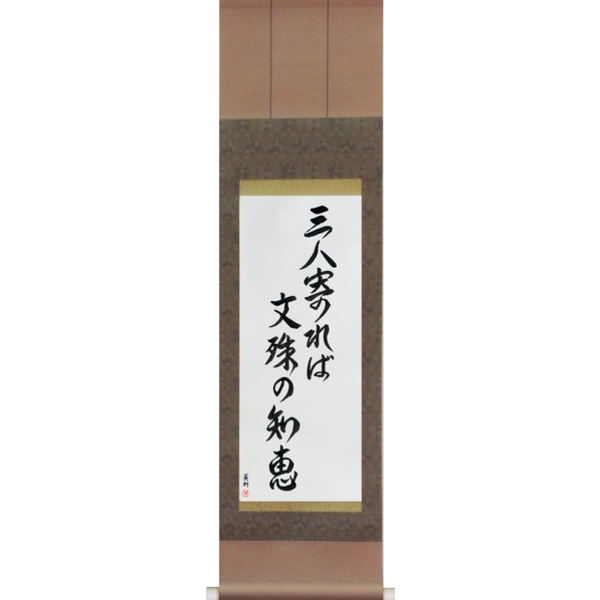
Sold as If three people gather, the wisdom of Monju · Read sannin yoreba monju no chie · Oldest witness the second Japanese proverb book, 1656, where it already stands beside the monkey that falls from the tree; its second half is a stock phrase in a Noh play of about 1384 · Sense even ordinary people, three of them taking counsel, reach the wisdom of the bodhisattva of wisdom.
The words
三人, sannin, three people; in the Chinese sayings the dictionaries set beside this one, three is the number at which a group becomes a multitude. 寄れば, yoreba, if they gather, the conditional of 寄る; every witness from 1656 to today has this form and none has 寄って. 文殊, Monju, is Mañjuśrī, the bodhisattva of wisdom, 智慧の菩薩; the Edo prints write him 文珠. の知恵, no chie, his wisdom; the Edo prints write ちゑ or 智慧. The constant in every dictionary's gloss is 凡人でも, even ordinary people: the point is not that three are wise but that three who are not can, together, reach what one wise man has. 文殊の智慧 was a superlative for wisdom before the proverb existed, paired in Noh and in the first proverb book with the Buddha's dullest disciple: 槃特が愚痴も文殊の智慧, Panthaka's dullness and Monju's wisdom, two faces of one thing.
A history, from the earliest witness
About 1384. The Noh play 卒都婆小町. 提婆が悪も観音の慈悲、槃特が愚痴も文殊の智慧, Devadatta's evil is Kannon's mercy; Panthaka's dullness is Monju's wisdom. The phrase the proverb borrows, already a fixed pairing. [the 精選版日本国語大辞典 under 文殊の知恵, kotobank.jp/word/文殊の知恵; text; 藤井乙男's 諺語大辞典, 1910, pid 862766, koma 311, OCR]
1638. 毛吹草, the first printed proverb collection. 文殊の智惠 stands alone in its list; there is no 三人 line. The proverb was built on the phrase after this. [藤井's 1929 reprint of the list, 諺の研究, pid 1452761, scan 149, pages 234 to 235, by eye; text at lab.ndl.go.jp/dl/api/page/1452761_149]
1656. 世話尽, the second proverb collection, edited by 皆虚. 三人よれは文珠のちゑ, with the readings さんにん, もんじゆ and ちゑ written beside the characters, in the さ column of the second book, between 三男に垣なし and 座頭は牛七疋ほどすねる, with 猿も木から落る two lines on. The 日国's first citation, and it holds at the leaf. The same book, in another list, has the older pairing: はんどくが愚痴も文殊のちゑ. [6]
1662. 為愚痴物語, a kana book. 三人よれば文珠の智惠ありと常にいへる, as people always say. Six years after the first list, a proverb already. [as quoted by 藤井 1910, pid 862766, koma 277, by eye; the book not opened]
1718 and 1721. Two books of the floating world. The proverb as a running joke: 三人よれば文珠のちゑ袋, the wisdom run on into a bag of wisdom, in a scene of hurried counsel; and 三人よれば文殊の知る恵と申せば, a pun the OCR reads and the eye did not confirm. [8][9]
1763. 平賀源内, 風流志道軒伝. 三人寄れば文殊の智惠、百人寄つても出ぬは金なり, three together make Monju's wisdom; a hundred together cannot make money. [10]
1790. A comic book titled with the line. 三人寄は文珠の智恵, by 時鳥館 with pictures by 桜川文橋, its cover label reading 三人よれバ文珠の知恵 in a later hand. [11]
1818. 喜多村節信, 瓦礫雑考, a philologist's notebook. The Edo argument about where the proverb comes from. An earlier writer, in the 秉穂録, had derived it from a Zen master's greeting to three new arrivals in the 五燈會元, 三人同行、必有一智, three walking together, one of them must be wise; 節信 objects that the 五燈會元 is too late a book to be the source of a Japanese proverb and reaches back to the Analects, 三人行必有我師焉, three walking together, one must be my teacher. [12]
1872. James Curtis Hepburn, 和英語林集成, page 330. MON-JU, 文殊, n. The name of a Buddhist divinity; supposed to be the god of wisdom. San nin yoreba — no chiye. (prov.) A proverb entered under the bodhisattva's name, with no English given. [14]
1910. 藤井乙男, 諺語大辞典. Five sources and no choice among them: a Chinese maxim that one man's wisdom is less than the crowd's folly, the 韓非子's no three go astray, the Analects, the 五燈會元, and a Japanese comic use in which three heads together produce only a shared blank look; then three European proverbs, two heads are better than one (Italian), four eyes see more than two (German), and a doctor and a boor know more than a doctor alone. [pid 862766, koma 244, pages 454 to 455, by eye; text at lab.ndl.go.jp/dl/api/page/862766_244]
Today. 精選版日本国語大辞典: 凡人でも三人集まって相談すれば、なんとかいい知恵が浮かぶものだということ, with 世話尽 as first citation. ことわざを知る辞典 adds the Chinese kin, 三箇臭皮匠、頂箇諸葛亮, three stinking cobblers make a Zhuge Liang, and the English Two heads are better than one. [kotobank.jp/word/三人寄れば文殊の知恵; text]
The sense across time
One sense from 1656 to now, and a joke about it from the start. The sense: three ordinary people in counsel reach what one wise man has. The joke: the floating-world writers pun the wisdom into a bag, 源内 caps it with money, and the counter-proverbs in the same collections answer it from the other side, 一人の文殊より三人のたくらだ, three dullards over one Monju. The modern dictionaries keep the sense and file the English two heads beside it, a smaller saying that loses both the three and the bodhisattva.
What is not a source
The Chinese sayings are the family, not the parent. The Analects has three travelers and a teacher; the 韓非子 has three who do not go astray; the Zen record has three arrivals and one wise one. None has three fools and a bodhisattva, and the Japanese proverb is not a translation of any of them. The nearest in shape is the Zen greeting, since Monju is the name the Zen monasteries gave wisdom, and 節信's objection, that a source must be older than the proverb's Japanese life, is the right test. 藤井 gave all of them and chose none; that is the honest position.
The text in English
Hepburn enters the proverb in 1872 and gives no English. 1897 and 1902, イーストレーキ's conversation books: Where the three people consult together, there results wisdom, then There is wisdom in a multitude of councillors, which is Proverbs 11:14. 1904, イーストレーキ and 越山, 新撰英和熟語集: Two heads are better than one, the first appearance of that equation, which becomes the only one in 斎藤 1918 and 岡倉 1929. 1909 and 1911, 井上十吉: In the multitude of counsellors there is safety [Two heads are better than one]. 1911, the dictionary 新渡戸 oversaw: the German four eyes see more than two eyes and the Italian a wise man and a fool together know more than a wise man alone, the closest thing in Europe to 凡人でも. [pids 871361, 870192, 870143, 1869465, 870153, 902975, 1681530, 1904907, OCR] 1965. Daniel Crump Buchanan, Japanese Proverbs and Sayings, University of Oklahoma Press, page 115. Sannin yoreba Monju no chie: "Three persons together produce the wisdom of Monju." "Monju" is the Japanese name for Maitreya, the Buddhist deity of wisdom and intellect. English parallels: Two heads are better than one. As many heads, as many wits. An error: Monju is Mañjuśrī; Maitreya is 弥勒, Miroku. [read by page image; a printed book] 2004. Edward Trimnell, Tigers, Devils, and Fools, Beechmont Crest, page 125. Three people have the wisdom of the Buddha, with 文殊 rendered the Buddha, a second error, and a reading about Japanese consensus. [the text layer] Not in Galef (1987, 2000) or Zona (1996). Today. JMdict: three heads are better than two; three ordinary people together have great wisdom; if three people gather, the wisdom of Manjushri. The house title is the literal, and it is the right choice, because the three and the bodhisattva are the proverb; the two English proverb books that carry the line each misname him, differently, and the house page, which names him right, is the better witness than either.
A reading
The design, the romaji and the title are sound, and the page's short explanation is right in every word. It could carry three more clauses from the sources: that the line is in the 1656 proverb book and was what people always say by 1662; that its second half is a Buddhist superlative two centuries older, paired in Noh with the Buddha's dullest disciple; and that Edo scholars argued whether it descends from a Zen master greeting three newcomers or from Confucius's three travelers, and the great dictionary gave both and chose neither. My own reading: the proverb is a democratic joke made from a monastic phrase. Monju is the wisdom the monasteries prayed to; the proverb hands it to three nobodies on condition that they sit down together. That is why the counter-proverbs exist and why 源内's cap lands. Signed, 典, 2026-09-05.
How this was read
By eye: the 1656 leaf at both lists, re-read on the day of writing; 藤井's 1929 毛吹草 excerpt and his 1910 entries at three leaves; 節信's 1818 argument in outline; the 1718 book; the 1790 cover label; Hepburn's page; Buchanan's page. By text at the address: the two kotobank entries; the ten leaves above at the National Diet Library's page API; the Zen record at CBETA and the Analects and 韓非子 at Wikisource; twenty Meiji and Shōwa books and the bilingual shelf by OCR; the English proverb books in their text layers. Not opened: 為愚痴物語 at its leaf; the 秉穂録 and the other Edo books reached through 藤井 or 節信; the Noh play in an edition; the 1721 pun by eye; the comic book's own pages beyond its label. Every address in this history is a text address except Buchanan's page, which a reader checks by holding the book. The full apparatus, with every address, is in the account.
References
- 論語 述而 (Warring States) — Wikisource 七之二一; 藤井 1910 by eye; 俚言集覧
- 韓非子 內儲說上 (3rd c. BC) — Wikisource, 參觀一 說; 藤井 1910 by eye (〔韓非子〕九)
- 五燈會元 卷十九, 楊岐方會 (Song (compiled 1252)) — CBETA X80n1565_p0388b20; 藤井 1910 by eye; 秉穂録 via 節信 by eye
- 卒都婆小町 (Noh) (c. 1384 (日国)) — 日国 (文殊の知恵); 藤井 1910 koma 311 OCR; 禅門法語集 続 1896 OCR
- 毛吹草 世話付古語 (1638/1645) — 藤井 1929 scan 149, by eye; 俚言集覧 and 1910 pair it with 槃特が愚癡
- 世話尽 巻二 (皆虚 編) (1656) — pid 2554768 koma 27 and 5, by eye; the 日国's 初出 ↩
- 為愚痴物語 六 (1662) — 藤井 1910 koma 277 by eye, under 【衆力功アリ】; the book not opened
- けいせい竈照君 巻四 (1718) — pid 2586910 koma 15, by eye ↩
- 日本契情始 (其磧) (1721) — pid 2567833 koma 10, leaf opened, wording OCR ↩
- 風流志道軒伝 (風来山人) (1763) — 1903 typeset pid 879494, OCR ↩
- 三人寄は文珠の智恵 (kibyōshi; 時鳥館 作, 桜川文橋 画) (1790) — pid 9892671 koma 2, label by eye (a later hand) ↩
- 瓦礫雑考 巻之二 (喜多村節信) (1818) — pid 2538783 koma 42–43, by eye (shape; not transcribed whole) ↩
- 娘消息 (為永春水) · 暁斎百図 · 芝居紋番附 (1834 · 江戸末 · undated) — OCR
- Hepburn 和英語林集成 (1872) — pid 993689 p. 330, by eye ↩
- 諺語大辞典 (藤井) (1910) — koma 244, by eye
- The catalogue and both live pages (2026) — cultural_works.csv:368