

為せば成る · naseba naru · Do it and it gets done
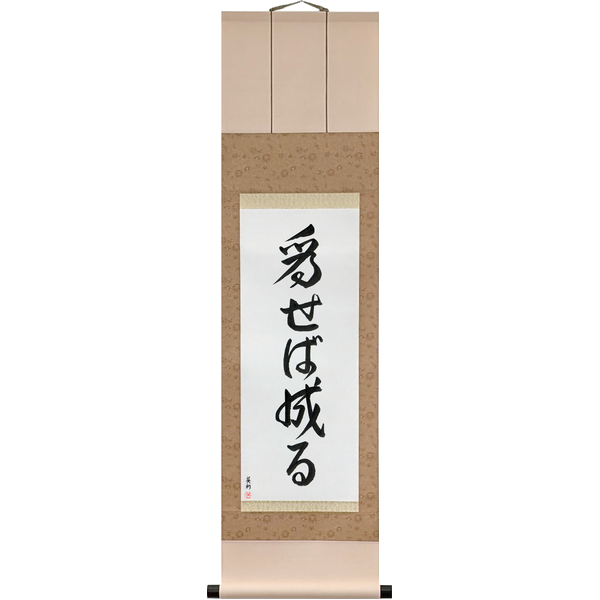
Sold as Try and You Will Succeed · Read naseba naru · Oldest witness an 1890 book of maxims for the ambitious young, where the line stands with no author; the name of the Yonezawa lord Uesugi Yōzan is attached to it in print from 1897 · Sense if you do the thing, the thing gets done; what stays undone is what nobody did.
The words
Five syllables, two verbs and a conditional. 為す (nasu) is the classical verb to do, to bring about, not the everyday する; 為せば is its conditional, if one does, or, as the rest of the poem makes it, when one does. 成る (naru) is to come into being, to be accomplished. The proverb is the first line of a thirty-one-syllable poem, and the scroll carries the line alone because everyone who knows it supplies the rest: なせばなる なさねばならぬ 何事も ならぬは人の なさぬなりけり, do it and it gets done; don't and it does not; whatever it is, what does not get done is what people did not do. The proverb is more often written in kana (なせばなる), and the dictionaries and the poem's quotations all write it so; the scroll's kanji form 為せば成る is the dictionary headword and nothing more than a spelling. One trap: the third line of the poem circulates in two forms, 何事も (whatever it is) and 成るものを (a thing that would get done), and the witnesses below use both.
A history, from the earliest witness
1890. 『金言万集』, a book of maxims for young men on the make (黒泉富三郎 ed., 日進舎). The line's oldest print found, and it stands unattributed in a list of stock sayings between a maxim on adversity and one on ambition: ○爲せば成る爲さざれば成らぞ成るものを成ららぬといふは爲さざるなり, do it and it gets done; don't and it does not; to call a thing that would get done undoable is to not do it (the OCR reads 成らぞ and 成ららぬ; read as 成らず and 成らぬ). No poet, no lord. [5]
1896. 『学生の良友』, a students' handbook (長沼梅仙 ed., 磊々堂), pp. 162–163. A page of poems by famous men, each with its author in large type: 眞木保臣, 高野長英, 有村治左衛門, 豐臣秀吉, then 武田信玄's 人は塀人は石垣人は堀 (with the furigana へい on 塀, where the poem is usually quoted with 城), and last, 爲せば成る爲さねば成らぬ成るものをならぬといふは爲さぬなりけり, credited 詠人不明, poet unknown. Six years after the maxim book the line is a poem, it stands beside Takeda Shingen's, and the compiler does not know whose it is. The third line here is 成るものを, not 何事も. [NDL pid 897477, koma 94; read by eye at width 3600; the OCR reads 詠人不 for the leaf's 詠人不明; text at lab.ndl.go.jp/dl/api/page/897477_94]
1897. Two teacher-training textbooks from one publisher (槙山栄次『新説教育学』; 永瀬伊一郎『新編実用教授学』, both 金港堂). The earliest witnesses found that name the lord. Both print the poem as a lesson example with the name in parentheses after it: なせばなるなさねば成らぬ何事も成らぬは人のなさぬなりけり(上杉鷹山公), and the first tells the teacher what to do with it: 教師此ノ意味ヲ說明シ、二三ノ生徒ヲシテ之ヲ讀マシム (the OCR reads 〓師 for 教師), the teacher explains the meaning and has two or three pupils read it aloud. The attribution enters the record as a schoolroom fact. [NDL pids 808377, koma 63, and 810578, koma 50; OCR; text at lab.ndl.go.jp/dl/api/page/808377_63 and 810578_50]
1897–1898. Two more anthologies, no name. A poetry manual, 津阪東陽『道の栞歌合』, prints the line as a specimen of resolve; a Buddhist book of precepts, 石堂慧猛『真俗訓言集』, sets it in a run of moral verses. Neither says who wrote it. [NDL pids 758345, koma 10, and 757384, koma 24; OCR]
1900. 笹川臨風『雨糸風片』(博文館), a travel sketch of Yonezawa. 米澤は寂しき町なり … 偉なる哉、鷹山の遺業。彼れ曾て咏じて曰く、なせばなるなさねばならぬ何事もならぬは人のなさぬなりけりと。彼は是を體して能く藩政改革の實を擧げたり, Yonezawa is a lonely town … how great, the legacy of Yōzan. He once sang: … and, living by it, he carried through the reform of the domain. The poem is now the lord's motto and the explanation of his reforms. [NDL pid 898414, koma 145; OCR]
1902. 『富豪の面影』, a success manual (桑谷定逸, 実業之日本社), p. 178. A list of maxims with authors: 貝原益軒, a Chinese proverb, Seneca, 大高源吾, and then 爲せば成る爲さねばならず何事も成らぬといふは爲さざればなり(讀人しらず), author unknown, followed by Napoleon. Five years after the textbooks named the lord, a popular compiler still does not. [NDL pid 758220, koma 99; read by eye at width 3600]
1906–1909. The other ending, and a third name. A teachers' research bulletin from Shimane prints the poem as an example of the proverb form with a different last line: なせばなる、なさねばならぬ何事もならぬとすつる人のおろかさ, … the folly of the one who throws it away as undoable, and no author. A 1909 self-help book, 井口丑二『日本自助論』, gives that same ending, 成る業を成らじと捨つる人のはかなき, and credits it to 本居宣長, the philologist. This is the form the modern dictionaries report, in hearsay, as Takeda Shingen's. So by 1909 the poem is in print under three names and under none. [NDL pids 808805, koma 5, and 758012, koma 134; OCR]
1908. 幸田露伴『普通文章論』(博文館), pp. 90–91. The novelist, arguing that old words come back into use, cites the line as a folk song: 然し備後の國の籾磨歌に「爲せば成る、爲さねば成らぬ、成るものをならぬ〳〵で世を渡る…」とあるのも一分の眞理には相違無い, but there is a grain of truth in what the rice-hulling song of Bingo says: do it and it gets done, don't and it does not, "it can't be done, it can't be done" is how a thing gets through the world, and two pages on calls it 爲せば成るの俚歌, the folk song "naseba naru". A rice-hulling song from Bingo, in a writer who had every chance to name the lord and did not. [NDL pid 865279, komas 55 and 57; koma 55 read by eye at width 3600; the leaf's closing syllables after 世を渡る are printed ゑ「し」 and are not resolved here]
1908. 秋山悟庵 ed.『上杉鷹山言行録』(内外出版協会). The first biography found that gives the poem a place in the lord's life. Its chapter 顯孝の近侍へ壁書, the wall-writing to the heir's attendants, says the heir 顯孝 was born 安永五年 (1776), was adopted as the successor in 天明二年 (1782) at eight, and on 寛政元年十一月廿八日 (1789), when he was named 世子 and moved from the inner to the outer palace, 父君より近侍輔導の士へ一篇の壁書を授け, his father gave the samurai attending and guiding him a wall-writing in one piece; the book lists its articles (the kinds of idle talk to keep from the boy) and closes: 而して最後に、なせばなるなさねばならぬ何事もならぬは人のなさぬなりけりと誠めたり, and at the end he admonished them with "naseba naru …". The heir died in 寛政六年 (1794) at nineteen (the OCR reads 寛正六年). [NDL pid 781088, komas 87–88; OCR; text at lab.ndl.go.jp/dl/api/page/781088_87 and 781088_88]
1912. 相島亀三郎『尋常小学修身書例話原拠』(a sourcebook for the primary-school ethics reader), pp. 432–433. The same story with a different occasion: 御隱殿建築落成し餐霞館と號す。公及顯孝公御移りあらせらる … 又此折顯孝公の侍臣へ壁書一篇を御示しあり。其末に一首の和歌を書き添へらる。「爲せば成る爲さねば成らぬ何事も成らぬは人の爲さぬなりけり」, the retirement residence was completed and named Sankakan; the lord and the heir moved in … and on this occasion he showed the heir's attendants a wall-writing, and at its end added a poem: …. The same book dates the lord's death to 文政五年 (1822) at seventy-two. The 1908 biography ties the wall-writing to the heir's investiture in 1789; this one ties it to the move into the retirement house, which Japanese Wikipedia dates 1785. The poem's own date, then, is 1785 or 1789 by the two sources that give one, and the letter itself was not opened. [NDL pid 811278, koma 229; read by eye at width 3600; text at lab.ndl.go.jp/dl/api/page/811278_229]
Today. ことわざを知る辞典: 為せば成る どんなことでも、強い意志をもって実行すれば成就できる, anything can be accomplished if carried out with a strong will, and on the origin, 江戸時代、米沢藩主上杉鷹山の書状に見える歌 … が、一般には出典として広く知られています, the poem in a letter of Uesugi Yōzan is widely known as the source; then two hedges, a line of the Chinese classic 書経 with the same idea, and 武田信玄にも同想の歌 … があるといいます, Takeda Shingen is also said to have a poem of the same thought. 故事成語を知る辞典 says the same and adds 似たような歌があるそうです for Shingen. Both quote the painter 上村松園's 1943 essay as their example of use. [7]
The sense across time
One sense, everywhere: the thing gets done by being done. What changes is the name on the poem. In the digitized record it is anonymous in 1890, 1896 (詠人不明), 1897, 1898 and 1902 (讀人しらず); it is Yōzan's in the teachers' textbooks of 1897, in the Yonezawa travel sketch of 1900, and in every biography after; it is a Bingo work song for Rohan in 1908; and the variant ending that the dictionaries attach to Takeda Shingen is Motoori Norinaga's in a 1909 self-help book and nobody's in 1906. The Yōzan attribution comes with a story, a wall-writing to the heir's attendants, and the story comes with two dates. That is the shape of a received attribution: not refuted, not proven at the letter, and carried by a tradition that had not settled on it as late as 1902.
What is not a source
The dictionaries set beside the poem a line of the Book of Documents (書経 太甲下): 嗚呼!弗慮胡獲?弗為胡成?, without thought, what is gained? without doing, what is done?, and say it is the same idea in an older book, not the poem's source; it reads as quoted at the Chinese Text Project. The Shingen poem and the Norinaga poem are the same words with another ending, and no text of either was opened. Yōzan's famous 伝国之辞, the 1785 instruction to his successor on holding the domain in trust, is a different document; the dictionaries do not put the poem in it and this history does not either. [ctext.org/shang-shu/tai-jia-iii; kotobank.jp/word/上杉鷹山-19206; text]
The saying in English
No English book on the shelf carries this line. The Meiji bilingual dictionaries do not head it; Hepburn 1872 has no entry for it. Buchanan's Japanese Proverbs and Sayings (1965) gives Where there's a will there's a way as the parallel for a different proverb, 一心岩をも通す, and does not print this one. So the English begins with the modern dictionaries.
ことわざを知る辞典. 〔英語〕Where there's a will, there's a way. The English proverb supplies a will the Japanese leaves unsaid. [kotobank, as above; text]
EDRDG (JMdict), at jisho.org. 為せば成る · なせばなる · if you have a mind to do something, you can do it, proverb, usually written in kana. [jisho.org/search/為せば成る; text]
Today. The house title, Try and You Will Succeed, puts try where the Japanese says do and succeed where it says gets done; it is the sense in English idiom. The house explanation's second rendering, if you have a mind to do something, you can do it, is EDRDG's gloss word for word. A rendering must keep the two verbs facing each other, do and get done, and the poem's last line if it gives the poem at all: what is undone is what no one did.
A reading
The proverb is the first line of a poem the whole country half-knows, and the scroll is right to carry the line alone; the reader supplies the rest, and the force of the line is in the last one, which turns a failure into a choice. On the author: the record says the poem was anonymous in print through the 1890s, became the Yonezawa lord's in the schoolroom, and has stayed his, with a wall-writing and a heir to hang it on and two dates for the occasion. I keep the attribution as the dictionaries keep it, received and widely known, and I would not put the lord's name on a scroll without the word attributed. On the words, 為せば成る is the headword form and the brush's; the poem is in kana. The English title is fair idiom. Signed, 典, 2026-09-06.
How this was read
By eye, at the National Diet Library page images at width 3600: the 1896 students' handbook, the 1902 success manual, Rohan's page, and the 1912 ethics sourcebook. By OCR at the page API: the 1890 maxim book, the two 1897 textbooks, the 1897 and 1898 anthologies, the 1900 travel sketch, the 1906 bulletin, the 1908 biography and the 1909 self-help book. By text at the address: the two dictionary entries and the biographical entry at kotobank, the Book of Documents at the Chinese Text Project, EDRDG at jisho. Not opened: any primary edition of the lord's letter or the wall-writing, so the poem's own orthography and date rest on the 1908 and 1912 books; any text carrying the Shingen or Norinaga poem; 上村松園's 1943 essay; the printed Buchanan beyond its text layer; the remaining two hundred and more digitized books that carry the line, of which the twelve above are the oldest and the ones that name or refuse to name a poet. A leaf cited as pid P, koma N resolves as text at lab.ndl.go.jp/dl/api/page/P_N and as an image at dl.ndl.go.jp/api/iiif/P/R<N, seven digits>/full/3600,/0/default.jpg. The full apparatus, with every address, is in the account.
References
- The scroll (ours) (—) — I6035SSVB5A; cultural_works 324
- 上杉鷹山's waka, as the dictionaries quote it (18th c. (ja.wikipedia: 1785)) — kotobank 346849; the letter not opened
- 武田信玄's poem, as reported (Sengoku (hedged)) — ことわざを知る辞典, …があるといいます; no text opened
- 書経 太甲下 (classical Chinese) — ctext.org/shang-shu/tai-jia-iii (TEXT); named by the dictionary as a same-idea line, read 慮らずんばなんぞ獲ん、為さずんばなんぞ成らん
- 黒泉富三郎 編『金言万集』日進舎 (1890) — NDL pid 755179 koma 46, page API, OCR; in a list of unattributed maxims ↩
- 上村松園『青眉抄』 (1943) — quoted by both kotobank dictionaries as 使用例; the book not opened
- ことわざを知る辞典 · 故事成語を知る辞典 (current) — kotobank 346849 ↩
- EDRDG (current) — jisho.org