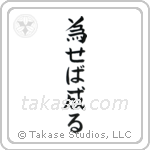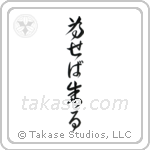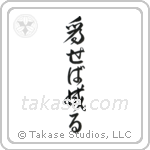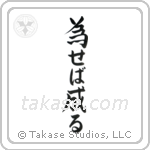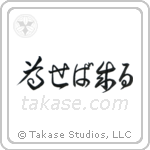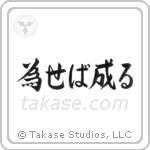

為す is the old verb to do, to bring about, and 為せば its conditional, if one does; 成る is to come about, to be accomplished. The line is the first of a thirty-one-syllable poem the whole country half-knows, なせばなる なさねばならぬ 何事も ならぬは人の なさぬなりけり: do it and it gets done, leave it and it does not; whatever it is, what stays undone is what nobody did.
The words carry the first line alone because the reader supplies the rest, and the force of the poem is in its last line, which turns a failure into a choice.
The dictionaries set beside it a line of the Chinese Book of Documents, without doing, what is done, as the same thought in an older book. Every design brushes the kanji form 為せば成る, the dictionary headword; the poem itself is usually written in kana. Try and You Will Succeed is the sense in English idiom; the literal line is do it and it gets done.
Attributed to the Yonezawa lord Uesugi Yōzan 上杉鷹山, whose name is attached to the poem in print from 1897, with a story that he gave it to his heir's attendants as the close of a wall-writing in 1785 or 1789; in print the line stands without an author from 1890, and the attribution is received and not proven at the letter.
We want you to be as happy with the meaning as you are with Master Takase's art. To learn more, visit Philology of 為せば成る.