

自業自得 · jigō jitoku · One's own deeds, one's own fruit
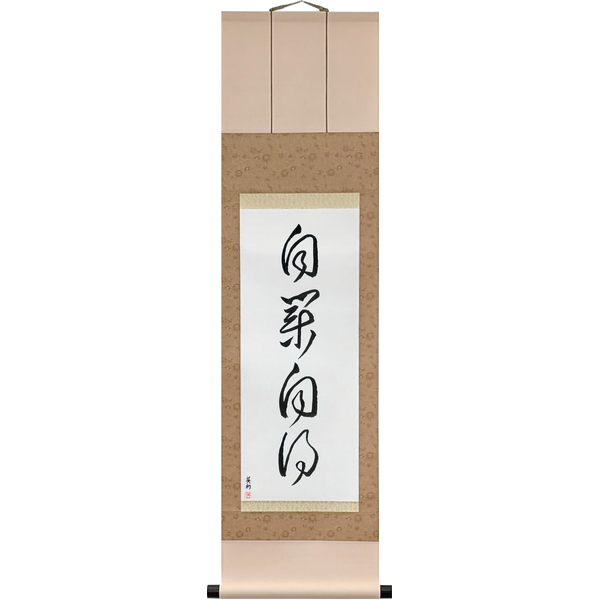
Sold as You Reap What You Sow · Read jigō jitoku; the catalogue writes jigou jitoku · Oldest witness a sutra translated into Chinese in 539, where a hell-warden says it to a sinner who asks why he burns; in Japanese, a monk's confession of about 1213 · Sense what you did comes back to you; neutral in the sutra, and in Japanese use said of the bad.
The words
自業, jigō, is one's own karma, the acts one has done, which bear fruit; Hepburn's dictionary of 1872 glosses it one's own works or actions, according to which reward or punishment is allotted in a future state. 自得, jitoku, is to receive oneself. The 得 here is not gain: 藤井乙男's 1910 dictionary glosses the whole 自己の爲したる業因により、其果報を受くるをいふ, to receive the fruit of the karma one made oneself, and the 日国 says 報いを自分の身に受けなければならない, must receive the recompense in one's own person. The house page glosses 得 as gain, profit, advantage, benefit, the character's general senses and the reverse of what the compound does; the correction is one word, receive. The sutra's form is five characters, 自業自得果, the fruit of one's own karma, self-received; the Japanese dropped the 果 by 1213. The historical kana is じごふじとく, which is what the Edo and Meiji books write beside the characters.
A history, from the earliest witness
539. 正法念處經 (the Saddharma-smṛtyupasthāna-sūtra), translated by 般若流支. Twice. In the first fascicle, plainly: 自作惡業、自得惡報, you do the evil deed yourself; you receive the evil fruit yourself. In the seventh, the chapter on the hells, a warden speaks a verse to a sinner: 非異人作惡,異人受苦報,自業自得果,衆生皆如是, it is not that one person does the evil and another suffers for it; each receives the fruit of his own act; all beings are so. And then: 汝自心所作 … 今為大火燒,何故爾呻喚, your own mind made this; now the great fire burns you; why do you wail? A search of the whole canon finds the four characters in this sutra alone among the Chinese texts; the rest are Japanese commentaries. [CBETA, T17n0721_p0004c04 to c05 and T17n0721_p0036b28 to c02, at cbdata.dila.edu.tw/stable/juans?work=T0721&juan=1 and juan=7; text]
About 1213. 貞慶 (解脱上人), 愚迷發心集, a confession. 自業自得因果必然也。當來苦報誠以難遁, one's own deeds, one's own fruit; cause and effect are inevitable; the suffering to come is truly hard to escape. The 日国's first Japanese citation, in a monk's kanbun, turned on himself. [3]
1252. 十訓抄, a collection of moral tales. The courtier 朝成 prays at Iwashimizu for promotion, boasting that he has cut off the heads of a hundred robbers; the shrine answers his boast in kind, and the tale calls it 如此の自業自得の類, this kind of one's-own-doing, beyond pity. [as told in 俚言集覧, 1900 edition, pid 991570, komas 128 to 129, by eye; text at lab.ndl.go.jp/dl/api/page/991570_129; the 十訓抄 itself not opened]
1532 and after. The verse in the mouth of King Enma and of a hell-warden. In the Zenkōji legend as the 塵添壒囊鈔 tells it, the Buddha asks the king of the dead to spare a boy, and 閻王答テ曰。非異人作惡異人受苦報自業自得果衆生皆如是ト唱テ。我力モ不及, Enma answered by reciting the verse, and said: it is beyond my power. In a Pure Land commentary, Jizō pleads for the damned and the warden recites the same verse: 云何是を免乎, how could they be spared? The sutra's line became, in Japanese storytelling, the one law a bodhisattva's plea cannot bend. [5][6]
1760. 白隠, おたふく女郎粉引歌, a sermon in the form of a mill-girls' song. 一切衆生は皆是前世の。父也母也恩ある族じや。何とぞ扶けて遣りたいものじやと。泪をこぼして勞りたまへど。自業自得の罪科はのがれず。心の田地に蒔置く種じやで。萌切り生出て一粒萬倍。無間の苦患を受けねばならない, all beings were your father and mother in a former life, and they weep and wish to save you; but the crime that is your own doing is not escaped; it is seed sown in the field of the heart, it sprouts ten-thousandfold, and the torment must be borne. Then, in the same breath: so change your nature today. The 日国's second citation, and the first with the reading written beside it, じごふじとく. The seed and the field are 白隠's own, and they are where the English harvest meets the Japanese. [8]
1815. 曲亭馬琴, 皿皿郷談. 鮮衣どのよ撃れしは自業自得よ侍るめり, that he was struck down was his own doing, said of a villain's death, with the reading じごふじとく. [9]
1827. 大全早引節用集, a household dictionary. The four characters in the じ list: the oldest dated print in the archive to carry them as a word. [10]
1910. 藤井乙男, 諺語大辞典. Filed as 仏語 with the two sutra lines, and with two European proverbs: As you make your bed so you must lie on it (French, German, Spanish, Danish) and As you sow, you shall reap (German, Dutch). 自作自受, the Zen records' form, is entered as the same thing. The word is absent from the two first proverb collections of the 1600s, which is what a Buddhist term looks like beside a folk proverb. [pid 862766, koma 252, by eye; text at lab.ndl.go.jp/dl/api/page/862766_252]
Today. デジタル大辞泉: 仏語。自分の行為の報いを自分自身が受けること。一般に、悪業の報いを受けることにいう. The ことわざを知る辞典 explains the shift in one sentence: 「業」は行為、所作の意で、本来は、よい行いにも悪い行いにもいいましたが、今日では主として後者についていいます, "karma" means act or deed; originally it was said of good acts and bad alike, but today mainly of the latter, with 三島由紀夫's 金閣寺 (1956) as its example: まあ怨むなよ … 結局君の自業自得なんだから. [kotobank.jp/word/自業自得; text]
The sense across time
The sutra is neutral and the Japanese use is not. In the sutra the law cuts both ways, good deed and good fruit, evil and evil; the same text says 自作善業、自得樂報 in another chapter. In Japanese, from the first kana witness on, the word is said of the bad: 白隠's 罪科, 馬琴's villain, 三島's you brought it on yourself, and the dictionaries record the narrowing. What did not change is the shape of the claim: no one else did this to you. The sutra says it to a sinner in hell, a monk says it of himself, a storyteller gives it to the king of the dead, a Zen master sings it to working women, and a novelist has one character say it to another. It is the same sentence each time, and it has never had an owner.
What is not a source
No legend attaches to the four characters; the stories that use them name the sutra. The kin the dictionaries give are 自作自受, the Zen form; 自業自縛, bound by one's own karma; 因果応報, the general law of cause and recompense; and the folk proverb 身から出た錆, rust from one's own body, which the dictionaries have paired with it since 1929. Galatians 6:7, whatsoever a man soweth, that shall he also reap, is the English equation, not a source, and it is older in the bilingual dictionaries than any other.
The text in English
1872. James Curtis Hepburn, 和英語林集成, page 181. JI-GŌ, 自業, One's own works or actions, according to which reward or punishment is allotted in a future state. (Bud.) Ji-gō ji-toku, to receive according to one's deeds, what a man soweth that shall he also reap. The first bilingual dictionary already has the equation the house page uses, and the Buddhist note. [11] 1904, 佐久間, 和英中辞林: Natural result of one's misdeed; one's deeds bring their own rewards; one must reap what one sowed. 1907, ロイド: Self do, self have; A man's sin brings its own punishment; He that makes his bed ill, lies ill thereon. 1909, 井上十吉: He has only brought it upon himself; we must resign ourselves to it as the result of our own deeds. 1918, 斎藤秀三郎: ten English idioms glossed with the word, from face the music to pay the penalty of one's deeds. 1929, 岡倉: reap as one has sown, paired with 身から出た錆 and 因果応報. [pids 870204, 903157, 1869465, 1681530, 1904907; OCR] Today. JMdict: paying for one's mistakes; getting one's just deserts; suffering the consequences of one's own actions; reap what you sow. No English proverb book on the shelf was opened for this word and the page cites none. The house title, You Reap What You Sow, is Hepburn's equation in its modern shape, and it is the right one: neutral like the sutra, moral like the Japanese use, and a harvest, which is 白隠's image too. What a rendering must keep is that the fruit is received, not gained.
A reading
The design is sound and the title is the right one. The page needs one word changed and three clauses added. The word: 得 is receive, not gain; a customer reading the page's gloss will take the compound as self-profit, and it means the reverse. The clauses: that the words are a sutra's, said in hell to a sinner who asks why he burns; that a Japanese monk wrote them of himself in 1213 and a Zen master sang them to mill-girls in 1760 with the seed and the field, which is where the English harvest meets the Japanese; and that the sutra says it of good deeds too, while Japanese usage says it of bad ones, so the scroll is a warning in Japanese and can be a promise in English. That last is worth saying because the design will be bought by people who mean it kindly. Signed, 典, 2026-09-05.
How this was read
By eye: 白隠's 1911 leaf, re-read on the day of writing; 貞慶 in the 1941 edition; the two 1922 editions with the verse in Enma's and the warden's mouths; 馬琴; 俚言集覧 at two leaves; 藤井's 1910 entry; Hepburn's page. By text at the address: the sutra at two columns and the canon search at CBETA; the kotobank entry with its five dictionaries, whole; the nine leaves above at the National Diet Library's page API; the 1827 dictionary, the Meiji and Shōwa dictionaries and the bilingual shelf by OCR. Not opened: the 十訓抄 itself; the sutra's line on good deeds at its own column; 白隠's song in its 1760 print; 貞慶 in a manuscript; any English proverb book. Every address in this history is a text address. The full apparatus, with every address, is in the account.
References
- 正法念處經 十善業道品 (般若流支 tr.) (539 (Eastern Wei)) — CBETA T17n0721_p0004c04–c05
- 正法念處經 地獄品 (539) — CBETA T17n0721_p0036b26–c02
- 貞慶 愚迷發心集 (c. 1213) — 1941 typeset pid 1040306 koma 108, by eye; the 日国's 初出 ↩
- 十訓抄 (the 朝成 story) (1252) — 俚言集覧 中 koma 128, by eye; the 十訓抄 not opened
- 塵添壒囊鈔 卷十七 (the Zenkōji legend) (1532) — 1922 typeset pid 952854 koma 218, by eye ↩
- 觀經厭欣鈔 卷中之末 (Jizō in hell) (Muromachi (recall)) — 1922 typeset pid 952740 koma 252, by eye ↩
- 日本治乱記 (山中長俊) (c. 1600; MS) — pid 10303684 koma 52, OCR
- 白隠 おたふく女郎粉引歌 (1760) — 1911 typeset pid 823165 koma 103, by eye; the 日国's second citation ↩
- 馬琴 皿皿郷談 (1815) — 1896 typeset pid 879500 koma 70, by eye ↩
- 大全早引節用集 (1827) — pid 2536906 koma 292, OCR; the oldest dated print in the archive with the four characters ↩
- Hepburn 和英語林集成 (1872) — pid 993689 p. 181, by eye ↩
- 諺語大辞典 (藤井) (1910) — koma 252, by eye
- The catalogue and both live pages (2026) — cultural_works.csv:369