

一石二鳥 · isseki nichō · One stone, two birds
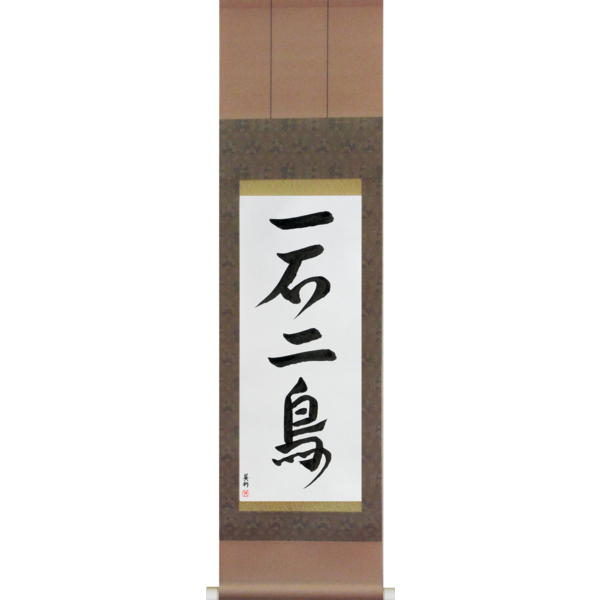
Sold as Kill two birds with one stone · Read isseki nichō; the catalogue writes issekinichou · Oldest witness an English bishop's jibe at Thomas Hobbes, printed 1656; in Japanese as a sentence in 1895 and as a word by 1926 · Sense two ends gained by one act.
The words
一石, isseki, is one stone; 二鳥, nichō, two birds. The four characters are a calque: an English image written in Chinese characters, which is why the compound keeps the whole picture and loses nothing between the languages, and why the page's literally translates as "one stone, two birds" is exactly right. The reading isseki nichō is attested by furigana from 1926 and in kana in 1936; before it settled, a translator of 1906 read the same four characters in Japanese, ひとつのいし、ふたつのとり, one stone, two birds, because the word did not yet exist for him. Japanese already had two words for the thought, both older than the calque. 一挙両得, ikkyo ryōtoku, one move, two gains, from a Chinese history of the seventh century, is the word the Meiji dictionaries used for the English proverb, and the page names it. 一箭双雕, issen sōchō, one arrow, two eagles, is the Chinese proverb with the nearest image, and in Japanese it lives mostly in Zen commentary.
A history, from the earliest witness
1656. John Bramhall, Bishop of Derry, in The Questions concerning Liberty, Necessity, and Chance, his printed quarrel with Thomas Hobbes, reply number twelve. T. H. thinks to kill two birds with one stone, and satisfy two arguments with one answer, whereas in truth he satisfieth neither. The speaker is the bishop, and the use is a reproach: Hobbes has tried to do two things at once and done neither. A century earlier John Heywood's proverb collection of 1546 has the same thought in another image, I will learne to stop two gaps with one bush. [Molesworth's English Works of Thomas Hobbes, volume V, pages 117 to 118, read in the archive.org text layer, archive.org/download/englishworksofth0005hobb/englishworksofth0005hobb_djvu.txt; Sharman's 1874 edition of Heywood, page 161, archive.org/download/cu31924027146566/cu31924027146566_djvu.txt; the 1656 quarto not opened]
1895. 平田久, 露西亜帝国, a book on Russia from the 民友社 press. On China's policy in Korea: 支那の政治家は實に一石を投じて二鳥を斃んと試みたり, the statesmen of China tried, in truth, to throw one stone and fell two birds, with emphasis dots down the column and a side-head, 一石を以て二鳥を撃つ, to shoot two birds with one stone. A sentence, marked by its author as a striking figure; not yet a word. [1]
1904 to 1929. The English-Japanese dictionaries refuse the image. 新撰英和熟語集 (1904): Kill two birds with one stone, to. 一擧兩得する. 英和双解熟語大辞典 (1909): 一擧兩得す — To accomplish two objects at the same time or by one effort, on the same page as stop two gaps with one bush. 新渡戸's 英和俗語熟語故事大辞典 (1911): 一擧にして兩得する. 斎藤秀三郎's Idiomological (1918, 1924, 1928, unchanged): To kill two birds with one stone. 一擧兩得. 研究社新英和中辞典 (1929): 一擧兩得(に相當す). And from the Japanese side, 一擧兩得 = killing two birds with one stone in ten Japanese-English dictionaries from 1902 to 1925. One dictionary translates the picture, as a sentence: 渡部万蔵's 和英引用辞典 (1910), 一石を以て二羽の鳥を殺す、-俚、〔一擧兩得。-類書纂要〕To kill two birds with one stone. [3]
1906. W. G. Smith's account of the Boer War, translated from English, 南阿戦争. は一石二鳥を斃すの戰略を案し, devised a strategy to fell two birds with one stone: the four characters are on the page, and the translator glosses them in Japanese, ひとつのいし・ふたつのとり over the compound and たふ over the verb. The compound exists as a written shape and not yet as a word. [2]
1919 to 1923. The Taishō press. 一石二鳥を擊つの兵法 in 山川菊栄 (1919); 一石二鳥を殺した and 一石二鳥を殺す式に in three books of 1920, the English verb kill still attached; 一石二鳥主義, the first compound built on it, in 1923. [4][5]
1923. 現代文選 教授参考資料, a schoolbook. A dialogue on a poem: 老「一石二鳥といふ譯ですな。詩「いや二兎を追うて一兎をも得てゐません。 One stone, two birds, you mean. No; chasing two hares and catching neither. Two Western imports set against each other, both current enough to be quipped. [6]
1926. 猪狩史山, 女禍伝. 一石二鳥を打つといふ諺はこんなことかも知れぬ, the proverb about striking two birds with one stone may mean something like this, with the furigana いつせきにちよう over the four characters and ことわざ over 諺. The earliest on-reading opened, and the calque called a proverb. [8]
1936. A shorthand record of the Kanamojikai's general meeting. イッセキ ニチョウ ト ユウ マデ ニ ユカナクトモ, the reading in katakana. [9]
1948. 三省堂, 集約英和辞典. kill two birds with one stone 一石二鳥を殺す, 一擧兩得する: the first dictionary in the archive to print the four characters, and it still gives the old equation beside them. [11]
Today. デジタル大辞泉: 一つの事をして同時に二つの利益・効果をあげること。一挙両得, with the note that it comes from the Western proverb To kill two birds with one stone. 精選版日本国語大辞典 gives its first citation as 八木義徳's story 劉広福 of 1944. ことわざを知る辞典 tells the whole story in two sentences: 幕末から英和辞典に収載され、明治期には「一挙両得」または「一石を以て二鳥を殺す」と訳されていました。後者が大正期に短縮され、四字熟語の形になりました, carried in English-Japanese dictionaries from the end of the Edo period, and in the Meiji rendered as ikkyo ryōtoku or as one stone to kill two birds; the latter was shortened in the Taishō into the four-character form. The public-domain corpus counted by five-year bin agrees: one book before 1910, ten in 1920 to 1924, sixty-three in 1925 to 1929, three hundred and fifteen in 1930 to 1934, seven hundred and eighty-five in 1940 to 1944. [kotobank.jp/word/一石二鳥; kotobank.jp/word/一挙両得; text; the corpus bins from the saved search of 2026-09-03 in the account]
The sense across time
The sense is the English proverb's and has never been anything else: two ends by one act. What moved is the form. In 1895 it is a sentence with a verb; in 1906 four characters read as Japanese words; through 1920 a compound still dragging the English verb, kill, shoot, strike; by 1926 a word with its own Sino-Japanese reading, called a proverb; by 1930 common. The English use is often a reproach, as Bramhall's was, for trying two things and doing neither; the Japanese word carries no reproach and is a plain word for efficiency, which is the one shade the calque did not carry across.
What is not a source
一挙両得 comes from the 晋書, in a memorial on settling farmers on the western frontier: 一舉兩得,外實內寬, one move, two gains: the border filled and the interior relieved. 一箭双雕 comes from the 北史, where the general 長孫晟 is handed two arrows for two eagles fighting over meat and 遂一發雙貫焉, with one shot pierced both. Neither is the source of 一石二鳥; they are what Japanese already had when the English arrived, and the dictionaries reached for the first of them for forty years. 二兎を追う者は一兎をも得ず, the two hares, is another Western import of the same generation. Latin and French have their own images for the thought, reported and not opened. [zh.wikisource.org/wiki/晉書/卷051; zh.wikisource.org/wiki/北史/卷022; transcriptions]
The text in English
For this text the English section is short, because the English is the source: the Meiji and Taishō dictionaries above are the reception, and they are given in their place. The American paperbacks add three witnesses.
1965. Daniel Crump Buchanan, Japanese Proverbs and Sayings, University of Oklahoma Press, pages 159 and 177. Under patience: Ikkyo ryōtoku: "A single stroke with double gain." (Lit., "One effort two gains.") English parallel: To kill two birds with one stone. And under a later heading: Isseki ni chō: "One stone, two birds." This is a direct translation into Japanese of the English proverb "To kill two birds with one stone." Correct on both counts, and the earliest English book on the shelf to say the Japanese word is a translation. [LCCN and ASIN not collected; read in the shelf's text layer, the pages from the running heads; a printed book, checkable by a reader who holds it]
2004. Edward Trimnell, Tigers, Devils, and Fools, Beechmont Crest, page 61. To kill two birds with one stone, then: The concept of "killing two birds with one stone" is well known to English-speakers, and the reading of the compound's parts; the loan acknowledged as a loan. [ASIN not collected; read in the shelf's text layer; a printed book, checkable by a reader who holds it]
The proverb is not in David Galef's three Tuttle collections (1987, 2000, 2012) or in Guy Zona's book of 1996, all searched.
Today. The house title is the source itself, and the page's one stone, two birds is the literal Japanese; nothing here needs translating. What the page needs is a date, and the right one is the Taishō.
A reading
The design is sound, the reading is sound, and the English is the source. The page's explanation is right in every part but one word: Meiji. What entered Japanese in the Meiji was the English proverb, and it entered as 一挙両得 in every dictionary and as a sentence in the prose that translated it; the four-character word is a Taishō coinage, as the ことわざを知る辞典 itself says, and the dictionaries did not admit it until after the war. The page could tell that as a story: a seventeenth-century bishop's jibe at a philosopher, refused by the Meiji dictionaries in favor of a Chinese idiom, rendered by a 1906 translator as hitotsu no ishi, futatsu no tori because he had no word for it, called a proverb by a novelist in 1926, and everyone's by 1930. The page's sentence on 一挙両得 is correct and worth keeping; 一箭双雕 could stand beside it as the Chinese image nearest the English one. The scroll page's dictionary link to a Yahoo host that no longer exists is in the page-defects ledger. Signed, 典, 2026-09-05.
How this was read
By eye: the 1895 and 1926 leaves, re-read on the day of writing; the 1906, 1923 and 1936 leaves. By text at the address: Bramhall and Heywood in the archive.org text layers; the seventeen bilingual dictionaries and the 1948 dictionary by OCR from the archive at the scans named in the account; the three kotobank entries; the two Chinese histories in transcription; the six English paperbacks in their text layers, two of which carry the proverb. By OCR from the full-text search, not opened at a page: the six Taishō witnesses of 1919 to 1923. Not opened: the 1656 quarto and Bramhall's 1655 book; 八木義徳's 1944 story; Cicero and the French and German forms; modern Chinese usage; Hepburn's 1872 dictionary by eye. Every leaf named by eye has a page-API text address beside it; Buchanan and Trimnell are checkable only by a reader who holds them. The full apparatus, with every address, is in the account.
References
- 平田久『露西亜帝国』(民友社) (1895) — pid 767334 scan 168 = printed p. 296, by eye (re-read s36 at width 3600; the verb glyph read as 斃 and the noun 二鳥; the OCR layer prints 輩 and 二島) ↩
- W. G. Smith『南阿戦争』(基督教書類会社), a Boer War account translated from English (1906) — pid 776828 scan 32 = p. 55, by eye ↩
- 渡部万蔵『和英引用辞典』 (1910) — pid 870190 scan 21 (OCR) ↩
- 山川菊栄 (in 『唯物史観の立場から』) · 『大日本実業家名鑑』 (1919) — pids 1901057 · 946084 (search highlights, OCR) — the earliest hits after 1906 ↩
- 『ユーゴー全集』第四巻 · 『農民の声を聞け』 · 『農村改造か農村革新か』 (1920) — pids 1718616 · 961595 · 961562 (OCR) — the English verb still attached ↩
- 『現代文選 教授参考資料』中巻 (1923) — pid 918752 scan 63, by eye — set beside the other Western import, which the 1910 dictionary marks 西諺の譯 ↩
- 『震災後の日本』 (1923) — pid 963939 (OCR) — the first compound built on it
- 猪狩史山『女禍伝』(大阪屋号書店) (1926) — pid 1018367 scan 126, by eye — the earliest on-reading opened ↩
- カナモジカイ会員総会速記録 (1936) — pid 1112786 scan 7, by eye ↩
- 八木義徳『劉広福』 (1944) — 精選版 日国 初出 (kotobank) — not opened
- 三省堂『集約英和辞典』 (1948) — pid 2134829 scan 23 (OCR) — the first dictionary in the archive to print the four characters ↩
- The catalogue and both live pages (2026) — cultural_works.csv:348