

夜の蘭香にかくれてや花白し · yoru no ran ka ni kakurete ya hana shiroshi · The orchid at night, hidden in its scent. The flower is white
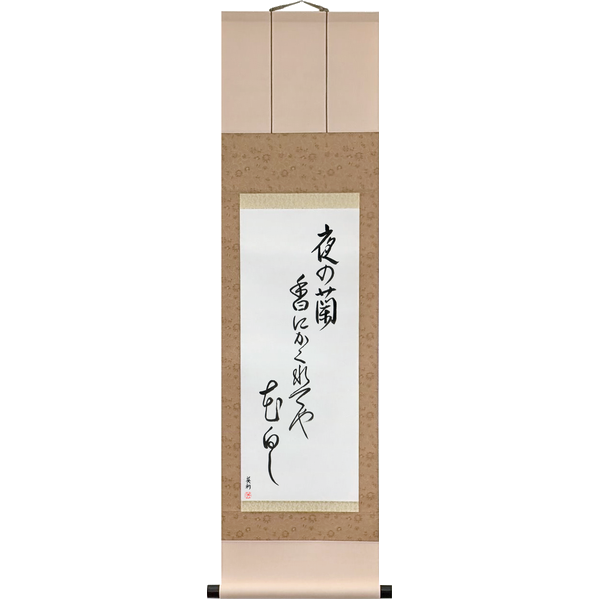
Sold as An evening orchid / Hidden in its scent / The flower's whiteness, under Buson's name and no translator's · Read yoru no ran ka ni kakurete ya hana shiroshi · Oldest witness the 蕪村句集 of 1784, the poet's own late selection, read at the leaf · Sense at night the orchid's stem and leaves vanish and its scent grows; the flower has hidden in its own perfume, and the one thing left to see is that it is white.
The text as brushed, and its variants
The scroll carries 夜の蘭香にかくれてや花白し, and so does the poet's own book. The 蕪村句集 of 1784, opened at the leaf, prints 夜の蘭香にかくれてや花白し in its autumn section, after the morning-glory verses and before a column that opens with the two-character headnote 蘭夕 over a different verse, 狐のくれし奇楠を炷む. Every later edition agrees: the 1896 句文集 (where the OCR misreads 蘭 as 關), the 1906 annotated edition, the 1935 edition of the 句集. Shiki's manuscript compilation of 1889 writes 隠れ for かくれ at one of its two entries, a kanji for a kana and one word. No witness varies a word. The one question the text layer raised, whether 蘭夕 is this verse's headnote, the leaf answers: it stands at the head of the next column, in the position every headnote in the book takes, over the incense verse, and this verse has none. The meter is five, seven, five, with 香 read ka: よ・る・の・ら・ん, か・に・か・く・れ・て・や, は・な・し・ろ・し.
The attribution, as a dated thread
Buson's, and never anyone else's. The 句集 that carries it was published under 几董's name with a postscript dated 天明四甲辰之冬十二月, the twelfth month of 1784, which falls in January–February 1785 by the Western calendar; the encyclopedia entry on kotobank, following 清水孝之, holds on the evidence of Buson's own late verse-books in the 本間美術館 that the selection was the poet's own and that 几董 copied it faithfully to print. Shiki's 1889 manuscript enters the verse twice and names the 蕪村句集 as its source at the second entry, through an OCR that garbles both names. The 1896, 1906 and 1935 editions are editions of Buson. Blyth in 1952 carries it and does not doubt it; Sawa and Shiffert in 2007 and Addiss in 2009 carry it too, below (s42 called Blyth the only one on the shelf, before the later deliveries). No witness dates the composition.
The words
夜の蘭 is the orchid at night; 蘭 is an autumn season word, and Blyth files the verse under ORCHIDS in his autumn volume. 香にかくれてや is hidden in its scent, with や an exclamation at the hiding; Blyth's note has the physics of it, as it grew darker, nothing could be seen of the stem and the leaves, but the fragrance was stronger than ever, and the orchid hid in its own perfume. 花白し is a predicate, the flower is white: the one thing that stays visible, palely gleaming through the darkness. 香 is read ka, the reading the meter needs, and the page's romaji has it right. As words the line says: The orchid at night, hidden in its scent: the flower is white. The page's English makes the last phrase a noun, the flower's whiteness, where the Japanese makes a statement.
A history, from the earliest witness
1784. 蕪村句集, 前編 巻之下, 秋之部, edited by 几董, the poet's own late selection. The verse in the autumn run after the morning-glory verses; the next column opens with the headnote 蘭夕 over 狐のくれし奇楠を炷む. [NIJL 国書データベース biblio 300106341, canvas 45, right page, read by eye at full resolution; the leaf is an image and has no text address]
1889. 正岡子規, 発句類題全集, a manuscript compilation of verses by topic. Under 蘭, 夜の蘭香に隠れてや花白し 蕪村; and in a second volume, 夜の蘭香にかくれてや花白し with the poet and the source, 蕪村句集, both garbled in the text layer. The leaves have not been seen. [NDL pid 2586429, koma 31, and pid 2586452, koma 256, OCR; text at lab.ndl.go.jp/dl/api/page/2586429_31 and 2586452_256]
1896. 三森幹雄, 蕪村句文集, an edition with the editor's marks. The verse in the autumn run, 朝顏や手拭のはしの藍をかこつ before it and 蘭夕 狐のくれし after; the OCR layer reads 關 for 蘭 in this verse and タ for 夕 in the next. [NDL pid 875710, koma 32, OCR; text at lab.ndl.go.jp/dl/api/page/875710_32]
1906. 岩本梓石, 蕪村俳句全集 標註, an annotated edition. The same run, 夜の蘭香にかくれてや花白し, then 蘭タ狐のくれし奇楠を炷ん; the edition annotates the verse's neighbors and not this verse. [NDL pid 875714, koma 92, OCR; text at lab.ndl.go.jp/dl/api/page/875714_92]
1935. 藤井紫影, 名家俳句集, the 蕪翁句集 巻之下. The verse in place, with 朝貌や手拭のはしの藍をかこつ immediately before it and 蘭夕 狐のくれし奇楠を炷かむ 辨慶讃 after; an earlier reading had set 朝貌にうすきゆかりの木槿哉 as its neighbor, and that verse stands some way off in the same column, not adjacent. [NDL pid 1259717, koma 233, OCR; text at lab.ndl.go.jp/dl/api/page/1259717_233]
Today. The Nipponica entry on kotobank, 蕪村, gives the poet's dates 1716–1783 and the judgment on the 句集 quoted above. The archive's index lists thirty books carrying the verse before 1945, five of them located to a koma. [kotobank 蕪村, read as text; harvest_index.py lookup --id 268 --year-to 1945, 30 total, 5 located, re-derived 2026-09-05]
The sense, across two centuries
One reading, and it is Blyth's paraphrase, because the Japanese witnesses opened are all editions and none of them stops to comment on this verse. The orchid's scent grows as its body disappears into the dark, until the flower seems to have hidden inside its own perfume, and what the eye keeps of it is its whiteness. There is no argument in the record; the verse has never needed one.
What is not a source
The headnote 蘭夕, an orchid evening, which the text layer set next to this verse in three editions, belongs to the next verse, 狐のくれし奇楠を炷む, burning the incense-wood the fox gave; the leaf places it at the head of that verse's column, as every headnote in the book is placed. It is not this verse's, and a reader who met it in an OCR run would have taken it for one. The morning-glory verses before it in every edition are its neighbors in Buson's ordering, not its kin.
The verse in English
The bilingual dictionaries of the Meiji shelf were not checked for this verse. Miyamori, Henderson, Ueda, Keene, Sato, Shirane, Hass and Reichhold were searched on the shelf and do not carry it; Sawa and Shiffert and Addiss do, added s92.
1952. R. H. Blyth, Haiku, volume 4, Hokuseido Press, Tokyo, under ORCHIDS, pages 125–126. An evening orchid,— / It hid in its scent, / The flower white, with the note on the darkening and the perfume quoted above. [docs/research/papers, Blyth 1952 vol. 4, pages 125–126 by the account's reading of the text layer, read as text; no ASIN collected]
Today. The house English, An evening orchid / Hidden in its scent / The flower's whiteness, is Blyth's first line to the word, his second with It hid made Hidden, and his third with The flower white made The flower's whiteness, under the poet's name alone. A rendering of this line has to keep 花白し as a statement, since that is what the Japanese is and what the poem ends on; Blyth's The flower white does, and whiteness turns the poem's last fact into a description of it.
2007. Yuki Sawa and Edith Marcombe Shiffert, Haiku Master Buson, White Pine Press. An orchid at night— / hidden by its own fragrance, / the white flower, with the romaji. [docs/research/papers, Sawa 2007, page 138 by the text layer's marker, read as text]
2009. Stephen Addiss, Haiku: An Anthology of Japanese Poems, Shambhala. In the introduction, as the example of a verse whose word-for-word English needs freeing: a close rendering, Evening orchid— / is it hidden in its scent? / the white of its flower, and a freer one, Evening orchid— / the white of its flower / hidden in its scent. [docs/research/papers, Addiss 2009, read as text; the text layer carries no page number at the passage]
A reading
This is a poem about one sense giving way to another, and I read it as Blyth does, without the sermon he sometimes adds and does not add here. In daylight an orchid is a shape; at night it is a smell, and the smell grows as the shape goes, so that the flower seems to have withdrawn into what it gives off. Then the last phrase, 花白し, gives back the one visible thing, and gives it back as a plain statement, the flower is white, which is why the verse ends rather than trails. The page's whiteness softens that ending into a quality; Blyth's the flower white keeps it a fact. Text, attribution and romaji stand, the 句集 leaf settles that the verse carries no headnote, and the scroll needs no change. The page's English is Blyth's and should say so, or become a house rendering that keeps his third line's shape. Signed, 典, 2026-09-05.
How this was read
By eye: the 1784 句集 at canvas 45 of the NIJL images, at full resolution, where the verse and the position of 蘭夕 were read. By OCR from the archive's text layer: Shiki's manuscript at both entries, the 1896, 1906 and 1935 editions. By text layer from the shelf: Blyth; the kotobank entry. Not opened: the twenty-five books the archive's index lists for the verse but has not located to a koma; the 1889 manuscript leaves as images, where the source cell would be read in Shiki's hand; a modern annotated edition at this verse; Blyth's page as an image, where the Japanese lines the OCR garbled would read. The 1784 witness is an image at NIJL and checks by eye alone; the NDL witnesses each carry a text address beside the image. A bracket of the form pid P, koma N resolves as text at lab.ndl.go.jp/dl/api/page/P_N and as an image at dl.ndl.go.jp/api/iiif/P/R<N, seven digits>/full/3600,/0/default.jpg. The full apparatus, with every address and the crop's path, is in the account.
Supersession 2026-09-14 (s92)
A read-only worker resolved this account's addresses (citation_checks_2026-09-14/history_yoru_no_ran_268_2026-09-05.check.md): 15 claims, 9 at the address. Corrected above, each opened by me: Sawa and Shiffert 2007 (page 138) and Addiss 2009 carry the verse, so Blyth is not the only translator on the shelf, as s42 said before those books were delivered; the postscript's 天明四年十二月 is glossed to the Western calendar as the research record already had it. Not yet read by a person.
References
Each witness is cited in the account above, at the frame or entry where it was read. A linked list follows when the record for this text is completed.