

世の中は地獄の上の花見哉 · yo no naka wa jigoku no ue no hanami kana · This world of ours is flower-viewing on the roof of hell
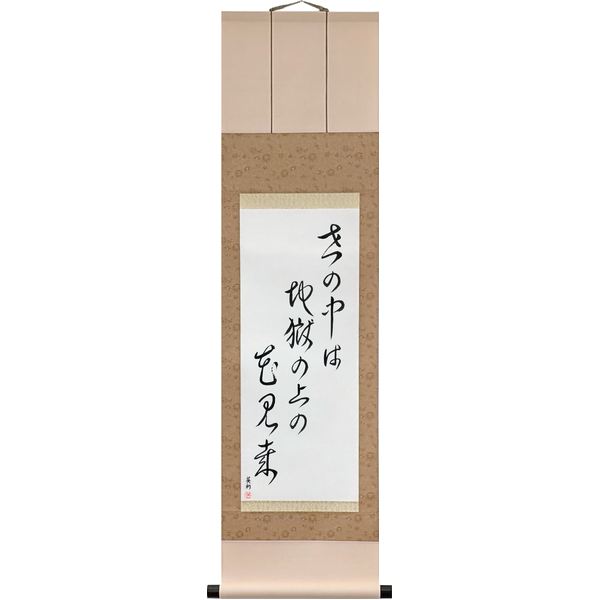
Sold as In this world of ours, / We walk above hell, / Gazing at flowers, under Issa's name and no translator's · Read yo no naka wa jigoku no ue no hanami kana · Oldest witness Issa's own verse-book 株番 of 1812–1813, by the 1928 index's source tag; the earliest print on the desk is 1908 · Sense the human world defined in one breath: a cherry-blossom party held on the lid of hell. The Japanese has no we and no walk; it is a copula, the world is this, and every reader since 1913 has heard the Pure Land preacher in it.
The text as brushed, and its variants
The scroll carries 世の中は地獄の上の花見哉. Every witness prints the same seventeen syllables; the only difference is whether the last word is written 哉 or かな. The two collected editions of 1908 and 1921 write 哉, the essayists of 1913, 1916 and 1936 write かな, the 1928 index 哉. They are one word. No witness varies a word of the verse. The meter is five, seven, five: よ・の・な・か・は, じ・ご・く・の・う・え・の, は・な・み・か・な.
The attribution, as a dated thread
Issa's, in every witness that names a poet, and in both collected editions. Where it comes from is named once on the record, by the 1928 index of the 日本俳書大系, which tags the verse (株番) and gives its item, 一茶四六. 株番 is a verse-book in Issa's own hand: the 精選版 日本国語大辞典 describes it as 江戸後期の俳書。一冊。小林一茶著。一茶が文化九年(一八一二)一月から同一〇年末にかけて下総、江戸、信濃を旅行したときの連句、発句、随筆などを収める, a haikai book of the late Edo period, one volume, by Kobayashi Issa, collecting the linked verse, hokku and prose of his travels in Shimōsa, Edo and Shinano from the first month of 1812 to the end of 1813. That gives the verse a date, 1812 or 1813, and a setting, the poet on the road between Shimōsa, Edo and Shinano. The account written before this history placed the verse also in おらが春, the journal of 1819, on the strength of Sam Hamill's 1997 translation; re-opening Hamill shows his rendering sits in the Selected Haiku appended to the journal, not inside it, and the archive agrees: the archive holds many typeset printings of おらが春, and not one of the seven books in it that carry this verse is one of them. So the record's one source is 株番, and おらが春 is withdrawn. The English translators, Blyth in 1963, Mackenzie in 1984, Hass in 1994 and Hamill in 1997, all give it to Issa and none doubts it.
The words
世の中は is this world, the human world, with は setting it up as the subject of a definition. 地獄の上の is on top of hell, and both Blyth and Hass hear the roof of hell; Hass's word-for-word gloss is hell's top's. The ground of the party is the lid. 花見 is cherry-blossom viewing, the spring outing with food and drink under the trees; a spring season word. 哉 closes the definition as an exclamation. The whole line is a copula with no verb of motion in it: the world is a flower-viewing on hell's roof. 角田浩々歌客 said it in 1913: 一茶は說明せず、世間を直に地獄の上とし, Issa does not explain; he makes the world directly the top of hell. As words the line says: This world: a blossom party on the roof of hell. The house English adds we and walk, which Blyth added first.
A history, from the earliest witness
1812–1813. 小林一茶, 株番, the poet's own verse-book, by the 1928 index's tag. Not opened; the book is named by the 精選版 日本国語大辞典 as above and the index gives the item, 一茶四六. [kotobank 株番, read as text; the index at NDL pid 1179400, koma 308]
1908. 俳諧寺可秋, 一茶一代全集, the first collected edition. The editor arranges a group of spring verses by the six realms of Buddhist rebirth, each under its own header down the page: 人間, the human realm, with さく花の中にうこめく衆生哉, printed so, without the dakuten, among the blossoms, the swarming of living beings; 餓鬼, the hungry ghosts; 畜生, the beasts; 地獄, hell, with 世の中は地獄の上の花見哉; 修羅, the fighting demons; 天上, the heavens. The verse under 地獄 is this one. It is the earliest print on the desk and the arrangement is the editor's, not the poet's. [NDL pid 874846, koma 27, printed pages 34–35, read by eye; text at lab.ndl.go.jp/dl/api/page/874846_27]
1913. 角田浩々歌客, 漫遊人国記, a travel book with literary asides. The verse set against an older one: 伊丹鬼貫の「骸骨の上を粧うて花見かな」の吟を一茶の「世の中は地獄の上の花見かな」に比し, compare 鬼貫's "skeletons dressed up for flower-viewing" with Issa's "this world is flower-viewing on the roof of hell"; and the difference named, 鬼貫 explains and Issa states. The OCR at this leaf is interleaved with furigana and the account's 比し is the OCR's 比か read as the grammar requires. [NDL pid 950566, koma 209, OCR; text at lab.ndl.go.jp/dl/api/page/950566_209]
1916, reprinted 1926. 高安月郊, 東西文学比較評論, comparative criticism. In a chapter on Issa as 悲観詩人, the pessimist poet: 露の世の露の中にて喧嘩かな露と知りながら彼自身も喧嘩するのである。世の中は地獄の上の花見かな彼の淚には笑がある、笑には涙がある (the OCR run, which sets no mark between a verse and the prose after it), "in this dewdrop world, quarreling in the dew": knowing it is dew, he quarrels himself. "This world is flower-viewing on the roof of hell": in his tears there is laughter, in his laughter tears. [NDL pid 953966, koma 32, and pid 953967, komas 31–32, OCR; text at lab.ndl.go.jp/dl/api/page/953966_32 and 953967_31]
1921. 勝峰晋風, 新選一茶全集, the second collected edition. Its 一茶俳句分類, the verses classified by subject, has a run of Buddhist topics down two pages, 開帳, 勧化, 經, 衆生, 六道, 極楽, 西方, 開山, 地獄, 鬼, 精進, 鐘. Under 衆生 stands 咲く花の中にうごめく衆生哉; under 地獄, three verses, 地獄へは斯う參れとか閑古鳥, 露ちるや地獄の種を今日も蒔く, and 世の中は地獄の上の花見哉. The 1908 editor's six-realm frame is gone; the topic is simply hell. [NDL pid 970100, koma 245, printed pages 434–435, read by eye; text at lab.ndl.go.jp/dl/api/page/970100_245]
1928. 勝峰晋風, 日本俳書大系, the index volume. Among the 世の中 verses: (株番)世の中は地獄の上の花見哉(一茶四六), between 世の中はくねり法度ぞ女郞花 and 世の中はよすぎにけらし艸の露. The one source tag on the record. [NDL pid 1179400, koma 308, OCR; text at lab.ndl.go.jp/dl/api/page/1179400_308]
1936. 富士川遊, 新撰妙好人伝, lives of exemplary Pure Land believers. Issa is one of them, and the verse is his view of life: それ故に一茶は、自分等の生活の相をば『世の中は地獄の上の花見かな』『咲く花の中にうごめく衆生かな』と考へざるを得なかつたのである。明日をも知れぬ命をもち、しかもそれは地獄に墮つることは, therefore Issa could not but see the shape of our lives as "this world is flower-viewing on the roof of hell" and "among the blossoms, the swarming of living beings": with a life that may end tomorrow, and a fall into hell …, and, as the account carries the sentence on, certain, they think nothing of it and view the flowers at their ease. This is the reading a 浄土真宗 reader of Issa's own century would have heard. [NDL pid 1185882, koma 20, OCR; text at lab.ndl.go.jp/dl/api/page/1185882_20]
Today. The kotobank page gives the poet's dates 1763–1828 in デジタル大辞泉 and 日本人名大辞典 (1828 because 文政10年11月19日 falls on 5 January 1828 by the Western calendar; 高安 writes 一七六三-一八二七, the Japanese year); Britannica writes them 宝暦13(1763).5.5 to 文政10(1827).11.19. The archive holds seven books before 1945 that carry the verse. [kotobank 小林一茶 and 株番, read as text; search_ndl_archive.py --phrase 地獄の上の花見, 7 books, 7 komas, derived 2026-09-05]
The sense, across a century
One reading, and it is the preacher's. From 1908, when an editor filed the verse under hell in a chart of the six realms, to 1936, when a Pure Land biographer made it Issa's creed, the Japanese readers hear a Buddhist sentence: the world is impermanent and damned and goes on partying. 高安 in 1916 adds the note that makes it Issa rather than a sermon, the laughter in the tears. Blyth in 1963 compresses the same thought to an aphorism, Happiness is impossible without forgetting. Hass in 1994 is the one reader who looks at the grammar instead of the doctrine and finds the poem's force there: the Japanese is very fast, a copula with no verb, and his own English, with its we walk, is slower and softer than the original. Between them the tradition says one thing twice: the verse is a definition, and what it defines is us.
What is not a source
鬼貫's 骸骨の上を粧うて花見かな, skeletons dressed up for flower-viewing, which 角田 sets beside the verse in 1913, is a predecessor in the same thought, a century older; it has not been opened at its own source and is a pairing, not an origin. The companion verse 咲く花の中にうごめく衆生哉, filed beside this one by both editors and by 富士川, is another poem with which the editors pair it, not a variant. おらが春, the journal of 1819 in which the account once placed the verse, is withdrawn as a source above. The six realms are the 1908 editor's frame, not the poet's headnote.
The verse in English
The bilingual dictionaries of the Meiji shelf were not checked for this verse. Henderson, Miyamori, Ueda, Keene, Sato, Shirane and Reichhold were searched on the shelf and do not carry it. Four translators do.
1963. R. H. Blyth, A History of Haiku, volume 1, Hokuseido Press, Tokyo. In this world of ours, / We walk on the roof of Hell, / Gazing at the flowers, and one sentence: Happiness is impossible without forgetting. Blyth supplies we walk, which the Japanese does not have, and the roof, which it very nearly does. [docs/research/papers, Blyth 1963 vol. 1, read as text; the file carries no page markers; no ASIN collected]
1984. Lewis Mackenzie, The Autumn Wind: A Selection from the Poems of Issa, Kodansha International. Number 103: In the world's way— / On the roof of hell we walk / Gazing at flowers! Blyth's roof and Blyth's walking, in a different order. [docs/research/papers, Mackenzie 1984, read as text; not cited by the account and found on the shelf this session; no ASIN collected]
1994. Robert Hass, The Essential Haiku, Ecco Press, page 158, and the afterword. In this world / we walk on the roof of hell, / gazing at flowers. In the afterword he takes his own version apart: Yo no naka wa / jigoku no ue no / hanami kana … world's middle as-for / hell's top's / flower viewing! It's very fast, and, the account records, a more accurate translation would be This world: hell's roof's flower viewing, which, he says, goes by too quickly to make a poem in English. His is Blyth's rendering with the articles removed. [docs/research/papers, Hass 1994, page 158 by the file's page numbers and the afterword, read as text; no ASIN collected]
1997. Sam Hamill, The Spring of My Life and Selected Haiku, Shambhala. In the Selected Haiku that follow his translation of the journal, not inside it: In the midst of this world / we stroll along the roof of hell / gawking at flowers, with the romaji beneath. Stroll and gawking are his, and they are the first English to hear the party as vulgar. [docs/research/papers, Hamill 1997, the Selected Haiku section, read as text; no ASIN collected]
Today. The house English, In this world of ours, / We walk above hell, / Gazing at flowers, is Blyth's first line to the word, his third with one article dropped, and his second with the roof of replaced by above. It is Blyth's rendering, lightly altered and uncredited, and the alteration loses the one image every translator kept. A rendering of this line must keep the roof, because the poem is not that hell is somewhere below but that we are standing on its lid; and it may, as the Japanese does, leave out we and walk altogether.
A reading
The verse is a sentence with a copula and no verb of motion, and I read it as a definition rather than a scene. Blyth's we walk turns it into a picture of people strolling, and every English version since has kept the stroll; the Japanese has no stroll, only the world, the roof, and the party. That is why Hass calls it fast. It is also why the Pure Land reading is not an imposition: a definition of the world as a party on hell's roof is a sermon's sentence, and Issa, who wrote it in a verse-book of his travels, knew the sermon. What I would add to the tradition is 高安's note, because it is what keeps the verse from being only a sermon: there is laughter in it. A party on the roof of hell is a terrible thing and it is also a party, and the poem does not tell you to leave. The page's English should restore the roof, by crediting Blyth or by a rendering of its own; text, attribution and romaji stand; the scroll needs no change. Signed, 典, 2026-09-05.
How this was read
By eye at width 3600: the 1908 全集 at its six-realm chart, pages 34–35; the 1921 全集 at its 地獄 topic, pages 434–435. By OCR from the archive's text layer: the 1913 travel book, the 1916 and 1926 printings of 高安, the 1928 index, the 1936 lives. By text layer from the shelf: Blyth, Mackenzie, Hass and Hamill; the kotobank entries for the poet and for 株番; the archive searched for the verse and for the opening verse of おらが春. Not opened: 株番 itself at item 46, which is the first record and would give the verse its place among the travels of 1812–1813; 鬼貫's verse at its source; a modern annotated edition of Issa at this verse; Blyth's, Mackenzie's and Hamill's printed pages, which the text layers do not number. A bracket of the form pid P, koma N resolves as text at lab.ndl.go.jp/dl/api/page/P_N and as an image at dl.ndl.go.jp/api/iiif/P/R<N, seven digits>/full/3600,/0/default.jpg; the two leaves read by eye were fetched at that address. The full apparatus, with every address, is in the account.
Supersession 2026-09-14 (s92)
A read-only worker resolved this account's addresses (citation_checks_2026-09-14/history_jigoku_no_ue_256_2026-09-05.check.md): 19 claims, 12 at the address, 8 it could not open (live URLs, API queries, printed pages read from the image). Corrected above: eleven syllables was an arithmetic slip for seventeen; the 1921 subject run had dropped 西方 and 開山 (koma 245 re-opened by me); the 1926 reprint's quotation runs onto koma 32, now in the address (koma 32 re-opened: 淚には笑 is there); Hass's closing words quoted rather than paraphrased; the 1827 and 1828 death years explained as one date in two calendars. The disclosed 比し-for-比か emendation stands as disclosed. Not yet read by a person.
References
Each witness is cited in the account above, at the frame or entry where it was read. A linked list follows when the record for this text is completed.