

うらやまし美しう成て散る紅葉 · urayamashi utsukushū natte chiru momiji · Enviable: to turn beautiful, and then to fall, the maple leaves
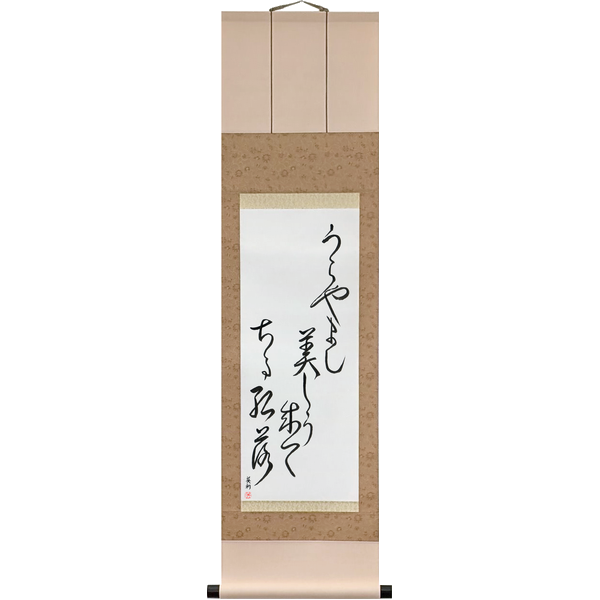
Sold as 支考's, with a house translation credited on the page to its translator by name and a pointer to the product page's notes · Read urayamashi utsukushū natte chiru momiji · Oldest witness two anthologies of 1909 from one Tokyo press, each with 支考 in the name column beside the verse; nothing from the poet's own century has been found, in the archive or in the whole digitized library · Sense how enviable, to turn beautiful and then to fall: the maple leaves. Read by Miyamori through the samurai's wild cherry and the maxim of the broken jewel.
The text as brushed, and its variants
The scroll carries うらやまし美しう成て散る紅葉, and both Japanese witnesses have these words, one writing 成て and the other なつて, one word. Miyamori reports another reading, 花よりも美しくなりてちる紅葉, more beautiful than the flowers it turns, and falls, which shares only its last word with ours, has no source in Miyamori and no other witness, and is a different verse on the same thought; the shelf's text layer of his page prints ちろ in the kanji line against chiru in his romaji, not settled by eye. No witness varies a word of ours. The meter is five, seven, five: う・ら・や・ま・し, う・つ・く・し・う・な・つ・て, ち・る・も・み・じ, the middle line seven with the classical adverb.
The attribution, as a dated thread
支考's, and now on Japanese witnesses as well as English ones. 沼波瓊音's 俳句の作り方 (1909) prints the verse in a list of hokku by their endings, and its name column, read on the leaf, sets 支考 under this verse between 芭蕉 (山里は萬歲遲し梅の花) and 杉風 (老淋し若葉の花をさかす枝); 高木武's 文学錦嚢 (1909) prints it in its 名吟之部 with 支考 in the column beneath, the verses before and after marked 同. The text layer of both ran the names into a string it could not align; the leaves align them. Miyamori 1932 and Yasuda 1947 name him. No witness dates the verse or names the book it comes from, and the search for one has now been made twice: the archive has two books carrying it, and the National Diet Library's full-text search over its whole digitized collection returns the same two and no other, for either spelling. 各務支考 (1665–1731 by kotobank and Blyth; 1664–1731 by Miyamori and Yasuda), of 美濃, first a priest and then a physician, one of the ten disciples, founder of the 美濃派, author of 笈日記 and 葛の松原; none of his own books opened for this verse.
The words
うらやまし is enviable; how I envy; the verse opens on the feeling and gives its object last. 美しう成て is having become beautiful, 美しう the classical adverbial of 美しく. 散る紅葉 is the maple leaves that fall, an autumn season word. As words the line says: Enviable: having turned beautiful, to fall; the maple leaves.
A history, from the earliest witness
1909. 沼波瓊音, 俳句の作り方, 文成社. Pages 86–87, a list of verses by their closing forms; under 「し」: 山里は萬歲遲し梅の花 芭蕉, うらやまし美しう成て散る紅葉 支考, 老淋し若葉の花をさかす枝 杉風, 酒涼し百首に洩れて西の宮 野坡, the names in a column at the foot. [NDL pid 994608, koma 48, printed pages 86–87, read by eye; text at lab.ndl.go.jp/dl/api/page/994608_48]
1909. 高木武 (ed.), 文学錦嚢, 文成社. Page 10, 名吟之部, 俳句: うらやまし美しうなつて散る紅葉 with 支考 beneath it, between verses marked 同 for 去來 above and for 支考 below. [NDL pid 872638, koma 15, printed page 10, read by eye; text at lab.ndl.go.jp/dl/api/page/872638_15]
Today. The archive lists two books carrying the verse, both opened; the NDL full-text search returns the same two. kotobank's page for 各務支考 gives his dates and books and does not quote the verse. [harvest_index.py lookup --id 264; lab.ndl.go.jp/dl/api/book/search, two keywords, 2026-09-05; kotobank 各務支考-15776, read as text]
The sense, across a century
Two readers, both in English. Miyamori set the verse in a tradition: the 山桜 that scatters at the height of its beauty, the samurai's flower, and the maxim 玉砕瓦全, better a jewel broken than a tile whole; the poet, led by these traditional ideas, envies the maple for dying the same way. Yasuda made the envy everyone's, Envied by us all. Blyth, who did not translate the verse, wrote of the poet that his haiku show his strong and stubborn character; they are practically senryu, which fits a verse that opens with its own opinion.
What is not a source
The two Japanese witnesses are two lists from one press in one year, and the poet's own books were not opened, so the attribution rests on 1909 and on Miyamori and Yasuda, who agree with it; nothing found contradicts it, and nothing found is older. Miyamori's other reading is his alone. The house translation and its notes were not read. The account's utsukushuu was its own spelling; the row and this history write utsukushū.
The verse in English
The bilingual dictionaries of the Meiji shelf were not checked for this verse. Blyth, Henderson, Hass, Shirane, Carter, Hamill and Mackenzie were searched on the shelf and do not carry it.
1932. Asatarō Miyamori, An Anthology of Haiku Ancient and Modern, Maruzen, Tokyo, no. 229, printed pages 308–309, 紅葉, The Maple Leaves. うらやまし美しう成て散る紅葉 支考; How I envy maple leafage / Which turns beautiful and then falls! Shikō. With the biography, the 山桜 and the maxim, and the other reading. [docs/research/papers, Miyamori 1932, printed pages 308–309 by the running heads of the file's page-marked layer, read as text (s41 cited 229, which is the item number); no ASIN collected]
1947. Kenneth Yasuda, A Pepper-Pod, Knopf; Tuttle, MAPLE LEAVES. Envied by us all, / The leaves of maple turn so / Beautiful — then fall! Urayamashi / Utsukushū natte / Chiru momiji. Shikō (1664–1731). [docs/research/papers, Yasuda 1947, read as text; no ASIN collected]
Today. The house page carries its own translator's lines, credited by name; its slug reads how enviable, turning beautiful then falling, maple leaves, which is Miyamori's sense. A rendering of this line has one thing to keep: the envy comes first and the leaves last.
A reading
I read the verse as Miyamori did, a verse of the tradition that admires the thing that falls at its best, said by a poet who liked to say what he thought. The attribution stands on two Japanese witnesses read by eye and two translators, and on the absence of any rival in the whole digitized library; it is not grounded in the poet's own century, and the history says so rather than implying otherwise. The text and the romaji stand; the scroll needs no change; the row's macron is the right spelling. What would finish the account is one of 支考's own collections at the verse, a search outside the archive. Signed, 典, 2026-09-05.
How this was read
By eye at width 3600: both 1909 anthologies at the verse and its name column. By text layer from the shelf: Miyamori, Yasuda, Blyth's History for the poet. As text: kotobank, the NDL full-text search. Not opened: any book of 支考's own; the product page's notes; Miyamori's page as an image. A bracket of the form pid P, koma N resolves as text at lab.ndl.go.jp/dl/api/page/P_N and as an image at dl.ndl.go.jp/api/iiif/P/R<N, seven digits>/full/3600,/0/default.jpg; the two leaves read by eye were fetched at that address. The full apparatus, with every address, is in the account.
Supersession 2026-09-14 (s92)
A read-only worker resolved this account's addresses (citation_checks_2026-09-14/history_urayamashi_264_2026-09-05.check.md): 17 claims, the NDL komas and the quotations at the address. Corrected above: Miyamori's entry is item no. 229 on printed pages 308–309 by the running heads, and s41 had read the item number as the page. Not yet read by a person.
References
Each witness is cited in the account above, at the frame or entry where it was read. A linked list follows when the record for this text is completed.