

露の世は露の世ながらさりながら · tsuyu no yo wa tsuyu no yo nagara sari nagara · A world of dew is a world of dew, and yet
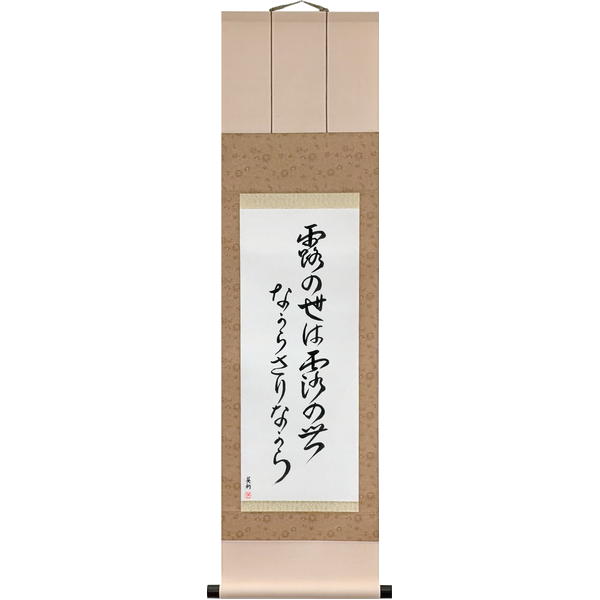
Sold as This dewdrop world, / is a dewdrop world, / and yet, a house rendering, under Issa's name, with the occasion the page gives, the death of his daughter · Read tsuyu no yo wa tsuyu no yo nagara sari nagara · Oldest witness Issa's own journal of 1819, おらが春, where the verse stands signed in his text after the death of his daughter Sato; the earliest print opened is the 1878 Nagano printing, read at the leaf · Sense the world is dew, as the sutras say, and the poet grants it; then one word, and yet, refuses to finish the sentence. The page's occasion is what Issa's own book says, and it is the firmest footing any page in this family has.
The text as brushed, and its variants
The scroll carries 露の世は露の世ながらさりながら, and the witnesses write one text. The 1878 print of おらが春, in a cursive hand, writes 露の世ハ露の世なからさりなから 一茶, the topic particle in katakana and the voicing marks left off as cursive does; the 1930 typeset of the same book writes 露の世ハ露の世ながらさりながら 一茶; the anthologies of 1924 to 1935 write 露の世は露の世ながらさりながら; a 1909 preaching dictionary writes it in katakana throughout; a 1933 rhetoric writes さり乍ら and 藤井's 1935 edition 去ながら for the last word. All one text. Shirane's sannagara in the shelf's file is a typesetting or scanning slip for sarinagara and is not a reading. The meter is five, seven, five, with the middle phrase running seven: つ・ゆ・の・よ・は, つ・ゆ・の・よ・な・が・ら, さ・り・な・が・ら.
The attribution, as a dated thread
Issa's, in his own book, signed. おらが春, My Spring, is the journal of the year 1819, 文政2; one dictionary estimates the fair copy as 1820, and it was first published in 1852, twenty-five years after his death, by 白井一之 from the autograph in 山岸梅塵's family, as a facsimile print. The passage as the 1930 typeset gives it and the 1878 print confirms by eye: the daughter, two years old by the old count, dies of smallpox 終に六月廿一日の蕣の花と共に此世をしぼミぬ, at last on the twenty-first of the sixth month withered from this world with the morning glories; her mother clings to the dead face and weeps; the father tries the consolations and cannot hold them, 思ひ切がたきハ恩愛のきづな也けり, hard to cut is the bond of a parent's love; then the verse, and under it 一茶; then the note that a pilgrimage north had been turned back at 善光寺 that April, かゝる不幸あらん迚、道祖神のとゞめ給ふならん, as if the road gods, foreseeing this misfortune, had stopped it. Every editor's note names the child さと and the year 文政二年; Shirane converts: born June 6, 1818, died August 10, 1819, fourteen months, and notes that her name carries 悟る, awakening. So the attribution is the poet's own hand through a facsimile, which is as firm as this family gets. Two things in the record stand beside it and neither shakes it. First, a popular anthology of 1911, the 寸鉄短歌集, gives the verse under a headnote about another poet: 井上士朗は名古屋の醫である、愛子が疱瘡に果てたるを歎きて, Inoue Shirō was a physician of Nagoya; grieving a beloved child dead of smallpox, and the name 士郎 stands under the verse in the poets' column, read by eye. It is a misattribution, carrying Issa's own story of a child dead of smallpox to another poet against the signature in Issa's own book, and it shows how the verse traveled in the popular books: as a bereaved parent's line, detached from its book. Second, Sam Hamill's 1997 introduction reports that Nobuyuki Yuasa, in his 1960 translation of the journal, points out that this poem actually was composed earlier, upon the death of Issa's firstborn son, and that Issa placed it in おらが春 to suit the work in progress. Yuasa has not been opened and Hamill gives no address into him; no Japanese witness opened says so; the 1935 headnote 愛子を失ひて, having lost a beloved child, does not say which. Until Yuasa is read, the earlier composition is reported, not held, and even if it holds, the verse stands where the poet put it.
The words
露の世 is the world as dew, the Buddhist figure for impermanence, 無常; Hass calls the first line a conventional piety of the Jōdo-shin sect, and Issa was a 浄土真宗 believer, which is the other subject of his book. ながら is while being, though it is: the world is dew, granted. さりながら is and yet, and the whole verse is on it. 高楠順次郎 in 1911: この「さりながら」と云ふのが「併し」と云ふことである、これが情の聲である, this "sarinagara" means "but", and it is the voice of feeling. Miyamori: extremely smooth and melodious. It is the one word in the verse that is not doctrine. As words the line says: A dew-world is a dew-world, granted; and yet.
A history, from the earliest witness
1819, printed 1852; the 1878 Nagano printing read. The passage above, in a cursive hand: the child's death, the mother's weeping, the bond that cannot be cut, then 露の世ハ露の世なからさりなから 一茶, then the pilgrimage turned back, then a set of verses by other poets on lost children under the heading 其引. On the next leaf, the dragonfly-hunter verse that the family's other Issa page sells, with Chiyo's name under it. [NIJL 国書データベース biblio 200003967, canvases 33 and 34, read by eye at full resolution; the leaves are images and have no text address]
1909. 田淵静縁, 布教大辭典, a preaching dictionary. 可愛い小供を天然痘の爲めに失ひ、どうしても、其諦めがつきませぬ、露の世は露の世ながらさりながらもと、其悲しい心の中をば歌ひ出したことがあります (the s39 text carried this in katakana; the leaf and its OCR are hiragana with furigana), he lost a dear child to smallpox and could not, whatever he did, resign himself, and sang his grief in the verse: the type of a grief that doctrine does not cure, in a book for preachers. [NDL pid 1085751, koma 105, OCR; text at lab.ndl.go.jp/dl/api/page/1085751_105]
1911. 高楠順次郎, 国民道徳の根柢, lectures on national morals. The gloss on さりながら quoted above, and the lecturer's own lost child beside it. [NDL pid 899348, koma 48, OCR; text at lab.ndl.go.jp/dl/api/page/899348_48]
1911. 辻井亨, 寸鉄短歌集, a popular anthology. The verse under the headnote about 井上士朗 and with his name in the poets' column, between verses on children by other hands; the misattribution described above. [NDL pid 904562, koma 36, printed pages 56–57, read by eye; text at lab.ndl.go.jp/dl/api/page/904562_36]
1924 to 1935. 俳諧文選; 志田義秀, 俳文学選; 藤村作's annotated おらが春; 潁原退蔵, 俳文俳論新選; the 一茶叢書 of 1930. Five printings of the おらが春 passage or the verse with its source named. 志田's heading, 幼時さと女を悼む, mourning the infant Sato, and margin: みどり子—名さと。時に二歲。文政二年. The 1930 叢書 typeset, read by eye, gives the passage whole with the signature 一茶 and the 其引 verses after it. [NDL pid 943272, koma 31; pid 947714, komas 43–44; pid 1032293, komas 29–30; pid 1053619, koma 57; pid 1186739, koma 29, printed pages 470–471, read by eye; text at lab.ndl.go.jp/dl/api/page/1186739_29 and the others]
1933 and 1935. 鵜沢四丁, 俳諧修辞学; 藤井紫影, 名家俳句集. The rhetoric writes さり乍ら; 藤井's 一茶発句集 heads the verse 愛子を失ひて and writes 去ながら, and a page earlier gives a verse headed さと女三十五日, Sato's thirty-fifth day, 秋風やむしり殘りの赤い花, autumn wind: the red flowers left unplucked, the memorial verse for the same child. [NDL pid 1213609, koma 48, OCR; pid 1259717, koma 440, printed pages 812–813, read by eye; text at lab.ndl.go.jp/dl/api/page/1259717_440]
1943. 宮城謙一, 一茶と芭蕉. 露の世は露の世ながらさりながら、の一茶、子煩惱の一茶、しかも子供に薄倖だつた一茶, the Issa of "a world of dew", the child-doting Issa, and the Issa unlucky in his children, drawn, 宮城 supposes, to 家持's poems on his children, 銀も金も玉もなにかせんまされる寶子にしかめやも and 妻子見ればめごしうつくし, which Issa copied into his 方言雑集. [NDL pid 1128423, koma 93, OCR; text at lab.ndl.go.jp/dl/api/page/1128423_93]
Today. The kotobank entries for the poet and for おらが春 give the book's year and the Pure Land frame; the archive lists a hundred and fifty-five books carrying the verse before 1945, twelve opened. [kotobank 小林一茶 and おらが春, read as text; harvest_index.py lookup --id 253 --year-to 1945 --located-only]
The sense, across a century
One reading, held by everyone who has written on the verse in either language: the first line is the doctrine and the last word is the refusal. 田淵 in 1909 uses it to show preachers a grief that resignation does not reach; 高楠 in 1911 calls さりながら the voice of feeling against the first line's teaching; Miyamori in 1932 hears but how sad this is in the smoothness of the word; Blyth in 1952 asks can an emotion of such profundity belong to a world that is merely a dewdrop? … Unconsciously almost, in his anguish, Issa is doubting; Hass in 1994 says the poem is the refusal to finish the sentence; Shirane in 2002 calls the 露の世 passage the climax of the book; and the house page's own sentence about clinging, taken from Lanoue, is the same reading. Nobody has read the verse as consolation. The only motion in the record is about where it was first written, and that is Yuasa's question, unopened.
What is not a source
The 1911 anthology's 士朗 is a misattribution and a witness to the verse's popular life, not to its author. Yuasa's earlier composition is a report at one remove. The verses under 其引 in the 1878 print, by 落梧, 其角, 猿雖, 杉風 and others on their own lost children, are the company Issa gave his verse in his own book, not sources for it. The Diamond Sutra's dream, phantom, drop of dew, lightning flash, which Hass sets behind the first line, is the doctrine the verse grants, not its text. The page quotes Lanoue saying in both poems Issa adds the phrase, and yet, and shows one poem, so the other poem is a dangling reference on the page.
The verse in English
The bilingual dictionaries of the Meiji shelf were not checked for this verse. Ueda, Keene, Reichhold, Henderson and Sato were searched on the shelf and do not carry it.
1932. 宮森麻太郎 Asatarō Miyamori, An Anthology of Haiku Ancient and Modern, Maruzen, Tokyo, printed pages 22–23 (the introduction) and 522–523 (the entry). Life is the morning dew; / 'Tis true, but well-a-day!, and the note on the word's music. [docs/research/papers, Miyamori 1932, printed pages 22–23 and 522–523 by the running heads of the file's page-marked layer, read as text (s39 gave 72–73, the PDF index of the introduction pages); no ASIN collected]
1952. R. H. Blyth, Haiku, volume 3, Summer–Autumn, Hokuseido Press, Tokyo, under DEW, page 433. This dewdrop world / It may be a dewdrop world / And yet — and yet —, with the question quoted above. Blyth's dewdrop is the word the house page keeps. [docs/research/papers, Blyth 1952 vol. 3, page 433 by the account's reading of the text layer, read as text; no ASIN collected]
1994. Robert Hass, The Essential Haiku, Ecco Press, page 190. The world of dew / is / the world of dew. / And yet, and yet—, with the note on the sect's piety. [docs/research/papers, Hass 1994, page 190 by the file's page numbers, read as text; no ASIN collected]
1997. Sam Hamill, The Spring of My Life, Shambhala. This world of dew / is only the world of dew— / and yet . . . oh and yet . . ., inside his translation of the journal, and the Yuasa report in his introduction. [docs/research/papers, Hamill 1997, read as text; no ASIN collected]
2002. Haruo Shirane, Early Modern Japanese Literature, Columbia University Press. This world of dew's / a world of dew, and yet— / and yet ..., with the dates for the child and the note on her name. [docs/research/papers, Shirane 2002, read as text; no ASIN collected]
Today. The house English, This dewdrop world, / is a dewdrop world, / and yet, is a house rendering with Blyth's dewdrop and Hass's shape, verbatim to neither, and needs no credit. A rendering of this line has to keep the repetition, because the verse grants the doctrine by saying it twice, and it has to end on the conjunction, because the verse does. The page's does both.
A reading
This is the best-founded page in the family and I have little to add to it. The verse is a sentence that stops. It says what the sutra says, twice, in the poet's own voice, and then it says the one word a believer is not supposed to say, and stops there, and the child is not in it. That is why it is unbearable and why it is not sentimental: the grief is in the grammar, in a conjunction with nothing after it. Blyth's Issa is doubting is right and too strong; Issa is not doubting the doctrine, he is refusing to be consoled by it, which a believer can do. On the occasion, I hold what the poet's own book holds: the verse stands after Sato's death with his name under it, and if Yuasa is right that it was first written for the son, then Issa moved it, and the moving is his act and tells us what he thought the verse was for. The 1911 士朗 is a mistake and a good one, because it shows the verse had become every bereaved parent's line within a century. The page could add the book's name and the daughter's, and could resolve or drop the Lanoue both. Text, attribution, romaji and occasion stand; the scroll needs no change. Signed, 典, 2026-09-05.
How this was read
By eye: the 1878 print of おらが春 at NIJL at canvases 33 and 34, at full resolution; the 1930 一茶叢書 typeset at the passage, pages 470–471; the 1911 寸鉄短歌集 at the verse and its headnote, pages 56–57; the 1935 名家俳句集 at the verse and the 三十五日 verse, pages 812–813, all at width 3600. By OCR from the archive's text layer: the 1909 dictionary, 高楠, the four anthologies of 1924 to 1935, the 1933 rhetoric, 宮城. By text layer from the shelf: Miyamori, Blyth, Hass, Hamill and Shirane; the kotobank entries. Not opened: the 1852 facsimile print, the primary, against which the 1878 print read here would be checked; Yuasa's 1960 translation at the passage Hamill cites, the one address that settles where the verse was first written; 勝峯晋風's 1941 評釈おらが春; Lanoue's page, where the other poem his both refers to would be found; a hundred and forty-three books the archive lists. The two NIJL leaves are images and check by eye alone; the NDL witnesses each carry a text address beside the image. A bracket of the form pid P, koma N resolves as text at lab.ndl.go.jp/dl/api/page/P_N and as an image at dl.ndl.go.jp/api/iiif/P/R<N, seven digits>/full/3600,/0/default.jpg. The full apparatus, with every address, is in the account.
Supersession 2026-09-14 (s92)
A read-only worker resolved this account's addresses (citation_checks_2026-09-14/history_tsuyu_no_yo_253_2026-09-05.check.md): 22 claims, the NDL komas and the five English renderings at the address, the house title verbatim to no shelf file. Corrected above: Miyamori quotes the verse in his introduction on printed pages 22–23 (the PDF index 72–73 that s39 cited) and in the entry on 522–523. Not yet read by a person.
References
Each witness is cited in the account above, at the frame or entry where it was read. A linked list follows when the record for this text is completed.