

月に遠くおぼゆる藤の色香かな · tsuki ni tōku oboyuru fuji no iroka kana · Under the moon, the wisteria's color and scent seem far
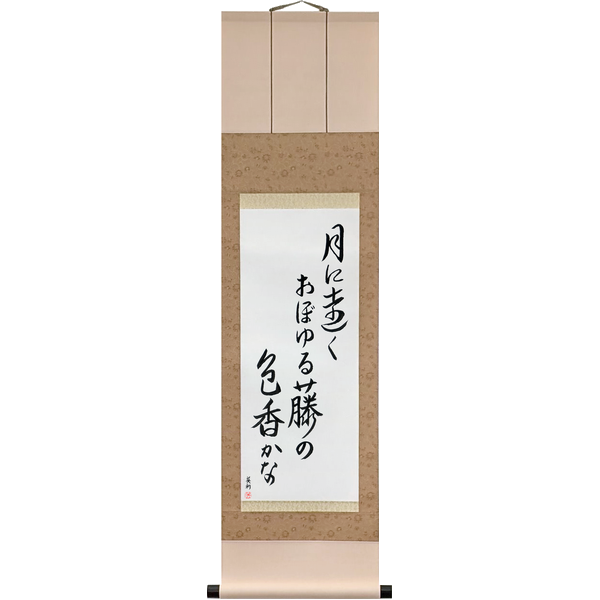
Sold as Buson's wisteria, with a page gloss on 色香 as one word for color and scent together · Read tsuki ni tōku oboyuru fuji no iroka kana · Oldest witness Shiki's 1900 manuscript copy of the canon, with the marker 新五子 beneath it; the source every editor names is the 蕪村遺稿, the posthumous papers, not opened here; no witness dates it · Sense wisteria at dusk or by night, its color and scent seeming far away under, or from, a faint moon. A verse whose one crux, what 遠く is far from, was argued out at a reading meeting in 1903 and never settled, and whose two English renderings by one translator take the two sides.
The text as brushed, and its variants
The scroll carries 月に遠くおぼゆる藤の色香かな, and every witness has this wording; the writing splits twice and the split does not follow date. 覺ゆる in Shiki's 1900 copy, in 紅緑 1904, the 1907 講義, 鳴雪 1909 and the 1910 三家集; おぼゆる in 岩本 1906, 零余子 1921, 半田 1925 and 1935, the 1926 collections and the 1928 index. 哉 in Shiki, the 講義, 鳴雪, 零余子 and the index; かな in 紅緑, the 三家集, 半田 and the 1926 名句全集. The page's kana form is the form of the editors of 1921 to 1935. The meter is six, seven, five, the first line one over: つ・き・に・と・お・く, お・ぼ・ゆ・る・ふ・じ・の, い・ろ・か・か・な (s39 wrote five, seven, five against its own kana).
The attribution, as a dated thread
Buson's at every witness that names a poet, from Shiki's copy in 1900 to Blyth, with no rival. The source is the 蕪村遺稿, the papers gathered after his death: 半田良平 tags the verse (遺稿) against the 句集 verses before it, 右三句、句集, and the 1907 講義 is a reading of the 遺稿 leaf by leaf, this verse from its spring section. Shiki's 1900 copy writes (新五子) under this verse and under the one before it, 藤の花あやしき夫婦休みけり, which names a source of his own, perhaps the 新五子稿, not opened. No witness opened dates the verse; Blyth does not; the collections file it under the season word 藤 alone.
The words
月に遠く is the crux: far from the moon, or far, under the moon. 紅緑 in 1904 set it among Buson's verses of distance, 春風や堤長うして家遠し and 都に遠き桃の宿, and said 遠き is the poet's own word. おぼゆる, written 覺ゆる, is the classical 覚ゆ, is felt to be, seems. 藤の色香 is the wisteria's color-and-scent, 色香 one word, as the page says and as 虚子 said in 1903, 唯調子で色香とつゞけた迄, the word is carried by the rhythm; so scent seems far is not to be pressed. かな is the exclamation; the sentence has no verb but seems. As words the line says: Under the moon, far off they seem, the wisteria's color and scent.
A history, from the earliest witness
Edo. 蕪村遺稿, the posthumous papers. Not opened; the source by 半田's tag and the 1907 講義's base text. [半田 1925 tag; see below]
1900. 正岡子規, 俳家全集, his manuscript copy of the poets, the Buson volume, 春草. 人なき日藤に培ふ法師かな (the OCR layer reads 塔ふ and 哉), 藤の花あやしき夫婦休みけり (新五子), 月に遠く覺ゆる藤の色香哉 (新五子) (the OCR layer writes 覚 and drops this second marker, which is on the leaf), then the waka 柴の戸にあけくれかゝる白雲を. The earliest witness opened, in Shiki's hand, with his source marker under the verse. [NDL pid 2546172, koma 89, read by eye; text at lab.ndl.go.jp/dl/api/page/2546172_89]
1903, printed 1907. 内藤鳴雪, 河東碧梧桐, 高浜虚子, 蕪村遺稿講義, the record of a reading meeting. 鳴雪氏曰: an evening with the wisteria in bloom, まだ全く夜に入らぬ時分, not yet fully night; the moon just up on one side, the wisteria trellis opposite, the poet seeing the flowers lit from the side, 月と藤と作者とは三角形をして居る, moon, wisteria and poet make a triangle. 碧梧桐氏曰: the positions do not matter; 其時分其月の光りで見た藤の花の色も香もが一番よい, at that hour, in that moon's light, the wisteria's color and scent are at their best, and that is what 月に遠く覺ゆる says. 虛子曰, so printed: no need for dusk; at night the color is blurred in moonlight and seems far, 香が月に遠く覺えるといふのはをかしいが、其は唯調子で色香とつゞけた迄であらう, that the scent should seem far from the moon is odd, but that is no more than the rhythm carrying 色香 along. 鳴、碧、兩氏曰: too extreme; some real distance from the moon is felt too. The record moves on without a ruling. [NDL pid 875701, koma 72, printed pages 136–137, read by eye; text at lab.ndl.go.jp/dl/api/page/875701_72]
1904. 佐藤紅緑, 蕪村俳句評釈. 彼れは又た遠景へ遠音及び凡て「遠き」といふ文字に大なる趣味を有せり, he also had a great taste for far views, far sounds, and the word "far" in every use, with this verse among the examples. [NDL pid 875716, koma 19, OCR; text at lab.ndl.go.jp/dl/api/page/875716_19]
1906, 1909, 1910. 岩本梓石, 蕪村俳句全集 標註; 鳴雪, 俳句作法; 俳諧三家集. The verse in three collections and manuals without comment, 覺ゆる in two of them. [NDL pid 875714, koma 37; pid 875595, koma 23; pid 875352, koma 74; OCR; text at lab.ndl.go.jp/dl/api/page/875595_23]
1921. 長谷川零余子, 蕪村俳句全集 校註解釈. Under 藤, the verse as 月に遠くおぼゆる藤の色香哉 with note 五: 日の暮れる時分に月が仄かに出て居た。その月が明らかなれば藤の花も近くあるやうに感じようが、ぼんやりして居るために遠くにある感じがする、その景色が一番よいとの意, at dusk a faint moon was out; were the moon bright the wisteria would seem near, but because it is dim the flowers seem far, and that scene is the best. The note before it, 三, on a hillside wisteria, belongs to 人なき日藤に培ふ法師かな. [NDL pid 968346, koma 33, printed pages 40–41, read by eye; text at lab.ndl.go.jp/dl/api/page/968346_33]
1925 and 1935. 半田良平, 蕪村俳句全集 季題別 and 季題別年代附. Under 藤: うつむけに春うちあけて藤の花 closes the 句集 verses with 右三句、句集, then 月に遠くおぼゆる藤の色香かな (遺稿), then 藤の花あやしき夫婦休みけり. The editor's tag is the plainest statement of the source. [NDL pid 964212, koma 19, printed page 25, read by eye; pid 1090303, koma 17, OCR; text at lab.ndl.go.jp/dl/api/page/964212_19 and 1090303_17]
1926, 1928. 一茶蕪村名句全集; 蕪村俳句集; the 日本俳書大系 index. The verse in two more collections and an index, おぼゆる in all three. [NDL pid 968909, koma 23; pid 1019573, koma 64; pid 1179400, koma 229; OCR; text at lab.ndl.go.jp/dl/api/page/968909_23]
Today. The archive lists eighteen books carrying the verse before 1945, twelve of them opened for the account. kotobank's page for 与謝蕪村 gives the poet's dates and does not quote the verse. [harvest_index.py lookup --id 249 --year-to 1945; kotobank 与謝蕪村, read as text]
The sense, across three centuries
The verse has had one argument, and it was held in a room in 1903. 鳴雪 drew the geometry, moon on one side and wisteria on the other and the poet at the third corner; 碧梧桐 said the geometry is beside the point and the verse praises the hour; 虚子 said the color is blurred by moonlight and seems far, and that the scent is carried along by rhythm; the other two said some real distance from the moon is felt as well. 紅緑 the next year filed it under Buson's love of the word far. 零余子 in 1921 took 碧梧桐's side with the dimness of the moon as the cause: bright, the flowers would seem near; faint, they seem far, and that is the scene. Blyth in 1949 rendered the wisteria far away in the moonlight, and in 1950 far from the moon; the two renderings are the two forks of the 1903 argument, and he took both. Nobody has proposed a third reading.
What is not a source
The 1907 record is the readers' argument, not the poet's intention; the page's gloss, that the wisteria keeps its color and scent and holds them at a distance, is 虚子's reading in gentler words. Shiki's marker names a source that was not opened. No witness gives an occasion or a date.
The verse in English
The bilingual dictionaries of the Meiji shelf were not checked for this verse. Miyamori, Henderson, Keene, Sato, Hass, Shirane and Carter were searched on the shelf and do not carry it; Ueda's Path of Flowering Thorn is not on the shelf. (SUPERSEDED s90, 2026-09-14: Ueda's Path of Flowering Thorn is on the shelf since the eighth delivery and carries it, and so does Hamill; read below in § Supersession 2026-09-14.)
1949 and 1950. R. H. Blyth, Haiku, volume 1, Eastern Culture, page 339; volume 2, Spring, page 102, Hokuseido Press, Tokyo. In the first, among a few verses given as examples: In the moonlight, / The colour and scent of the wistaria / Seem far away. In the second, romanized Tsuki ni toku / oboyuru fuji no / iroka kana and rendered The scent and colour / Of the wistaria / Seem far from the moon, after 都に遠き桃の宿, the capital far away, among Buson's verses with the same feeling of distance. Blyth's only two renderings on the shelf, and they read the particle two ways. [docs/research/papers, Blyth 1949 vol. 1 and 1950 vol. 2, read as text; page numbers from the text layers; the 1981 Heian reprint of vol. 2 carries the second; no ASIN collected]
Today. The house page carries no English rendering of its own; it glosses 色香 as one word, which is right, and reads the verse as the wisteria holding color and scent at a distance under the moon. A rendering of this line has one choice to make and cannot avoid it: far from the moon or far, under the moon; Blyth made it both ways.
A reading
I read the verse with 零余子 and 碧梧桐: the faintness of the moon is what makes the flowers seem far, and the verse praises the dimness. 虚子's aside is the philological point worth keeping, that 色香 is one word by rhythm and scent seems far is not to be pressed; Blyth's far from the moon takes the other fork and is a legitimate reading of the particle. The page need not choose, but it could tell the 1903 argument, which is the kind of story this family can carry. The source line should read 遺稿, not 句集. The text, the attribution and the romaji stand, and the scroll needs no change. Signed, 典, 2026-09-05.
Supersession 2026-09-14 (s90)
The layer after 1950. The English join built this session finds the verse in two books shelved since the tenth, each opened at its page and read as text.
- 1995. Sam Hamill, The Sound of Water: Haiku by Bashō, Buson, Issa, and Other Poets, Shambhala: In pale moonlight / the wisteria's scent / comes from far away. [shelf, EPUB text, line 1045]
- 1998. Makoto Ueda, The Path of Flowering Thorn: The Life and Poetry of Yosa Buson, Stanford University Press, page 127: so far from the moon— / the color and fragrance / of wisteria, romaji tsuki ni toku oboyuru fuji no iroka kana, cited to the complete works 1: 461, and set among the hokku Buson brought to a poetry group's meetings, at least twenty-seven, of which this is one of three examples. The book the s39 draft named as not on the shelf. [shelf, pdfpage 143, 229]
Sawa and Shiffert's Haiku Master Buson (White Pine, 2007) is on the shelf and does not carry this verse in its text layer (one wisteria verse, 山本に, at page 67). Blyth's two renderings stand as the earliest English found.
What it changes. The reading stands; Ueda's so far from the moon is the first rendering to keep 遠く with the moon rather than with the scent, which is where this history's reading put it.
How this was read
By eye at width 3600: Shiki's 1900 copy at the wisteria run, where the two (新五子) markers were read; the 1907 講義 at both its pages; 零余子 1921 at the verse and its notes, where note 五 was separated from note 三; 半田 1925 at the 藤 section and its tags. By OCR from the archive's text layer: 紅緑 1904, the collections of 1906, 1909, 1910, 1926, the 1935 半田 and the 1928 index. By text layer from the shelf: Blyth in two volumes. Not opened: the 蕪村遺稿 in any edition, the source; the 新五子稿; Ueda's Path of Flowering Thorn; six books the archive lists. A bracket of the form pid P, koma N resolves as text at lab.ndl.go.jp/dl/api/page/P_N and as an image at dl.ndl.go.jp/api/iiif/P/R<N, seven digits>/full/3600,/0/default.jpg; the four leaves read by eye were fetched at that address. The full apparatus, with every address, is in the account.
Supersession 2026-09-14 (s92)
A read-only worker resolved this account's addresses (citation_checks_2026-09-14/history_tsuki_ni_tooku_249_2026-09-05.check.md): 27 claims, the twelve NDL komas and the four English renderings at the address. Corrected above: the first line is six morae and s39 called it five against its own kana; the neighboring verse on Shiki's 1900 copy now carries the OCR layer's forms beside the by-eye reading. Not yet read by a person.
References
Each witness is cited in the account above, at the frame or entry where it was read. A linked list follows when the record for this text is completed.