





Jiun · 自運 · VD4B
Jiun (自運) is the calligrapher's word for writing from one's own invention. As a Shihan, Master Takase has a hand of her own, and these designs are that hand: she draws freely on the classic scripts to create exactly the look she wants.
月に遠く
おぼゆる藤の
色香かな
tsuki ni tōku
oboyuru fuji no
iroka kana
buson 蕪村
In the moonlight,
the color and scent of the wisteria,
seems so far away
Under the moon, the wisteria's color and scent seem far.
Master Takase creates this beautiful scroll when your order is placed, personally preparing the ink and brushing your art, which proudly bears her signature and seal. This is an original work of art.
Description
In the moonlight,
the color and scent of the wisteria,
seems so far away
|
tsuki ni tōku oboyuru fuji no iroka kana |
月に遠く おぼゆる藤の 色香かな |
| buson | 蕪村 |
月に遠くおぼゆる藤の色香かな (tsuki ni tōku oboyuru fuji no iroka kana): under the moon, the wisteria's color and scent seem far. 月に遠く is far from the moon, or far, under the moon, and the verse turns on which; おぼゆる is the classical seems, is felt to be, the only verb in it; 藤 is wisteria, the late-spring season word, and 色香 is one word for its color and scent together; かな closes it. In 1903 three men of Shiki's circle read Yosa Buson's verse together and argued what the distance is: Meisetsu drew a triangle of moon, wisteria and poet; Hekigotō said the geometry is beside the point and the verse praises the hour; Kyoshi said the color is blurred in moonlight and seems far, and that the scent only seems far because the rhythm carries the word along. Were the moon bright, the flowers would seem near; because it is faint, they seem far. Meisetsu said so at the meeting, and Reiyoshi repeated it in 1921. That dimness is the scene. Blyth translated it twice and took each side once. The English is Timothy L. Jackowski's, made for Takase Studios.
The verse is Buson's, one of the hokku he brought to the verse-writing sessions of his circle in 1780, and it was first printed in 1800 in the anthology 新五子稿.
We want you to be as happy with the meaning as you are with Master Takase's art. To learn more, visit Philology of 月に遠くおぼゆる藤の色香かな.
Delivery
Your scroll is brushed when you order it and completed within 1 to 3 business days. It ships by USPS Priority Mail from Master Takase's studio in Washington State, boxed and ready to hang, with a printed page giving the art's English, romaji and Japanese.
Sending it as a gift? Add your message at checkout and we will include it.
Shipping is calculated at checkout from your address; within the United States it is $13 to $23. We ship worldwide, and any import charges for your country are shown at checkout before you pay.
Every order is covered by our 30-day money-back guarantee. If your scroll arrives damaged, or we made an error, we replace it or refund you in full, including shipping. Refund policy
About Our Scrolls
Master Japanese Calligrapher Eri Takase brushes your scroll by hand when you order it. Each scroll bears her red seal, 英利, and her signature.
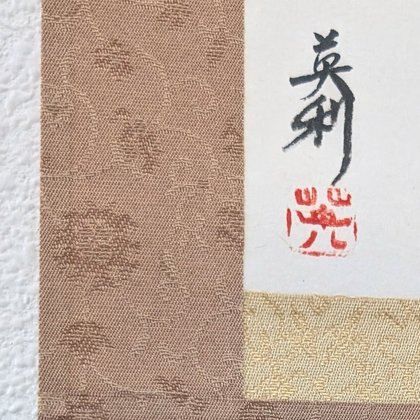


The scrolls are 12 1/4" W × 43" H (31 × 109 cm), with woven damask borders and layered Japanese paper, designed to last generations. The scrolls themselves are made by a scroll maker in Gifu, Japan, and we have worked with them for over two decades.
Eri Takase was born and raised in Osaka, Japan, and holds the rank of Shihan, the highest rank in Japanese calligraphy, from the Bokuteki-kai and the Bunka-shodo. About Master Takase
Related products

Buson - From far and near, Hearing the sounds of waterfalls, Young leavesをちこちに滝の音聞く若葉哉ochikochi ni taki no oto kiku wakaba kana

Buson - In loneliness, there is joy too, An autumn eveさびしさのうれしくも有秋の暮sabishisa no ureshiku mo ari aki no kure

Buson - A flash of lightning, The sound of dew, Dripping down the bamboos稲妻にこぼるる音や竹の露inazuma ni koboruru oto ya take no tsuyu
