

塚も動け我が泣聲は秋の風 · tsuka mo ugoke waga naku koe wa aki no kaze · Move, grave-mound: my weeping voice is the autumn wind
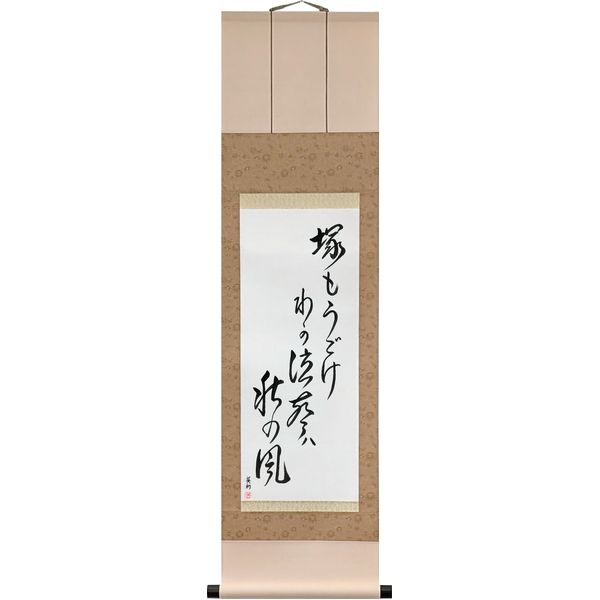
Sold as Bashō's, with no English and a house note that the cursive designs carry his grief at the death of his friend · Read tsuka mo ugoke waga naku koe wa aki no kaze · Oldest witness the poet's own book: おくのほそ道, in the 1702 print, 塚も動け我泣聲は秋の風, under its headnote about a poet of Kanazawa who had died the winter before; and before the book, by report, the memorial anthology 西の雲 (1691) and 其角's 雑談集 (1691) · Sense grave-mound, move too: my weeping voice is the autumn wind. Kanazawa, the seventh month of 1689, at the memorial for a poet Bashō never met.
The text as brushed, and its variants
The scroll carries 塚も動け我が泣聲は秋の風, and the record carries one text written several ways. The が. The 1702 print writes 我泣聲, read by eye on the 北海道大学 copy's leaf; so do the 1723 雑談集 (我なく声, 我泣声), 潁原's 1932 apparatus (我泣こゑ, 我泣聲), the Meiji anthologies and the 1928 index. Every one of them is read waga naku koe; the が is the reading spelled out, as the annotated editions of 1926, 1935 and 1936 spell it and as the scroll does. 動け / うごけ. The 1702 print and 淡々's first citation write 動け; 淡々's second, at the grave, writes うこけ; 梅丸's commentary, 陸奥鵆 and 潁原's two entries write うごけ. 聲 / 声 / こゑ, and 秋の風 / あきの風, are writings. Shiki's copy of the verse into his 発句類題全集 (1889) and Buson's hand in the 1932 facsimile are the same text. There is no variant of sense; the record disagrees on nothing but spelling. The meter is five, seven, five: つ・か・も・う・ご・け, わ・が・な・く・こ・え・は, あ・き・の・か・ぜ, with a six-syllable first line, which Fitzsimons marks 6-7-5. The four designs served for this text do not all brush the catalogue's form: three write 動け我が and one writes 塚もうごけわが泣聲は秋の風, kana throughout; the same text in the print's two spellings.
The attribution, as a dated thread
Bashō's, on the strongest footing a verse can have: it stands in his own travel book, with its occasion in his own prose. The headnote, read by eye on the 1702 leaf: 一笑と云ものは此道にすける名のほのぼの聞えて世に知る人も侍りしに去年の冬早世したりとて其兄追善を催すに, a man called 一笑, whose name for devotion to this art had reached even me and whom the world knew, had died young the winter before, and his elder brother held a memorial gathering; then the verse; then ある草庵にいざなはれて, invited to a hut, 秋涼し手毎にむけや瓜茄子, and 途中吟, on the road, あかあかと日は難面もあきの風. The date is the twenty-second day of the seventh month of Genroku 2, 5 September 1689, by Shirane's index and Fitzsimons's note; the memorial was at 願念寺 in Kanazawa, where a stone now carries the verse (Fitzsimons). The dead man was 小杉一笑, a tea dealer of Kanazawa and, by the count of 一つ松 (1687), the most prolific poet of Kaga (Shirane, note 45); he died on the sixth day of the eleventh month of Genroku 1, 1688, aged thirty-six (Blyth 1952; Miyamori's note gives 元祿元年歿 享年三十六 (by eye; the text layer reads 發 for 歿) and the years 1652–1688, Fitzsimons 1653–88). Before the book: the memorial anthology 西の雲 (1691, 丿松) carries the verse under the headnote 途中吟 by 潁原's report, and 其角's 雑談集 (1691) tells the story, by the 1723 雑談集's report and 梅丸's; neither is opened here. The travel book itself was written in 1693–94 and printed in 1702, so the two anthologies are the older witnesses and the book the poet's own.
The words
塚 is the grave-mound; も, too, even: the mound as well as the mourners is to be moved. 動け is the imperative, move, shake. 我が泣く聲 is my weeping voice; は marks it as the topic of the line that follows; 秋の風, the autumn wind, the season word. The syntax makes the voice the wind, not like it: my weeping voice is the autumn wind, and it is that wind that is asked to move the mound. As words the line says: Grave, move too: my crying voice is the wind of autumn.
A history, from the earliest witness
1689, the twenty-second of the seventh month. Kanazawa, the memorial for 一笑. By the travel book's own prose and by the two anthologies of 1691 as reported. [おくのほそ道, below; Shirane 1998, index p. 360; Fitzsimons 2022, note to no. 548]
1691. 丿松 (ed.), 西の雲, the memorial anthology; 其角, 雑談集. 西の雲 prints the verse as 途中吟 by 潁原's apparatus; 其角's 雑談集 tells of it, by 淡々's 1723 citation and by 梅丸, who sends his reader there: 其角が雜談集を讀まば此句の字々に魂のゆきわたれるをしらん, read 其角's 雑談集 and you will know how the soul runs through every character of this verse. Neither opened. [潁原 1932, koma 64, printed page 113, read by eye; 淡々雑談集 and 茜堀, below. 西の雲: NIJL WID 1531755, eleven holdings, none with images. 雑談集: NIJL WID 5049, fifty-eight holdings, twenty-two with images; the 一笑 passage not located in the copy BID 300106346 this session]
1702. 松尾芭蕉, おくのほそ道, the 井筒屋 print. On the Kanazawa leaf: 大坂よりかよふ商人何處といふ者ありそれが旅宿を共にす / 一笑と云ものは此道にすける名のほのぼの聞えて世に知る人も侍りしに去年の冬早世したりとて其兄追善を催すに / 塚も動け我泣聲は秋の風 / ある草庵にいざなはれて / 秋涼し手毎にむけや瓜茄子 / 途中吟 / あかあかと日は難面もあきの風. Read by eye in the 北海道大学 copy; my transcription of the woodblock hand normalizes kana. [NIJL 国書データベース, 奥の細道 WID 15725 (211 holdings, 68 with images), copy BID 100000092, canvases 45–46 of its IIIF manifest, read by eye]
1723. 半時庵淡々, 淡々雑談集, twice. First, as a citation: 奥の細道及ひ雑談集にも加賀の金沢一笑と云者早世しける追善に翁の句 塚も動け我なく声ハ秋の風とあり (the entry opens with the list mark 一; the leaf writes 声ハ where the OCR layer reads 声は, and the OCR layer reads 金沢笑 and 臣善 for the leaf's 一笑 and 追善), in おくのほそ道 and in the 雑談集 too there is the master's verse for the memorial of one 一笑 of Kanazawa in Kaga, who died young; then the story of a basket-maker of 駿河府中 (the OCR layer reads 駿河国府中; on the leaf 駿河 closes one column and 府中 opens the next, and I read no 国 between them), 籠作り九兵衛, whose grave the master was led to, where he wrote on a wooden tablet 塚もうこけ我泣声は秋の風 and offered it. The second use is a legend, told of a different dead man in a different province, and its only footing is this book. [NDL pid 2533380, komas 44–45, read by eye; text at lab.ndl.go.jp/dl/api/page/2533380_44 and _45]
Edo, undated. 梅丸, 蕉翁發句茜堀, autumn book, a commentary. Under 加州一笑が墓に詣でゝ, visiting 一笑's grave in Kaga: 塚もうごけ我が泣く聲は秋の風 / 眞の句なり。一笑が俳諧に信厚きより此吟あり。其角が雜談集を讀まば此句の字々に魂のゆきわたれるをしらん, a true verse; because 一笑's faith in haikai was deep, this verse came; read 其角's 雑談集 and you will know…; then the 古今集 poem 秋なれば山響むまでなく鹿に我れおとらめや獨りぬる夜は and 元政's account of weeping for 西行 on the 天龍 ferry, as the verse's kin. The headnote makes it a grave visit, which the travel book does not say. [俳諧註釈集, 1912 typeset, NDL pid 950162, koma 40, printed page 53, read by eye; text at lab.ndl.go.jp/dl/api/page/950162_40]
1774, 1889. 蝶夢's 芭蕉翁発句集; Shiki's 発句類題全集. The verse in the eighteenth-century selection and in Shiki's manuscript compilation of 1889, both by the account's OCR reading, with the travel book's spelling. [NDL pids 2540314 and 2586451, OCR, per the account]
1890–1936. The anthologies and readers. 百家説林 (1890), the 1896 是空俳話, 大塚's 1903 全集 (一笑追善 塚も動けわが泣聲は秋の風), 安藤's 1906 俳家逸話 with the grave story, 佐藤紅緑's 1906 作法, 大町桂月's 文章大辞林 (1913, with furigana つかうごけ), 島田 1927, 勝峯 1931, 志田 1926, 藤井紫影's 1935 名家俳句集 with the legend in full, 西山 1936 (我が泣く聲はあきの風, and the gloss that the wind is the weeper). [NDL pids 993393 koma 232, 875193 koma 20, 875661 koma 64, 875446 komas 119 and 124, 875594 koma 51, 951697 koma 138, 1194541 komas 48 and 103, 1190046 koma 83 — komas derived s92 from the OCR zips, where s42 gave the pids alone — and the account's list, OCR]
1928, 1932. The index and the apparatus. The 1928 俳諧全句索引 lists the verse under ツカモ from 類聚, 奧細, 陸奥 and more, all 塚もうごけ / 塚も動け我泣聲は秋の風. 潁原's 1932 校註 芭蕉俳句集 prints two entries: under the travel book's headnote, 塚もうごけ我泣こゑは秋の風 (奥の細道・泊船集), and under 途中吟, 塚もうごけ我泣聲は秋の風 (西の雲), with the note ○塚もうごけ——この句雜談集を參照すべし, for this verse see the 雑談集. [NDL pid 1179400, koma 190, OCR, the entry confirmed in the archive's fulltext zip for that koma; pid 1170439, koma 64, printed page 113, read by eye; text at lab.ndl.go.jp/dl/api/page/1170439_64]
Today. The archive lists two hundred and eighty-eight books carrying the verse, and the NDL full-text search returns two hundred and forty-six for 塚も動け and twenty-six for 塚もうごけ. kotobank's entry for 小杉一笑 was read at s26. [harvest_index.py lookup --id 265 --year-to 1945; lab.ndl.go.jp/dl/api/book/search, two keywords, 2026-09-05]
The sense, across three centuries
梅丸 read it as the truest kind of verse, 眞の句, and set beside it a 古今集 poem in which a man weeping alone at night will not be outdone by the belling deer, and 元政's tears for 西行: grief that is louder than the season and becomes it. 淡々 read it as the model of an offering, a verse so exactly fitted to its use that the master could offer it twice. Miyamori: what a violent outburst of grief; none but poets of Bashō's genius and sincerity can think of such impressive symbolism. Blyth in 1952: an elegy like Lycidas or Adonais, which seems to have aroused in Bashō a state of mind in which utterly unrelated things are brought together, or rather, are seen connected in a fashion that strongly reminds us of ancient Hebrew poetry, with Psalm 29 beside it, the voice of the Lord shaketh the wilderness; and in 1994, against Tennyson's In Memoriam, as the example of the animistic in haiku, a dead man is alive, as alive as the lifeless sun. Shirane files it among the poems of the journey without comment beyond the date. The page's note, that the cursive carries the grief, is a reading of the calligraphy, not of the text; the text's grief is in the imperative and the copula.
What is not a source
His friend is the page's word and no witness's: Bashō had never met 一笑, who had hoped to meet him (Fitzsimons, note); the grief is for a poet known by name. The basket-maker's grave and the tablet are 淡々's legend of 1723 and are told of nobody else before him. 梅丸's headnote makes a grave visit of what the travel book calls a memorial gathering. 1652 and 1653 for 一笑's birth are Miyamori's and Fitzsimons's, and they disagree.
The verse in English
The bilingual dictionaries of the Meiji shelf were not checked. Hass and Watson were searched on the shelf and do not carry it; Henderson does, page 39, below, and the s42 sentence that listed him with the others was wrong.
1932. Asatarō Miyamori, An Anthology of Haiku Ancient and Modern, Maruzen, Tokyo, page 12, in the introduction. Haijin Isshō no Shi wo Itamu; Tsuka mo ugoke / Waga naku koe wa / Aki no kaze; In Sorrow for the Death of the Haijin Isshō; Oh, grave-mound, move! / My wailing is the autumn wind. Used as the book's example of the season word. The note on 一笑, with his surname 小杉, his death year and his trade, is on page 336, under his own verses. [docs/research/book_originals, Miyamori 1932, pages 12 and 336 read by eye from the PDF; no ASIN collected]
1958. Harold G. Henderson, An Introduction to Haiku, Doubleday Anchor. Headed At the Grave of His Pupil Isshō, dated 1688: Grave mound, shake too! / My wailing voice— / the autumn wind. [docs/research/papers, Henderson 1958, page 39 by the running head, read as text]
1952. R. H. Blyth, Haiku, volume 3, Summer-Autumn, Hokuseido Press, Tokyo, page 409, THE AUTUMN BREEZE. 塚も動け我泣く聲は秋の風 芭蕉; Tsuka mo ugoke waga naku koe wa aki no kaze; Shake, O tomb! / My weeping voice / Is the wind of autumn. With the paragraphs quoted above. Again in The Genius of Haiku (1994), page 78. [docs/research/book_originals, Blyth 1952 vol. 3, page 409, and Blyth 1994, page 78, read by eye from the PDFs; no ASIN collected]
1998. Haruo Shirane, Traces of Dreams, Stanford, note 46 to chapter 8. Grave mound, move too! my weeping voice is the autumn wind, with the date in the index. [docs/research/book_originals, Shirane 1998, pages 332 and 360 (s42 gave 376 for the index; the running head is 360 Cited Hokku by Bashō), read by eye from the PDF; no ASIN collected]
2006. Michael Haldane, in Bashō and the Haikuists, Delphi Classics, 2022. … shake your tomb! / my weeping voice …, with the romaji; the text layer breaks the lines. [docs/research/papers, Delphi Classics 2022, read as text; no ASIN collected]
2022. Andrew Fitzsimons, Bashō: The Complete Haiku of Matsuo Bashō, University of California Press, no. 548. Arouse the gravemound too / the wail of my grief-filled cry / the wind in autumn; Autumn, 1689; the note on 一笑, the memorial at 願念寺 and the stone. [docs/research/papers, Fitzsimons 2022, read as text; no ASIN collected]
Today. The house page carries no English. A rendering has one thing to keep: the mound is told to move too, and the voice does not resemble the wind, it is the wind.
A reading
I read the verse as the travel book frames it: a poet arrives to meet a man who has been dead since winter, and is asked to speak at the memorial. What he says is an order to the grave and an identification of his own voice with the season, and the two are one gesture: if the voice is the wind, the wind can move the mound. 梅丸's kin are right, the belling deer and the tears on the ferry; Blyth's Psalm is righter. The scroll's が is the readers' spelling of what every witness reads and is a fair choice for a stranger's eye. What the page should say is what the verse is: Bashō's verse at the memorial for 一笑 of Kanazawa, a tea dealer and the best poet of his province, dead at thirty-six the winter before, on the road of おくのほそ道 in the autumn of 1689; and it should drop his friend, since the grief is for a man he never met, which is the harder and the truer thing. Signed, 典, 2026-09-05, s42.
Eri
Nothing to ask. She brushed 我が on three designs and わが on the fourth, and the readers' editions write it so.
How this was read
By eye at NIJL from the IIIF manifest, at width 2600: the 1702 おくのほそ道, 北海道大学 copy, canvases 45–46, located by contact sheets of canvases 35–58. By eye at width 2400 from NDL: the 1723 淡々雑談集 at komas 44 and 45; 茜堀 in the 1912 俳諧註釈集 at koma 40; 潁原 1932 at koma 64; and from the shelf's PDFs Miyamori's pages 12 and 336, Blyth's 1952 page 409 and 1994 page 78, Shirane's 1998 pages 332 and 360 (s42 gave 376 for the index; the running head is 360 Cited Hokku by Bashō). By OCR from the archive's text layer, per the account and the reader: the 1774 and 1889 witnesses, the Meiji and Taishō anthologies, the 1928 index. By text layer from the shelf: Fitzsimons, Haldane. As text: kotobank, the NDL full-text search, the NIJL work and holdings records. Not opened: 西の雲; 其角's 雑談集 at the 一笑 passage (the copy BID 300106346 was sheeted whole at 900 px and two prose canvases opened at full size, neither the passage); 陸奥鵆 and 泊船集 at this verse; 一つ松 (1687); the stone at 願念寺. A bracket of the form pid P, koma N resolves as text at lab.ndl.go.jp/dl/api/page/P_N and as an image at dl.ndl.go.jp/api/iiif/P/R<N, seven digits>/full/3600,/0/default.jpg; an NIJL canvas resolves through kokusho.nijl.ac.jp/biblio/<BID>/manifest. The full apparatus, with every address, is in the account.
Supersession 2026-09-14 (s92)
A read-only worker resolved this account's addresses (citation_checks_2026-09-14/history_tsuka_mo_ugoke_265_2026-09-05.check.md): 27 items, the NDL komas and the English quotations at the address. Corrected above, each re-opened by me: Henderson 1958 carries the verse at page 39, where s42 said he did not; Shirane's index entry is on page 360, not 376; Miyamori's 歿 is marked as a by-eye reading against the OCR's 發; the eight 1890–1936 witnesses cited by pid alone now carry the koma each verse is on, derived from the zips. The Shiki manuscript pid the account gives, 2586451, carries the verse at koma 16, and the research record's 2586419 at koma 200 — two books, not a typo. The worker's book_originals row is its file set: the PDFs the brackets say were read by eye are there. Not yet read by a person.
References
Each witness is cited in the account above, at the frame or entry where it was read. A linked list follows when the record for this text is completed.