

蜻蛉釣り今日はどこまで行ったやら · tonbo-tsuri kyō wa doko made itta yara · Off catching dragonflies. How far did he get today, I wonder
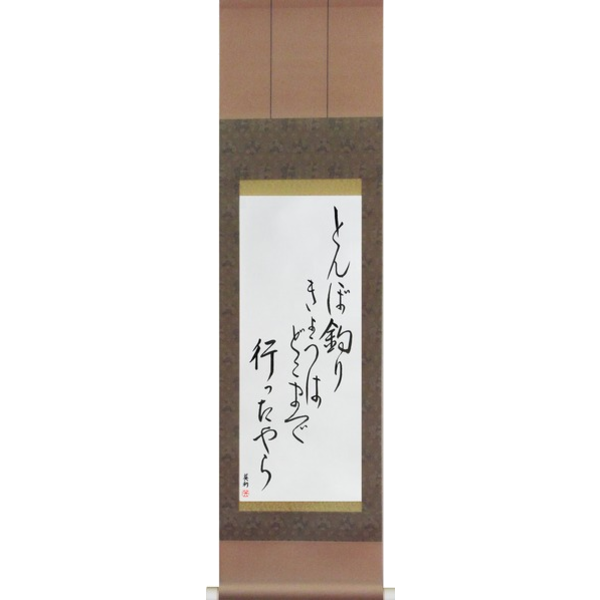
Sold as Chiyojo: My little dragonfly hunter, where has he gone today, I wonder · Read tonbo-tsuri kyō wa doko made itta yara · Oldest witness an anecdote book of 1816, forty-one years after Chiyo died · Sense a child is out catching dragonflies and a parent wonders how far he got today; since 1816 the line has been read as a mother's verse for a dead child, and no witness shows that Chiyo wrote it.
The text as brushed, and its variants
The scroll carries 蜻蛉釣り今日はどこまで行ったやら, the form every modern Japanese reader knows. It is not the oldest form. The 1816 anecdote book that first prints the verse writes 蜻蛉釣今日ハ何處まで行たやら, with the furigana とんぼつり over the first word and どこ over 何處: the verb without its small っ, the distance in kanji, the topic marker in katakana. The 1892 typeset of the same book keeps 行たやら and 何處 and adds けふ over 今日. Issa, writing in 1819, gives the line differently at its end: 蜻蛉釣りけふはどこまで行た事か, what did he do, not how far did he go, the one variant on record that changes the sense. From there the Japanese printings modernize in steps: 往たやら in a girls' reader of 1912, 行つたやら from 1915, and by 1940 a haiku manual prints どこまで行つたやら, the brushed form with an old-style small tsu. Blyth prints it with okurigana in 1963, character for character as the scroll has it. The spellings 今日 and けふ, 行た and 行った, 何處 and どこ are one word each in three ages of orthography; nothing in the sense turns on them. The meter is five, seven, five: と・ん・ぼ・つ・り, きょ・う・は・ど・こ・ま・で, い・っ・た・や・ら.
The attribution, as a dated thread
Nobody in Chiyo's lifetime prints this verse under her name. Her two collections, 千代尼句集 (1764) and 松の聲 (1771), were printed while she lived, and their modern editor counts 546 and 327 verses in them; the seat read their autumn sections by eye in the 1922 reprint and ran the whole reprint through OCR, and the dragonfly hunter is not there. Her own dragonfly verse is: 行水にをのが影追ふ蜻蛉哉, a dragonfly chasing its shadow over the bathwater. The first print of the line is 竹内玄玄一's 『俳家奇人談』, an anecdote book of 1816, inside a string of stories about her wit and modesty, under the four-character headnote 我子を失ひける時, when she lost her child. Three years later Issa, mourning his daughter, copies the verse into おらが春 with 子をうしなひて above it and かゞ千代 below, and it is his page, not the anecdote book, that the English tradition descends from. The modern editor of her complete verse, 中本恕堂, states the rule that governs all of this: 以上が生存中のものである。後世になって種々の句集は出たが信頼出来るものはない, the lifetime collections are the record and nothing printed after her death can be trusted. The Heibonsha encyclopedia says the same of the anecdotes themselves, いずれも信じるべきでない, and Japanese Wikipedia files the dragonfly verse under 誤説. In English the attribution is manufactured in the opposite direction: Hearn in 1901 says the verse was written by Chiyo after her boy died; Miyamori in 1932 supplies a title and a marriage at nineteen; only Blyth, in 1963, writes usually given as hers. The verse is the one Issa wrote her name under. That is the whole of what the record supports.
The words
Five words, eleven characters, and none of them is my, little, son or death. 蜻蛉釣 tonbo-tsuri is a noun, the children's game of catching dragonflies with a decoy on a thread or a rod tipped with birdlime; the 精選版 日本国語大辞典 defines it as おとりのとんぼを竿の先に糸で結びつけ、他のとんぼを誘いよせて捕えること, marks it a season word of autumn, and gives as its earliest printed example this very line, in the 1816 anecdote book. The word names the game, and by an ordinary metonymy the child at it. 今日は kyō wa is today as topic. どこまで doko made is how far, to what point, not where. 行った itta is went, with no subject, no number, no gender. やら yara is the particle of wondering aloud, and I wonder is its exact English. As words the line says: Dragonfly-catching. Today, how far did it go, I wonder. The mother, the boy, his smallness and his death all arrive from outside the text, and the history below says by whom.
A history, from the earliest witness
1816. 竹内玄玄一『俳家奇人談』, an anecdote book. The 千代女 entry of the second volume is a chain of stories: a painting inscribed on the instant, a pair of crossed letters with the poet 乙由 in which she yields to his verse, her nun's name 素園, her gourd verse. Inside it stand two verses with headnotes, はじめて夫を見へたる時「澁かろかしらねど柿の初契」, when she first met her husband, and then 我子を失ひける時「蜻蛉釣今日は何處まで行たやら」。其情態思ふべし, when she lost her child: … consider the state of her feeling. The author gives no date and no age, and cites no book. The verse's earliest sense is the four characters he adds to it: feel what she felt. [NIJL 国書データベース biblio 100173968, 巻下 leaves 十一–十二, scans 103–104, read by eye at full resolution; the 1892 今古堂 typeset at NDL pid 993059 printed p. 百四十二, scans 74–75, read by eye beside it]
1819. 小林一茶『おらが春』, a poet's journal of the year. Issa's daughter Sato died of smallpox on the twenty-first day of the sixth month. After his own verse for her, 露の世はつゆの世ながらさりながら, he sets down other poets' verses on a lost child, each with a headnote, and among them: 子をうしなひて 蜻蛉釣りけふはどこまで行た事か かゞ千代. A grieving father writes her name under the line. His text ends 行た事か, what did he do, the only witness that reads so; the headnote is his, three words, not the anecdote book's four. [NIJL biblio 200003967, the 1878 Nagano printing, koma 34, read by eye; Hasegawa Yū's transcription read as text, at issa.utakura.com/oragaharu.htm and as plain text at utakura.com/issa/]
1906. 浜口恵璋『女性と宗教』, a Buddhist priest's book on women. The section 加賀の千代尼 reprints the 1816 entry nearly whole, with emphasis dots beside every character of the verse, signs it (俳家奇人談), and adds a page of the priest's own on her Buddhist verses. The sense is the anecdote book's, carried into a religious reader. [NDL pid 816716, koma 72, read by eye; text at lab.ndl.go.jp/dl/api/page/816716_72]
1912. 教育研鑽会『ほまれ 花の巻』, a moral reader for girls. Her life told as a story with full furigana: married at eighteen to 金沢の福岡某, one child who died young, the husband dead soon after, the return to her father's house, the verse as what she composed when the child died, and a death date five years wrong. The numbers Miyamori will print in English twenty years later already stand here in Japanese, for schoolgirls. The form is 往たやら. [NDL pid 1169427, koma 27, read by eye; text at lab.ndl.go.jp/dl/api/page/1169427_27]
1915. 佐々醒雪・巌谷小波 校『俳人逸話紀行集』, a scholarly anthology of the haikai anecdote books. The 1816 entry typeset and lightly modernized, with its 其の情態もまた思ふべし; the first witness on the desk to write 行つたやら. The editors reprint the anecdote as an anecdote and add no source. [NDL pid 950168, koma 216, read by eye; text at lab.ndl.go.jp/dl/api/page/950168_216]
1937. 安倍季雄『家庭教育講演』, a radio lecture on raising children. The verse is quoted with no poet's name at all, as what a parent who has lost a child feels: 其蜻蛉釣をやつて居る子供を見た時に、不圖去年亡した子供のことを想起した。今頃は何處の世界で我子は何をして居るだらうか, seeing the children at their dragonfly-catching, the parent suddenly remembers the child lost last year: in what world is my child now, and what is he doing. This is Hearn's reading of 1901, in Japanese, in a lecture hall, with the author gone. It is paired with 破る子のなくて障子の寒さかな, the same pair Blyth prints in 1963. [NDL pid 1909710, koma 6, read by eye; text at lab.ndl.go.jp/dl/api/page/1909710_6]
1940. 沼波瓊音『俳句の作り方味い方入門』, a haiku manual. The short history at its end lists her verses with headnotes, 子を失ひたる時 over this one and 夫を失ひたる時 over the mosquito-net verse, and prints the line in the fully modern form. [NDL pid 1116343, koma 100, read by eye; text at lab.ndl.go.jp/dl/api/page/1116343_100]
1966. 中本恕堂『加賀の千代真蹟集』, the editor's companion to her complete verse. Page 65 describes the two lifetime editions, bibliographically, and rules: 以上が生存中のものである。後世になって種々の句集は出たが信頼出来るものはない. Page 15 gives the count behind the 1,700 verses the encyclopedias cite: 867 from the lifetime collections (his figure; his own per-volume counts on page 65 sum to 873, and the pages read do not explain the difference), 757 added on evidence the editor trusted, 76 more in this supplement. The dragonfly verse is not among the 76. Whether it is among the 757, and on what grounds it was admitted or refused, is on page 119 of the 全集 itself, which the seat has not opened. [HathiTrust wu.89107420770, read as page text; 172 pages of the volume carry no OCR]
Today. 改訂新版 世界大百科事典, 千代女: 千代女に関しては伝説が多く、寡婦になったとき〈起きてみつ寝てみつ蚊帳の広さかな〉と詠み、子どもを死なせたときは〈とんぼ釣りけふはどこまで行つたやら〉の句を成したという話などあるが、いずれも信じるべきでない. Japanese Wikipedia, 加賀千代女 § 誤説, says the verse Issa quoted is not among her 1,700 and is regarded as legend. Her dates in the modern dictionaries are 1703–1775; Miyamori prints 1701. [kotobank 千代女, 加賀千代, 蜻蛉釣, read as text]
The sense, across two centuries
One line and two readings, and the tradition itself says which one is in the text. Read as words, the verse is a parent's sentence at dusk: the child is out at the game, how far did he get today. Read under its headnote, from 1816 onward, it is a mother's verse for a dead child, and the road in どこまで becomes the road of the dead: Hearn in 1901 hears her wondering, in presence of the infinite Mystery, what has become of the little soul; the 1937 lecturer asks 今頃は何處の世界で我子は何をして居るだらうか; Henderson and Miyamori read the same. Miyamori, a Japanese scholar writing for foreigners, is the one who states the relation between the two plainly: The original which does not contain "in the unseen world" would be ambiguous without its theme, "Longing for a Departed Child," which I have supplied. The grief is real and it is the reader's, put there by a headnote nobody attributes to the poet. Blyth alone refuses the poem its dignity, This is not haiku, but the Japanese Little Boy Blue, and doubts the biography while taking the grief on trust. The Japanese sources hold the verse as a legend of Chiyo the bereaved mother, and hold the legend as untrustworthy; they do not read the line without it.
What is not a source
The marriage, the widowhood and the child are one account, and the tellings disagree on the numbers: the 1912 reader marries her at eighteen, Miyamori at nineteen, the Heibonsha entry's 一説 at eighteen with widowhood at twenty-five, Miyamori at twenty-seven, Wikipedia's marriage account at twenty. A spread like that is what a legend looks like. The bridal persimmon verse 澁かろかしらねど柿の初契 and the widow's mosquito net 起きてみつ寝てみつ蚊帳の広さかな are two more verses of the same shape, carried by the same anecdote tradition and absent from the same collections; the 1937 lecture and Blyth both pair the dragonfly hunter with a third, 破る子のなくて障子の寒さかな, whose attribution Blyth calls doubtful. Miyamori's title 亡兒を憶ふ, Longing for a Departed Child, is his own, by his own preface: Most of the titles of the verses are from my own pen. None of these is a source for the verse; they are the company it keeps.
The verse in English
The bilingual dictionaries of the Meiji shelf were not checked for this verse; a haiku does not travel through them as a proverb does, and the English begins with Hearn.
1901. Lafcadio Hearn, A Japanese Miscellany, the essay Dragon-flies, pages 117–118. Catching dragon-flies! … I wonder where he has gone to-day!, with the note: It was written by the famous female poet, Chiyo of Kaga, after the death of her little boy. Hearn supplies the story, the mother and the certainty; his own reading, she sees children running after dragon-flies, and thinks of her own dead boy who used to join in the sport, is the one the 1937 Japanese lecture will repeat. He also records the methods of the game, nets, birdlime, a switch, and that the switch is disapproved because injuring the insect is unlucky, by reason, perhaps, of its supposed relation to the dead. His Catching dragon-flies! is the one rendering in the lineage that keeps 蜻蛉釣 as the game rather than the child. [archive.org, japanesemisc00hearrich, read as text; no ASIN collected]
1902–1923. Chamberlain, Revon, Walsh, Porter, Page. Five foreign renderings that Miyamori thought worth collecting under his own in 1932, quoted here as he prints them, pages 421–422; the seat has not opened the five books, and their dates are from recall. Basil Hall Chamberlain: Where may he have gone to-day— / The hunter after dragonflies. Michel Revon, in French: Le pêcheur de libellules! / Aujourd'hui, jusqu'où / Est-il allé? Clara A. Walsh: How far, I wonder, did he stray, / Chasing the burnished dragonfly, to-day! William N. Porter: Autumn and autumn skies! / But where is my laddie, he who chased / The flitting dragonflies? Curtis Hidden Page: I wonder in what fields to-day— / He chases dragonflies in play— / My little boy—who ran away. Chamberlain supplies hunter; Walsh supplies How far, I wonder; Porter supplies my laddie and an autumn sky that is not in the Japanese; Page supplies My little boy. [Miyamori 1932, pages 421–422, read by eye]
1932. 宮森麻太郎 Asatarō Miyamori, An Anthology of Haiku Ancient and Modern, Maruzen, Tokyo, entry 377, pages 420–421. The Japanese, a romaji, a title, a rendering and a note: 亡兒を憶ふ · Longing for a Departed Child · How far may he have gone to-day— / My little dragonfly hunter! Then: Chiyo was married at nineteen, eight years later her husband died and the following year she was bereft of her only son. And the admission quoted above, that the original does not contain in the unseen world and would be ambiguous without the title he supplied. His biography of her is the 1816 entry's first four sentences, and his numbers are the 1912 girls' reader's. His second line, My little dragonfly hunter, is the first line of the house translation, verbatim. [docs/research/book_originals, Miyamori 1932, printed pages 420–422 and preface page ii, read by eye; a revised edition of his One Thousand Haiku Ancient and Modern of 1930, not opened; no ASIN collected]
1963. R. H. Blyth, A History of Haiku, volume 1, Hokuseido, Tokyo, the chapter Women Haiku Writers, pages 218–223. The little dragon-fly hunter,— / How far, I wonder, / Has he gone today? Blyth's How far, I wonder is Walsh's. He introduces it on page 222 as one of two verses usually given as hers, both as referring to her own child who had died, and judges on page 223: This is not haiku, but the Japanese Little Boy Blue. On page 218 he writes that her husband died eight years after the marriage; on page 221, of the persimmon verse, she apparently died unmarried; the contradiction stands. His four-volume Haiku (1949–1952), which gives the dragonfly eight pages and prints sixteen verses of Chiyo's with Japanese and commentary, leaves this verse out entirely; it enters his work only in the biographical volume, where the anecdote tradition lives. [docs/research/book_originals, Blyth 1963 vol. 1, page 223 read by eye, pages 218–223 as text; Haiku vol. 4 pages 71–78 and every indexed Chiyo entry read as text; no ASIN collected]
1958, 1973, 1977. Henderson, Buchanan, Rexroth. Harold G. Henderson, An Introduction to Haiku, page 82: how far has he gone in his journey in the next world? Daniel C. Buchanan, One Hundred Famous Haiku, page 67: This poem was composed after the death of her little son, her only child, who was fond of hunting dragonflies. Kenneth Rexroth, Women Poets of Japan, page 223: My hunter of dragonflies, / How far has he wandered today? None of the three doubts the attribution. The seat has not opened these three pages; they are quoted from the unpublished apparatus of the house page, and the dates are recall. [not opened]
Today. The house translation, My little dragonfly hunter / I wonder where he is / off to today, is Miyamori's second line followed by Hearn's where. A rendering of this line has one thing to keep: what the Japanese leaves out. It has no my, no little, no he, and no death; it has how far rather than where, and やら, which is I wonder. Hearn's Catching dragon-flies! I wonder where he has gone to-day and Walsh's How far, I wonder between them hold most of it; every rendering since Miyamori has put the child into the first line, where the Japanese has only the game.
A reading
The line is a mother's sentence, and it is beautiful because it stops where it stops. どこまで行ったやら is what any parent says at dusk with a child not home; the grief that two centuries of readers hear in it is real, but it is the reader's, carried in by a headnote nobody attributes to the poet. I read it as the house page's author does, the ordinary worry, with the loss in the silence after; and I hold that the soul's-road reading was inevitable once Issa placed the verse among the poems for his dead daughter, because a line that withholds is a line that receives. On the attribution I take the position the Japanese reference takes. The verse is not in the collections Chiyo saw printed; it first appears two generations after her death, in an anecdote book, packaged with a second legend; and its authority in English rests on Issa's grief and Hearn's prose, not on a witness. It is the verse Issa wrote her name under. A page can say exactly that, and it is a better sentence than Chiyojo penned this poem upon the passing of her son. The scroll needs no change. Signed, 典, 2026-09-05.
How this was read
By eye at the page: the 1816 entry whole, at full resolution from the NIJL images, with the 1892 typeset beside it; Issa's おらが春 in the 1878 printing; the autumn sections of both lifetime collections in the 1922 reprint; the five Japanese books of 1906 to 1940 at the koma; Hearn; Miyamori's preface and entry; Blyth's page 223. By OCR or text layer: the whole 1922 reprint of the collections; the 1966 真蹟集; Blyth's History pages 218–223 and every Chiyo verse in his Haiku; the kotobank entries; Japanese Wikipedia; Hasegawa's transcription of Issa. Not opened: 中本恕堂's 『加賀の千代全集』 itself, and its page 119, which is where the verse is admitted or refused by name; the 1764 and 1771 originals against the 1922 reprint; Miyamori's 1930 first edition; Chamberlain, Revon, Walsh, Porter and Page in their own books; Henderson, Buchanan and Rexroth at the page; Donegan and Ishibashi's 1998 study of Chiyo, which the modern doubt descends from; the Iwanami Bunko 校注 of the 1816 anecdote book; a manuscript copy of the 1816 entry, the 鶯宿雑記, seen only in a search snippet; and the thirty-odd further public-domain books that the NDL full-text search shows quoting the verse between 1906 and 1942. Two things about checking: the 1816 and 1819 witnesses are images at NIJL and have no text address, so they check by eye alone; the five NDL books of 1906 to 1940 each carry a text address beside the image, and a reader's AI can open those. The full apparatus, with every address, is in the account.
References
Each witness is cited in the account above, at the frame or entry where it was read. A linked list follows when the record for this text is completed.