

旅に病んで夢は枯野をかけ廻る · tabi ni yande yume wa kareno o kakemeguru · Ill on the road, and my dreams run round the withered fields
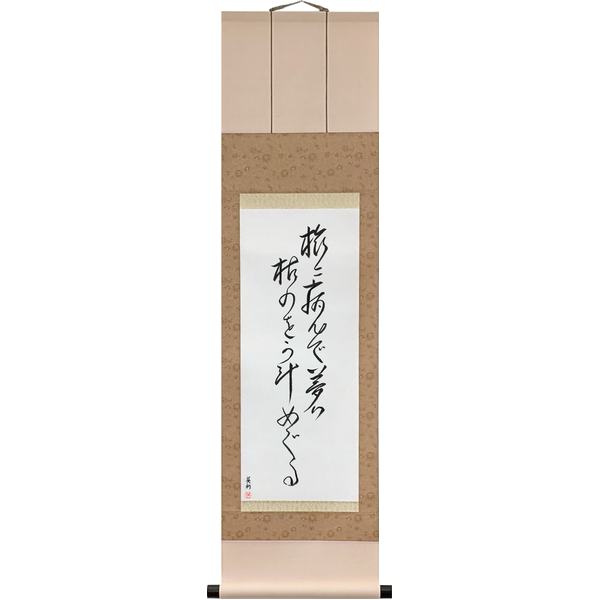
Sold as I'm taken ill while travelling; / And my dreams roam o'er withered moors, Miyamori's rendering, credited to him, under a page that names no poet in its own text · Read tabi ni yande yume wa kareno o kakemeguru; the page prints wo for を, the catalogue's form · Oldest witness the record of Bashō's last days kept by his disciples in the tenth month of 1694; the two manuscript miscellanies and the 1770 book on the desk are the earliest copies opened · Sense a poet sick on a journey, whose body cannot move and whose dreams range over the winter fields. It is the last verse Bashō composed, four days before his death, and he refused to call it a death-verse; the argument about whether it is one is the verse's history.
The text as brushed, and its variants
The scroll carries 旅に病んで夢は枯野をかけ廻る. The verb is written six ways across the witnesses and read one way, yande: 病んで in the undated 反古ばさみ manuscript, 沼波's 1909 manual and 志田's 1926 anthology; 病んて in the 1829 俳諧正語抄; 病て in the 1845 collection and the 1902 花屋日記 print; 病で in the 1927 全集; 病みて once in a 1906 storyteller's transcript; and やんて, in kana, printed so in the 1909 typeset of the 泊船集, read by eye. The last word is written かけ廻る, かけまはる, かけめぐる and 駈廻る, and is one word. Two readings differ in more than writing. 旅に寢て, lying down on the road, stands in the undated 鶯宿雑記 manuscript and in one of 沼波's two lists, a minority against every dated edition, and where it comes from the text layer does not say. 枯野を廻る夢, a dream that circles the withered fields, is not a variant but the poet's own second thought: the 花屋日記 and the 鶯宿雑記 both have him offer the two forms to his disciples and ask which should stand, and then regret even that as attachment. The 1909 泊船集 prints the verse under the headnote 病中の吟, composed in illness, with the note 死前の事は枯尾花に見えたり, the events before his death are seen in 枯尾花, the memorial volume of 1694 that is the record's root and has not been opened here. The meter is six, seven, five, the first line one over: た・び・に・や・ん・で, ゆ・め・は・か・れ・の・を, か・け・め・ぐ・る (s41 wrote five, seven, five against its own kana).
The attribution, as a dated thread
There has never been a second name. The verse is Bashō's by the disciples who watched him dictate it, by every collection since, and by every translator. The one line in the record that could be mistaken for a rival, the 1909 泊船集's 是は路通が「もも月ふり」に翁の句なりと書出しぬ, this one 路通 wrote out in his もも月ふり as the Master's, belongs by eye to the verse printed after ours, あさよさを誰松しまぞかたこゝろ, under the heading 雜句; it is a note on a disciple's transcription of a different verse and touches this one not at all. The account written before this history read the note correctly as a transcription note and placed it under this verse; the leaf moves it. The house page names no poet in its explanation and the catalogue row has no poet field; whether the page's template shows Bashō's name was not checked, and if it does not, that is the page's first defect.
The words
旅に病んで is fallen ill on a journey; 支考's headnote for it is 病中吟, composed during illness, which Shirane renders During Illness (his book carries the English only), and 志田's is 難波にて病中, at Naniwa, while ill. 夢は sets the dreams off with は against the body that cannot move. 枯野 is the withered fields, the winter season word; Miyamori makes it withered moors and names them, in his gloss, the moors of Owari and Mino, the country Bashō had walked; Hass, glossing the word in another poem, says it implies uncultivated land … its associations are equivalent to the beginning of a ghost story. かけ廻る is to run around, to range: Miyamori's dreams travel freely like birds, Carter's I run about in my dreams, Blyth's wander. As words the line says: Ill on the road, my dreams run round the withered fields. The page's romaji writes wo for を, which is the catalogue's standard and the seat's ruling question, not the verse's.
A history, from the earliest witness
1694, the eighth night of the tenth month, as the disciples recorded it. The 花屋日記 as printed in 1902, in the entry for the ninth day, signed 惟然記: the master, dressed in clean clothes at his disciples' care, says 我邊地波濤のほとりに草を敷寢塊を枕として終をとるべき身のかゝる美くしき褥の上にしかも未來までの友とち賑々しく鬼錄に上らむ事受生の本望なり, I who should have ended on grass spread by some far shore with a clod for a pillow, to go onto the register of the dead on a bed this fine, with friends for the life to come around me, this is the wish of a lifetime. Then he calls 丈草 and 去来: 昨夜目のあはざるまゝ計らず案し入りて呑舟に書せたる各詠じたまへ, last night, unable to sleep, I fell without meaning to into composing, and had 呑舟 write it down; each of you read it. Two forms follow, 旅に病て夢は枯野をかけ廻る and 枯野をめぐる夢心ともし侍る, and the question いづれなるべき, which should it be? Then his ruling on what it is: これは辭世にあらず辭世にあらざるにもあらず病中の心なり, this is not a death-verse, nor is it not one; it is the mind of my illness, and his regret that with life and death before him he should still be at his art, 是も妄執の一ッともいふべけん, this too may be called one of my attachments; and 去来's answer that a man whose every day was poetry cannot be blamed for a verse at the end. Shirane, from 支考's own diary of the mourning, gives the date as the early morning of the eighth day of the tenth month of Genroku 7, which he converts once to November 24 and once to November 25, 1694, and does not reconcile. Bashō died on the twelfth. [NDL pid 875665, koma 16, printed pages 22–23, read by eye; text at lab.ndl.go.jp/dl/api/page/875665_16. Shirane 1998, the epilogue's epigraph, read as text]
Undated manuscripts. 反古ばさみ and 鶯宿雑記. Two miscellanies in manuscript carry the deathbed. The first, 旅に病んで夢は枯野をかけまはる, inside a narrative of the death that cites 枯尾花 on its next leaf. The second gives the two forms together and the reading 旅にねて, lying down on the road: 心弱き夢のさめたるはとて〽旅にねて夢は枯野をかけ廻る又枯野を廻る夢人ともせはやと, saying that a weak heart's dream had woken … or, "a dream that circles the withered fields", and asked which. [NDL pid 2554960, komas 24–25; pid 10301648, komas 59–61; OCR; text at lab.ndl.go.jp/dl/api/page/2554960_24 and 10301648_60]
1770. 花仙, なつほうす, a memorial volume for another poet. The half-line already a phrase: 彼蕉翁の夢は枯野をかけ廻るとありしも思ひ合され, and one recalls the old master Bashō's "dreams run round the withered fields", said of a different man's dying. Seventy-six years after the death, the verse is the language for a poet's end. [NDL pid 2540284, koma 7, OCR; text at lab.ndl.go.jp/dl/api/page/2540284_7]
1829. 浪化, 俳諧正語抄, a manuscript treatise. The scene told again, with a detail the print does not have, 手つから墨すり給ひて, grinding the ink himself, and the first recorded argument about what the verse is. First the case that his whole life of haikai and travel was the preparation for this one day, 我一生の俳諧も行脚も今日死の一大事を能せん為なり; then the verse, and 旅に病んて夢は枯野をかけ廻るといふ一句に一生は終りたまへり, in the one verse "ill on the journey" his life came to its end; then 此句辞世のやうに心得たる人もあるよしさにはあらず, some take this verse for a death-verse; it is not so; and what follows is the filial reading, 人は死するまて父母の恩愛を忘れさるを孝とはいふへし今父母の地を離れて旅に終る何そ父母をしたひ思はさらんや, a man who to his death does not forget his parents' love is called filial; now, far from his parents' land and ending on the road, how could he not think of them with longing? The OCR layer writes 勺 for 句 and drops the dakuten throughout. The 1909 泊船集 note names the same argument's source, 枯尾花. [NDL pid 2540297, komas 29–31, koma 30 read by eye; text at lab.ndl.go.jp/dl/api/page/2540297_30]
1845. 馬場錦江, 蓁々翁發句集. 旅に病て夢は枯野をかけ廻ると芭蕉翁の高吟, the old master Bashō's lofty verse. [NDL pid 2540304, koma 39, OCR; text at lab.ndl.go.jp/dl/api/page/2540304_39]
1906. 桃川実, 芭蕉旅日記, a storyteller's performance in print. The death told for an audience, 元祿七年十月十二日 … 浪花の旅亭に歿し, he died in an inn at Naniwa on the twelfth day of the tenth month of Genroku 7; the verse in two spellings across the book, 病んで and 病みて … 駈廻る; and the disciples' verdict staged, 辭世にして辭世に非ず … 辭世に非ず、是は師の絕句である, a death-verse and not a death-verse … not a death-verse: it is the master's last verse. [NDL pid 890755, komas 4 and 83–85, OCR; text at lab.ndl.go.jp/dl/api/page/890755_84]
1909. 風国, 芭蕉泊船集, in the 寸珍叢書 typeset. 病中の吟 / 旅にやんて夢は枯野をかけ廻る / 死前の事は枯尾花に見えたり; then 雜句 and the next verse with its 路通 note. The verb in kana, printed so. [NDL pid 875664, koma 75, printed pages 132–133, read by eye; text at lab.ndl.go.jp/dl/api/page/875664_75]
1909. 蓑笠庵梨一, 奥細道菅菰抄, typeset; and 沼波瓊音, 俳句の作り方. The 1909 typeset carries a 芭蕉句選 arranged by season, and the verse stands in its 冬之部 as 旅に病て夢は枯野をかけ廻る, between 鞍つほに小坊主のるや大根引 and 馬ほく〳〵我を繪に見る枯野哉, in a verse list and not in a gloss; the manual lists it twice, once as 病んで and once as 寢て. [NDL pid 888896, koma 113; pid 994608, komas 53 and 79; OCR; text at lab.ndl.go.jp/dl/api/page/888896_113, 994608_53, 994608_79]
1926 and 1927. 志田義秀, 俳文学選; 島田青峰, 芭蕉俳句紀行全集. 志田 gives the headnote 難波にて病中 and uses the verse to gloss Buson's phrase 枯野の夢 in his essay on rebuilding Bashō's hut; 島田 files it under the season word 枯野. [NDL pid 947714, komas 39 and 74; pid 1194541, koma 64; OCR; text at lab.ndl.go.jp/dl/api/page/947714_74 and 1194541_64]
Today. The Britannica entry on kotobank gives the poet's dates and his death at Osaka in 1694. The archive lists five hundred and one books carrying the verse before 1945, twelve of them opened. [kotobank 松尾芭蕉, read as text; harvest_index.py lookup --id 254 --year-to 1945]
The sense, across three centuries
The Japanese argument is about the verse's status and the English tradition has never had it. Bashō himself, as the disciples recorded him, refused the word 辞世 and refused to refuse it: not a death-verse, nor not one; the mind of my illness. 去来, in the same record, wanted it to stand as his testament. 浪化 in 1829 says flatly it is not a death-verse, because a life is not summed in a line; the storyteller of 1906 has the disciples call it the master's last verse and not his death-verse, which is the same distinction made for a crowd. The English books settle what the Japanese ones left open. Yasuda in 1947 heads it THE LAST VERSE; Blyth in 1963 calls it his death-verse and praises it for mystery without solemnity, finality without despair, truth without ornament; Carter in 1991 says only written while he was ill … a few days before his death; Shirane in 1998 sets it as his book's epigraph with the headnote During Illness and adds nothing. The reading of the line itself has not moved: a body that cannot travel and dreams that do, over the winter country he had spent his life walking. What has moved is the frame, and the frame is the whole of the dispute.
What is not a source
The second form, 枯野を廻る夢, is Bashō's own alternative and not a variant reading; it belongs in the account, and a page should not print it as a version of the verse. The reading 旅に寢て is a real variant of unknown footing and is a question for 枯尾花, not for the page. Buson's phrase 枯野の夢 in his record of rebuilding Bashō's hut, and the 1770 eulogist's borrowing of the half-line, are reception, the verse already become an idiom; the storyteller's staged verdict of 1906 is a performance of the argument, not evidence for it. That the 花屋日記 is a later composition rather than a diary kept at the bedside is a judgment of the discipline the seat has not read this turn and marks as recall; the scene as told above is that book's, and the two manuscripts and the 1829 treatise tell it the same way, which shows how far the telling had spread, not that its details are true.
The verse in English
The bilingual dictionaries of the Meiji shelf were not checked for this verse. Hass, Henderson, Keene, Ueda, Reichhold and Sato were searched on the shelf and do not carry it.
1932. 宮森麻太郎 Asatarō Miyamori, An Anthology of Haiku Ancient and Modern, Maruzen, Tokyo, page 219. Taken Ill While Travelling as the title, then I'm taken ill while travelling; / And my dreams roam o'er withered moors, and a prose gloss in which the dreams carry his soul over the moors of Owari and Mino. The house page quotes both the rendering and the gloss, and calls the gloss a translation; it is his commentary. He is credited, which is right. [docs/research/papers, Miyamori 1932, page 219 by the account's reading of a column-scrambled text layer, reassembled and not checked against the image; the Dover reprint the page links not opened; no ASIN collected]
1947. Kenneth Yasuda, A Pepper-Pod, Tuttle. Under THE LAST VERSE: Having become ill / This journey, o'er withered moors / My dream wanders still. [docs/research/papers, Yasuda 1947, read as text; no ASIN collected]
1963. R. H. Blyth, A History of Haiku, volume 1, Hokuseido Press, Tokyo. Ill on a journey; / My dreams wander / Over a withered moor, introduced as his death-verse and praised as above; and, elsewhere in his work, the senryū parody House-imprisoned, / My dreams hover / Over a prostitute quarter, which is reception of a kind. [docs/research/papers, Blyth 1963 vol. 1, read as text; the file carries no page markers; no ASIN collected]
1991. Steven D. Carter, Traditional Japanese Poetry: An Anthology, Stanford University Press. Ill on a journey, / I run about in my dreams / over withered fields, with the note that it was written a few days before his death. Carter alone keeps the running. [docs/research/papers, Carter 1991, read as text; no ASIN collected]
1998. Haruo Shirane, Traces of Dreams, Stanford University Press, the epilogue's epigraph. The romaji and a gloss, with the headnote During Illness and the note on dictation to 呑舟 quoted above. [docs/research/papers, Shirane 1998, read as text; no ASIN collected]
Today. The house English is Miyamori's, credited to him, and his gloss is printed beside it as a second translation, which it is not. A rendering of this line has to keep the dreams as the subject that moves and the body as the one that cannot, and to keep 枯野 as the winter fields; every translator on the shelf does. What the page lacks is not English but two facts: the poet's name, and the date, four days before his death in 1694.
A reading
I read the verse as Bashō read it, and I take his refusal seriously rather than as modesty. A death-verse is written to be a last word; this was written because a sick man could not sleep and composed in spite of himself, and he was ashamed of it the next morning, not of the verse but of still wanting to write one. That is why it is better than a death-verse. It does not sum up a life; it reports a night. The dreams run because the body cannot, and the fields are withered because it is the tenth month and because he had walked them, and there is nothing in it about death at all except that a man who says his dreams are ranging the country is a man who knows he will not range it again. The English tradition made it his death-verse because it needed one, and the Japanese tradition argued for two centuries because he had told them not to. The text stands, 病んで and かけ廻る being the majority form in every century and the modern editions' form; the attribution stands; the romaji stands, with wo as the catalogue's question. The page should say who wrote it and when, and should call Miyamori's gloss a gloss. Signed, 典, 2026-09-05.
How this was read
By eye at width 3600: the 1829 manuscript at the deathbed, koma 30; the 1902 花屋日記 print at the ninth-day entry, pages 22–23; the 1909 泊船集 typeset at the verse and its neighbors, pages 132–133. By OCR from the archive's text layer: the two undated manuscripts, the 1770 memorial volume, the 1845 collection, the 1906 transcript at both places, the 1909 commentary and manual, the 1926 and 1927 anthologies. By text layer from the shelf: Miyamori, Yasuda, Blyth, Carter and Shirane; the kotobank entry. Not opened: 枯尾花 of 1694 and 支考's diary of the mourning, the two primaries every later telling descends from, where the headnote, the 寢て reading and the second form would be found at their root; Miyamori's page as an image; the live page, for the poet's name; four hundred and eighty-nine books the archive lists. A bracket of the form pid P, koma N resolves as text at lab.ndl.go.jp/dl/api/page/P_N and as an image at dl.ndl.go.jp/api/iiif/P/R<N, seven digits>/full/3600,/0/default.jpg; the three leaves read by eye were fetched at that address. The full apparatus, with every address, is in the account.
Supersession 2026-09-14 (s92)
A read-only worker resolved this account's addresses (citation_checks_2026-09-14/history_tabi_ni_yande_254_2026-09-05.check.md): 34 claims, 22 at the address. Corrected above: the first line is six morae, and the account said five against its own kana; the headnote sentence implied Shirane prints the kanji 病中吟, where his book carries only During Illness. The worker reported 沼波 1909 and 島田 1927 with their spellings swapped; I re-opened both komas this turn (pid 994608 koma 53 reads 病んで, pid 1194541 koma 64 reads 病で), which is what the account says. Not yet read by a person.
References
Each witness is cited in the account above, at the frame or entry where it was read. A linked list follows when the record for this text is completed.