

白梅に明る夜ばかりとなりにけり · shiraume ni akuru yo bakari to nari ni keri · White plum blossoms: from now, every night will only dawn on them
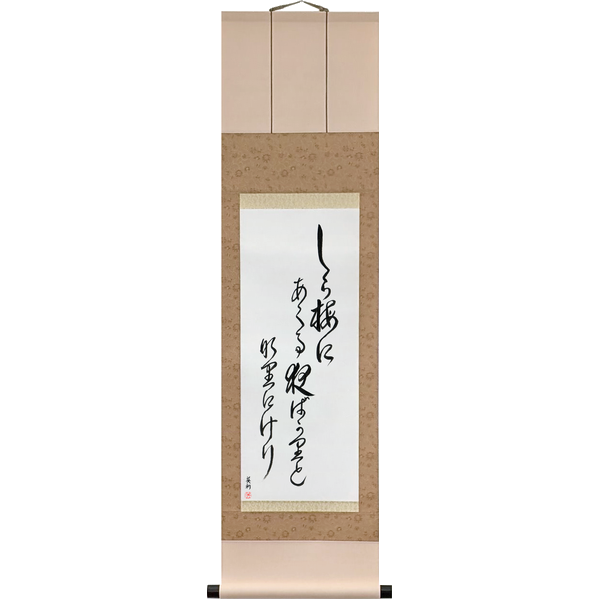
Sold as Buson's, with the English To white plum blossoms / Each night just dawning / Evermore · Read shiraume ni akuru yo bakari to nari ni keri · Oldest witness 几董's account of his master's death, 夜半翁終焉記, printed in から檜葉 in 1784 and read on its leaf: しら梅に明る夜はかりとなりにけり, the last of three verses dictated on the night of the twenty-fourth of the twelfth month of 天明3, with the poet's instruction that it be headed 初春 · Sense it has come to this: nights that only dawn on white plum blossoms. Buson's death verse, January 1784.
The text as brushed, and its variants
The scroll carries 白梅に明る夜ばかりとなりにけり, and the record carries one text with its middle written three ways. The 1784 print writes しら梅に明る夜はかりとなりにけり, kana for 白 and はかり without the voicing mark, as the woodblock hand does; the 1897 and 1925 typesets keep しら梅 and はかり, the 1924 typeset of 大江丸 writes 白梅に明る夜はかり, and the twentieth-century editions, Blyth, Hass and Shirane write 白梅に … ばかりと, which is the scroll's form. 明る / 明くる. The print and every Buson edition write 明る, read akuru; a 1910 anthology and two 1930s school books write 明くる, spelling the reading out, and so does the dictionary the account cites. に / の. A 1932 department-store biography and the 1933 年譜 built on it write しら梅の明る夜ばかり; every other witness に. と / に. kotobank's 日本人名大辞典 line reads 明くる夜ばかりになりにけり by the account's fetch; every edition と. The sense holds across all of them. The meter is five, seven, five: し・ら・う・め・に, あ・く・る・よ・ば・か・り, と・な・り・に・け・り. The five designs served for this text do not all brush the catalogue's form: three write 白梅に明る夜, one しら梅に明る夜 and one しら梅にあくる夜, the print's spellings and the editions'.
The attribution, as a dated thread
Buson's, the last verse he made, on the testimony of the disciple who wrote it down. 几董's 終焉記, read on the 1784 leaves: the master, 靜にして言語も常にかはらず, calm, his speech no different from usual, said 病中の吟あり, I have verses from my illness, called 月溪 to his side and told him いそぎ筆とるべし, take up the brush quickly; while brush, inkstone and paper were being fetched, the disciple listened, 吟声を窺ふに, and heard 冬鶯むかし王維か垣根哉 and うぐひすや何こそつかす藪の霜; ときこえつゝ猶工案のやうすなり, and he seemed still to be working; しばらくありて又, after a while, again: しら梅に明る夜はかりとなりにけり; こは初春と題を置べしとぞ, this one, he said, should be headed 初春; 此三句を生涯語の限として睡れるが如く臨終正念にして往生を遂げたまひけり, with these three verses as the last words of his life he passed, as if into sleep, with a mind at rest. The date: the night of the twenty-fourth day of the twelfth month of 天明3; the death toward dawn on the twenty-fifth, 25 January 1784 by the Western calendar; the poet sixty-eight. 洒竹's 1897 life gives the day and the age from the same source; Shirane's note has 1783, when he was sixty-eight and the twenty-fifth day of the Twelfth Month. The headnote 初春 is the poet's own, dictated with the verse; 潁原's 1925 全集 prints the verse under it with the tag から檜葉, and the 1925 season-and-year editions print it under 臨終 instead.
The words
白梅 is the white plum, shiraume, the first blossom of the year and a season word for early spring, which is why the poet asked for the heading 初春 in the last week of the twelfth month. に locates the dawning at the blossoms. 明る夜 is the night that dawns, 明くる in full; ばかり, only, nothing but; となりにけり, it has become, the classical perfect with its exclamatory weight: it has come to be that. As words the line says: It has come to this: nights that do nothing but dawn on white plum blossoms. Blyth's from now and Morris's each and every night are readings of ばかりとなりにけり, not of any word for evermore.
A history, from the earliest witness
1784, the night of the twenty-fourth of the twelfth month of 天明3. The 夜半亭, Kyoto. By the disciple's account, above. [から檜葉, below]
1784. 高井几董 (ed.), から檜葉, the memorial collection, opening with 夜半翁終焉記. The account quoted above, canvases 9–10 of the 北海道大学 copy, the verse at the head of canvas 10's recto (folio 七); the piece is dated at 金福寺 in the twelfth month and signed 几董; the mourning verses of the disciples follow, among them 月溪's under the headnote 師翁白梅の一章を吟し終て兩眼を閉今そ世を辭すへきの時也, the master finished the white-plum verse, closed both eyes: now was the time to take leave of the world. Read by eye; my transcription of the woodblock hand normalizes kana. [NIJL 国書データベース, から檜葉 WID 140976 (nine holdings, four with images), copy BID 100000054, canvases 3–13 and 18 of its IIIF manifest, read by eye; the 1897 typeset at NDL pid 875713, komas 124 and 129, printed pages 220–221 and 230–231, read by eye; text at lab.ndl.go.jp/dl/api/page/875713_124]
1799. 大江丸, 秋存分, the seventeenth-anniversary memorial. 夜半亭蕪村居士病床にありて 白梅に明る夜はかりとなりにけり。初春と題を置へしとて云終て、唾れる如く往生の素懷を遂られけるも、はや十とせあまり七とせの昔となりけり (so the leaf: 置へし without the voicing mark, 唾れる with the mouth radical where the sense wants 睡れる, 懷; the typeset cuts と and せ in forms the OCR layer reads as ミ and セ), Master Buson on his sickbed: the verse; he said it should be headed 初春, and having said it passed as if into sleep; already seventeen years ago. [1924 typeset, NDL pid 977304, koma 32, printed pages 210–211, read by eye; text at lab.ndl.go.jp/dl/api/page/977304_32]
1897. 大野洒竹, 与謝蕪村; 阿心庵雪人, 蕪村全集 校註. 洒竹 quotes 几董's account whole from から檜葉 and closes: 天明三年癸卯の歲、冬十二月の廿四日夜、是れ蕪村か菩薩となりし日なり。日面佛、月面佛、『しら梅に明る夜ばかりとなりにけり』、行年六十八齡なりき. 雪人 prints the 終焉記 with a gloss box on 王維 and the mourning verses with the 〔白梅の一章〕 gloss. [NDL pid 875927, koma 68, printed pages 118–119, read by eye; pid 875713 as above; text at lab.ndl.go.jp/dl/api/page/875927_68]
1902–1935. The editions. 山田 1902, 岩本's 標註 1906, 零余子 1921, the 蕪村三千句 and 半田's season-and-year edition of 1925 (both under 臨終), 潁原's 全集 of 1925 (初春 / しら梅に明る夜はかりとなりにけり (から檜葉), with the note 初春——この句蕪村終焉の吟), the 1935 半田. [NDL pids 875715, 875714, 968346, 924926, 964212, 1090303, OCR; pid 1018320, koma 48, printed pages 40–41, read by eye; text at lab.ndl.go.jp/dl/api/page/1018320_48]
1910–1953. The variants in the popular record. 明くる夜 in the 1910 俳諧三家集 and in 1936 and 1938 school books that give the verse as 辭世 with the date; しら梅の in the 1932 上方俳星遺芳 and the 1933 年譜; the 1938 蕪村一代物語 retelling the deathbed with 暫くあつて. [NDL pids 875352, 1279518, 1145037, 1187282, 1688733, 1223003, OCR]
Today. The archive lists thirty-four books carrying the verse; the NDL full-text search returns fifteen for 白梅に明る夜, twenty for しら梅に明る夜, eight for 白梅に明くる夜 and twenty-seven for 明る夜ばかり. [harvest_index.py lookup --id 269 --year-to 1945; lab.ndl.go.jp/dl/api/book/search, five keywords, 2026-09-05]
The sense, across three centuries
几董 read it as the master did: the last words of a life, with a season heading asked for in the last hour, so that the verse would stand in the new year's part of the book. 月溪, who took it down, made its finishing the moment of death. 大江丸 kept the heading in his memorial. Blyth in 1950: it has no further, no ulterior meaning beyond the simple fact that every day now, dawn comes from the direction of the white plum-blossoms. But the emphasis on the night brings out the power of the glimmering white flowers; however many times darkness covers the earth, and thick darkness the people, they have the power to bring back the dawn again; and: this verse of Buson's is said to be his death-verse, 辭世. It shows a stage of enlightenment to which even the word "selfless" is inapplicable. He died in the serenity of natural beauty in which he had lived. Shirane in 2002: the plum's faint whiteness seems to embody Buson's spirit as it disappears into the light of dawn, and the verse is also about the passage from winter to spring, the poet dying in the last month of winter. Hass: this poem is difficult to translate, and three renderings laid side by side. The page's Evermore is a strong word for ばかりとなりにけり and not a wrong one.
What is not a source
The page's English is a house rendering, verbatim to no one, and needs no credit. The 蕪村句集 of 1784 does not carry the verse, by one instrument (the 1935 reprint, checked in order); it was compiled before the death. The 1932 biography's しら梅の is its own. The date 1783 in English books is the Japanese year; the death fell in January 1784.
The verse in English
The bilingual dictionaries of the Meiji shelf were not checked. Miyamori, Henderson and Watson do not carry it on the shelf.
1950. R. H. Blyth, Haiku, volume 2, Spring, Hokuseido Press, Tokyo, page 312, TREES AND FLOWERS. 白梅に明る夜ばかりとなりにけり 蕪村; Shiraume ni akuru yo bakarito nari ni keri; Every night from now / Will dawn / From the white plum-tree. With the paragraphs quoted above; again in Oriental Humour (1959), page 354, set against a senryū on a maid at dawn. [docs/research/book_originals, Blyth 1950, page 312, and Blyth 1959, page 354, read by eye from the PDFs; no ASIN collected]
1978, 1986, via Hass 1994. Yuki Sawa and Edith Shiffert; Mark Morris. With white plum blossoms / these nights to the faint light of dawn / are turning (Sawa and Shiffert); Now each and every night will end / Dawning in white plum blossoms (Morris), quoted in Hass's note with the deathbed scene from Sawa and Shiffert, page 48. [docs/research/book_originals, Hass 1994, Notes, page 278, read by eye from the PDF; no ASIN collected]
2002. Haruo Shirane, Early Modern Japanese Literature, Columbia, page 546, LITERATI MEDITATIONS. Early spring: / shiraume ni / akuru yo bakari / to narikeri / Amid white plum blossoms / night turns to dawn— / the time has come, from 蕪村全集 (Kōdansha, 1992) vol. 1, with note 21. [docs/research/book_originals, Shirane 2002, page 546, read by eye from the PDF; no ASIN collected]
Today. The house page's To white plum blossoms / Each night just dawning / Evermore stands. A rendering has one thing to keep: the only, ばかり, which makes the dawns the whole of what is left.
A reading
I read the verse as 几董 wrote it down: a man who has just made two verses about a bush warbler and a hedge of 王維's, still working, and then, after a pause, this, with a season heading for a spring he would not see. The white plum is the first flower and the color of the light before sunrise; ばかりとなりにけり says that this is now all the nights are for. It is not a verse about dying; it is a verse about what the nights have become, and that is why it is the best death verse in the language after Bashō's. The scroll's text is the editions' and every translator's; the print's しら梅 and はかり are the woodblock's spelling of the same words. What the page should say is the one thing that matters and that it does not say: that this is the last verse Buson made, dictated to 月溪 on the night before he died, and that he asked for it to be headed early spring. One sentence, sourced to 几董. Signed, 典, 2026-09-05, s42.
Eri
Nothing to ask. She brushed と on every design, and every edition and the 1784 print agree; the designs differ only in しら梅 / 白梅 and あくる / 明る.
How this was read
By eye at NIJL from the IIIF manifest, at width 3000: から檜葉, 北海道大学 copy, canvases 9 and 10 (the three verses) and 3, 13 and 18 (the opening, the signature, 月溪's verse), located by contact sheets of canvases 1–49. By eye at width 2400 from NDL: 雪人 1897 at komas 124 and 129; 洒竹 1897 at koma 68; 大江丸 in the 1924 typeset at koma 32; 潁原 1925 at koma 48; and from the shelf's PDFs Blyth's 1950 page 312 and 1959 page 354, Hass's page 278, Shirane's page 546. By OCR from the archive's text layer, per the account and the reader: the 1902–1953 editions and school books. As text: kotobank, the NDL full-text search, the NIJL work and holdings records. Not opened: the 蕪村全集 (講談社 1992) that Shirane translates; Sawa and Shiffert's page 48; the 1784 蕪村句集 as a print. A bracket of the form pid P, koma N resolves as text at lab.ndl.go.jp/dl/api/page/P_N and as an image at dl.ndl.go.jp/api/iiif/P/R<N, seven digits>/full/3600,/0/default.jpg; an NIJL canvas resolves through kokusho.nijl.ac.jp/biblio/<BID>/manifest. The full apparatus, with every address, is in the account.
Supersession 2026-09-14 (s92)
A read-only worker resolved this account's addresses (citation_checks_2026-09-14/history_shiraume_269_2026-09-05.check.md): 18 claims, 8 at the address, 9 it could not open (six variant witnesses whose zips the driver did not hand it; the 1935 reprint's range; the Sawa page reached only through Hass's note). Its one differs row, that Hass's note is on page 277, is wrong: I rendered the notes page this turn and its footer reads 278 Notes with Brush and inkstone were prepared on it, so the s42 correction to 278 stands. Nothing changed in the account. Not yet read by a person.
References
Each witness is cited in the account above, at the frame or entry where it was read. A linked list follows when the record for this text is completed.