



Jiun · 自運 · VD6B
Jiun (自運) is the calligrapher's word for writing from one's own invention. As a Shihan, Master Takase has a hand of her own, and these designs are that hand: she draws freely on the classic scripts to create exactly the look she wants.
白梅に 明る夜ばかりと なりにけり shiraume ni akuru yo bakari to nari ni keri buson 蕪村 To white plum blossoms. Each night just dawning. Evermore.
White plum blossoms, and nights that now do nothing but dawn on them.
Master Takase creates this beautiful scroll when your order is placed, personally preparing the ink and brushing your art, which proudly bears her signature and seal. This is an original work of art.
Description
To white plum blossoms.
Each night just dawning.
Evermore.
|
shiraume ni akuru yo bakari to nari ni keri |
白梅に 明る夜ばかりと なりにけり |
| buson | 蕪村 |
白梅に明る夜ばかりとなりにけり (shiraume ni akuru yo bakari to nari ni keri): white plum blossoms, and nights that now do nothing but dawn on them.
Yosa Buson's last verse looks toward a spring he would not see. He asked that it be headed early spring. Most readers hear nights that will now always dawn on the white plum. Others hear a single night, the one dawn left to him. The grammar allows both, and readers still divide.
In the Japanese, 白梅, shiraume, is the white plum, a season word for spring. 明る夜 is the night that dawns. ばかり can mean nothing but, or about, and the reading turns on it. となりにけり is it has come to be, said with the weight of a thing just realized. Two of the hands write 白 in kana, as しら梅, and one writes 明る as あくる.
The English is Timothy L. Jackowski's, made for Takase Studios.
Buson died not seeing the dawn and not seeing again the plum blossoms that he envisioned in his poem. He died on the last month of winter and the plum blossoms outside, the harbinger of spring, perhaps spoke to him of what was to come.
Whether all Buson was saying was that it would be enough for him to see the plum blossoms just one more time in the morning or that he is speculating on the afterlife ... forever in our hearts will be Buson's image of night breaking into dawn, winter into spring ... and the promised hope of plum blossoms.
This is for Victoria.
Calligraphy Notes:
1) 明る (akuru) today is more commonly written 明くる (akuru).
2) For purely artistic reasons I have used kana for shira. So sometimes I use 白梅 (shiraume) and others しら梅 (shiraume).
Translation Notes:
白梅に
明る夜ばかりと
なりにけり1) 白梅 (shiraume) - meaning "white plum blossoms". This combines the kanji 白 (read shira here) and 梅 (ume).
2) に (ni) - As Henderson puts it ni is "A postposition with many uses (at, in, to, by, for, etc.). These are usually indicated sufficiently in the literal translation." Some translators render it "with" here. Shirane suggests "amid" and we have used "to".
3) 明る (akuru) is the verb 明く (aku), meaning "to dawn", in the form that leads into a noun: 明る夜 is the night that dawns.
4) 夜 (yo) - means "night; evening"
5) ばかり (bakari) - meaning, in this case, "just" (as in "just dawning").
6) と (to) - marking what the nights have become.
7) なり (nari) - from the verb なる (naru), meaning "to become".
8) に (ni) - here the auxiliary ぬ (nu), marking the change as complete.
9) けり (keri) - according to Jeffrey's Japanese <-> English dictionary, "(1) indicates recollection or realization (i.e. of hearsay or the past); (2) indicates continuation from the past to the present; (3) end; conclusion". Henderson offers, "A kireji marking either a pause or final stop. It was originally a verb suffix indicating a past tense, but has now no special meaning."
Buson dictated the verse to his disciple 月溪 on the night of the twenty-fourth of the twelfth month of 天明3 (16 January 1784), the last of three verses given before he died toward dawn on the twenty-fifth (17 January 1784), as the account his disciple 几董 printed in から檜葉, 夜半翁終焉記, records.
We want you to be as happy with the meaning as you are with Master Takase's art. To learn more, visit Philology of 白梅に明る夜ばかりとなりにけり.
Delivery
Your scroll is brushed when you order it and completed within 1 to 3 business days. It ships by USPS Priority Mail from Master Takase's studio in Washington State, boxed and ready to hang, with a printed page giving the art's English, romaji and Japanese.
Sending it as a gift? Add your message at checkout and we will include it.
Shipping is calculated at checkout from your address; within the United States it is $13 to $23. We ship worldwide, and any import charges for your country are shown at checkout before you pay.
Every order is covered by our 30-day money-back guarantee. If your scroll arrives damaged, or we made an error, we replace it or refund you in full, including shipping. Refund policy
About Our Scrolls
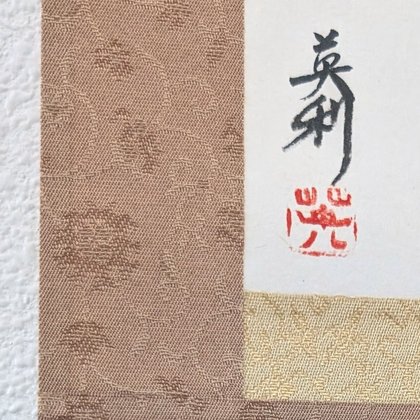
Master Japanese Calligrapher Eri Takase brushes your scroll by hand when you order it. Each scroll bears her red seal, 英利, and her signature.
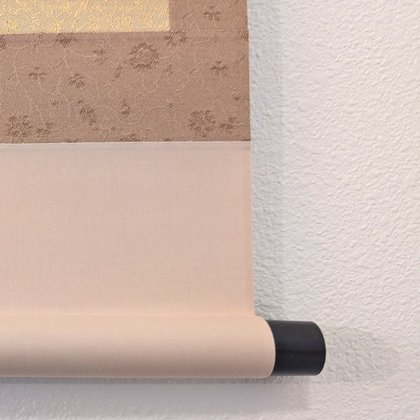
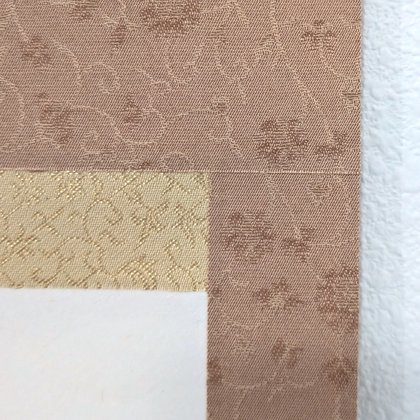
The scrolls are 12 1/4" W × 43" H (31 × 109 cm), with woven damask borders and layered Japanese paper, designed to last generations. The scrolls themselves are made by a scroll maker in Gifu, Japan, and we have worked with them for over two decades.
Eri Takase was born and raised in Osaka, Japan, and holds the rank of Shihan, the highest rank in Japanese calligraphy, from the Bokuteki-kai and the Bunka-shodo. About Master Takase
Related products

Buson - From far and near, Hearing the sounds of waterfalls, Young leavesをちこちに滝の音聞く若葉哉ochikochi ni taki no oto kiku wakaba kana

Buson - In loneliness, there is joy too, An autumn eveさびしさのうれしくも有秋の暮sabishisa no ureshiku mo ari aki no kure

Buson - A flash of lightning, The sound of dew, Dripping down the bamboos稲妻にこぼるる音や竹の露inazuma ni koboruru oto ya take no tsuyu
