

澁いとこ母が喰ひけり山の柿 · shibui toko haha ga kui keri yama no kaki · The astringent part the mother ate: wild persimmons
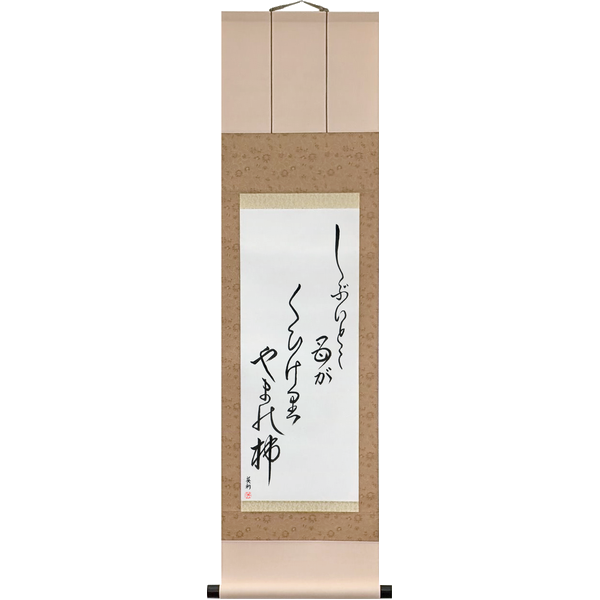
Sold as Issa's, with the house lines The bitter part / eaten by the mother / mountain persimmon and a note that the mother gives the sweet end to the child and eats what is left · Read shibui toko haha ga kui keri yama no kaki · Oldest witness the 1902 一茶俳句全集; no edition dates the verse, and the 1928 index sources it to a 選抄 · Sense a wild persimmon is sweet at one end and astringent at the other, and the mother eats the astringent end. Read since 1910 as a verse about mothers and children, and by 津田左右吉 in 1921 as the verse of a man who lost his own mother at three and watched other children have one.
The text as brushed, and its variants
The scroll carries 澁いとこ母が喰ひけり山の柿, and every Japanese witness has these words; the writing splits only in the verb's kanji. 喰 in the five Issa editions and the index, 食 in 高島's 1910 anthology, 津田's 1921 study, the 1935 school text and the 1935 girls' school collection; one verb. 澁 is the old form on every leaf and 渋 on the scroll; one character. Blyth prints the verse in kana both times, しぶいとこ母がくひけり山のかき. Two text-layer readings are noise: 半田's 1935 edition reads 濃いとこ in the OCR, a recognition slip for 澁, and the 2022 Shambhala reprint of Blyth's essays prints 渋いこと for とこ, a slip in that edition that no Japanese witness has and that makes no sense where とこ, the part, does. No witness varies a word. The meter is five, seven, five: し・ぶ・い・と・こ, は・は・が・く・い・け・り, や・ま・の・か・き.
The attribution, as a dated thread
Issa's at every edition of Issa and at every anthology that names a poet: 大塚's 1902 全集, 高島's 1910 anthology of children in literature (the section credited 一茶), 津田 1921, 勝峰's 1921 全集 and his 1928 index, 半田's 1925 and 1935 editions by season and year, the 1926 一茶蕪村名句全集, the 1935 school text; Blyth in 1942, 1952 and the posthumous essays; Beilenson 1968; Watson does not carry it. Two anthologies print it without a name, a 1934 book of conduct for women under a 川柳 heading and a 1935 girls' school collection under 句; lapses of credit, not rival claims. No witness dates the verse. 半田's two editions, which tag a year in parentheses wherever the manuscripts allow (the 栗 verse two columns on carries 文化十), leave every 柿 verse untagged; 勝峰's 1928 index sources it to a 選抄, a selection, not to a dated diary. The 1921 全集 files it under the heading 母, mother, in its classified section, directly after 父 with 父ありて曙見たし靑田原, and before seven more 母 verses beginning 母の分もひとつ潜る茅の輪哉.
The words
澁い is astringent, the persimmon's tannin that dries the mouth; bitter is the page's word and Blyth's first, astringent Blyth's later one and the exact one. とこ is ところ, the part, the place on the fruit. 母が喰ひけり is the mother ate it; けり closes it as a thing seen and done. 山の柿 is wild persimmons, the small unreliable fruit of the hills, an autumn season word; the 1935 school text glosses it, まして山の柿などはあぶないものだ, and wild persimmons above all are chancy. As words the line says: The astringent part, the mother ate: wild persimmons.
A history, from the earliest witness
1902. 大塚甲山 (ed.), 一茶俳句全集, 内外出版協会. Printed pages 222–223, under the heading 柿 in a run of persimmon verses: 湯上りの拍子に凉む熟柿かな, 柿の木であいと答へる小僧かな, 澁いとこ母が喰ひけり山の柿, 澁柿と烏も知つて通りけり, 京の見柿の澁さをかくしけり, and over the page 澁柿をこらへてくふや京の見, 山柿も佛の目には甘からむ. The National Diet Library's record dates the book 1907 where the archive says 1902; not reconciled. [NDL pid 874848, koma 114, printed pages 222–223, read by eye; text at lab.ndl.go.jp/dl/api/page/874848_114]
1910. 高島平三郎 (ed.), 竹久夢二 (ill.), 児童を謳へる文学, 洛陽堂. Under 俳句に現はれたる兒童, children as they appear in haiku, 澁いとこ母が食ひけり山の柿, the section credited 一茶. [NDL pid 871654, komas 83–84, OCR; text at lab.ndl.go.jp/dl/api/page/871654_84]
1921. 津田左右吉, 文学に現はれたる我が国民思想の研究, 第4. Pages 343–344. Issa's feeling for children has a second root: 幼にして母に別れ、繼母に虐待せられ、六歲にして「われと來て遊べや親の無い雀」とおのづからなる句を口ずさんだといふ彼は、母の愛に饑えてゐた, parted from his mother in infancy, ill-treated by his stepmother, said to have murmured at six the verse "come and play with me, sparrow without parents," he hungered for a mother's love; the family circle was 彼にとつてはみづから入ることを許されざる天國, for him a heaven he was not permitted to enter; まづ彼が如何に母子の情を寫したかを見るがよい, first see how he portrayed the feeling between mother and child, and four verses follow: 「下冷の子とねかはりて添乳かな」、「ねせつけし子の洗濯や夏の月」、「澁いとこ母が食ひけり山の柿」、「母親を霜よけにしてねた子かな」(橋上乞食)。母ある子の如何に嬉しく彼の心には感じたであらう, how happy a child with a mother must have seemed to his heart. This verse is the third of the four. [NDL pid 1913174, komas 185–186, printed pages 342–345, read by eye; text at lab.ndl.go.jp/dl/api/page/1913174_185 and 1913174_186]
1921. 勝峰晋風 (ed.), 新選一茶全集, 町田書店. In the classified section 一茶俳句分類, pages 392–393, the headings 親子, 夫婦, 父, 母: under 父, 父ありて曙見たし靑田原; under 母, this verse first, then 母の分もひとつ潜る茅の輪哉, 母親を霜よけにして寢た子哉 and five more. [NDL pid 970100, koma 224, printed pages 392–393, read by eye; text at lab.ndl.go.jp/dl/api/page/970100_224]
1925 and 1935. 半田良平 (ed.), 一茶俳句集 季題別年代考; 一茶俳句全集 季題別年代附. Pages 52–53 of the 1925 edition, 植物, 柿: nine persimmon verses in a run, this one third, none carrying the year tag the editor gives where he can. The 1935 edition the same, its OCR reading 濃 for 澁. [NDL pid 917542, koma 34, printed pages 52–53, read by eye; pid 1034501, koma 33, OCR; text at lab.ndl.go.jp/dl/api/page/917542_34 and 1034501_33]
1928. 勝峰晋風 (ed.), 日本俳書大系, the kana index 俳諧全句索引. Under 一茶, シ: シブイ (選抄) 澁いとこ母が喰ひけり山の柿, the source abbreviation naming the 一茶選抄 volume of the series. [NDL pid 1179400, koma 274, printed pages 216–217, read by eye; text at lab.ndl.go.jp/dl/api/page/1179400_274]
1935. 郡山市赤木尋常小学校, 実際的家庭教育, a school's book for parents. Pages 112–113, the chapter 子供を歌へる詩歌, section (七) 母性愛を詠める歌: 母の愛ほど世に至純にして貴く强いものはあるまい, nothing in the world is purer, nobler or stronger than a mother's love; then two verses of Issa's, 蚤の跡數へながらに添へ乳かな and 澁いとこ母が食ひけり山の柿, and the gloss: 蚤の喰つた跡でさへ氣にかゝる母である。まして山の柿などはあぶないものだ。先づ自分で毒味をして、甘い所を子に與へる。子を育てるにはかうした細かい注意がなければならない, a mother who worries even over the marks a flea has bitten; and wild persimmons above all are chancy. She tastes first, and gives the sweet part to the child. Raising a child needs care this fine. The page's reading, in a Fukushima school's words. [NDL pid 1442173, koma 74, printed pages 112–113, read by eye; text at lab.ndl.go.jp/dl/api/page/1442173_74]
1926, 1934, 1935. Four more prints. The 1926 一茶蕪村名句全集 in its 柿 run; the 1934 women's-conduct book under 川柳 with no name; the 1934 児童百科大辞典 in a run of 柿 verses on the koma (the OCR places the heading 柿の俳句、短歌 after the run, so which heading governs it is not settled from the text layer), its name column not pairable there; the 1935 girls' school collection 母子の楔 under 句 with no name. [NDL pid 968909, koma 152; pid 1052657, koma 30; pid 1740507, koma 59; pid 1111443, koma 35; OCR; text at lab.ndl.go.jp/dl/api/page/968909_152 and 1740507_59]
Today. The archive lists twelve books carrying the verse before 1945, all opened for the account, and two postwar reprints of 津田. kotobank's page for 小林一茶 gives the poet's dates, 1763 to 1828 in 大辞泉 and 文政10(1827).11.19 in Britannica, and does not quote the verse. [harvest_index.py lookup --id 258; kotobank 小林一茶, read as text]
The sense, across a century
The verse has been read as a verse about a mother since it was first anthologized, and the readers divide on whose mother. 高島 in 1910 filed it among the children in haiku; 勝峰 in 1921 among the mothers. The Fukushima school in 1935 read it as the page does: the mother tastes first and gives the child the sweet end, and that is how a child is raised. 津田 in 1921 read it from the poet's life: Issa, motherless at three and mistreated by a stepmother, is not describing his own mother but the mother he watched other children have, and the verse is one of four in which he painted a happiness he was shut out of. Blyth translated it three times and glossed it once, in 1942, where it closes a run of verses about children as an instance of childlikeness before he turns to Wordsworth. Beilenson in 1968 made the mother's act a thing to notice: And notice how the mother / Eats the bitter parts.
What is not a source
No edition dates the verse; the 1928 index's 選抄 is a selection, not a diary. The page's sweet-end-and-bitter-end reading has a Japanese witness that says the same, the 1935 school text, and the page's own paragraph about Black Like Me has none and needs none, being the page's voice. Bitter for 澁い is soft; the fruit is astringent, and the sweet end of the same fruit is why the verse works. The 2022 reprint's こと is that edition's slip.
The verse in English
The bilingual dictionaries of the Meiji shelf were not checked for this verse. Miyamori, Henderson, Buchanan, Hass, Watson and Mackenzie were searched on the shelf and do not carry it.
1942. R. H. Blyth, Zen in English Literature and Oriental Classics, Hokuseido Press, Tokyo, page 361, chapter CHILDREN. Wild persimmons: / The mother is eating / The bitter parts. The Japanese in kana beneath, しぶいとこ母がくひけり山のかき, the last of four children's verses on the page, no poet named for any of them; then But this childlikeness is just as effective when applied to serious things, to death, for example, in We are Seven. The earliest English rendering found. [docs/research/book_originals, Blyth 1942, page 361 read by eye from the PDF; no ASIN collected]
1952. R. H. Blyth, Haiku, volume 4, Autumn-Winter, Hokuseido Press, Tokyo, page 135, PERSIMMONS. しぶいとこ母がくひけり山のかき 一茶, Shibui toko haha ga kuikeri yama no kaki, Wild persimmons, / The mother eating / The bitter parts. Issa. Unglossed, after Bashō's 里ふりて柿の木持たぬ家もなし. [docs/research/book_originals, Blyth 1952 vol. 4, page 135 read by eye from the PDF, where the text layer's page count says 136; no ASIN collected]
1968. Peter Beilenson, A Haiku Garland, Peter Pauper Press, Mount Vernon, unpaginated. Nice: wild persimmons… / And notice how the mother / Eats the bitter parts, signed Issa, on a page with verses of Sōkan and Shiki; Blyth's three words the bitter parts kept and the rest recast in the Peter Pauper manner. [docs/research/book_originals, Beilenson 1968, the page read by eye from the PDF, its 152nd page; no ASIN collected]
2022. R. H. Blyth, Poetry and Zen, Shambhala, a posthumous collection. 渋いこと母が喰ひけり山の柿, Mountain persimmons; / The mother is eating / The astringent parts. (Issa). Blyth's exact word for 澁い, in an edition whose Japanese has slipped a kana. [docs/research/papers, Blyth 2022, read as text; no ASIN collected]
Today. The house page prints The bitter part / eaten by the mother / mountain persimmon, a house rendering in the Japanese order and not Blyth's, which needs no credit. A rendering of this line has one thing to keep: the persimmons come last, and the mother's part comes first.
A reading
I read the verse with 津田: the mother is not Issa's, who died when he was three, but the one he watched other children have, and the editors of 1921 who put the verse under 母 beside 父ありて曙見たし, another verse of a parent he did not have, read it the same way. The school's reading is not wrong, it is the verse's surface, and the page's paragraph says it well; what the page could add is one sentence of 津田's frame, which turns a moral into a poem. Bitter should be astringent, since that is what a wild persimmon is and the sweet end is the point. The text, the poet and the romaji stand, and the scroll needs no change. Signed, 典, 2026-09-05.
How this was read
By eye at width 3600: the 1902 全集 at pages 222–223; 津田 1921 at pages 342–345; 勝峰 1921 at pages 392–393; 半田 1925 at pages 52–53; the 1928 index at pages 216–217; the 1935 school text at pages 112–113; and from the shelf's PDFs, Blyth 1942 page 361, Blyth 1952 page 135, Beilenson 1968. By OCR from the archive's text layer: 高島 1910, 半田 1935, the 1926, 1934 and 1935 anthologies. By text layer from the shelf: Blyth 2022. As text: kotobank. Not opened: the 一茶選抄 the 1928 index names; Issa's diaries and manuscripts, where a date would be if there is one; the 1934 児童百科大辞典 as an image, where the name column would pair; the two postwar reprints of 津田. A bracket of the form pid P, koma N resolves as text at lab.ndl.go.jp/dl/api/page/P_N and as an image at dl.ndl.go.jp/api/iiif/P/R<N, seven digits>/full/3600,/0/default.jpg; the six leaves read by eye were fetched at that address. The full apparatus, with every address, is in the account.
Supersession 2026-09-14 (s92)
A read-only worker resolved this account's addresses (citation_checks_2026-09-14/history_shibui_toko_258_2026-09-05.check.md): 22 claims, the NDL komas and the English quotations at the address. Corrected above: the paragraph headed Three more prints lists four; the 1934 encyclopedia's heading is now said to be unsettled in the text layer, which places 柿の俳句、短歌 after the run the verse is in. The worker doubted that Beilenson signs the verse Issa because the OCR's signature slot is blank; I rendered the book's 152nd page this turn and Issa stands under the verse in the book's script hand, so the account's attribution holds. Not yet read by a person.
References
Each witness is cited in the account above, at the frame or entry where it was read. A linked list follows when the record for this text is completed.