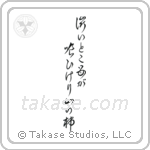
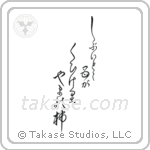
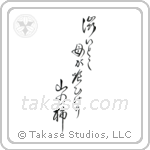
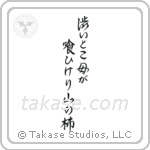
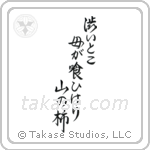
The bitter part eaten by the mother mountain persimmon | shibui toko haha ga kui keri yama no kaki | 澁いとこ 母が喰ひけり 山の柿 |
| Issa | issa | 一茶 |
The mother takes the astringent part for herself so her child can have the sweet end. A Japanese school's book for parents read the verse that way, as a picture of a mother's care. Wild persimmons are chancy, so she tastes first. Read with Issa's own life, the verse becomes one of longing. He lost his mother at three and was treated badly by his stepmother. The mother here may be one he watched other children have.
The word 澁い means astringent, the tannin in a persimmon that dries the mouth. The title's bitter is the looser word for it. Our English keeps the Japanese order, so the mother's part comes first and the persimmons come last. The semi-cursive designs write the first character as 渋, its modern form, where old printings have 澁. One design writes most of the verse in kana.
The English is Timothy L. Jackowski's, made for Takase Studios.
This poem always reminds me of a story in Black Like Me by John Howard Griffin where a mother gave the entire chocolate bar, a very rare treat indeed, to her child. A little chocolate got on the child's face and she wiped it off with her finger and ... took a small taste of the sweet for herself.
The verse is Issa's, set down in his verse diary under the year 1820; the diary is known from a copy finished in 1851 and first printed in 1927, and the verse was already in print in a collected edition of 1902.
We want you to be as happy with the meaning as you are with Master Takase's art. To learn more, visit Philology of 澁いとこ母が喰ひけり山の柿.