

をちこちに滝の音聞く若葉哉 · ochikochi ni taki no oto kiku wakaba kana · Here and there the sound of waterfalls: young leaves
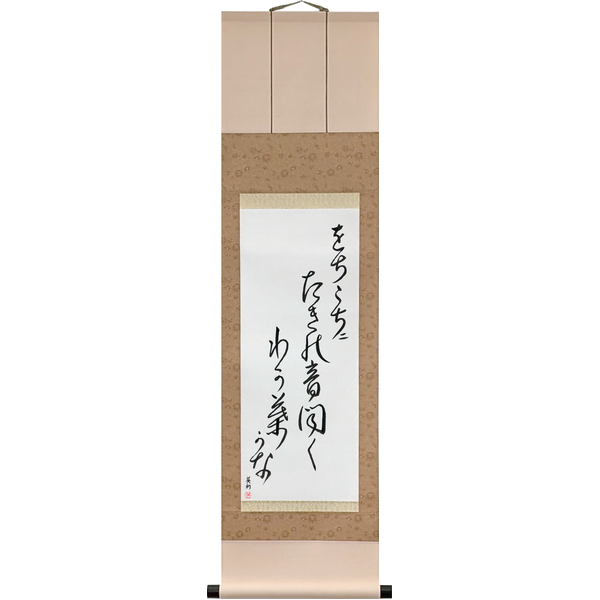
Sold as Buson's, with a house translation credited on the page to its translator by name and a pointer to the product page's notes · Read ochikochi ni taki no oto kiku wakaba kana · Oldest witness Shiki's 1889 manuscript copy of the poets, which gives the verse to 蕪村 and names its source, 新花摘, his diary-collection of 1777; the 1906 and 1925 Buson editions · Sense waterfalls heard from here and there through the young leaves of early summer. 小幡's example of Buson as the poet of the ear; and a verse that Blyth once printed, in another season, under another poet's name.
The text as brushed, and its variants
The scroll carries をちこちに滝の音聞く若葉哉, and every Buson edition has these words; the writing splits in 滝 and 瀧, 聞く and きく, 哉 and かな, which are one verse. Two witnesses read 落葉 for 若葉, fallen leaves for young leaves, autumn for summer. One is 小幡重一's 響 of 1938, where the verse recurs in a different essay, a radio talk on sound in the 万葉集 and 新古今集, by the author whose 耳の詩人 essay printed 若葉 in 1934 and 1936; the leaf, opened at width 3600, prints 落葉, so it is the compositor's or the author's and not the scanner's. The other is Blyth's Haiku, volume 4, where under FALLEN LEAVES the page prints をちこちに瀧の音聞く落葉かな 芭蕉, Ochikochi ni taki no oto kiku ochiba kana, and a paragraph on Bashō's feeling. Fitzsimons's complete Bashō carries no such verse and no verse with 滝の音 but 山吹 and the 西河; no Japanese witness opened gives the words to Bashō; the NDL full-text search for the 落葉 form returns one book in the whole digitized library, 小幡's. So there is one poem, Buson's, in 若葉, and two prints of it in 落葉, one of them under the wrong name. The meter is five, seven, five: を・ち・こ・ち・に, た・き・の・お・と・き・く, わ・か・ば・か・な.
The attribution, as a dated thread
Buson's, at every Buson edition and every anthology that names a poet, and with a source: Shiki's 1889 copy writes 蕪村 and, in his hand, 新花摘, the 句日記 of 1777 that kotobank names among Buson's works; 岩本's 1906 標註, the 蕪村三千句 and 半田's edition of 1925, 潁原's 1935 selection, 小幡's three books, Miyamori 1932, Blyth's History in 1963 and 1964. 半田 closes a group of nine with 右九句、後篇, these nine from the 後篇, a stratum of the corpus and not a book named at the koma. The verse is not in the 1784 蕪村句集 as one instrument shows: the 1935 typeset of the 句集 carries six 若葉 verses and five 瀧 and not this one, while the same instrument finds three other catalogue verses where the woodblock has them; that agrees with Shiki's 新花摘. The one dissent is Blyth's 1952 page, which credits 芭蕉; his own History of Haiku gives it to Buson twice, and the 1952 page is his error. No witness dates the verse; 新花摘's own date, 1777, is the year of the book.
The words
をちこちに is 遠近, here and there, far and near; Miyamori here and there, Blyth from here and there. 滝の音聞く is hearing the sound of waterfalls, plural by the をちこち. 若葉 is young leaves, the fresh green of early summer, a summer season word; 潁原 counts this among more than ten Buson verses on 若葉 and calls them his 積極的 summer. 哉 closes on the leaves. As words the line says: Here and there, hearing the sound of waterfalls: the young leaves.
A history, from the earliest witness
1777. 与謝蕪村, in 新花摘. By Shiki's source note; the book itself is digitized in three copies at the National Diet Library and was not opened. [Shiki 1889, below; ndlsearch 新花摘, 2026-09-05]
1889. 正岡子規, 発句類題全集, his manuscript copy. Under the topic 若葉 (瀧): 瀧の根を深く見せたる若葉かな 宗瑞 (百番句合), いつの間に瀧をつゝみし若葉かな 沈水 (鞍馬筆), をちこちに瀧の音聞く若葉哉 蕪村 (新花摘), 透とをる瀧を櫻に若葉かな 太無 (太無集), then 白雄 and 闌更. The verse with its poet and its source, in Shiki's hand. [NDL pid 2586414, koma 131, read by eye; text at lab.ndl.go.jp/dl/api/page/2586414_131]
1906. 岩本梓石 (ed.), 蕪村俳句全集 標註. 般若よむ庄司が宿の若葉哉, をちこちに瀧の音聞く若葉哉, 出家して親王ます里の若葉哉. [NDL pid 875714, koma 61, OCR; text at lab.ndl.go.jp/dl/api/page/875714_61]
1925. 蕪村三千句; 半田良平 (ed.), 蕪村俳句全集 季題別. In the summer run, をちこちに瀧の音きく若葉かな; 半田 closes the group 右九句、後篇. [NDL pid 924926, koma 38; pid 964212, koma 27; OCR; text at lab.ndl.go.jp/dl/api/page/964212_27]
1934, 1936, 1938. 小幡重一, 聞える音・聞えぬ音; 音の映像; 響. The essay 『耳の詩人』蕪村 in the first two, whose opening page names its debt, この一篇は著者が二十余年の昔高等學校時代に讀んで非常な感興を覺えた佐藤紅綠氏著「蕪村俳句評釋」に負ふところ少くない, this piece owes not a little to 佐藤紅緑's 蕪村俳句評釈, which the author read as a schoolboy twenty-odd years ago; then, over the page, three verses of purely natural sounds, 古井戶や蚊に飛ぶ魚の音くらし, をちこちに瀧の音聞く若葉哉, 五月雨のうつぼ柱や老が耳, and 相對比せしめた二つの音の種類の選擇に蕪村の非凡なる手腕が認められる, in the choice of two kinds of sound set against each other Buson's uncommon skill is seen. The 1938 book quotes the verse again in a talk on sound in the 万葉集 and 新古今集, and there it reads 落葉哉, on its leaf. [NDL pid 1181386, komas 23–24, the title and the debt on 23, the verses on 24, read by eye; pid 1230298, komas 65–66; OCR; pid 1257540, koma 45, printed pages 66–67, read by eye; text at lab.ndl.go.jp/dl/api/page/1181386_24 and 1257540_45]
1935. 潁原退蔵 (ed.), 俳文俳論新選. 蕪村には直ちに若葉を詠じたる者十…餘句あり。皆若葉の趣味を發揮せり, and seven examples ending with this verse. [NDL pid 1053619, koma 96, OCR; text at lab.ndl.go.jp/dl/api/page/1053619_96]
Today. The archive lists twenty-seven books carrying the verse before 1945, eight opened for the account. kotobank's page for 与謝蕪村 gives the poet's dates and names 新花摘 and does not quote the verse. [harvest_index.py lookup --id 262 --year-to 1945; kotobank 与謝蕪村, read as text]
The sense, across a century
The readers hear it. 小幡, a physicist writing on sound, made Buson the poet of the ear and this verse one of three pure natural sounds, its art in setting two sounds against each other; he leaned on 佐藤紅緑's commentary of 1904, not opened. 潁原 set the 若葉 verses beside Bashō's quieter summer as Buson's positive one. Miyamori: a refreshing scene in early summer. Blyth, in his History: here it is the glittering element that joins sound and sight, and then Buson's deep feeling of time. Blyth in 1952, having moved the verse to autumn and to Bashō, heard submergence in Nature, waters falling into boulders and withered leaves falling through cold damp air, the one who stands there, what is he? He is the hearing of the sounds of the waterfall, the seeing of the falling leaves; a fine paragraph on a verse that does not exist.
What is not a source
Blyth's 1952 page is not a witness to a Bashō verse; it is a slip in season and name that his own later books correct, and 小幡's 1938 落葉 is a second slip, unrelated by anything found. 半田's 後篇 is a stratum, not a book. The verse is Buson's and summer's at every Japanese address. The house translation and its product-page notes were not read.
The verse in English
The bilingual dictionaries of the Meiji shelf were not checked for this verse. Yasuda, Hass, Shirane, Carter and Watson were searched on the shelf and do not carry it; Henderson does, page 104, below, and the s41 sentence that listed him with the others was wrong.
1932. Asatarō Miyamori, An Anthology of Haiku Ancient and Modern, Maruzen, Tokyo, page 466, no. 439, 瀧, Taki. をちこちに瀧の音聞く若葉かな 蕪村; Ochi-kochi ni / Taki no oto kiku / Wakaba kana; Waterfalls. Hark! waterfalls are heard, / Here and there, through young leaves. Buson. A refreshing scene in early summer. [docs/research/book_originals, Miyamori 1932, page 466 read by eye from the PDF; no ASIN collected]
1952. R. H. Blyth, Haiku, volume 4, Autumn-Winter, Hokuseido Press, Tokyo, page 357, FALLEN LEAVES. をちこちに瀧の音聞く落葉かな 芭蕉; Ochikochi ni taki no oto kiku ochiba kana; From far and near, / Voices of waterfalls are heard, / Leaves falling. Bashō. The verse in another season under another name, with the paragraph quoted above. [docs/research/book_originals, Blyth 1952 vol. 4, page 357 read by eye from the PDF; no ASIN collected]
1958. Harold G. Henderson, An Introduction to Haiku, Doubleday Anchor. Under the title The Sound: Here… there… / the sound of waterfalls is heard— / young leaves, everywhere, with his word-for-word gloss beneath. [docs/research/papers, Henderson 1958, page 104 by the running head on the page image, read as text and at the page]
1963, 1964. R. H. Blyth, A History of Haiku, volumes 1 and 2, Hokuseido Press. Listening to waterfalls / From here and there: / The young leaves!, with the sentence on sound and sight; and I listen to the sound of the waterfalls / Here and there / Among the young leaves! Both Buson's. [docs/research/papers, Blyth 1963 and 1964, read as text; no ASIN collected]
Today. The house page carries its own translator's lines, credited by name, and its slug reads from far and near, hearing the sounds of waterfalls, young leaves; from far and near is Blyth's 1952 phrase. A rendering of this line has one thing to keep: the sound comes before the leaves, and the leaves are young.
A reading
I read the verse as 小幡 did: a verse of hearing, waterfalls placed by their sounds in a landscape the eye does not need, and the young leaves as the only thing seen, which is why the season word matters and why 落葉 breaks it. Blyth's 1952 page is worth a sentence on the product page only if the page wants to say how a verse can be misfiled by a great reader; otherwise it is the account's. The text, the poet and the romaji stand; the scroll needs no change. What the page could add is the source, 新花摘, and 小幡's reading in one sentence. Signed, 典, 2026-09-05.
How this was read
By eye at width 3600: Shiki's 1889 copy at the 若葉 (瀧) topic; 小幡's 1938 print at pages 66–67; and from the shelf's PDFs, Miyamori's page 466 and Blyth's page 357. By OCR from the archive's text layer: the 1906, 1925, 1934, 1935 and 1936 prints. By text layer from the shelf: Blyth's two History volumes; Fitzsimons's complete Bashō, searched for the verse and its words. As text: kotobank, the NDL catalogue and full-text search. Not opened: 新花摘 at the verse (NDL pids 2539964, 1917821, 1028405); 佐藤紅緑's 蕪村俳句評釈 (1904); 潁原's 1925 蕪村全集; nineteen books the archive lists; the product page's notes. A bracket of the form pid P, koma N resolves as text at lab.ndl.go.jp/dl/api/page/P_N and as an image at dl.ndl.go.jp/api/iiif/P/R<N, seven digits>/full/3600,/0/default.jpg; the two leaves read by eye were fetched at that address. The full apparatus, with every address, is in the account.
Supersession 2026-09-14 (s92)
A read-only worker resolved this account's addresses (citation_checks_2026-09-14/history_ochikochi_262_2026-09-05.check.md): 31 claims, every NDL koma and every Blyth and Miyamori page at the address. Corrected above: Henderson 1958 carries the verse under The Sound, where s41 said he did not; the page is 104, read from the rendered page image's running head (the worker said 105, taking the marker for a footer — Henderson's numbers run at the head of the page, which also confirms the Henderson pages given in 246, 271 and 274 this session). Not yet read by a person.
References
Each witness is cited in the account above, at the frame or entry where it was read. A linked list follows when the record for this text is completed.