



Jiun · 自運 · VD5B
Jiun (自運) is the calligrapher's word for writing from one's own invention. As a Shihan, Master Takase has a hand of her own, and these designs are that hand: she draws freely on the classic scripts to create exactly the look she wants.
をちこちに
滝の音聞く
若葉哉
ochikochi ni
taki no oto kiku
wakaba kana
buson 蕪村
From far and near,
Hearing the sounds of waterfalls,
Young leaves
Here and there the sound of waterfalls, heard: the young leaves.
Master Takase creates this beautiful scroll when your order is placed, personally preparing the ink and brushing your art, which proudly bears her signature and seal. This is an original work of art.
Description
From far and near,
Hearing the sounds of waterfalls,
Young leaves
|
ochikochi ni taki no oto kiku wakaba kana |
をちこちに 滝の音聞く 若葉哉 |
| buson | 蕪村 |
をちこちに滝の音聞く若葉哉 (ochikochi ni taki no oto kiku wakaba kana): here and there the sound of waterfalls, heard: the young leaves.
をちこちに滝の音聞く若葉哉 is a verse of hearing, set in early summer. をちこち, far and near, is the old kana spelling of the word also written 遠近, and it makes the waterfalls more than one. 若葉, the young leaves, is the season word, and 哉 closes the verse on them.
The English is Timothy L. Jackowski's, made for Takase Studios.
Yosa Buson paints an amazing scene of early summer where one is surrounded by the sound of waterfalls (rapids) but only sees the fresh new leaves. On the other hand, because of the ambiguity in the original Japanese one could conclude that no one was there to witness the scene and it was the young leaves themselves listening to the waterfalls!
Calligraphy Notes:
1) Ochikochi in modern Japanese is most commonly written in hiragana as おちこち. One also sees it in kanji as 遠近 (which combine the kanji for "far" and "near"). In these designs we use the older kana spelling をちこち, with を where modern Japanese writes お. Both spellings are read "ochikochi".
2) The final "kana" can be written either in hiragana as かな or in kanji as 哉. The meaning is the same.
Translation Notes:
をちこちに
滝の音聞く
若葉哉1) をちこち (ochikochi) - "distance; far and near; here and there".
2) に (ni) - this is a Japanese part of speech indicating location.
Harold G. Henderson explains ni as, "A preposition with many uses (at, in, to, by, for, etc.). These are usually indicated sufficiently in the literal translations. It is, however, important to realize that when ni is used after words indicating places, there is no action at that place".
3) 滝 (taki) - "waterfall; rapids"
4) の (no) - "indicates possessive". In this case, acts like a "'s" making this "waterfall's" or "waterfalls'".
5) 音 (oto) - "sound; noise" or "sounds; noises"
Thus 滝の音 (taki no oto) is "Waterfalls' sound" or "sound of waterfalls".6) 聞く (kiku) - to hear; to listen
7) 若葉 (wakaba) - new leaves; fresh verdure
8) 哉 (kana) - how!; what!; alas!
According to Harold G. Henderson kana is, "A special kireji used to mark the end of a haiku. It has an undefinable emotional effect, sometimes like that of a soft sigh, more often that of a preceding 'Ah!' or 'Oh!' It usually follows a noun that the first part of the poem has described. As normal Japanese sentences end with a verb, kana may be considered as in a sense substituting for it."
In her delightful book, "The Haiku Apprentice: Memoirs of Writing Poetry in Japan", Ms. Friedman writes:
"Kireji are easy to grasp, she [Momoko] said. These words have no concrete meaning but are sounds that can add emphasis or alter the rhythm of a poem. The most common cut-words are the sounds keri, kana, and ya, although there are many others, too."In this same sense then "wakaba kana" makes the word "young leaves" last for the full five syllables of the final line of the haiku.Sometimes I would find kireji translated to English as a dash, an exclamation point, or a comma. Some translators insert the exclamation 'Ah' or 'Oh!' in the place of a kireji. A common phrase in Japanese haiku, for example, is samusakana or "the cold kana." By tacking kana on to the end, the word "cold" lasts for a full five syllables, or the duration of one line in a five-seven-five haiku."
The verse is Buson's, set down in his verse diary 新花摘 (Shin hanatsumi) under the eighth day of the fourth month of 1777, the day the diary begins, and printed in 1797, after his death, in a woodblock carved from his own manuscript.
We want you to be as happy with the meaning as you are with Master Takase's art. To learn more, visit Philology of をちこちに滝の音聞く若葉哉.
Delivery
Your scroll is brushed when you order it and completed within 1 to 3 business days. It ships by USPS Priority Mail from Master Takase's studio in Washington State, boxed and ready to hang, with a printed page giving the art's English, romaji and Japanese.
Sending it as a gift? Add your message at checkout and we will include it.
Shipping is calculated at checkout from your address; within the United States it is $13 to $23. We ship worldwide, and any import charges for your country are shown at checkout before you pay.
Every order is covered by our 30-day money-back guarantee. If your scroll arrives damaged, or we made an error, we replace it or refund you in full, including shipping. Refund policy
About Our Scrolls
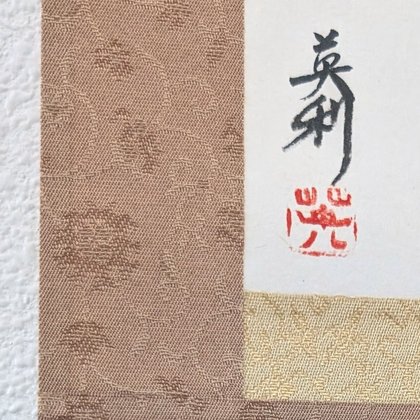
Master Japanese Calligrapher Eri Takase brushes your scroll by hand when you order it. Each scroll bears her red seal, 英利, and her signature.
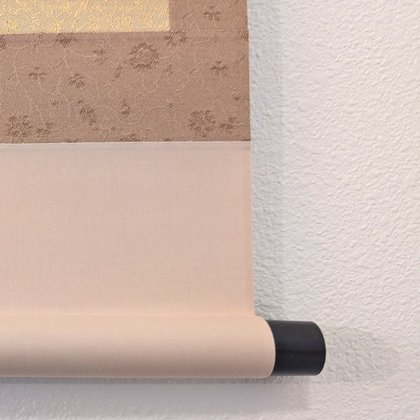
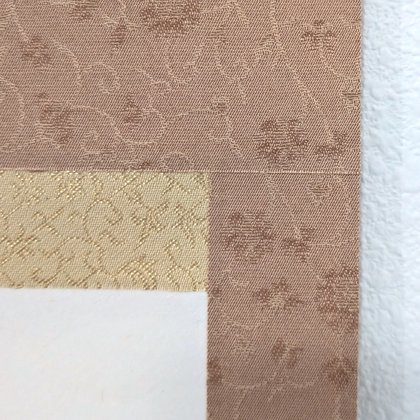
The scrolls are 12 1/4" W × 43" H (31 × 109 cm), with woven damask borders and layered Japanese paper, designed to last generations. The scrolls themselves are made by a scroll maker in Gifu, Japan, and we have worked with them for over two decades.
Eri Takase was born and raised in Osaka, Japan, and holds the rank of Shihan, the highest rank in Japanese calligraphy, from the Bokuteki-kai and the Bunka-shodo. About Master Takase
Related products

Buson - In loneliness, there is joy too, An autumn eveさびしさのうれしくも有秋の暮sabishisa no ureshiku mo ari aki no kure

Buson - A flash of lightning, The sound of dew, Dripping down the bamboos稲妻にこぼるる音や竹の露inazuma ni koboruru oto ya take no tsuyu

Buson - An evening orchid, Hidden in its scent, The flower's whiteness夜の蘭香にかくれてや花白しyoru no ran ka ni kakurete ya hana shiroshi
