

盗人にとり残されし窓の月 · nusubito ni torinokosareshi mado no tsuki · The thief left it behind: the moon in the window
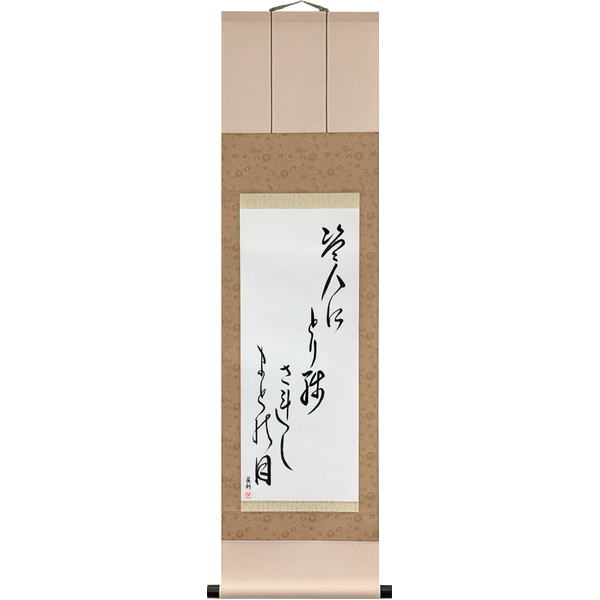
Sold as Ryōkan's, with the English The thief, / left behind, / the moon in my window and a note that 盗人 is read nusubito, also nusutto · Read nusubito ni torinokosareshi mado no tsuki · Oldest witness the 1918 良寛全集, read on its leaf: under 俳句, the headnote 五合庵へ賊の入りたるあとにて, after a thief had got into the 五合庵, on its own line, and ぬす人に取り殘されし窓の月 beneath it; nothing before 1918 was found, and the pupil's collection of 1835 is held at NIJL without images · Sense what the thief left behind: the moon in the window.
The text as brushed, and its variants
The scroll carries 盗人にとり残されし窓の月, and the record carries one text in three writings and one real departure. ぬす人 / 盜人 / 盗人. The 1918 全集 and the books that copy its headnote write ぬす人; the 1918 lecture, the 1930 literary history and the 1940 Zen lectures write 盜人; the scroll writes the modern form. 取り殘されし / とり殘されし / とり残されし are writings of one word. The 1938 place-name dictionary writes 盜賊, a prose writer's substitution that no verse witness shares. Miyamori's とりのこされたり is a different verb form, たり for し, and no Japanese witness has it; it is his or his printer's, and Blyth and Carter romanize the し that every Japanese book prints. The sense holds across all of them. The meter is five, seven, five: ぬ・す・び・と・に, と・り・の・こ・さ・れ・し, ま・ど・の・つ・き.
The attribution, as a dated thread
Ryōkan's, on the testimony of the 1918 collected edition, which prints the verse under a headnote naming his hut, and of every book after it; no witness before 1918 was found. The NDL's full-text search over its digitized library returns nothing older for any spelling, and the collection his pupil 貞心尼 made, 蓮の露 (self-preface 1835), is held at NIJL in one copy without images, so the earliest layer of the record was not opened. The 1937 reader that strikes the falling-leaves verse from his canon on the strength of Issa's diary keeps this one among the few it accepts as his. Miyamori in 1932 gave it to him in English with a different verb form, Blyth in 1942 and 1952 with the received text, Carter in 1991 with the headnote; none argues the attribution and none had cause to. The house page's English is Tim's arrangement of Blyth's three nouns in his order, a title adapted from Blyth and verbatim to no one on the shelf; under Tim's ruling of 2026-09-14 it carries an after Blyth credit on the page, which is 照's string.
The words
盗人に is by the thief, the に of the agent with a passive; read nusubito, as the page says, the colloquial contraction being nusutto, and the meter takes either at five. とり残されし is left behind, 取り残す in the passive with the attributive し of the classical perfect: the thing left is the moon, the one who left it is the thief, and the whole line is a relative clause on 窓の月, the moon in the window, an autumn word by the moon. As words the line says: the moon in the window, left behind by the thief. 土田杏村's gloss of 1924 is the Japanese sense in one sentence: whatever a thief steals is a thing self-interest can touch; only Ryōkan's sense of beauty stands apart from self-interest, and no thief can do anything with that.
A history, from the earliest witness
1918. 玉木礼吉 (ed.), 良寛全集, 良寛会; the 俳句 section. Read on its leaf: 俳句 / 五合庵へ賊の入りたるあとにて / ぬす人に取り殘されし窓の月、 / 渡部村阿部氏に宿し鰯賣の走るを見て / いくつれかおよひてゆくやいわしうり、, printed page 241. The headnote stands on its own line above the verse, as the editor's frame; it names a burglary and the hut on 国上山 and nothing else. [NDL pid 957395, koma 128, printed page 241, read by eye; text at lab.ndl.go.jp/dl/api/page/957395_128]
1918. 新井石禅, 青年指導修養講演, a Zen abbot's lectures to young men. Read on its leaf, printed page 69: 或時泥棒が何か取る積りで這入つて來た見ると巾着も米櫃も簞笥も皆空つぼう、大變な見込違ひブツ〳〵いひ乍らすご〳〵と歸らうとするのを和尙が呼止めて折角來たものぢやから何か持つて行け、持つて行けつて何にもないぢやありませんか、茲にまだ一遍しか着ない布子があるから這入つた紀念に持つて行け、そんな抹香臭い物はいやです、さう云はないで持つて行け、折角の思召止を得ないから頂戴致しますと泥棒が出て行くのを戶口で見送つて道中不用心だから氣を付けろよ、室に戾つて見ると窓一杯に月影が映つて居るあゝ泥棒奴此月影の妙趣を知らぬと見ゆる不憫なものぢといひつゝ 盜人にとり殘されし窓の月 と詠じた, one time a thief came in meaning to take something and found purse, rice-bin and chest all empty; grumbling at his miscalculation he was slinking off when the master called him back: you came all this way, take something; take what, there is nothing; here is a padded robe I have worn only once, take it as a keepsake of your visit; I don't want a thing that smells of incense; don't say that, take it; the thief accepts, and the master sees him off at the door: the road is unsafe, mind yourself; goes back into the room and finds the window full of moonlight: ah, the thief, poor fellow, seems not to know the beauty of this moonlight; and he composed the verse. The leaf prints 泥棒奴 with furigana, 妙趣, 見ゆる and 不憫 where the OCR layer reads 泥棒取, 妙慈, 見わる and 不盛. The robe telling, in speech, the same year as the 全集. [NDL pid 959268, koma 36, printed page 69, read by eye; text at lab.ndl.go.jp/dl/api/page/959268_36]
1920–1926. 菅原洞禅; 野々村直太郎. 菅原's 改造の基礎 (1920) and 日本禅門偉傑伝 (1924): 更に再び賊の入りたるあとに歸り來て、ぬす人に取り殘されし窓の月, and again, coming back after a thief had got in; 野々村's 禅と念仏 (1926): たま〳〵賊の爲にその大切の布子を盜み去らるゝやぬす人に取り殘されし窓の月と詠じた, when a thief happened to carry off his precious padded robe he composed. [NDL pid 963224, koma 147; pid 944045, koma 144; pid 1019168, koma 148; OCR, the iteration marks as read]
1924, 1929. 土田杏村, 教育思潮叢書; 福岡師範学校附属小学校, 教育の純粋相と真指導. 土田: 五合庵へ賊の入りたるあとにてぬす人に取り殘されし窓の月 たゞ此の一句であるが、味ひはなか〳〵に盡きない … 盜人の盜む樣なものはすべて利害心の關與し得る品物である。ひとり良寛の美意識だけは、さうした利害心を離れたしろものですから、いかなる盜人も其れをどうする譯にはいかない, just this one verse, but its savor is far from exhausted; and the gloss above. The Fukuoka school reused it five years later as a lesson in 心の磨き, polishing the heart: まんまるい月が窓に浮んでゐる。なんと澄んだよい情趣だ. [NDL pid 937890, koma 116; pid 1464446, koma 73; OCR]
1930. 福井久蔵, 近世和歌史. 乙子祠畔の草庵で唯一枚しかない古布子を量賊にくれて、窓にさし入る月を眺め、「盜人にとり殘されし窓の月」と口ずさんだ, in his thatched hut by the 乙子 shrine he gave a thief the one old padded robe he owned, gazed at the moon coming in at the window, and murmured the verse; the hut moved from 五合庵 to the shrine below it. [NDL pid 1127659, koma 201, OCR]
1937. 三木清 et al. (eds.), 人生読本, the Ryōkan reader. After striking たくほどは風がもて來る落葉かな from his canon on Issa's 七番日記: 彼獨自の味はいを見せた作品としては、有名なも,五合庵に賊入りたる後にてぬす人に取り殘されし窓の月の俳句と、霞立つ長き春日を … の歌と … の外には、殆どない, as works showing his own flavor there is almost nothing beyond the famous verse under its headnote, the long-spring-day poem, and the exchange with 貞信尼. [NDL pid 1220735, koma 30, OCR]
1938. The gazetteers and the place-name dictionary. 躍進長野県新潟県総覧: 五合庵に盜人が忍び入つた。所が何一つ盜む物もないのに、盜人もあきれ返つた。然るに良寛は、其は盜人に氣の毒であると云つて、わざと蒲團からころがり出たので、盜人は好機逸すべからずとなし、蒲團を抱へて逃げ去つた … ぬす人にとり殘されし窓の月と詠んだと云ふ, a thief crept into the hut, found nothing to steal and was dumbfounded; Ryōkan said that was hard on the thief and rolled himself off his futon on purpose, and the thief seized the chance and ran off with it … so it is said: the futon telling. The 日本地名大辞典, under 島崎村, writes 「盜賊にとり殘されし窓の月」と口ずさめ. [NDL pid 1053297, koma 111; pid 1457668, the twin printing; pid 1116270, koma 203; OCR]
1940. 加藤咄堂, 碧巌録大講座, 良寛和尙と盜賊. The robe telling once more, 一夜盜賊に見舞れた … こゝにたつた一枚、大切にしてゐる綿入ぬの布子があるから (the OCR layer carries a stray token inside 綿入ぬの布子)、これをお持ちかへり下され … 盜賊を見送るために窓を開けると、皎々たる月が … 盜人にとり殘されし窓の月と一句を詠んだ--といふ有名な話がありますが, there is the famous story that …, set beside 南泉, who gave away everything for the monks. [NDL pid 1246931, koma 133, OCR]
1941, 1946. After the record. A novelized life, 善き人々 (1941), has the verse written on a sliding door in the poet's own hand, ぬすびとに取り殘されし窓の月, and a visitor admiring 唐紙に書かれた良寛さまの書; an essayist of 1946, 静に思ふ, retells the futon telling, has the master regret that the night's visitor was not 『東村の叟』, the old man of the east village, and then laugh: 『なるほど、何を持つて行つても、これだけは持つて行けぬわい。ありがたいことぢや。』, of course, whatever they carry off, this one thing they cannot carry; a blessing. [NDL pid 1042908, koma 19; pid 1130452, koma 42; OCR]
Today. The harvest index lists fifteen books carrying the verse; the NDL full-text search returns eight for 取り残されし窓の月 and seven for とり残されし窓の月, none before 1918. [harvest_index.py lookup --id 272 --year-to 1945; lab.ndl.go.jp/dl/api/book/search, four keywords, 2026-09-05]
The sense, across a century
The 1918 editor gave the verse a frame and no story; the 1918 preacher gave it the robe; the gazetteer of 1938 gave it the futon; Miyamori in 1932 gave it a family distressed the morning after. The three tellings do not agree on what was taken, when the verse was made, or where the hut stood, which is what a legend looks like, and its earliest attestation among what was opened is 1918, in a lecture and in the 全集's bare headnote. 土田 in 1924 read it as the beauty a thief cannot reach; the 1946 essayist as the one thing that cannot be carried off. Blyth in 1942: the robbed that smiles steals something from the thief, from Othello, and Ryōkan stole the moon from the thief, and smiled in seventeen syllables; in 1952: in any other poet but Ryōkan this verse might be suspected of affectation, but our knowledge of Ryōkan's daily life enables us to read this as it was written, in complete simplicity and truth, with Cory's Heraclitus, For Death, he taketh all away, but them he cannot take. 加藤 in 1940 set it beside 南泉 as a Zen anecdote.
What is not a source
The stories are legend with a 1918 floor, and the page tells none of them, which is right. Miyamori's とりのこされたり is his own text. Nothing in the poet's hand, and nothing from 蓮の露, was opened: the one NIJL holding has no images and the 定本全集 was not on the desk. The page's English is derived from Blyth's and needs no credit; what it needs is its object back, below.
The verse in English
The bilingual dictionaries of the Meiji shelf were not checked. Henderson, Hass and Shirane do not carry it on the shelf.
1932. Asatarō Miyamori, An Anthology of Haiku Ancient and Modern, Maruzen, Tokyo, printed pages 602–603, THE MOON OF THE WINDOW. 盗人に とりのこされたり 窓の月 良寛; The moon at my window is left / Unstolen by the thief. Ryōkwan, with the morning-after telling and a biography giving 1756–1831. [docs/research/papers, Miyamori 1932, printed pages 602–603 by the running heads of the file's page-marked layer, text layer (s43 cited 748, the PDF index); no ASIN collected]
1942, 1952. R. H. Blyth. Zen in English Literature and Oriental Classics, Hokuseido, page 298: The thief / Left it behind / The moon at the window, with the Othello line; Haiku, volume 3, Summer–Autumn, 1952, page 395: Nusubito ni / torinokosareshi / mado no tsuki — The thief / Left it behind,— / The moon at the window. Ryōkan, with the paragraph quoted above. [docs/research/papers, Blyth 1942 and 1952, text layer; no ASIN collected]
1991. Steven D. Carter, Traditional Japanese Poetry, Stanford, no. 1079. Written after thieves had broken into his hut — At least the robbers / left this one thing behind— / moon in my window, with the romaji; the headnote rendered. [docs/research/papers, Carter 1991, text layer; no ASIN collected]
Today. The house page's The thief, / left behind, / the moon in my window is Blyth's three nouns in his order with his verb made a participle and his it dropped, and the change costs the sentence its object: Blyth's Left it behind says the thief left the moon; the page's left behind can be read as the thief being left behind, which is the opposite. One word restores the grammar of とり残されし: The thief / left it behind: / the moon in my window, or Carter's shape.
A reading
I read the verse as the 1918 editor framed it and as 土田 glossed it: not a story about a thief but a sentence about what cannot be stolen, with the thief as its grammatical agent and the moon as its subject. The three tellings are what a century did with a headnote of eleven characters, and the page is right to tell none of them; the headnote itself, after a thief had got into the 五合庵, is the poet's own frame as far as the record goes and could stand on the page. The text is one text; the scroll's is the 全集's in modern writing. What the page must do is recover the object of its English verb. What would ground the account further is 蓮の露 at the verse, for a text and a headnote in the pupil's hand before 1918. Signed, 典, 2026-09-06, s43.
Eri
Nothing to ask.
How this was read
By eye at width 2400 from NDL: the 1918 全集 at koma 128; the 1918 lecture at koma 36, cropped to the OCR box carrying the story. By OCR from the archive's text layer, per the account and the reader: the 1920–1946 witnesses. As text: kotobank on the poet, the NDL full-text search on four spellings, the NIJL work and holdings records for 蓮の露 (WID 1600426, one holding, no images), the shelf's text layers for Miyamori, Blyth and Carter. Not opened: 蓮の露 in any form; the 定本良寛全集; the 1941 and 1946 books beyond the verse's page. A bracket of the form pid P, koma N resolves as text at lab.ndl.go.jp/dl/api/page/P_N and as an image at dl.ndl.go.jp/api/iiif/P/R<N, seven digits>/full/3600,/0/default.jpg. The full apparatus, with every address, is in the account.
Supersession 2026-09-14 (s92)
A read-only worker resolved this account's addresses (citation_checks_2026-09-14/history_nusubito_272_2026-09-06.check.md): 25 claims; all fourteen NDL komas and the four English renderings resolve verbatim. Corrected above: Miyamori's entry is on printed pages 602–603 by the running heads, not 748 (the PDF index). The house title, adapted from Blyth, is now said to be so for the page's credit under Tim's 2026-09-14 ruling. Not yet read by a person.
References
Each witness is cited in the account above, at the frame or entry where it was read. A linked list follows when the record for this text is completed.