

夏草や兵どもが夢の跡 · natsukusa ya tsuwamonodomo ga yume no ato · Summer grass. The trace of the warriors' dreams
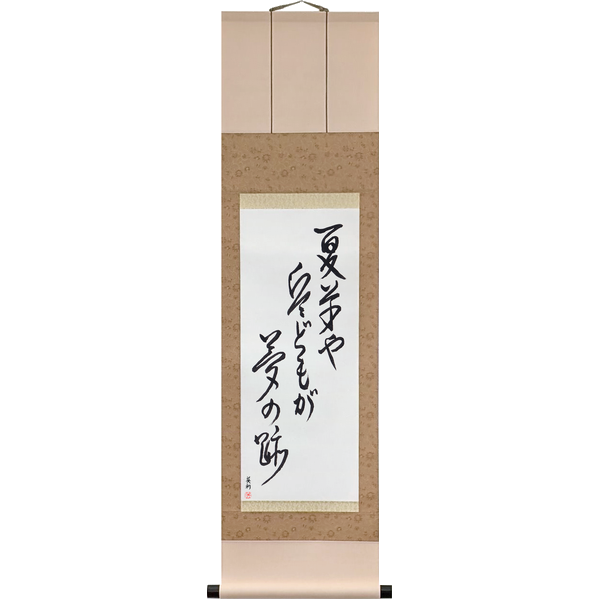
Sold as Bashō's verse at Hiraizumi, with a page that names the place, the Fujiwara, the Narrow Road and the old word for warrior, and carries no English · Read natsukusa ya tsuwamonodomo ga yume no ato · Oldest witness 奥の細道 itself, where the verse stands at Hiraizumi in the entry for the thirteenth day of the fifth month of 1689; read here in five annotated editions, not at an Edo leaf · Sense summer grass grows where the warriors fought and dreamed; what is left of them is the grass. The page is right in every clause, and the record adds a date to the day, a second text of Bashō's own that carries the verse, and a Japanese afterlife a century older than the English one.
The text as brushed, and its variants
The scroll carries 夏草や兵どもが夢の跡, and the witnesses that quote the verse as a verse write one text. 兵ども and 兵共, 草 and 艸, 跡 and あと, つはもの and 兵 are writings: the five 奥の細道 editions and 島田's 1927 全集 print 夏草や兵どもが夢の跡; 萩原 in 1942 writes 夏艸; the 1931 一代集 writes 兵共; the 1933 children's encyclopedia writes 夢のあと with the old word glossed in kana above; Miyamori prints つはものどもが夢のあと. The fair copy 柏木素龍 made for the poet in 1694, read at the leaf in its 1932 photographic facsimile, writes 夏草や兵どもか夢の跡, the particle a cursive か without dakuten, read が by ordinary practice and plainly not の. Two Edo witnesses and one traveler write の for が, and none of them is quoting the verse: 京伝 in 1813 made 夏草や兵どもの夢路の落人 a chapter title, a gazetteer borrowed 兵どもが夢の跡 for a castle ruin, and a traveler of 1897 remembered the verse as 兵どもの夢のあと, read by eye. The first English readers were given that の, not the manuscript's が: Chamberlain's romaji in 1902 and again in 1905, where he also set the Japanese in type as 夏草やつはもの共の夢の跡, Dickins copying Chamberlain in 1906, and Nitobe in 1909, whose own footnoted Japanese is 夏草や武者どもの夢の跡, with 武者 for 兵 as well. Miyamori in 1932 is the first English book to print が. The meter is five, seven, five: な・つ・く・さ・や, つ・わ・も・の・ど・も・が, ゆ・め・の・あ・と.
The attribution, as a dated thread
Bashō's, in his own book, on a day he dates. The 奥の細道 entry: the glory of three generations of Fujiwara 一睡の中にして, gone in the space of one sleep; 秀衡's seat 田野に成りて, turned to rice paddies and wild fields; then the climb to 高館, the hill where 義経 died with his retainers, and the prose that leads to the verse, quoted below. Shirane's index gives the day as the thirteenth of the fifth month of Genroku 2, June 29, 1689; Fitzsimons heads the verse At Takadachi in Ōshū Province and dates it Summer, 1689. A second text of Bashō's own carries the verse, and the record had not placed it until the 1931 一代集 was read by eye: a short prose piece headed 御曹子, the young lord, on 牛若丸, who left the temple at Kurama at fifteen and whose journeys ended as the earth of this same hill, 此高館の土となりて; it closes with the verse signed 旅士 はせを, the traveler Bashō, and the editor dates the piece 元禄二年作 and names its source as 洒堂's 白馬集. So the verse stands in two of the poet's own texts, the travel journal and a prose piece for the hill's dead prince, both of 1689. No one has ever given it to anyone else; the English translators, eleven of them on the shelf counting Miyamori's five, all name Bashō.
The words
夏草や is summer grass, the summer season word, with や setting it as the scene. 兵ども, tsuwamonodomo, is the warriors, the older word for a fighting man, as the page says, and ども the plural that can carry contempt or pathos; the 1933 encyclopedia glosses it in kana above the line for children. 夢の跡 is the trace, site, aftermath of a dream; Shirane glosses 跡 as site, aftermath, trace, track and 夢 as dream, ambition, glory, and says the poem depends on polysemous key words; Miyamori calls the line a puzzle to most readers for its ellipsis. The translators show the range of the phrase: all that remains in Blyth, Nitobe, Carter and Hass; traces in Shirane and Revon; glory's aftermath in Fitzsimons; a relic in Chamberlain; and Porter's soldiers asleep within the grave, still dreaming. The 1936 school edition gives the plain sense: 嘗て忠義な士たちが勇戰し功名を立てた、その功名も夢の如くはかなく過ぎ去りてあとかたもなく, the loyal men who once fought bravely and won their names; even that glory passed like a dream and left no trace, and one sees only the heedless summer grass, green. As words the line says: Summer grass: the trace of the warriors' dreams. The page's what is left of them is grass is that sense.
A history, from the earliest witness
1689. 松尾芭蕉, 奥の細道, the Hiraizumi entry, as 志田義秀 prints it in 1926. 三代の榮耀一睡の中にして、大門のあとは一里こなたにあり。秀衡が跡は田野に成りて、金鷄山のみ形を殘す。先づ高館にのぼれば、北上川南部より流るゝ大河なり。衣川は和泉が城をめぐりて、高館の下にて大河に落入る。泰衡等が舊跡は、衣が關を隔てゝ南部口をさし堅め、夷をふせぐと見えたり。偖も義臣すぐつて此の城にこもり、功名一時の叢となる。國破れて山河あり、城春にして草靑みたりと、笠うち敷きて時のうつるまで泪を落し侍りぬ。 The glory of three generations passed in the space of one sleep; the site of the great gate is a league this side of here. 秀衡's seat has turned to paddies and fields; only 金鷄山 keeps its shape. First I climbed 高館: the 北上 is a great river flowing down from 南部; the 衣川 circles 和泉's castle and falls into the great river below the hill. 泰衡's old seat, beyond the 衣 barrier, guarded the 南部 road against the northern tribes. Here the chosen loyal men shut themselves in this castle, and their glory became in a moment the grass. "The country broken, the hills and rivers remain; the castle in spring, and the grass is green": I spread my hat and wept until time passed. Then the verse, and after it 曾良's 卯の花に兼房みゆる白毛哉, in the white deutzia I see 兼房's white hair. 志田's margin glosses Du Fu, 國破れて云々—杜甫、春望「國破山河在、城春草木深」, and 兼房 as 義経's old retainer who fought with his white hair streaming and died. [NDL pid 947714, komas 55–57, koma 56 read by eye, printed pages 96–97; text at lab.ndl.go.jp/dl/api/page/947714_56. The passage also in 島田 1927, 萩原 1929, 潁原 1935 and 西山 1936, OCR: pids 1194541 koma 98, 1189216 komas 53–55, 1053619 komas 33–35, 1275207 komas 39–40]
1689. 松尾芭蕉, 御曹子, a prose piece, as the 1931 一代集 prints it. さてもそのゝち御さうしは、十五と申はるの比、鞍馬の寺を忍ひ出、あづまくだりの旅衣、はるけき四國西國も、此高館の土となりて、申ばかりはなみだなりけり。 And so, after that, the young lord, in the spring of his fifteenth year, slipped out of the temple at Kurama in a traveler's robe for the east; the far provinces of the west and of Shikoku too, all became the earth of this 高館, and there is nothing to say of it but tears. Then 夏草や兵共が夢の跡 旅士 はせを. The editor's note dates the piece 元祿二年作, names 洒堂's 白馬集 as carrying it, and records 「此一章得『古翁眞蹟』如『墨末』乾」也, that a copy was taken from the old master's own hand while the ink was fresh. [NDL pid 1190041, koma 34, printed pages 644–645, read by eye; text at lab.ndl.go.jp/dl/api/page/1190041_34]
1694. 柏木素龍's fair copy of 奥の細道, the 素龍清書本 that Bashō kept, as photographed in 1932. The Hiraizumi passage in Sōryū's cursive: 偖も義臣すぐつて此城に籠り功名一時の叢となる 国破れて山河あり城春にして草青みたりと笠打敷て時のうつるまで泪を落し侍りぬ, then in its own column 夏草や兵どもか夢の跡, then Sora's 卯の花 verse and 兼て耳驚かしたる二堂開帳. 兵 and 跡 in kanji, ども in kana, the particle a か without dakuten. The closest witness to the poet's hand that is open online, and it writes が. [NDL pid 1175286, koma 41, printed pages 52–53, read by eye at width 3600; the cursive read by the seat, not by a paleographer]
Edo, undated. 松亭金水 and 広重, 絵本江戸土産, a picture-book of Edo. The phrase 兵どもが夢の跡 borrowed, without the poet's name, for the ruin of the 里見 castle at 国府台: by this book's day the verse was the Japanese phrase for any ruin. [NDL pid 8369306, komas 20–22, OCR; text at lab.ndl.go.jp/dl/api/page/8369306_21]
1813. 山東京伝, 雙蝶記, a tale, illustrated by 豊国. 夏草や兵どもの夢路の落人, summer grass: fugitives on the warriors' dream-road, as a chapter title in a tale of 北条時行 (the text at koma 12 prints 兵 with the reading つはもの above it; the contents leaf at koma 11 carries the reading only, 夏草やつはものどもの夢路の落人), and 夏草の露と消にし夢の跡 as an allusion in the text. The verse remade for a story a century and a quarter after it was written. [NDL pid 2554013, komas 11–12, OCR; text at lab.ndl.go.jp/dl/api/page/2554013_11 and 2554013_12]
1897. 西川太次郎, 全國週游日記, a traveler's diary. At Hiraizumi, the old castle and 中尊寺 visited, and 「夏草や兵どもの夢のあと」の句あるは此近郊とす, the verse "summer grass, the trace of the warriors' dreams" belongs to these parts; the account places it under an old tree at 衣が關, 衣が關古樹の下に, and says nothing of how it stands there; the の for が is a traveler's memory. [NDL pid 762105, koma 25, printed pages 42–43, read by eye; text at lab.ndl.go.jp/dl/api/page/762105_25]
1927 to 1942. 島田青峰; 小原国芳's 児童百科大辞典 of 1933; 伊藤松宇's 俳諧雑筆 of 1934; 西山隆二's school edition of 1936; 萩原蘿月 in 1929 and 1942. The verse in a kigo run, in a children's encyclopedia with つはもの glossed, in an essay on Bashō climbing the hill 弔ひ, to mourn, with the verse, in a school reader with the gloss quoted above and the note that Bashō changed Du Fu's 草木深 to 草青みたり, and there the craft lies. [NDL pids 1194541 koma 41; 1720355 koma 120; 1235614 koma 43; 1275207 komas 39–40; 1189216 komas 15–16; 1899874 koma 123; OCR]
Today. The Britannica entry on kotobank gives the poet's dates; its separate 奥の細道 entry dates the journey to 1689. The archive lists two hundred and eleven books carrying the verse before 1945, twelve opened. [kotobank 松尾芭蕉-16739 and 奥の細道-40061, read as text; harvest_index.py lookup --id 275 --year-to 1945 --located-only]
The sense, across three centuries
The prose around the verse fixes its sense and nobody has moved it: the warriors' glory became the grass, and the poet wept. What the readers add is what kind of thing the verse is. Shirane in 1998 reads it against the Noh play 邯鄲 and 李華's 弔古戦場文, the landscape as the memory of a text; Konishi, carried by Ueda and Fitzsimons, says for the first time in the history of haikai, an idea has become the subject of a poem; Miyamori in 1932 warns that the ellipsis lets a casual reader take it as grasses wave where the warriors dreamed of glory when the real sense is heroic deeds which have proved empty as in a dream. The one live question is in 夢の跡, and the translators show it: is the dream over, so that the grass is all that remains, or is it still being dreamt, so that the grass is its trace and Porter's soldiers sleep beneath it dreaming? No Japanese reader opened takes Porter's reading, and it is a real reading of the Japanese.
What is not a source
Du Fu's 春望 is the text Bashō quotes on the hill, and the 1936 editor is right that the craft is in the one word he changed; it is the verse's company, not its origin. The Noh play and 李華's lament are Shirane's frame. Kyōden's chapter title, the gazetteer's borrowed phrase and the traveler's stone are the verse's Japanese afterlife, and they show that it had become the phrase for a ruin a century before it became one in English; they are not sources for it. Its sources are the poet's two texts of 1689, read here in twentieth-century editions and not at an Edo leaf.
The verse in English
The verse entered English through Basil Hall Chamberlain's 1902 paper to the Asiatic Society, and for thirty years every English book that carried it either quoted him or worked from his romaji, which writes の. The bilingual dictionaries of the Meiji shelf were not checked for this verse. Henderson, Keene, Reichhold and Ueda are not on the shelf; the haiku-lineage rows of the want list, 135 to 185, are not yet delivered, so the layer after 1932 is the shelf's and not the lineage's. (SUPERSEDED s90, 2026-09-14: they are on the shelf since the eighth delivery, and the layer after 1932 is read below in § Supersession 2026-09-14.)
1902. Basil Hall Chamberlain, "Bashō and the Japanese Poetical Epigram," Transactions of the Asiatic Society of Japan, volume 30, Rikkyo Gakuin Press, Tokyo, page 305, number 46. Natsu-gusa ya / Tsuwa-mono-domo no / Yume no ato; Haply the summer grasses are / A relic of the warriors' dream. Then his gloss: That is, "Of the warriors' dream of power and glory, nought remains but the high grasses waving o'er the moor that is their tomb." Introduced as Bashō's lines composed on one of Japan's most famous battle-fields, now a desolate moor. The earliest English rendering the harvest holds, and the one Miyamori calls Chamberlain's relic. [archive.org transactionsasi20japagoog, leaf 333, read by eye; three further copies in the harvest]
1905. Basil Hall Chamberlain, A Practical Introduction to the Study of Japanese Writing (Moji no Shirube), second edition, Crosby Lockwood, London, and Kelly & Walsh, Yokohama, pages 223–224, number 8. The Japanese set in type on page 223, 夏草やつはもの共の夢の跡, and on page 224 the romaji with の and The summer grasses are what remains of the warriors' dreams. (Composed on an ancient battle-field.), beside 古池 and 物いへば as reading exercises. A plainer second rendering by the same hand. [archive.org practicalintrodu00cham, leaves 237–238, read by eye]
1906. F. Victor Dickins, Primitive & Mediaeval Japanese Texts, translated into English, Clarendon Press, Oxford, "Epigrams — Hokku," page 310, number XXXII. Natsu-gusa ya / tsuwa-mono-domo no / yume no ato; Nought but summer grasses tall / fallen warriors' dreams recall. (The vanity of glory.) Page 309 says the texts are taken verbatim from Professor Chamberlain's admirable paper and the translations based on those there given; so one witness for the text and a second for the rendering, a rhymed couplet. [archive.org primitivemediaev00dickuoft, leaf 454, read by eye]
1909. 新渡戸稲造 Inazō Nitobe, Thoughts and Essays, Teibi Publishing Company, Tokyo, "In Hiraizumi," page 153. My thoughts are again with the dead, as my feet wander among these fields on the banks of the Kitakami and the Koromo … Even if the master epigrammatist sings,— "The summer grass!— / 'Tis all that's left / Of ancient warriors' dreams," I will not believe that the waving weeds are all that remain of strong men's aspirations and endeavors. Their brave deeds are ours still. His footnote prints the Japanese as 夏草や武者どもの夢の跡. The piece is undated; the one before it is signed Sakata, January 1906. The rendering Miyamori calls Nitobe's, at its first printing. [archive.org thoughtsessays00nito, leaf 171, read by eye; second copy thoughtsessays00nitouoft, leaf 173]
1921. Paul-Louis Couchoud, Japanese Impressions, with a note on Confucius, translated by Frances Rumsey, preface by Anatole France, John Lane, London, "The Lyric Epigrams of Japan," page 65. Or above all by the grave and perpetual thought of death: … The summer's green! / All that remains / Of the dreams of dead warriors. This last example was written on the site of a battlefield. The French line in English, and not Revon's; Couchoud's French original was not opened. [archive.org japaneseimpressi00couc, leaf 93, read by eye]
1923. Curtis Hidden Page, Japanese Poetry: an historical essay with two hundred and thirty translations, Houghton Mifflin, Boston, page 116. Old battle-field, fresh with Spring flowers again — / All that is left of the dream / Of twice ten thousand warriors slain. Unattributed on the page, inside his pages on these apparent trifles of Bashō's. The summer grass is gone and spring flowers stand in its place; only a search for dream followed by warriors found it. [archive.org japanesepoetryhi00page, leaf 148, read by eye]
1927. Inazō Nitobe, Japanese Traits and Foreign Influences, Kegan Paul, Trench, Trubner, London, "On Haiku," page 131. The 1909 lines verbatim, now set in a scene of his own: Bashō at the old battlefield of Koromo Fort, on his straw hat, the cicadas and the tall grass, then He feels intensely the vanity of human life. [archive.org japanesetraitsfo0000nito_u7l4, leaf 147, read by eye]
1932. 宮森麻太郎 Asatarō Miyamori, An Anthology of Haiku Ancient and Modern, Maruzen, Tokyo, printed pages 125–126, number 17, 高館の廢墟. Ah, summer grasses wave! / The warriors' brave deeds were a dream!, and on the same pages five earlier renderings collected: Chamberlain's relic, Porter's soldiers asleep within the grave, Page, Nitobe and Revon in French. Chamberlain, Page and Nitobe are now read at their own pages above; Porter and Revon are still known here only through him: the harvest's one copy of Porter's A Year of Japanese Epigrams (1911) is scanned upside down and its text layer is unreadable, and Revon is French. [docs/research/papers, Miyamori 1932, printed pages 125–126 by the running heads of the file's page-marked layer, read as text (s39 cited 197–198, the PDF index); no ASIN collected]
1952. R. H. Blyth, Haiku, volume 3, Summer–Autumn, Hokuseido Press, Tokyo. Ah! Summer grasses! / All that remains / Of the warriors' dreams. [docs/research/papers, Blyth 1952 vol. 3, read as text; no ASIN collected]
1991. Steven D. Carter, Traditional Japanese Poetry, Stanford University Press. Summer grasses— / all that is left to us now / of warriors' dreams. [docs/research/papers, Carter 1991, read as text; no ASIN collected]
1994. Robert Hass, The Essential Haiku, Ecco Press. Summer grass— / all that's left / of warriors' dreams. [docs/research/papers, Hass 1994, read as text; no ASIN collected]
1998. Haruo Shirane, Traces of Dreams, Stanford University Press, pages 238–239. summer grasses / traces of dreams / of ancient warriors, and the reading against the Noh and the Chinese lament; the book takes its title from the verse. [docs/research/papers, Shirane 1998, pages 238–239, read as text; no ASIN collected]
2022. Andrew Fitzsimons, Bashō: The Complete Haiku of Matsuo Bashō, University of California Press, number 515, page 191. The summer grasses / For warriors of the past / glory's aftermath, headed At Takadachi in Ōshū, dated Summer, 1689, with Konishi's judgment carried from Ueda. [docs/research/papers, Fitzsimons 2022, page 191, read as text; no ASIN collected]
Today. The house page carries no English and needs none to be right. If it wants a line it has more than thirty in this history to choose from, every one read at its own page, and could credit any. A rendering of this line has to hold 夢の跡 open, because the Japanese does, and Shirane's traces of dreams holds it best.
A reading
This is one of the two pages in the family that need no correction, and the record makes it better rather than different. Two things I would add. The date, since the record has it to the day, the thirteenth of the fifth month of 1689, and the sentence before the verse, Du Fu's line and the hat spread on the ground, because the verse is an answer to that line and a reader who has the line has the verse. And the second text: Bashō wrote the verse into a prose piece for 義経 as well as into the journal, and signed it the traveler, which tells us he thought of it as a verse for the dead prince and not only for the view. On 夢の跡 I hold the phrase open, as Shirane does, and I think Porter's soldiers asleep and dreaming under the grass is a real reading the Japanese permits and the Japanese commentators do not take, which is exactly the kind of thing a history should record. Text, attribution and romaji stand, the page's explanation stands in every clause, and the scroll needs no change. Signed, 典, 2026-09-05.
Supersession 2026-09-12 (s83)
The English layer. The first draft began the verse's English at Miyamori 1932 and carried five earlier renderings from his pages with dates from recall. That is withdrawn as the shape of the record, not as fact: Miyamori's list was right, and it was second-hand. The archive.org harvest of pre-1931 English books, searched by eight forms and read by eye at every hit, gives the layer seven witnesses before him, three of which the draft did not have at all (Chamberlain's 1905 textbook, Dickins 1906, Couchoud in Rumsey 1921), and gives Chamberlain, Page and Nitobe their own pages and dates. The earliest English is Chamberlain 1902, page 305. Porter and Revon stay as the draft had them, through Miyamori, with the reason named.
The text. The draft said no Edo leaf was opened. The 素龍本, the 1694 fair copy, has now been read at the Hiraizumi leaf in its 1932 facsimile and writes が. That is new, and it changes the weight of the の witnesses: the draft had の from Kyōden, a gazetteer and an 1897 traveler; it now also has it from every English book of 1902 to 1909 that printed the Japanese or a romaji, and Nitobe's 武者ども beside it. The の is a Meiji reading of the verse, carried into English by Chamberlain; the manuscript's が reached English print with Miyamori.
Everything else in the history stands: the poet's two texts of 1689, the date to the day, the Japanese witnesses, the sense, the reading.
Supersession 2026-09-14 (s90)
The layer after 1932. The s83 draft said Henderson, Keene, Reichhold and Ueda were not on the shelf. They have been since the eighth delivery of 2026-09-12, and the English join built this session (tools/ten/shelf_index.py, 343 query forms over 437 shelf files and 6,624 harvest items) finds the verse in fifty-six books shelved since the tenth. The ones that render it were opened at their pages and read as text; locators are the PDF's page index, with the printed page where the page shows it.
- 1926. 宮森麻太郎 Asatarō Miyamori, Masterpieces of Chikamatsu, Kegan Paul, Trench, Trubner, London, a translator's footnote: Of the warriors' dream of power and glory nothing remains but the high grasses waving upon the moor that is their tomb. Chamberlain's 1902 gloss, nearly word for word, six years before Miyamori's own anthology: his debt to Chamberlain is older than 1932. [shelf, EPUB text, line 1293]
- 1934. Harold G. Henderson, The Bamboo Broom, Houghton Mifflin, Boston, page 27: The summer grasses grow. / Of mighty warriors' splendid dreams / The afterglow., with a word-by-word gloss that writes tsuwamonodomo ga. [shelf, pdfpage 45]
- 1955. Donald Keene, Anthology of Japanese Literature, Grove Press, New York (Tuttle, Tokyo): The summer grasses— / Of brave soldiers' dreams / The aftermath., romaji Tsuwamono domo ga. Reprinted unchanged in his Narrow Road to Oku (Kodansha International, 1996) and quoted as Keene's by Beichman 1982. [shelf, EPUB text, line 9479; Keene 1996 pdfpage 88; Beichman pdfpage 65]
- 1958. Harold G. Henderson, An Introduction to Haiku, Doubleday Anchor, New York, page 27: It is almost impossible to reproduce this in English, because we have no proper words. His notes on the words: 夏草 stands for all the quick-growing plants of summer; tsuwamono, literally "the strong ones," a name for medieval warriors, somewhat archaic even in Bashō's time; ato includes relic, trace, aftermath, what is left behind. His literal line, Summer grasses: the afterward of strong men's dreams, and then, after twenty-five years of trying, the best that I can do: Summer grass: / of stalwart warriors splendid dreams / the aftermath. And: I wish that some genius could find the proper English for this haiku. [shelf, pdfpage 39]
- 1960. R. H. Blyth, Japanese Life and Character in Senryu, Hokuseido Press, Tokyo: cites the verse as the model of a senryū parody, printing 夏草やつわものどもの夢のあと, the last word in kana, romaji tsuwamono-domo no, and his 1952 rendering. The の, in Blyth's own Japanese, in 1960. [shelf, page marker 599]
- 1966. Nobuyuki Yuasa, The Narrow Road to the Deep North and Other Travel Sketches, Penguin, page 118: four lines, A thicket of summer grass / Is all that remains / Of the dreams and ambitions / Of ancient warriors. [shelf, pdfpage 120]
- 1968. Cid Corman and Kamaike Susumu, Back Roads to Far Towns, Grossman, New York: summer grass / warriors / dreams' ruins. Corman again in One Man's Moon (Gnomon Press, 2003), page 16: The summer grasses / the mightiest warriors' / dreams' consequences. [shelf, pdfpage 77; 2003 pdfpage 30]
- 1976. Donald Keene, World Within Walls, Grove Press, page 104: a second rendering, The summer grasses— / For many brave warriors / The aftermath of dreams., and his note that the hokku's strength is partly sound: the first line has only a and u vowels. [shelf, pdfpage 122–123]
- 1981. Hiroaki Sato, From the Country of Eight Islands, Anchor, page 285: one line, Summer grass: where the warriors used to dream. Again in Bashō's Narrow Road (Stone Bridge Press, 1996), romaji tsuwamono-domo ga, and in On Haiku (New Directions, 2018), where he prints the Japanese as 夏草や兵共のゆめの跡. The の, in Sato's Japanese, in 2018. [shelf, pdfpage 331; 1996 pdfpage 89; 2018 EPUB text, line 4798]
- 1985. Lucien Stryk, On Love and Barley, University of Hawaii Press, number 252: Summer grasses, / all that remains / of soldiers' dreams. Again in Zen Poetry (Grove, 1995). [shelf, pdfpage 80; 1995 line 2862]
- 1985. William J. Higginson, The Haiku Handbook, McGraw-Hill, page 22: summer grass / those mighty warriors' / dream-tracks. [shelf, pdfpage 38]
- 1991. Sam Hamill, Narrow Road to the Interior, Shambhala: Summer grasses: / all that remains of great soldiers' / imperial dreams, kept in The Sound of Water (1995), The Essential Bashō (1998) and The Poetry of Zen (2004), where he calls it a brilliant indictment of the stupidity and cruelty of war. [shelf, pdfpage 79; 1998 pdfpage 25 and 56; 2004 line 2382]
- 1992. Makoto Ueda, Bashō and His Interpreters, Stanford University Press, page 242: summer grasses / where stalwart soldiers / once dreamed a dream, romaji tsuwamono-domo ga, and the Japanese commentators in sequence: Nobutane on the scorched leaf-tips, Ebara on the transitoriness of glory, the emptiness of prosperity, Shiison on the summer grass warm with blood against Buson's cold gale, Imoto on the endeavors that have left no trace on the present landscape. The page the s83 draft listed as not read; it is 242, not 243. [shelf, pdfpage 252–253]
- 2002. Miyamori, Classic Haiku, Dover reprint of the 1932 anthology, page 80: the 1932 page with its lineup, and his own note that the Japanese is ambiguous, and might lead a casual reader to construe it as "Ah! summer grasses wave where the warriors dreamed of glory." [shelf, pdfpage 91–92]
- 2004. David Landis Barnhill, Bashō's Haiku, SUNY Press, number 386, page 93: summer grass: / all that remains / of warriors' dreams, with the date in his notes: 1689, thirteenth of the Fifth Month, June 29. [shelf, pdfpage 111 and 234]
- 2008. Jane Reichhold, Bashō: The Complete Haiku, Kodansha USA, number 528, notes: the word gloss summer grass / soldier common of / dream of trace, and a reading of her own: the pillow of grass of journey poetry, the cut grass under the poorest soldiers' heads still holding a trace of their dreams. Her verse rendering in the main text was not located in the file's text layer. [shelf, pdfpage 324]
- 2018. Minh Nguyen, editor, New Essays in Japanese Aesthetics, Lexington Books, page 233, the essay "Bashō and the Art of Eternal Now": Ah, summer grass! / brave warriors' / site of dreams. [shelf, pdfpage 310]
Also on the new shelf, not renderings: Ueda's Light Verse from the Floating World (1999) on a senryū parody of the verse; Higginson on Shiki's battlefield haiku answering it (page 23); Kato's History of Japanese Literature (1983) naming it among the three verses of Bashō everyone knows.
The text, again. The s83 supersession said the の was Meiji's, carried into English by Chamberlain, and that the manuscript's が reached English print with Miyamori. That stands as far as it went and is now too narrow: Blyth in 1960 and Sato in 2018 both print the Japanese with の, and every other post-1932 witness that prints Japanese or romaji writes が (Henderson 1934 and 1958, Keene 1955 and 1976, Miyamori 1932 and 2002, Higginson 1985, Ueda 1992, Sato 1996, Barnhill 2004, Reichhold 2008). The の is a living reading of the verse, not a Meiji one, and the history's text section should say so.
The sense. Two facts about the line's resistance to English belong beside the readings: Henderson's twenty-five years and his wish for a genius, and Miyamori's own note that the Japanese is ambiguous. They are the translators saying what the Japanese commentators say in Ueda: 夢の跡 holds more than one sentence, and no English line has held all of it. The reading in this history stands.
How this was read
By eye at width 3600: the 1932 facsimile of the 素龍本 at the Hiraizumi leaf, pages 52–53, the verse column cropped at full resolution; 志田's 1926 edition at the Hiraizumi passage with its margin glosses, pages 96–97; the 1931 一代集 at the prose piece 御曹子 and its editorial notes, pages 644–645; the 1897 diary at the Hiraizumi paragraph, pages 42–43. By eye at the archive.org leaf: Chamberlain 1902 (page 305) and 1905 (pages 223–224), Dickins 1906 (page 310), Nitobe 1909 (page 153) and 1927 (page 131), Couchoud in Rumsey 1921 (page 65), Page 1923 (page 116), each located by the archive's search-inside route and read as an image. By OCR from the archive's text layer: the other four 奥の細道 editions, the Edo picture-book, Kyōden, the 1927 kigo run, the 1933 encyclopedia, the 1934 essay, the 1942 book. By text layer from the shelf, s90 (2026-09-14), at the pages named in § Supersession 2026-09-14: Miyamori 1926 and 2002, Henderson 1934 and 1958, Keene 1955, 1976 and 1996, Blyth 1960, Yuasa 1966, Corman 1968 and 2003, Sato 1981, 1996 and 2018, Beichman 1982, Stryk 1985 and 1995, Higginson 1985, Hamill 1991, 1995, 1998 and 2004, Ueda 1992 and 1999, Barnhill 2004, Reichhold 2008, Nguyen 2018, each found by tools/ten/shelf_index.py lookup --id 275 and opened whole at the page. Earlier: by text layer from the shelf: Miyamori and his five, Blyth, Carter, Hass, Shirane in two books, Fitzsimons. Not opened: 奥の細道 in the 1702 井筒屋 first print, or the 去来本 in its 1933 facsimile, which the same NDL search surfaced; Porter's 1911 book at a readable copy; Revon in French; 洒堂's 白馬集, the source the 1931 editor names for the prose piece; Ueda's Bashō and His Interpreters at page 243, where the Japanese commentators are set in sequence and Konishi speaks in his own words; the stone at 衣が関; a hundred and ninety-nine books the archive lists. A bracket of the form pid P, koma N resolves as text at lab.ndl.go.jp/dl/api/page/P_N and as an image at dl.ndl.go.jp/api/iiif/P/R<N, seven digits>/full/3600,/0/default.jpg; the three leaves read by eye were fetched at that address. The full apparatus, with every address, is in the account.
Supersession 2026-09-14 (s92)
A read-only worker resolved this account's addresses (citation_checks_2026-09-14/history_natsukusa_275_2026-09-05.check.md): 73 claims, 56 at the address, 3 differing, 14 it could not open. Corrected above: Miyamori's entry is on printed pages 125–126 by the running heads, not 197–198 (the PDF index); Blyth 1960 prints 夢のあと in kana, where s39 wrote the kanji. Of the 14 it could not open, the six NDL books are on the shelf as zips the driver did not hand it, and the archive.org witnesses (Chamberlain 1902 and 1905, Dickins, Nitobe, Couchoud, Page) are in the harvest under their archive ids; I re-opened 西山 1936 (pid 1275207) this turn — the 夏草 passage, 草靑 and 草木深 are on komas 39 and 40, none on 41, so the range is narrowed. The 素龍本 koma the worker names as unverified was read by eye at s83 and stands on that reading. Not yet read by a person.
References
Each witness is cited in the account above, at the frame or entry where it was read. A linked list follows when the record for this text is completed.