

鉈あげてきらんとすれば木の芽かな · nata agete kiran to sureba konome kana · Hatchet raised to cut it, and there, the buds
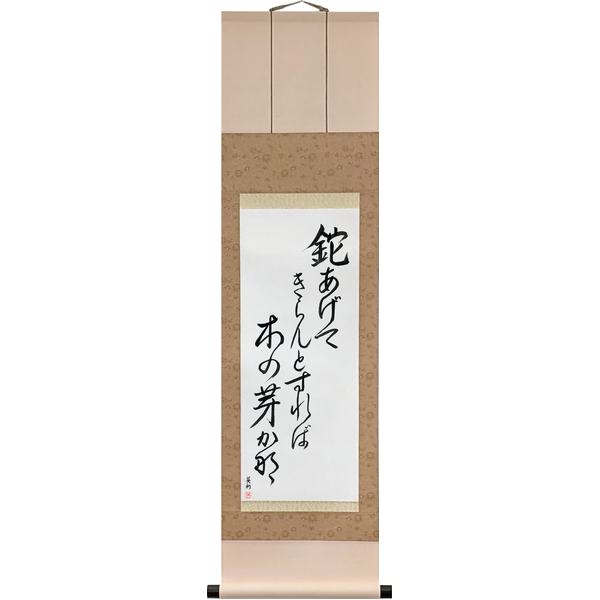
Sold as Shiki's, with Blyth's three lines Lifting up the hatchet, / To cut it down, / It was budding and a citation to Haiku volume four, page 985 · Read nata agete kiran to sureba konome kana · Oldest witness the 1925 アルス 子規全集, which prints it in the 寒山落木 volume for 1893, the first verse under the heading 木の芽; the 1885 autograph and the 1915 政教社 selection were not opened · Sense a hatchet raised to cut a tree, and the buds on it stop the hand. Blyth's example of the haiku poet's tenderness, almost too distinctly shown; the one critic who has written on it.
The text as brushed, and its variants
The scroll carries 鉈あげてきらんとすれば木の芽かな, and the one Japanese witness opened has the same words with 哉 for かな: 鉈あげてきらんとすれば木の芽哉, printed in the 1925 全集 and read on the leaf. 哉 and かな are one word. Blyth prints the verse in kana, 鉈あげてきらんとすれば木の芽かな, above his English. No witness varies a word. The 1925 book was scanned twice by the National Diet Library, and in the second scan the OCR breaks the verse at 木の and runs it into the verse after; the leaf of the first scan, opened at width 3600, prints three verses in a row under the heading 木の芽, this one first, then 枯枝と知れてものうし木の芽時, then 木の芽とは豆腐の上に生ふる者なり; the run the text layer glued onto this verse belongs to those two. The meter is five, seven, five: な・た・あ・げ・て, き・ら・ん・と・す・れ・ば, こ・の・め・か・な.
The attribution, as a dated thread
Shiki's, by the one book it was found in: his own manuscript collection 寒山落木, five volumes in his hand holding most of his verses by kotobank's account, as the 1925 全集 typeset it. The book's table of contents puts the leaf in 卷二, the volume for 明治二十六年, 1893; that is a date by inclusion, not a note at the verse, and no witness carries a headnote. No one has given the verse to anyone else. Blyth names Shiki in 1952 and 1994 and adds that the verse has been compared to 鳴雪's sickle verse of thirteen years later; who compared them he does not say.
The words
鉈 is the hatchet, the woodsman's short heavy blade. あげて … きらんとすれば is raised it, and was about to cut, when; the verse turns inside すれば, the conditional that carries a discovery. 木の芽, konome, is the tree's buds, a spring season word, and the heading the 全集 files the verse under; it is the reason a hatchet stops. かな closes on the buds and holds the arrest. As words the line says: Hatchet raised, and about to cut, when: the buds.
A history, from the earliest witness
1893. 正岡子規, in 寒山落木 卷二. The verse in his manuscript collection, by the year of the volume the 1925 print assigns it to; the autograph was not opened. [『子規全集』第1巻 1925, table of contents; see below]
1925. 正岡子規, 子規全集 第1巻, 俳句全集 1, アルス. Under the heading 木の芽, on printed page 250, three verses, this one first: 鉈あげてきらんとすれば木の芽哉 / 枯枝と知れてものうし木の芽時 / 木の芽とは豆腐の上に生ふる者なり; then 接木 and 椿. The book's contents put this leaf in 寒山落木 卷二, 明治二十六年. The same book in its second scan, where the OCR breaks the verse. [NDL pid 978835, koma 137, printed pages 250–251, read by eye; text at lab.ndl.go.jp/dl/api/page/978835_137. The second scan at pid 978834, koma 138, OCR]
Today. The archive lists two addresses carrying the verse before 1945, and they are one book. The National Diet Library's catalogue lists the 1885 autograph 寒山落木, 寒川鼠骨's 1915 政教社 selection 寒山落木より, and the 1975 講談社 typeset, none opened. kotobank's page for 正岡子規 gives the poet's dates and names 寒山落木, and does not quote the verse. [harvest_index.py lookup --id 255 --year-to 1945; ndlsearch.ndl.go.jp opensearch, 133 results for 寒山落木; kotobank 正岡子規, read as text]
The sense, across a century
One reader has written on the verse in what was opened, and he wrote twice. Blyth, in the Preface to the last volume of Haiku in 1952, sets it after a verse of Taigi's about passing through a temple and says: The tenderness of mind which is the most prominent characteristic of the writer of haiku is distinctly (almost too distinctly) seen the following verse by Shiki. The almost too distinctly is his reservation: the verse shows its feeling. In The Genius of Haiku, printed after his death, he repeats the verse and adds the pairing: This has been compared to the verse by Meisetsu, composed thirteen years later: Kama o togeba akaza kanashimu keshiki ari — Sharpening the sickle, / The goose-foot / Looks as if grieving. No Japanese commentary on the verse was opened; none is in the archive's two addresses.
What is not a source
The date 1893 is the volume's, not a note at the verse. The Meisetsu pairing is Blyth's report of a comparison he does not attribute. The page's citation as it stood at s41, page 985, Haiku, Volume Four: Autumn-Winter (corrected in the store on 2026-09-06 to Preface, page vii on this account's finding), was not a page of the 1952 printing: the verse is in that volume's Preface, on the page numbered vii, and again in Appendix I as romaji, and the volume's own pagination ends at 396. The Hokuseido reprint of the early 1980s numbers the four volumes continuously (its reprint of the Spring volume carries pages 423–434 where the 1950 printing carries 99–103), so a page 985 may exist in that reprint's fourth volume; that reprint is not on the shelf, and the citation is unverified there and wrong for 1952.
The verse in English
The bilingual dictionaries of the Meiji shelf were not checked for this verse. Miyamori, Henderson, Buchanan, Hass, Watson and Beilenson were searched on the shelf and do not carry it. (SUPERSEDED s90, 2026-09-14: the eighth delivery was searched by the English join s90 and carries no rendering either; § Supersession 2026-09-14.)
1952. R. H. Blyth, Haiku, volume 4, Autumn-Winter, Hokuseido Press, Tokyo, Preface page vii and Appendix I. Lifting up the hatchet / To cut it down,— / It was budding. The Japanese in kana above it; the romaji, Nata agete kiran to sureba konome kana, in the appendix that transliterates the Preface's verses. [docs/research/book_originals, Blyth 1952 vol. 4, the Preface page read by eye from the PDF; the appendix by text layer; no ASIN collected]
1994. R. H. Blyth, The Genius of Haiku, British Haiku Society and Hokuseido Press, pages 93–94. The same three lines with the same dash, and the Meisetsu comparison quoted above. [docs/research/papers, Blyth 1994, pages 93–94 by the text layer's page numbers, read as text; no ASIN collected]
Today. The house page prints Blyth's lines to the word, credited, with his dash after down set as a comma. A rendering of this line has one thing to keep: the buds come last, after the blade is already up.
A reading
I read the verse as Blyth did and would keep his reservation. The hatchet is up and the cut is coming, and the buds, seen only now, stop it; the verse is the stop, and かな holds it. It is a small verse of a young man's spring, filed by his editors under the season word it turns on, and it needs no story. The text, the poet and the romaji stand on one Japanese book and one translator, which is enough for a verse this plain and thin for an account; what would fill it is the autograph or the 1915 selection at the leaf, and a Japanese reader who has written on it, if one has. The page's English is right and credited; its page number should read the Preface, page vii, or name the reprint it was taken from. Signed, 典, 2026-09-05.
Supersession 2026-09-14 (s90)
A null, stated as one. The English join built this session ran the verse's forms (romaji anchors, hatchet or axe near bud) over the 437 shelf files and the 6,624-item harvest. Every hit in the books shelved since the tenth is noise (Katō's natabori, the Zen ax of nihilism, Barnhill's woodsman's axe on the pine); Beichman's Masaoka Shiki (1982), Keene's The Winter Sun Shines In (2013), Ueda's Modern Japanese Haiku (1976) and Watson's Selected Poems (1997) were grepped by hand for hatchet and nata agete and carry nothing. Blyth's two printings and Beilenson's remain the verse's whole English as far as this shelf reaches. A null of the shelf, not of the world.
How this was read
By eye at width 3600: the 1925 全集 at printed page 250, the first scan; and Blyth's 1952 Preface page from the shelf's PDF. By OCR from the archive's text layer: the second scan of the same book, where the verse is broken. By text layer from the shelf: Blyth's appendix and The Genius of Haiku. As text: kotobank, the library catalogue. Not opened: the 1885 autograph 寒山落木; 寒川鼠骨's 1915 selection; the 1975 講談社 typeset; the early-1980s Hokuseido reprint where a page 985 might be; any Japanese commentary on the verse. A bracket of the form pid P, koma N resolves as text at lab.ndl.go.jp/dl/api/page/P_N and as an image at dl.ndl.go.jp/api/iiif/P/R<N, seven digits>/full/3600,/0/default.jpg; the leaf read by eye was fetched at that address. The full apparatus, with every address, is in the account.
Supersession 2026-09-14 (s92)
A read-only worker resolved this account's addresses (citation_checks_2026-09-14/history_nata_agete_255_2026-09-05.check.md): 23 claims, 15 at the address, 0 failing. It reported that only two lines stand under 木の芽 on the 1925 leaf and that the 豆腐 line is not on the page; I re-opened the leaf (pid 978834, koma 138, printed page 250) at width 3600 this turn, and the three lines stand there as § A history gives them, 鉈あげて…, 枯枝と知れて…, 木の芽とは豆腐の上に生ふる者なり, the third a quip in prose meter typeset in the run; the OCR of both scans carries 豆腐の上に生ふる. The worker was wrong on that row. Its other finding is right and now recorded above: the store's citation was corrected to Preface, page vii on 2026-09-06 (imp-etl for str-terasu's eighth wave), so the refutation in § The verse in English is of a citation that no longer stands. Not yet read by a person.
References
Each witness is cited in the account above, at the frame or entry where it was read. A linked list follows when the record for this text is completed.