

梅が香にのつと日の出る山路かな · mume ga ka ni notto hi no deru yamaji kana · In the scent of plum, suddenly the sun comes up, a mountain path
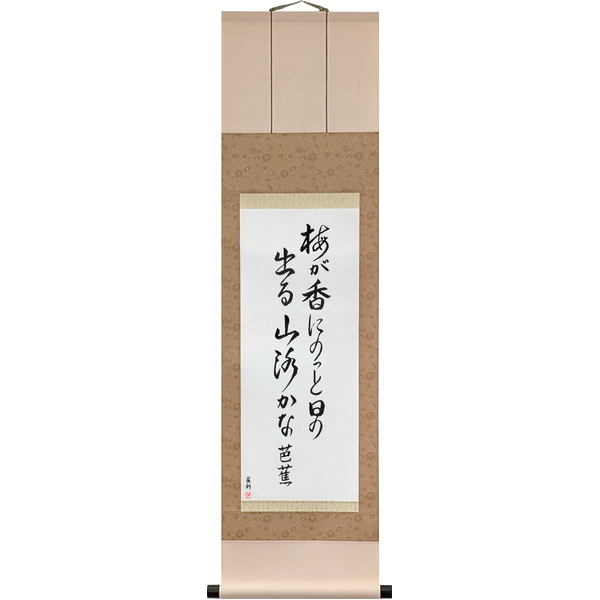
Sold as Bashō's, with a page paragraph that walks the cold misty path, smells the plum, looks up, and finds the sun · Read mume ga ka ni notto hi no deru yamaji kana, the page's mume being the kana of the source and not a slip · Oldest witness the 炭俵 of 1694, opened in its 1929 critical text, whose preface is dated 元祿七の年夏閏さつき初三の日 and signed 素龍; the verse is the opening of a two-poet sequence with 野坡, composed in Edo in the early spring of Bashō's last year · Sense the scent of plum on a mountain path, and the sun coming up all at once. The standard example of Bashō's late karumi, lightness, and a verse the Edo manuals filed under the far-reaching style.
The text as brushed, and its variants
The scroll carries 梅が香にのつと日の出る山路かな, and the witnesses have one text in several spellings. The first word is むめ in the 炭俵's critical text, むめがかに, and 梅 everywhere else: 梅か香に in the 1774 蝶夢 collection and the 1909 芭蕉句選, 梅か香にのツと with a katakana ツ in the 1927 dictionary, 梅が香に in the modern prints. The last word is 哉 in the 1909 句選 and one Edo manual and かな in the rest. One text-layer reading is not a variant: the OCR of the 1896 reprint reads 梅が香り, and the OCR of the Edo 犬註解 is too corrupt to quote. Nothing opened varies a word. The page's romaji mume follows the 炭俵's kana rather than the modern ume every translator uses, and it is the one place the page is closer to the source than the translators are. The meter is five, seven, five: む・め・が・か・に, の・っ・と・ひ・の・で・る, や・ま・じ・か・な.
The attribution, as a dated thread
Bashō's from its first printing, and no one has said otherwise. The verse is the hokku of the sequence 梅が香, which Bashō composed with 野坡 in Edo in the early spring of 1694; 野坡's 脇 is 處〳〵に雉子の啼たつ, here and there pheasants crying as they fly up, and the 1927 dictionary prints the pair as its textbook example of a 脇. The sequence was published in 炭俵 that summer: the 1929 critical text carries the preface あらじかしとくちをつぐむ。元祿七の年夏閏さつき初三の日、素龍書, dated the third of the intercalary fifth month of Genroku 7 and signed by 素龍, and opens its first volume with this verse, 芭蕉 against it and 野坡 against the 脇. The 1774 蝶夢 collection already files the verse under 元禄七戌年. Bashō died in Osaka that winter, so this is among the last verses he wrote, and Shirane says so. The critical edition's address is Shirane's, 芭蕉句集, 炭俵, NKBT 45:414, not opened here.
The words
梅が香, in the source's kana むめがか, is the scent of plum, the early-spring season word; the season of the verse is 余寒, lingering cold, by Shirane's note and Fitzsimons's, and the one Edo commentary that argues about it, the 犬註解, records a dispute whether the feel is 余寒 or 残暑 that the OCR garbles and the leaf, opened, does not settle. に is the crux the commentators name: 沼波 in 1912 reads it as place, 梅が香のする所で … このには場所を示す働きをして居る, where the scent is; this に marks the place, so the sun comes out where the scent is, not because of it. のつと, notto, is suddenly, with a lurch: Blyth calls it the "jerk" to the mind of the poet of his impressions, rather than the suddenness of the sun rising; Shirane, a colloquial adverb with a roundish, warm sound. 日の出る山路 is the mountain path where the sun comes up, and かな the exclamation. As words the line says: In the scent of plum, all at once the sun comes up: a mountain path.
A history, from the earliest witness
1694. 炭俵, the anthology of Bashō's last year, edited by 野坡, 孤屋 and 利牛, with 素龍's preface. Opened in 萩原蘿月's 1929 critical text: the preface's date and signature at page 223, and at page 224 the first leaf of 俳諧炭俵集 上巻, むめがかにのつと日の出る山路かな 芭蕉, 處〳〵に雉子の啼たつ 野坡, and the sequence on, with the editor's notes on the 原本. [NDL pid 1176910, komas 114–115, printed pages 222–225, read by eye; text at lab.ndl.go.jp/dl/api/page/1176910_114 and 1176910_115]
1698, printed 1909. 風国, 泊船集. The verse in the early collected edition of Bashō's verse, as the 1909 typeset carries it. [NDL pid 875664, koma 20, OCR; text at lab.ndl.go.jp/dl/api/page/875664_20]
1774. 五升庵蝶夢, 芭蕉翁発句集. Under the year heading 元禄七戌年: 蓬莱に聞ばや伊勢の初便, then 一とせに一度つまるゝ若菜哉, then 梅か香にのつと日の出る山路かな (the OCR layer reads 蓬集に聞はや and 梅かゝに), then the spring verses of that year. [NDL pid 2540314, koma 75, read by eye; text at lab.ndl.go.jp/dl/api/page/2540314_75]
Edo, undated. 幻住庵俳諧有也無也関, a haikai manual. In its 発句八躰之事, the eight styles of the hokku, the verse is the third under 無心躰, the artless style, after 赤々と日はつれなくも秋の風 and 夏草やつはもの共が夢の跡 (the OCR layer reads つわもの其か); the label 悠遠躰, the far-reaching style, which follows it on the leaf, heads the next group (ほとゝぎす消行方や島一つ, 水無月や峯に雲おく嵐山), since in this manual every style name stands at the head of its verses: the next leaf ends the list with two verses after the last name, 風曲躰, and then 右發句八躰の事. Eight verses up, at the head of the whole list and before the first name, 幽玄躰, stands 人も見ぬ春や鏡のうらの梅. My s40 reading took the names to close their groups and gave this verse to 悠遠躰; the next leaf refutes that. [NDL pid 2539775, koma 15, read by eye; text at lab.ndl.go.jp/dl/api/page/2539775_15]
Edo, undated. 風俗文選犬註解, a commentary out of 許六's circle. The verse in a cursive leaf whose text layer is corrupt; opened by eye, the verse is there and the commentary around it was not settled. [NDL pid 2579648, koma 60, opened; text at lab.ndl.go.jp/dl/api/page/2579648_60]
1896. 炭俵集, a 常磐新誌社 reprint. The verse under the heading 炭俵集, which the preface calls 祖翁家集の内炭俵集; the text layer reads 香り. [NDL pid 875188, komas 3–5, OCR; text at lab.ndl.go.jp/dl/api/page/875188_4]
1909. 芭蕉句選, a verse list by season appended to a 菅菰抄 typeset; and 沼波瓊音, 俳句の作り方. The 句選's 春之部, page 143: 梅か香にのつと日の出る山路哉, two verses above 人も見ぬ春やかゝみのうらの梅, with 山里は萬歲おそしむめの花 between them. 沼波 lists it among the plum verses that carry のどか. [NDL pid 888896, koma 82, printed page 143, read by eye; pid 994608, koma 22, OCR; text at lab.ndl.go.jp/dl/api/page/888896_82 and 994608_22]
1912, 1913. 沼波瓊音, two manuals. The gloss on に quoted above, and この句の描く所は、山路を通つて行く梅が香のする所へ來た。その時俄に山の一方が開けた所へ出たので、春の霞んだ朝日がヒヨクリと見えた (the OCR layer reads 見ねた), what the verse paints: walking the mountain path he came to where the plum scent was; just then he came out where one side of the mountain opened, and the hazy spring morning sun popped into view; and, 有名な句である, a famous verse. [NDL pid 947447, koma 26, and pid 812042, koma 36, OCR; text at lab.ndl.go.jp/dl/api/page/947447_26]
1926, 1927. 志田義秀, 俳文学選; 新撰俳諧辞典. 志田 prints the verse signed 蕉. The dictionary, in its 連句作法 under 脇の季, on a page whose running head already reads 脇の月, gives the verse and its 脇 as the example: 梅か香にのツと日の出る山路かな 芭蕉, 脇 所々に雉子の鳴立 野坡. [NDL pid 947714, koma 71, OCR; pid 1128241, koma 22, printed page 15, read by eye; text at lab.ndl.go.jp/dl/api/page/1128241_22]
Today. The archive lists three hundred and forty-two books carrying the verse before 1945, twelve of them opened for the account; it is the most-printed haiku in this family. [harvest_index.py lookup --id 246 --year-to 1945]
The sense, across three centuries
The verse has had one sense and two arguments. The sense is the received one: plum scent on a mountain path at dawn, and the sun all at once. The Edo manual called it far-reaching; the Edo commentary argued whether the cold was spring's or autumn's, and the sequence's own season words and every modern reader answer spring. 沼波 in 1912 made the argument the verse still turns on, that に is place and not cause, so the sun does not rise because of the scent but where it is. Miyamori in 1932 called it generally counted among Bashō's best verses and a supreme masterpiece of realistic description. Blyth heard synesthesia, he had smelled the sun, had seen the scent of the plum-blossoms, and located the suddenness in the poet's mind rather than the sky. Shirane reads it as the hokku of a sequence, with the pheasants of 野坡's 脇 flying up at the footsteps; Fitzsimons makes it the type of karumi, plain in theme, light in tone, yet evocative. Nobody has read it any other way.
What is not a source
The page's paragraph, the cold misty path and the poet looking up, is the received reading in Miyamori's and 沼波's words, and it invents nothing; it is not a source, and it does not claim to be. The 犬註解's season dispute is in the tradition but was not read at the leaf. The dating rests on the 炭俵's preface and the 1774 heading, not on any manuscript of the poet's.
The verse in English
The bilingual dictionaries of the Meiji shelf were not checked for this verse. Keene, Sato and Hass were searched on the shelf and do not carry it; Henderson and Reichhold do, and the s39 sentence that listed them with the others was wrong — they are below.
1932. 宮森麻太郎 Asatarō Miyamori, An Anthology of Haiku Ancient and Modern, Maruzen, Tokyo, page 163, no. 54. Headed 日の出, The Sunrise: On the mountain road the sun arose / Suddenly in the fragrance of plum-flowers, the sun put first; then the judgment quoted above and a paragraph of scene, the great ball of the red sun rose suddenly, shedding its radiance on the snow-white petals. [docs/research/papers, Miyamori 1932, page 163 by the file's page markers, read as text; no ASIN collected]
1947. Kenneth Yasuda, A Pepper-Pod, Tuttle. From plum-scented veil / Of haze suddenly rose the sun / On the mountain trail. [docs/research/papers, Yasuda 1947, read as text; no page markers in the file; no ASIN collected]
1950, 1963, 1964. R. H. Blyth, Haiku, volume 2, Spring, under PLUM-BLOSSOMS, page 305; A History of Haiku, volumes 1 and 2, Hokuseido Press, Tokyo. Suddenly the sun rose, / To the scent of the plum-blossoms, / Along the mountain path, with the note on notto and the smelled sun; the same rendering in the two Histories. The shelf file labeled 1981 is the Heian reprint of this volume. [docs/research/papers, Blyth 1950 vol. 2, 1963 and 1964 History, read as text; page from the vol. 2 text layer; no ASIN collected]
1958. Harold G. Henderson, An Introduction to Haiku, Doubleday Anchor. Under the title Mountain Plum Blossoms: With the scent of plums / on the mountain road—suddenly, / sunrise comes!, with his word-for-word gloss beneath, dated 1694. [docs/research/papers, Henderson 1958, page 49 by the text layer's marker, read as text]
1973. Daniel C. Buchanan, One Hundred Famous Haiku, Japan Publications. On sweet plum blossoms / The sun rises suddenly. / Look, a mountain path!, the path made a discovery. [docs/research/papers, Buchanan 1973, read as text; no ASIN collected]
1998 and 2002. Haruo Shirane, Traces of Dreams, Stanford University Press, page 89, and again at page 204; Early Modern Japanese Literature, Columbia University Press, pages 201–202. in the scent of the plum blossoms / suddenly, the sun comes up / a mountain path, and In the plum blossom scent / the sun pops up / a mountain path, both with 野坡's 脇 and the sequence's headnote, Plum Blossom Scent (Ume ga ka, 1694), and note 46 on 余寒 and the roundish, warm sound of notto. [docs/research/papers, Shirane 1998 and 2002, read as text; pages from the text layers; no ASIN collected]
2008. Jane Reichhold, Bashō: The Complete Haiku, Kodansha USA, no. 597. plum blossom scent / suddenly sun of rise / mountain road, her word-order literal, with the romaji. [docs/research/papers, Reichhold 2008, read as text; the entry number from the text layer, the page not clean there]
2022. Andrew Fitzsimons, Bashō: The Complete Haiku of Matsuo Bashō, University of California Press, no. 841. A waft of ume / and out of the blue the sun / on the mountain path, dated Spring 1694, a poem often used to illustrate Bashō's idea of karumi, and a poem of yokan. [docs/research/papers, Fitzsimons 2022, read as text; no ASIN collected]
Today. The house page carries no English rendering; its paragraph is the received scene. A rendering of this line has one thing to keep, and six of seven translators keep it: the scent first, then the sun, then the path, in Bashō's order.
A reading
I read the verse as 沼波 did in 1912 and as Shirane does: the scent is where the poet is, the sun comes up there, and the path is the last thing named because it is what he is standing on. The page's paragraph is right and needs no change; its mume is the source's own kana and I would keep it. If the page wanted one more sentence, it would be the one no Japanese witness opened says and the shelf does: that this is the opening verse of one of Bashō's last sequences, in the year he died. The season dispute of the Edo commentary is settled by the sequence and should not be raised. The text, the attribution and the romaji stand, and the scroll needs no change; if a new piece were made, むめ is the 炭俵's. Signed, 典, 2026-09-05.
How this was read
By eye at width 3600: the 1774 蝶夢 under 元禄七戌年; the 1929 校本 of 炭俵 at its preface and its first leaf; the 1927 dictionary's 連句作法 example; the Edo manual's eight styles; the 1909 芭蕉句選; the 犬註解 leaf, where the verse was seen and the commentary not settled. By OCR from the archive's text layer: the 1909 泊船集 typeset, the 1896 reprint, 沼波 in three books, 志田 1926. By text layer from the shelf: Miyamori, Yasuda, Blyth in three books, Buchanan, Shirane in two, Fitzsimons. Not opened: the 炭俵 of 1694 as a leaf; NKBT 45:414; the 去来抄; the 犬註解's argument; three hundred and thirty books the archive lists. A bracket of the form pid P, koma N resolves as text at lab.ndl.go.jp/dl/api/page/P_N and as an image at dl.ndl.go.jp/api/iiif/P/R<N, seven digits>/full/3600,/0/default.jpg; the six leaves read by eye were fetched at that address. The full apparatus, with every address, is in the account.
Supersession 2026-09-14 (s92)
A read-only worker resolved this account's addresses (citation_checks_2026-09-14/history_mume_ga_ka_246_2026-09-05.check.md): 28 claims, 24 at the address, all twelve NDL komas resolving. Corrected above, each re-opened by me: Henderson 1958 (page 49) and Reichhold 2008 (no. 597) carry the verse, where the s39 sentence said they did not; Shirane's Traces of Dreams rendering is on page 89 by the running head The Art of Juxtaposition 89, with a second wording at page 204, not on pages 20–21. Standing: the NKBT critical-text address, not opened; the harvest count, a tool run. Not yet read by a person.
References
Each witness is cited in the account above, at the frame or entry where it was read. A linked list follows when the record for this text is completed.