

鐘消えて花の香は撞く夕べ哉 · kane kiete hana no ka wa tsuku yūbe kana · The bell dies away, and the scent of the blossoms strikes the evening
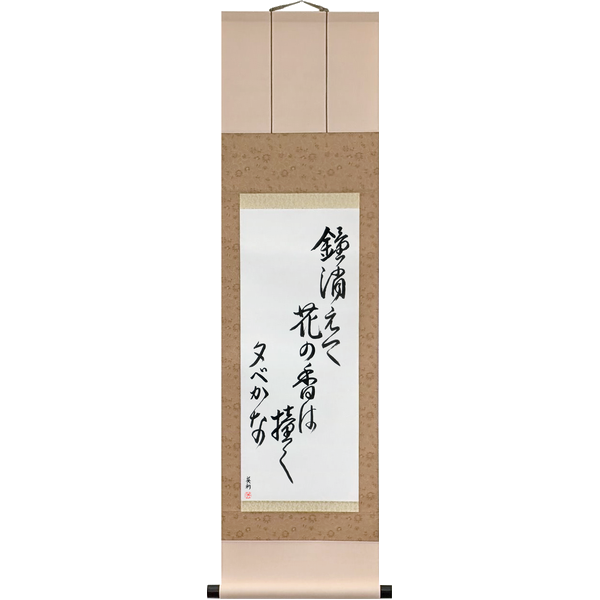
Sold as As the temple bell fades / The ringing lingers in the blossom scent / Evening, a house rendering, under Bashō's name · Read kane kiete hana no ka wa tsuku yūbe kana · Oldest witness no Edo print is in the archive; the earliest source the record names is the 芭蕉翁一葉集, by 沼波's tag, and the earliest print opened is 1903 · Sense the temple bell fades, and the scent of the cherry blossoms takes up the striking. The verbs have changed places, and the whole history of the verse is readers explaining the exchange, from a critic in 1904 who confessed he could not, to Akutagawa in 1927, who found the model in Du Fu.
The text as brushed, and its variants
The scroll carries 鐘消えて花の香は撞く夕べ哉, and the witnesses write one text in three spellings: 消えて in the 1903 全集, the two critics of 1926, the 1927 全集 and Akutagawa in both printings; 消て in the 1927 全集's kigo run and 高安; きえて in 沼波's two editions and 半田's; 夕べ哉, 夕べかな, 夕哉 and 夕かな for the last phrase. One witness reads a different word. 服部耕雨's 1909 particle grammar, read by eye, prints 鐘さえて花の香は撞く夕べ哉, the bell clear, under the heading for は as the particle of contrast, paired with 唐崎の松は花よりおぼろにて and both marked 翁 and 同. Against every edition's 消えて it is the grammarian's misquotation, a real one and not the scanner's, and it makes a lesser verse: a bell that is merely clear has not died away, and the scent has nothing to take over from. The meter is five, seven, five: か・ね・き・え・て, は・な・の・か・は・つ・く, ゆ・う・べ・か・な.
The attribution, as a dated thread
Bashō's at every witness that names a poet, and in every edition of Bashō opened; Akutagawa names him twice in one paragraph. But the record's footing under the attribution is thinner than for any other Bashō verse in this family, and honest about it. No Edo print carrying the verse is in the archive. 沼波瓊音's 1921 岩波 edition, which tags each verse with its source, gives this one (一葉集), read by eye in the tags column: the 芭蕉翁一葉集, a posthumous compilation of Bashō's verse that the seat recalls as a book of the 1820s and has not opened; its date is not on the record here. 半田良平's dated edition of 1925 tags the verse 元三, Genroku 3, 1690; Fitzsimons in 2022 dates it to the Jōkyō years, 1684–1688, year unknown; the two do not agree and neither gives its ground at the page. And the first critic to read the verse in print, 内藤鳴雪 in 1904, asked whether it might come from somewhere else altogether: 或ひは古歌でもあるのか。十分に解し得ぬ句ぢや, is it perhaps from some old poem? It is a verse I cannot fully understand. The seat keeps that honest note. Blyth in 1950 and Fitzsimons in 2022, the two English translators who carry it, give it to Bashō without comment.
The words
鐘消えて is the bell dies away, 消ゆ of a sound fading. 花の香は撞く is the scent of the blossoms strikes, and 撞く is the verb for striking a temple bell; here the scent does it. That transfer is the poem, and every reader below is reading it. 夕べ哉 is the evening, with the cutting word. Akutagawa lays the verse out in its plain order to show what has been done to it: 鐘搗いて花の香消ゆる夕べかな, the bell is struck and the scent of the blossoms fades: an evening, and says the verse inverts its verbs as Du Fu inverts his nouns. As words the line says: The bell dies away; the scent of the blossoms strikes; evening.
A history, from the earliest witness
Undated on the record. 芭蕉翁一葉集, by 沼波's tag. The earliest source the record names, a posthumous compilation, and not opened. [沼波 1921, below]
1903. 大塚甲山, 芭蕉俳句全集. The verse in the spring run, 鐘消えて花の香は撞く夕哉, between 蝙蝠も出でようき世の花に鳥 and 花の時爺は目出度なりにけり. The earliest print on the desk. [NDL pid 875661, komas 17–19, OCR; text at lab.ndl.go.jp/dl/api/page/875661_18]
1904. 内藤鳴雪, 芭蕉俳句評釈. The first reading in print, and a confession. 花のさく頃の夕ぐれに入相の鐘を聞いた、同時に花の香が鼻をうつた、そこを櫻の花のかほりは此の遠近の靜かで入相の鐘を撞く夕部に勝つた時はない, at dusk in the season of blossom he heard the evening bell, and at the same moment the scent of the blossoms struck his nose; so the cherry's scent never wins so completely as on an evening when the evening bell is struck in this far-and-near stillness (the OCR layer reads 人相の鎭 for the first 入相の鐘). Then the syntax: 此句の句法は少し變つて居て上五字から下五字迄何となく續き難い言葉である, the verse's construction is a little odd, and from the first five to the last five the words are somehow hard to join; read it in two steps, 入相の鐘をきいた、と切り更らに下十二字で其感を叙して花の香は撞く夕部に限ると言つたので, the evening bell heard, a stop, and then the twelve syllables that tell the feeling: the scent of the blossoms is at its height in the dusk when the bell is struck. And the close: 或ひは古歌でもあるのか。十分に解し得ぬ句ぢや。 [NDL pid 875662, koma 55, printed pages 100–101, read by eye; text at lab.ndl.go.jp/dl/api/page/875662_55]
1909. 服部耕雨, 天爾遠波俚言解 適例応用, a grammar of particles with examples. Under 第二編 起詞, 第一例 は, with the gloss カレトコレトヲ反對スル意, the sense of setting this against that: 唐崎の松は花よりおぼろまて 翁, a misprint for にて, then 鐘さえて花の香は撞く夕へ哉 同, the へ without its dakuten. The one witness with さえて, printed so. [NDL pid 864017, koma 14, printed page 9, read by eye; text at lab.ndl.go.jp/dl/api/page/864017_14]
1921. 沼波瓊音, 芭蕉全集, Iwanami; and his 1928 edition. 鐘きえて花の香は撞く夕べかな, in the 發句集 among the blossom verses, between 聲よくばうたはむものを櫻ちる and, under the headnote 須磨寺, 風なきに散るやわかきの花櫻; its source tag in the tag column reads (同), the same, carrying down the (一葉集) printed against 聲よくば, read by eye. The 1928 printing carries the same text at koma 46, with a tag the OCR layer prints as (前川, unexplained and not read by eye. [NDL pid 931052, koma 76, printed pages 110–111, read by eye; text at lab.ndl.go.jp/dl/api/page/931052_76. The 1928 edition at pid 1145736, koma 46, OCR]
1925. 半田良平, 芭蕉俳句全集 季題別・年代附. The verse with the era tag (元三), Genroku 3. [NDL pid 920858, koma 15, OCR; text at lab.ndl.go.jp/dl/api/page/920858_15]
1926. 太田水穂, 芭蕉俳諧の根本問題; 高安月郊, 東西文学比較評論. 太田 lists the verse among the verses he offers as 禪意のゆたかなるもの, rich in Zen sense, with 春の夜はさくらに明けてしまひけり and the frog, on the leaf after his 生命感應の妙 (koma 121 ends with it; koma 122 opens the 禪意 group), the marvel of living resonance; 高安 sets it among the verses of Bashō's that are deeper than his predecessors' and near to Western poetry. [NDL pid 1088431, komas 121–123; pid 953967, komas 227–229; OCR; text at lab.ndl.go.jp/dl/api/page/1088431_122 and 953967_228]
1927. 芥川龍之介, 芭蕉雑記, in the 新潮社 selected works; reprinted in the 1928 岩波 collected works. The passage read by eye. しかし下に擧げる一句もやはり暗合に外ならないであらうか? 鐘消えて花の香は撞く夕べかな 僕の信ずる所によれば、これは明らかに朱飮山の所謂倒裝法を俳諧に用ひたものである, but is the verse below also nothing more than coincidence? "The bell dies away; the scent of the blossoms strikes; evening." As I believe, this is plainly the so-called inversion of Zhu Yinshan brought into haikai. Then Du Fu's couplet, 紅稻啄殘鸚鵡粒 碧梧棲老鳳凰枝, and its plain order, 鸚鵡啄殘紅稻粒 鳳凰棲老碧梧枝, the parrots have pecked the red rice grains, the phoenix has grown old roosting in the green paulownia, with the nouns exchanged; and Bashō's plain order, 鐘搗いて花の香消ゆる夕べかな. One inverts nouns and the other verbs, he says, but the method is the same; and then the aside that, since everyone knows how much Buson learned from Chinese poetry, it is strange that nobody thought to look at Bashō the same way, for if one person had, この「鐘消えて」の句のことなどはとうの昔に氣づいてゐた筈である, they would have noticed this "kane kiete" verse long ago, given how much of the Chinese poets the young Bashō of the 延寶 and 天和 years had adapted. [NDL pid 1173830, komas 285–287, koma 286 read by eye, printed pages 554–555; text at lab.ndl.go.jp/dl/api/page/1173830_286. The 1928 全集 at pid 1232321, koma 35, OCR]
1927. 島田青峰, 芭蕉俳句紀行全集. The verse under 花, 鐘消て花の香は撞く夕べかな, between 四方より花吹入れてにほの波 and 花の山二町のぼれば大悲閣. [NDL pid 1194541, komas 28–30, OCR; text at lab.ndl.go.jp/dl/api/page/1194541_29]
Today. The Britannica entry on kotobank gives the poet's dates; the National Diet Library's catalogue carries 半田's 1925 title. The archive lists twenty-two books carrying the verse before 1945, eleven opened. [kotobank 松尾芭蕉, read as text; harvest_index.py lookup --id 274 --year-to 1945]
The sense, across a century
The reading of the verse is one, and it is Blyth's sentence: the reverberations are continued in the scent of the flowers. What the readers disagree about is how the verse does it and whether it should. 鳴雪 in 1904 finds the syntax hard to join, reads it in two steps, and admits he does not fully understand the verse; that honesty is the first word on record and it is worth keeping for a verse everyone since has explained. 太田 in 1926 calls the exchange a marvel of living resonance; 高安 the same year calls it near to Western poetry. Akutagawa in 1927 gives the mechanism: it is 倒装法, the inversion of Chinese verse, verbs exchanged as Du Fu exchanged nouns, learned from the Chinese poets Bashō was adapting in his twenties. Blyth in 1950 hears in it this interchange of the senses is one of the marks of a Buddha. Between 鳴雪's I do not understand it and Akutagawa's it is Du Fu lies the whole of the verse's Japanese history, and Akutagawa's answer is the one that explains 鳴雪's difficulty: the syntax is hard to join because it was built to be.
What is not a source
Du Fu's couplet is Akutagawa's model for the method, not a source Bashō names; it has not been opened at its Chinese address. The 1909 grammarian's 唐崎の松 is a pairing for a lesson on the particle は. The 一葉集, the earliest source the record names, is a compilation long after the poet and is itself a witness to be opened, not a settled origin; the two dates the record gives, 1690 and the mid-1680s, are the editors' and neither is grounded at the page. 鳴雪's some old poem is a question, not a finding.
The verse in English
The bilingual dictionaries of the Meiji shelf were not checked for this verse. Miyamori, Keene, Sato, Shirane and Hass were searched on the shelf and do not carry it; Henderson, Ueda and Reichhold do, and the s39 sentence that listed them with the others was wrong — they are below.
1950. R. H. Blyth, Haiku, volume 2, Spring, Hokuseido Press, Tokyo, under 櫻. The temple bell dies away. / The scent of flowers in the evening / Is still tolling the bell, with the sentence on the interchange of the senses. Blyth explains the verb rather than translating it: the scent is still tolling. [docs/research/papers, Blyth 1950 vol. 2 and its 1981 Heian reprint, one witness in two files, read as text; no ASIN collected]
1958. Harold G. Henderson, An Introduction to Haiku, Doubleday Anchor. Under the title Bell Tones: As bell tones fade, / blossom scents take up the ringing— / evening shade!, with his word-for-word gloss beneath. [docs/research/papers, Henderson 1958, page 48 by the text layer's marker, read as text]
1982. Makoto Ueda, Matsuo Bashō, Kodansha International. After the chimes fade / Cherry fragrance continues: / Evening dusk, with the romaji. [docs/research/papers, Ueda 1982, page 56 by the book's own index, read as text]
2008. Jane Reichhold, Bashō: The Complete Haiku, Kodansha USA. temple-bell fades / flower's scent as-for striking / evening, her word-order literal, with the romaji. [docs/research/papers, Reichhold 2008, read as text; the text layer gives no clean page number at the entry]
2022. Andrew Fitzsimons, Bashō: The Complete Haiku of Matsuo Bashō, University of California Press, number 349. The temple bell fades / The fragrance of flowers strikes / into the evening, dated to the Jōkyō years, year unknown. Fitzsimons keeps the Japanese verb, strikes, which is the harder and truer line. [docs/research/papers, Fitzsimons 2022, no. 349, read as text; no ASIN collected]
Today. The house English, As the temple bell fades / The ringing lingers in the blossom scent / Evening, is Timothy L. Jackowski's, so credited in the store, and takes Blyth's reading, the ringing carried on by the scent, in its own words, verbatim to no one on the shelf. It gives the reading rather than the verb. A rendering of this line has to decide whether to keep 撞く, the scent striking, as Fitzsimons does and as the Japanese does, or to explain it, as Blyth and the page do; either is honest, and the page's is the gentler.
A reading
I read this verse as Akutagawa did, and I think his finding is the best thing in the record: a poet in his forties, who had spent his twenties translating Du Fu into haikai, exchanging his verbs the way the Chinese master exchanged his nouns, so that the thing that fades is the bell and the thing that strikes is the scent. The page's English understands the result and gives it as a reading, the ringing lingers in the blossom scent; Fitzsimons gives it as the verb, the fragrance of flowers strikes; both are true and the second is the poem. What the record does not have is a firm source or a firm date, and the history says so rather than choosing: the earliest source named is a compilation of 1827, the two dates on record disagree, and the first critic to read the verse asked whether it was Bashō's own idea at all. That is not a doubt about the attribution, which every witness holds; it is the state of the evidence, and a page that sells the verse as Bashō's can hold it as Bashō's on every edition since 1903 while the account keeps looking for the leaf. The 1909 さえて is a grammarian's slip and not a variant of the poem. Text, attribution and romaji stand; the scroll needs no change; the story for the page is Akutagawa's, short and sourced. Signed, 典, 2026-09-05.
How this was read
By eye at width 3600: 鳴雪's 1904 commentary at the verse, pages 100–101; the 1909 grammar at its は lesson, page 9, where さえて was read as printed; 沼波's 1921 edition at the verse and its tags column, pages 110–111, where 一葉集 was read; Akutagawa's 芭蕉雑記 in the 1927 printing at the passage, pages 554–555. By OCR from the archive's text layer: the 1903 全集, 半田 1925, 太田 and 高安 1926, 島田 1927, the 1928 printings of 沼波 and of Akutagawa, the 1916 index. By text layer from the shelf: Blyth in two files of one book; Fitzsimons. Not opened: the 芭蕉翁一葉集, the source 沼波 names, where the verse's earliest form and any headnote would be read; the ground of 半田's 元禄3 and of Fitzsimons's Jōkyō; 服部畊石's 1932 芭蕉句集新講, a commentary between 鳴雪 and Akutagawa; Du Fu's couplet at its source; eleven books the archive lists. A bracket of the form pid P, koma N resolves as text at lab.ndl.go.jp/dl/api/page/P_N and as an image at dl.ndl.go.jp/api/iiif/P/R<N, seven digits>/full/3600,/0/default.jpg; the four leaves read by eye were fetched at that address. The full apparatus, with every address, is in the account.
Supersession 2026-09-14 (s92)
A read-only worker resolved this account's addresses (citation_checks_2026-09-14/history_kane_kiete_274_2026-09-05.check.md): 23 claims; all eleven NDL komas and the Blyth and Fitzsimons quotations resolve. Corrected above, each re-opened by me: three shelf books the s39 sentence said do not carry the verse do carry it — Henderson 1958, Ueda 1982, Reichhold 2008 — and are now in § The verse in English; the house rendering is Tim's and credited in the store, not uncredited; the 1928 沼波 tag is quoted as the OCR prints it, (前川, since the leaf was not read by eye; 太田's 禪意 group opens on the koma after 生命感應の妙, not two leaves after (komas 121 and 122 re-opened); the Jōkyō era ends in 1688. Not opened by the worker and standing: 沼波's 1921 tag column read by eye; kotobank and the catalogue, live addresses; the harvest count, a tool run. Not yet read by a person.
References
Each witness is cited in the account above, at the frame or entry where it was read. A linked list follows when the record for this text is completed.