

稲妻にさとらぬ人の貴さよ · inazuma ni satoranu hito no tattosa yo · Lightning, and a person it does not enlighten: how admirable
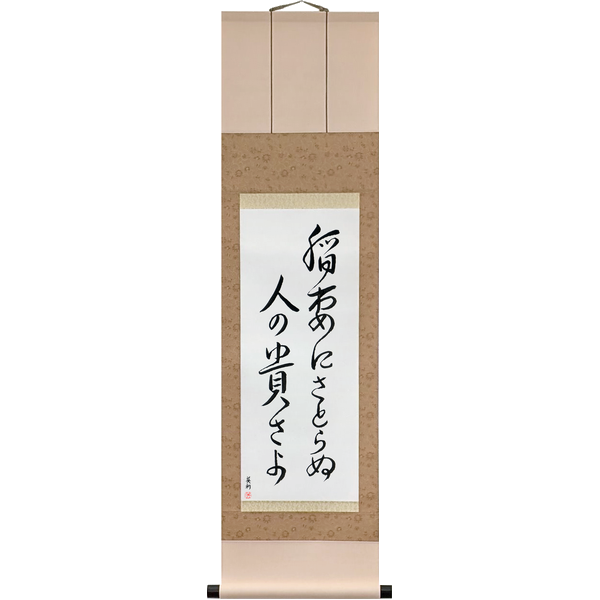
In one line. Bashō, autumn 1690, in a letter from Lake Biwa to a disciple in Edo, scolding the disciples he had left behind for their easy Zen: lightning is the sutras' image of how everything passes, and the admirable person is the one who sees the flash and does not mistake it for awakening.
The story
In the autumn of 1690 Bashō was living at Gichū-ji, the temple on the south shore of Lake Biwa where he would later be buried. On the sixth day of the ninth month he wrote to Suganuma Kyokusui, a samurai of the Zeze domain and his host in Ōmi, who was away on duty in Edo. More of Bashō's surviving letters are to Kyokusui than to anyone else. This one, by the account of the three modern complete editions, praises Kyokusui's sincerity and criticizes the disciples still in Ōmi for the complacency of their verse and the looseness of their lives. In it Bashō sets down something a Zen teacher had said to him and, under it, this verse. The letter's headnote, as the 1947 edition transcribes it: ある智識のゝ給ふ、なま禅なま仏是魔界, a teacher said: half-raw Zen, half-raw Buddha, that is the demon realm. The verse in the letter is written 稲妻にさとらぬ人のたつとさよ, the last word in kana.
Two years later the verse was printed for the first time, in the anthology 己が光 (1692), with a different headnote and the character the scroll carries: ある智識ののたまはく、なま禅大疵のもとゐとかや、いとありがたく覚えて, a teacher said, "half-raw Zen is the root of great harm"; I found it deeply true, and then 稲妻にさとらぬ人の貴さよ, signed 翁, the old master. なま, raw, unripe, half-done, is the word for a beginner's Zen, and the sentence has the shape of a proverb about a little learning being dangerous. Every later printing descends from one of these two forms.
The flash of lightning is one of the oldest images in Buddhism for how things pass. The Diamond Sutra ends on it: 一切有為法、如夢幻泡影、如露亦如電、應作如是觀, all conditioned things are like a dream, an illusion, a bubble, a shadow, like dew and like lightning; see them so. In Zen the stock phrase is 電光石火, lightning and the spark from a flint, the instant. A fashionable Zen of Bashō's day heard every flash as a small enlightenment and said so. Bashō's admiration goes the other way: to the person who sees lightning and lets it be lightning. That is what his teacher's warning meant, and the verse has been read that way by everyone who has written on it since, from the Zen commentator of 1783 to the translators of 2022. What the readers argue about is only the flavor: rebuke, or praise, or a joke at the expense of the whole business of meaning.
The words
稲妻 inazuma, lightning, the autumn season word; literally the rice's spouse, from the old belief that lightning ripened the ears (the dictionaries' etymology, from recall; not opened this session). に marks what the person is not enlightened by. さとらぬ satoranu, does not awaken, the negative of 悟る, the verb of Buddhist enlightenment; in the letter and the first printing it is in kana, and later printings write 悟らぬ. 人の hito no, the person's. 貴さよ tattosa yo, how admirable, the noun of 尊い / 貴い, noble, precious, to be revered, with the exclamation よ. The scroll carries 貴, the form of the 1692 first printing; the printings of 1829 and after mostly write 尊; the letter writes the word in kana. As words the line says: lightning; and a person it does not enlighten; how admirable.
The last word's sound. The word has two readings, and both were in the language five hundred years before Bashō: tōtoshi is the plain descendant of the classical たふとし, and tattoshi a contracted form first attested about 1179. Bashō's own letter spells it たつとさ, tattosa. The printed tradition, which writes it as a character, was read the other way by its commentators: the 1783 Zen commentary glosses its own 貴 with the kana タフト, a verse list of 1909 spells it とうとさ, and the 1932 commentary normalizes it to たふとさ. The modern complete editions, working from the letter, print tattosa (Barnhill, Reichhold, Fitzsimons); the mid-century translators, working from the printed text, print tōtosa (Miyamori, Blyth, Sato, Hamill, Haldane).
What the sources say
The Japanese readers. The 1783 俳諧第一義集, a Zen reading of the whole haikai canon, puts the verse last among six verses the master showed his disciples and glosses it: the admirable one is 覚りながらさとらぬ, awakened and not claiming it, who has become 赤子の心, the mind of an infant. Rōka's treatise of 1829 reads it as a warning against 張臂, flexing the arm at the flash and calling that right seeing; the honest way to see lightning is as frail, pitiable and lonely. Shiki copied it into his manuscript anthology in 1889 under 稲妻 with its headnote, and in 1891, defending a verse of his own, reached for it as the whole of what he meant, capping it with 草木国土悉皆成仏, grass, trees, land and earth all attain Buddhahood. Hattori Kōseki in 1932 names the target outright: 野狐禅, fox Zen, which likes to tie a feeling of impermanence to every flash, as in "like dew, like lightning"; the person who takes no notice of any of that is far more admirable.
The English readers. Miyamori (1932) says it reproves a superficial realization of the vanity of life and admits that most critics do not rate such didactic verses highly. Blyth (1942) turns it into an aphorism: life is not fleeting, life is not eternal; life is life, lightning is lightning; in his Haiku (1952) he sets Whitman beside it, let your soul stand cool and composed before a million universes. Sato (1983) calls it Bashō's only hokku that directly bears on the subject of Zen, and reads in it great wariness of enlightenment. Hass (1994), in his note, gives Robert Aitken's literal reading and then Roland Barthes, who in Empire of Signs took the verse as a send-up of the whole system of meaning that haiku and cultures run on: the enlightened thing is to see nothing that is not there and the nothing that is. Barnhill (2004) supplies the letter's date and its business; Reichhold (2008) and Fitzsimons (2022) the same, from the same Japanese scholarship.
Nobody reads it any other way. Three centuries of commentary agree on what the verse says. The one contested thing is the tone: the Japanese readers hear a rebuke to shallow Zen, Blyth hears a plain statement about life, Sato hears wariness, Barthes hears a joke.
The verse in English, in order
1932. Miyamori, An Anthology of Haiku Ancient and Modern, Maruzen, p. 149. Romanizes tōtosa. How noble he who realizes not, / From lightning-flashes, life is vain!
1942. Blyth, Zen in English Literature, Hokuseido, p. 372. How admirable, / He who thinks not, "Life is fleeting," / When he sees the lightning-flash
1949, 1952. Blyth, Haiku vols. 1 and 3, Hokuseido, vol. 3 p. 72. Romanizes tôtosa. the 1942 line, unchanged
1983. Sato, One Hundred Frogs, Weatherhill, p. 131. Romanizes totosa. Someone not enlightened by lightning / —how venerable!; headnote Undigested Zen and undigested Buddhism—they are hell (the letter's form)
1994. Hass, The Essential Haiku, Ecco, p. 24; note p. 259. How admirable! / to see lightning and not think / life is fleeting. Note: Aitken's How noble / the person not enlightened / by lightning
1998. Hamill, The Essential Bashō, Shambhala, p. 111. Romanizes totosa. How very noble! / One who finds no satori / in the lightning flash
2004. Barnhill, Bashō's Haiku, SUNY, no. 508 p. 116; note p. 230. Romanizes tattosa. lightning, / yet unenlightened: / so admirable
2006. Haldane, in Bashō and the Haikuists, Delphi 2022. Romanizes tōtosa. how striking! / those not enlightened / by the lightning
2008. Reichhold, Bashō: The Complete Haiku, Kodansha, no. 685 p. 171; note p. 346. Romanizes tattosa. with lightning / one is not enlightened / how valuable
2022. Fitzsimons, Bashō: The Complete Haiku, U. California, no. 652 p. 242. Romanizes tattosa. In a lightning storm / who sees no enlightenment / that's one to admire
The house's title — How admirable, to see lightning, and not think life is fleeting — is Hass's 1994 line, word for word, and Hass's line is Blyth's 1942 line reshaped. The page credits the English to the house; the credit belongs to Hass, or the title should be the house's own. That is Tim's call and 照's page.
A reading
The verse is Bashō correcting his students, and the correction is the poem. He had spent that year among the Ōmi disciples, and the letter that carries the verse is his complaint about them. Their fault was not that they meditated but that they believed themselves; the teacher's phrase なま, half-raw, is exact. Lightning in the sutras is the emblem of how quickly everything goes, and the half-raw practitioner, seeing it, feels a small thrill of insight and calls the thrill awakening. Bashō's admiration is for the person who is not moved to that. I do not read the verse as anti-Zen, as Sato half does, nor as Barthes's joke on meaning: the headnote is a Zen teacher's own warning and Bashō is grateful for it. It is a verse about not flattering yourself, and it is aimed at people he loved. Signed, 典, 2026-09-14.
The romaji, ruled again. At s40 I ruled the last word tōtosa, on the 1783 furigana, the 1909 spelling and a count of translators, and said no witness wrote たつとさ. I had not opened the letter. The letter is the only witness in Bashō's own voice and it spells the word たつとさ; the modern editions that work from it print tattosa. The s40 ruling is withdrawn. The reading of record is tattosa, with the note that 貴 on the scroll is a character and tōtosa is the same word in its other sound, which is how the printed tradition's commentators read it. The page's original note was right that Bashō wrote tattosa and wrong that tōtosa is modern; my correction of it was wrong in the other direction. The store's romaji field and three page surfaces now carry tōtosa on my s40 word; reversing them is Tim's call, then 礎's and 照's act. The slug never changed and reads tattosa.
For the page — the level-2 paragraph, derived from § The story
Bashō wrote this verse in the autumn of 1690, at Gichū-ji on Lake Biwa, in a letter to his disciple Kyokusui, who was away on duty in Edo. The letter scolds the disciples left behind in Ōmi for their easy verse and easy lives, and above the verse Bashō quotes a warning a Zen teacher had given him: "half-raw Zen, half-raw Buddha: that is the demon realm." In Buddhist teaching a flash of lightning is the standard picture of how quickly everything passes; the Diamond Sutra closes on it. So a half-trained student who sees lightning knows what he is supposed to feel, feels it, and takes that small shiver of all is fleeting for enlightenment. That reflex is the half-raw Zen. Bashō's admiration goes to the person the lightning does not enlighten: who sees it, and lets it be lightning. The verse was first printed in 1692 with the character 貴 the scroll carries. Bashō's own letter spells the last word tattosa.
Title credit: the page's English title is Robert Hass's line (The Essential Haiku, 1994, p. 24), and the page must say so, or carry a title of the house's own. Tim's ruling 2026-09-14.
Passed: Tim, 2026-09-14, str-ten s92, verbatim: "the paragraph is passed." The paragraph above is the page's level-2 text from this date; it went to 照 the same turn for both stores, and the credit follows Tim's ruling of the same afternoon (DECISION_LOG 2026-09-14, SUPERSCRIPT REFERENCE): on the scroll page the title takes a superscript [1] to a References entry, Hass, Robert (1994). The Essential Haiku. Ecco., and the prose credit sentence comes off (礎 s467, 50bf857a05); on the word page the sentence The English is Robert Hass's, from The Essential Haiku, 1994. stays until that template renders a References block (照's FX-138).
Apparatus
本文, the text as brushed. 稲妻にさとらぬ人の貴さよ. The scroll's 貴 is the 1692 form. Variants by witness: letter 1690 たつとさよ (kana); 己が光 1692 貴さよ; 第一義集 1783 貴 (furigana タフト in the gloss); 萍花謾筆 1800 貴; 正語抄 1829 悟らぬ・尊; 鶯宿雑記 (Edo ms.) 高 in one copy; Shiki 1889 悟らぬ・尊; 芭蕉句選 1909 とうとさよ; 芭蕉俳句紀行全集 1927 貴; Hattori 1932 たふとさよ (normalized); Ebara 1947 both forms side by side. Meter five-seven-five.
出典・成立, source and date. Letter to 曲水 dated 元禄3年9月6日 (7 October 1690 by Barnhill's conversion; Reichhold alone writes winter), written at 義仲寺 (Fitzsimons). The 1956 書簡篇 lists the holograph as (元禄三年)九月六日附曲水宛, 和田久左衛門氏蔵, among letters it does not annotate. The letter's text is here only as Ebara's 1947 transcription; the holograph and the 校本 text are not seen. First printing 己が光, 1692, compiled by 車要 of Osaka (per the 1956 書簡篇). Also in 浮世の北, やどりの松 and 泊船集 (1698), per Ebara's note.
The headnote's home. Shiki's 1889 manuscript tags the headnote (十論為弁抄), Shikō's treatise of 1725. The treatise is not in the Lab under its title, and the Iwanami 芭蕉俳諧論集 (1939), which excerpts it, does not carry this anecdote. Not opened.
The sutra. 金剛般若波羅蜜経, Kumārajīva's translation, closing gāthā, at CBETA T08n0235_p0752b28–29: 一切有為法,如夢、幻、泡、影,如露亦如電,應作如是觀。
How this was read
By eye at width 3600, s91: 潁原退蔵 編著『新校芭蕉俳句全集』(全国書房 1947), NDL pid 1128353, koma 76: both forms of the verse, both headnotes, the source tags (己[が光]) and (曲[水宛消息]), and the note 句は浮世の北・やどりの松・泊船集にも出づ. 『日本俳書大系』第2巻 蕉門俳諧前集 (春秋社 1934), NDL pid 1194199, koma 241, p. 434: 己が光, the headnote and the verse signed 翁. 服部畊石『芭蕉句集新講』下巻 (四条書房 1932), NDL pid 1145829, koma 56, p. 640: the verse as たふとさよ with (己が光), and the first line of the commentary; the rest of the commentary by OCR. Images in backlog_reading_2026-09-06/250_inazuma_ni_satoranu/ (gitignored); addresses dl.ndl.go.jp/api/iiif/<pid>/R<koma, seven digits>/full/3600,/0/default.jpg.
By OCR from the Lab, s91: 『芭蕉講座』第7巻 書簡篇 (三省堂 1956), NDL pid 1344079, koma 189, the list of unannotated letters; koma 161 for 車要 and 己が光. 小宮豊隆・横沢三郎 編『芭蕉俳諧論集』(岩波 1939), NDL pid 1684194, searched for the verse and the headnote, absent.
By text layer from the shelf, s91: Barnhill 2004 pdf-pages 134 and 255; Reichhold 2008 pdf-pages 171 and 348; Hass 1994 pdf-pages 47 and 282; Sato 1983 pdf-page 161; Hamill 1998 pdf-page 144; Blyth 1942 pdf-page 408; Blyth 1952 vol. 3 pdf-page 102; Fitzsimons 2022 pdf-page 288; Miyamori 1932 and Haldane 2006 as at s40. Searched and absent: Ueda, Bashō and His Interpreters (1992); Aitken, The River of Heaven (2011); Shirane, Traces of Dreams (1998) and Early Modern Japanese Literature (2002); Henderson 1958; Keene, World Within Walls (1976). The join: tools/ten/shelf_index.py lookup --id 250.
At CBETA, s91: cbdata.dila.edu.tw/stable/juans?work=T0235&juan=1, the closing gāthā at the column cited.
Outside check, s92 (2026-09-14): every address in this account was resolved by a read-only worker against the koma text files and the shelf (docs/projects/ten/citation_check_250_2026-09-14.md): 34 claims, 27 at the address in the source's own words, 2 differed, 3 the OCR could not show, 2 pages the text layer could not settle. Settled here, each re-opened by me this turn: Barnhill converts the letter's date to 7 October, not 6 (corrected above); Fitzsimons's entry sits on p. 242 alone, by the book's own export markers (corrected); Blyth 1952 vol. 3 carries the verse on p. 72, read from the page image's running head 72 SKY AND ELEMENTS (corrected; s91 wrote 71); Hamill 1998 p. 111 confirmed from the page image's footer; the 1934 『日本俳書大系』 page is 434, not 423 — the page image's own number, with 435 facing (corrected; s91 misread 四三四); the signature 翁 under the verse on that page, and the furigana タフト beside 貴 in the 1783 gloss, are both on the page images and invisible to the OCR (the 1783 koma re-fetched from the NDL IIIF at width 3600 this turn). The 1939 『芭蕉俳諧論集』 absence claim was outside the worker's reach (only cited koma were provided) and stands on the s91 Lab search. Not yet read by a person.
Carried from s40, not re-opened this session: the 1783 第一義集 (pid 2568263 koma 10), Shiki 1889 (pid 2586419 koma 27) and 1891 in 子規遺稿 (pid 937217 koma 384), the 1909 芭蕉句選 (pid 888896 koma 100), all by eye at s40; the 1800, 1829, Edo-manuscript, Meiji-textbook, 1921 and 1927 witnesses by OCR at s40; the dictionary entries for 尊い and たっとい on kotobank at s40. Addresses in the s40 file and the research record.
Not opened: the holograph letter and its 校本 text; 十論為弁抄; 己が光 in an Edo printing (the Lab has only the 1934 typeset); 浮世の北, やどりの松; Barthes, Empire of Signs; Aitken, A Zen Wave (1978), the likely home of the literal reading Hass quotes; any modern Japanese annotated edition (山本健吉, 今栄蔵, 堀切実), none on the shelf; the proverb 生兵法は大怪我のもと in a dictionary, which I name as the headnote's model from recall.
References
Each witness is cited in the account above, at the frame or entry where it was read. A linked list follows when the record for this text is completed.