
How to Write Names in Japanese
Your name is written in Japanese by how you say it, not by how it is spelled, so one spelling can have more than one Japanese name. Robert is ロバート (robāto) when it is said ro-BURT, ロベール (robēru) when it is said ro-BEHR, ロベルト (roberuto) when it is said ro-BEHRT, and ローベルト (rōberuto) when it is said ROH-behrt. Each one is right for the person who says it that way.
The standard script for a foreign name is katakana. It is how Japanese newspapers and magazines write foreign names, following the government's 1991 basis for writing foreign words. That basis lists the katakana for foreign sounds, and it says itself that it does not bind the personal names that cannot follow it.
There are three other ways to write a name, and each is a choice for art or for meaning. Some reasons are aesthetic: katakana is angular and limited calligraphically, while hiragana has naturally flowing curves suited to semi-cursive and cursive brushwork. Others are about meaning: kanji characters carry meaning, so a name can become a personal statement, "gentle tiger" or "garden dream," rather than only a sequence of sounds.
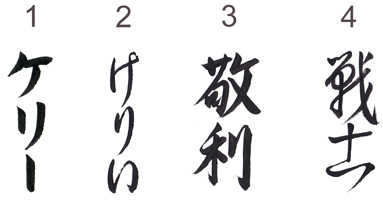
In Japan, katakana and hiragana are used in the names of men and women alike, though kanji is by far the most common script for native Japanese given names.
Why Names Change in Japanese
Before choosing a method, it helps to understand why your name will look and sound different in Japanese. It is not because the translation is imprecise. The two languages organize sound in different ways.
Japanese counts time in beats. Each beat is a vowel, or a consonant followed by a vowel, or one of three beats of their own: ン (n), ッ (a held consonant) and ー (a long vowel). The government's table holds about a hundred basic sounds, plus 33 combinations added for sounds Japanese did not have.
When a foreign name enters Japanese, it is rebuilt from these beats. Every consonant gets a vowel except n, usually u, and o after t and d. So names grow longer: Grant, one syllable in English, is グラント (guranto), four beats (グ・ラ・ン・ト).
This is not an error. It is the natural result of expressing one language's sounds through another language's structure. The goal is a version of your name that a Japanese speaker can say naturally and that you can still recognize as yours.
Some sounds take a neighbor
Several sounds common in English have no direct equivalent in Japanese:
- L and R are one Japanese sound, written with the same katakana. Lena and Rena are both レナ (rena).
- TH without voice, as in Catherine, becomes s: キャサリン (kyasarin). TH with voice, as in the word mother, becomes z: マザー (mazā).
- V is written two ways in Japanese, and both are current: with ヴ, or with the B sounds. Victoria is written both ヴィクトリア (vikutoria) and ビクトリア (bikutoria). In hiragana, V is written with the B sounds.
Names get longer
Because every consonant takes a vowel, names gain beats. Brad, one syllable in English, is four beats in Japanese: ブ・ラ・ッ・ド.
| Name | Japanese | Beats |
|---|---|---|
| Smith | スミス sumisu | 3 |
| Brad | ブラッド buraddo | 4 |
| Christine | クリスティン kurisutin | 5 |
The more consonant clusters and final consonants a name has, the longer it becomes in Japanese. This is normal and expected.
The Four Methods
1. Phonetic Translation to Katakana
The standard way to write foreign names. Katakana is angular and crisp, and to a Japanese reader it marks a word as foreign. It has been extended with combinations for sounds that native Japanese does not have, which makes it the closest phonetic rendering.
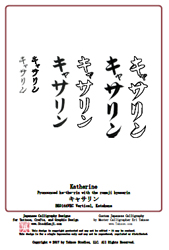
Best for: Standard usage, the closest match to the sound, names that will be read by Japanese speakers.
Limitation: Angular strokes leave little room for calligraphic expression. Katakana has no cursive and few semi-cursive styles. Seal script (tensho) is also unavailable: it is more than a thousand years older than katakana and was only ever written for kanji.
Read more: How to Write Names in Katakana
2. Phonetic Translation to Hiragana
The aesthetic alternative. Hiragana is flowing and curved, historically called onnade or "feminine hand," though it is used by everyone in modern Japan. Writing a foreign name in hiragana gives it a softer, more Japanese feel, as if the name has been welcomed into the language rather than marked as foreign.
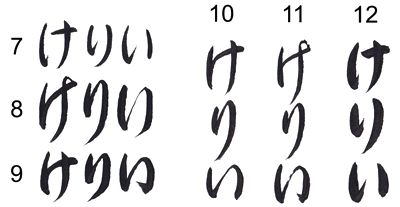
Best for: Feminine aesthetics, cursive calligraphy, designs where flowing lines matter.
Trade-off: Hiragana does not have the extended combinations that katakana has, and it writes a name the way a Japanese word would be written: V with the B sounds, F with the H sounds. Writing F with H is an old Japanese custom, kept in words like coffee, コーヒー (kōhī). The result sounds a little more Japanese and a little less like the original name.
Read more: How to Write Names in Hiragana
3. Phonetic Translation to Kanji (Ateji)
A phonetic translation to kanji is known as ateji (当て字, "assigned characters"). The sound of your name is preserved, but each syllable is written with a kanji that carries meaning. The result is a name that sounds like you but says something: "man of fire," "gentle tiger," "mercy, grace, benevolence."
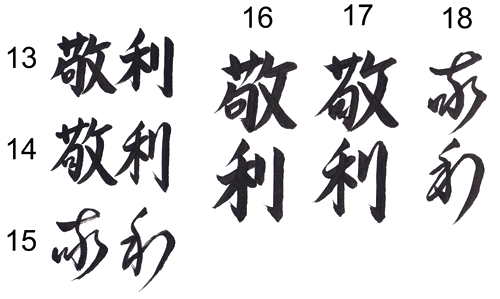
Best for: Names of one to three syllables, seal designs, all calligraphy fonts, personal meaning.
Trade-off: Not every syllable maps cleanly to kanji. Longer names require more characters, making meaningful combinations harder to find. Most people will not be able to read the name correctly on sight, since each kanji can have many possible pronunciations.
Read more: How to Write Names in Kanji
4. Literal Translation to Kanji
With a literal translation, the meaning of the name is translated rather than the sound. The name "Violet" becomes 菫 (sumire, "violet"). The name "Hunter" becomes 狩人 (kariudo, "hunter"). The pronunciation changes entirely, but the meaning carries through.
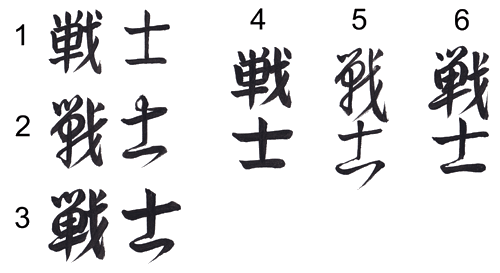
Best for: Names that are common words (Angel, Rose, Joy, Liberty, Hunter, Star), names where the meaning is personally significant.
Limitation: Many names have lost their original meaning or have meanings that don't translate gracefully. The pronunciation will be completely different from the original name.
Read more: How to Write Names in Kanji
Pronunciation Determines the Translation
For all three phonetic methods, the Japanese follows how the name is said, never its spelling. Kathy and Cathy, said alike, are both キャシー (kyashī). Jan said with a J is ジャン (jan); said with a Y, it is ヤン (yan). Andrea has several readings, one for each way it is said.
Several readings for one spelling is the point, not confusion: each is right for the person who says it that way. That is why every name on our site shows how it is said, and why our name search asks how you say yours. How we get your name's Japanese explains how a reading is made and how you can check it.
Choosing the Right Method
| Priority | Recommended Method |
|---|---|
| Standard usage, closest to the sound | Katakana |
| Feminine or flowing aesthetics | Hiragana |
| Personal meaning + sound | Kanji (ateji) |
| Preserve name's original meaning | Kanji (literal) |
| Seal design (tenkoku) | Kanji (either method) |
| All calligraphy fonts available | Hiragana or Kanji |
Methods can also be combined. In the TV series Boston Legal, Denny Crane's name once appeared in Japanese as デニー鶴: the first name written phonetically in katakana, the surname translated literally with the kanji 鶴, "crane."
What to Expect
Even with good preparation, a few things about your Japanese name may surprise you.
Katakana and hiragana versions may differ. In katakana, the extended combinations keep sounds like V. In hiragana, V is written with the B sounds. Each is right in its own script. See the hiragana article for why.
Reading your Japanese name
When you see your name in Japanese for the first time, sound it out one beat at a time. Each full-size kana is one beat. A small ャ, ュ or ョ joins the kana before it into a single beat, and ン, ッ and ー are each a beat of their own. Each beat takes about the same time.
Every design includes a pronunciation guide called romaji: Japanese sounds written in Roman letters. A line over a vowel, as in robāto, marks a long sound. When you see maikeru next to Michael, the romaji tells you that this is your name, rebuilt in Japanese sounds.
Summary
A foreign name rarely has one right answer in Japanese. One spelling said several ways has several right answers, and each of our readings is tied to the way of saying it, so you can choose the one that is your name. Our readings follow the government's 1991 basis for writing foreign words and, where it leaves the choice open, our own written convention.
Beyond the reading, Master Takase's brushwork gives each design its own character. The designs are composed from characters she brushed by hand. The pronunciation gets you to the right sounds. The calligraphy makes it art.
Ready to see your name? Search over 180,000 names, with designs composed from characters Master Takase brushed by hand.