

How to Write Names in Hiragana
Should your name be in katakana or hiragana? Katakana is how Japanese writes a foreign name, so where a Japanese reader must know it as your name, on a document or a card, use katakana. For a scroll, a gift or a tattoo, hiragana 平仮名 is the brush's own script, flowing and curved, and the choice is yours.
Women often ask Master Takase to write their name in hiragana rather than the standard katakana, and she understands why. It gives the name a softer, more Japanese feel, as if it has been welcomed into the language rather than marked as foreign.
For an overview of all four methods, see How to Write Names in Japanese.
A Brief History
Nobody invented hiragana; the brush did. In the eighth century Japanese could be written with Chinese characters used only for their sound, man'yōgana. Written fast with the brush, they ran into a cursive, and toward the end of the Nara period and through the Heian (794–1185) that cursive was simplified into hiragana. Each kana keeps its parent: あ comes from 安, か from 加, and め from 女, woman. Among the earliest dated examples is a provincial official's note of 867, and dishes and cups from a Kyoto minister's house of the same decades carry it in ink, some of it, it seems, poems. Every surviving copy of the Kokinshū (905), the first anthology of Japanese poetry made by imperial command, is written in it.
The Heian court called it 女手 onnade, "the women's hand," because the women of the court wrote their letters, poems, diaries and tales in it, while men's official writing was in Chinese. Men wrote it too. In 935 the poet Ki no Tsurayuki wrote his Tosa Diary in hiragana in a woman's voice: "I intend to see whether a woman can produce one of those diaries men are said to write." The great prose of the age is in the women's hand, Sei Shōnagon's Pillow Book and Murasaki Shikibu's Tale of Genji among it, and in the Genji the hero says that everything has declined from the old days except kana, which has never been finer. To a Heian reader the masculine hand was kanji. Katakana, born in the margins of Buddhist study, was a third hand of its own.
A medieval legend credits the priest Kūkai (774–835) with the script and with the いろは poem, which uses every kana of its day once. For centuries hardly anyone doubted it. The earliest written telling of it scholars know, a conversation of 1109, nearly three centuries after Kūkai's death, adds that the speaker had seen nothing to prove it, and the handbooks today date the poem after Kūkai's time from its own sounds. Until 1900 a sound could have several shapes; the school rules of that year kept one for each, and calligraphy still uses the others, the hentaigana.
Today hiragana is used to write grammatical elements, verb and adjective inflections, and native Japanese words for which kanji either does not exist or is not commonly used. Japanese given names written in hiragana alone are mostly women's names, though men's exist. For a foreign name, choosing hiragana over the standard katakana is a deliberate aesthetic decision.
Because hiragana is itself a cursive, it offers the full range of calligraphy fonts, block, semi-cursive and cursive, and suits Japanese calligraphy far better than katakana, the square kana, which has no cursive of its own.
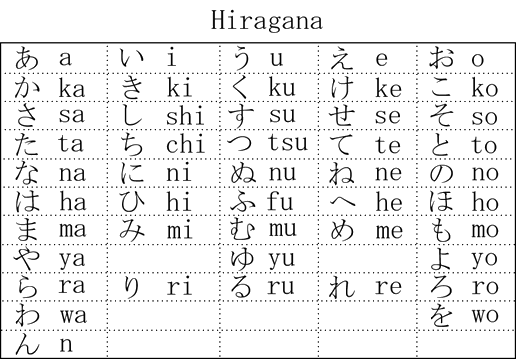
The Hiragana Character Set
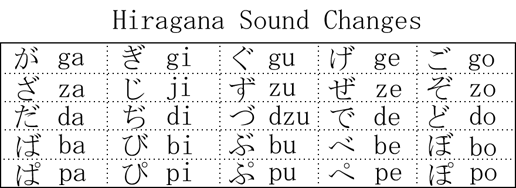
Like katakana, hiragana uses dakuten (voicing mark) and handakuten (semi-voicing mark) to create additional sounds.
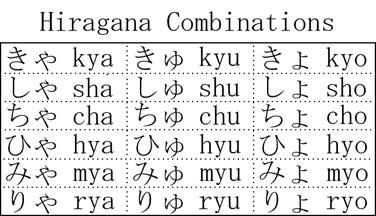
Hiragana also uses small characters (shōji) for palatalized syllables (yōon) and geminated consonants (sokuon).
What Changes When a Name Is Written in Hiragana
Katakana writes sounds Japanese does not have of its own, such as v, f and w before a vowel, with extended characters: a kana with a small vowel beside it, or a voicing mark. Hiragana could write them the same way. In hiragana we write a foreign name closer to how a Japanese word is written, so three of these sounds change, and the rest stay as they are. Each name in this section links its name page, where you can read it in both scripts.
V becomes B
Victoria is ヴィクトリア (vikutoria) in katakana and びくとりあ (bikutoria) in hiragana.
F becomes H
Fiona is フィオナ (fiona) in katakana and ひおな (hiona) in hiragana.
W before a vowel becomes a vowel pair
ウィ, ウェ and ウォ become うい (ui), うえ (ue) and うお (uo). William is ウィリアム (wiriamu) in katakana and ういりあむ (uiriamu) in hiragana.
What stays
ti, di, tu, du, she, je, che and tsa stay as they are, written with the same small kana in both scripts. Timothy is ティモシー (timoshī) in katakana and てぃもしい (timoshii) in hiragana.
Fatima shows both at once: ファティマ (fatima) in katakana is はてぃま (hatima) in hiragana. The fa becomes ha, and the ti stays.
Quick reference
| Katakana | Hiragana | Rule |
|---|---|---|
| ヴァ ヴィ ヴ ヴェ ヴォ | ば び ぶ べ ぼ | V → B |
| ファ フィ フェ フォ | は ひ へ ほ | F → H |
| ウィ ウェ ウォ | うい うえ うお | W → vowel pair |
| ティ ディ トゥ ドゥ | てぃ でぃ とぅ どぅ | Stays |
| シェ ジェ チェ ツァ | しぇ じぇ ちぇ つぁ | Stays |
Long Vowels: The Biggest Difference
This is the most visible difference between katakana and hiragana name designs, and it is worth understanding well.
Katakana uses the chōonpu (ー), a dash-like mark, to extend any vowel sound. Kelly ends with a long "ee": ケリー. Simple, clean, unambiguous.
The chōonpu does not exist in hiragana. Instead, long vowels are written by doubling the vowel character:
| Long sound | Katakana | Hiragana | What happens |
|---|---|---|---|
| Long a | ー (after ア-row) | ああ | a + a |
| Long i | ー (after イ-row) | いい | i + i |
| Long u | ー (after ウ-row) | うう | u + u |
| Long e | ー (after エ-row) | ええ | e + e |
| Long o | ー (after オ-row) | おう | o + u (not o) |
The long "o" is the one exception — it doubles as おう (o + u) rather than おお (o + o), as Japanese writes long o in its own words (おとうさん).
Kelly in both scripts:
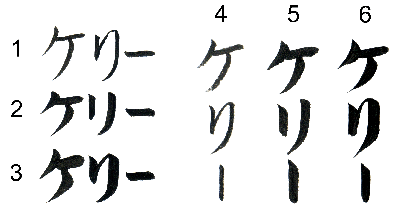
Kelly in katakana: ケリー (kerī) — the final long vowel uses the chōonpu.
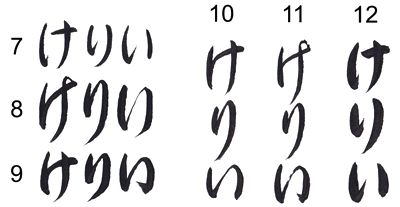
Kelly in hiragana: けりい (kerii), the final long vowel doubling the い. See Kelly's name page for both.
Each script has its own romaji, because romaji spells the kana actually written. In katakana romaji the long mark is a macron, ケリー kerī; in hiragana romaji the doubled vowel is spelled out, けりい kerii, and a long o written おう is ou.
Two vowels, or one long one
Because hiragana writes a long vowel by doubling it, it cannot tell two vowels side by side from one long vowel. Katakana can. Saavedra, said with two a's, is サアベドラ (saabedora); said with one long a, it is サーベドラ (sābedora). In hiragana both are さあべどら (saabedora). Most names do not meet this, but if yours does, katakana keeps the difference.
When to Choose Hiragana
Hiragana is a strong choice when:
- Calligraphic expression matters. Hiragana supports all fonts including cursive (sōsho) and semi-cursive (gyōsho), where the brush flows between characters. Katakana, the square kana, has no cursive of its own.
- You prefer a softer, more Japanese aesthetic. Hiragana's flowing curves give the name a different visual character from katakana's angular strokes.
- The sounds that change suit you. If your name has v, f or w before a vowel, those sounds change in hiragana. If keeping the v matters to you, katakana keeps it.
- You are creating a design for display, not identification. For documents, business cards, or contexts where a Japanese reader needs to identify a foreign name, katakana is expected. For art, gifts, and personal items, hiragana is a beautiful alternative.
Summary
Hiragana offers what katakana cannot: flowing brushwork, cursive expression, and a warm, Japanese aesthetic. In hiragana, v becomes b, f becomes h, w before a vowel becomes a vowel pair, and long vowels are written by doubling. For most names, these changes are small. And in Master Takase's experience, the result is often more beautiful than the katakana version.
For the standard phonetic rendering, see How to Write Names in Katakana. For designs that carry meaning or require seal script, see How to Write Names in Kanji.
Ready to see your name? Search over 180,000 names, with designs composed from characters Master Takase brushed by hand.