
IV ARMOUR-MAKING AND ARMOUR-MAKERS
Armour was made by experts, and points to which they paid special attention in producing good armour will be briefly explained.
Armour must of course be strong and durable. At the same time, however, it must be light, easy to put on and take off, and also convenient to carry about and preserve. It is also important that it must be beautiful and have dignity. Further, it must fit the wearer’s body for active movements on the battle-field. All these points have to be considered in making an armour.
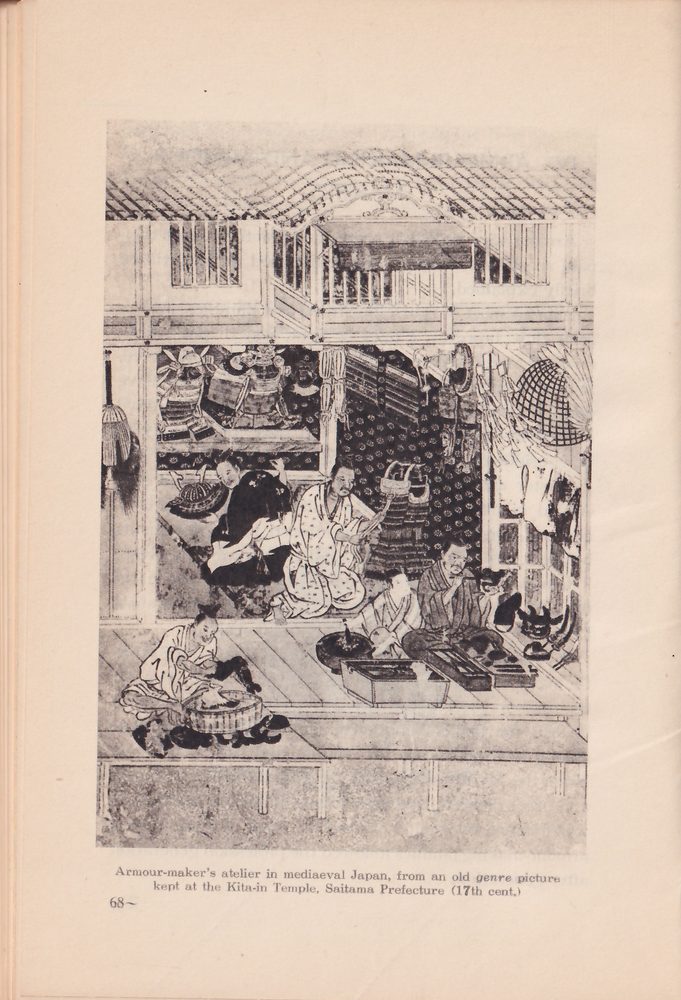
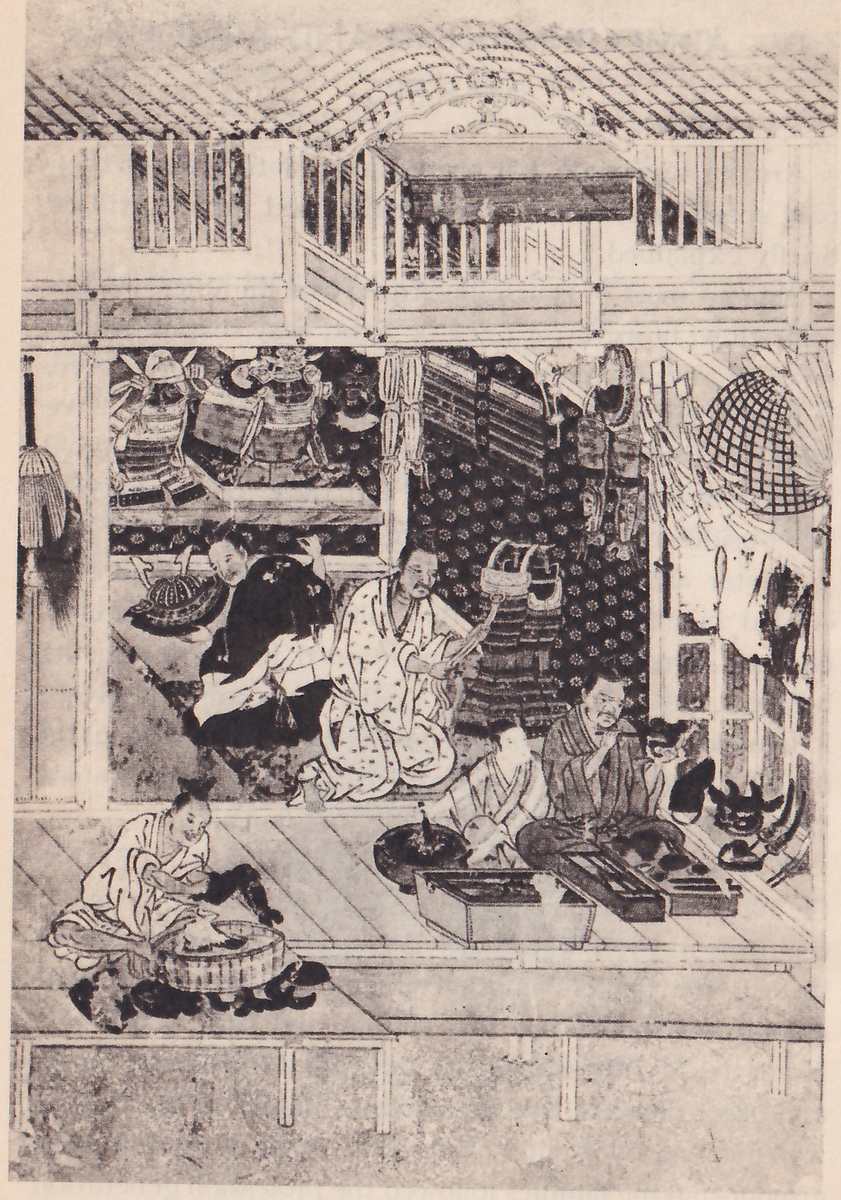
Master armour-makers overcame difficulties and succeeded in making armour that fulfilled all these requirements. Armour-makers are mentioned in the documents before 1,200 A.D., but individual names are not given. The makers of those magnificent specimens of armour of the time of the Minamoto and Taira war and the Kamakura Period (1185–1392) are quite unknown.
It is since the later Muromati Period (1392–1568) that the name of armour-makers has become known. Among the armours preserved today there are some of this period bearing the makers’ engraved names. The most famous among such names are the Haruta and Iwai families of Nara, the Myōtin school that spread from Kyōto to Kantō and other districts, and the Saotome family of Kantō that was founded by a pupil of Myōtin. Most of these famous armour-making families followed the profession generation after generation.
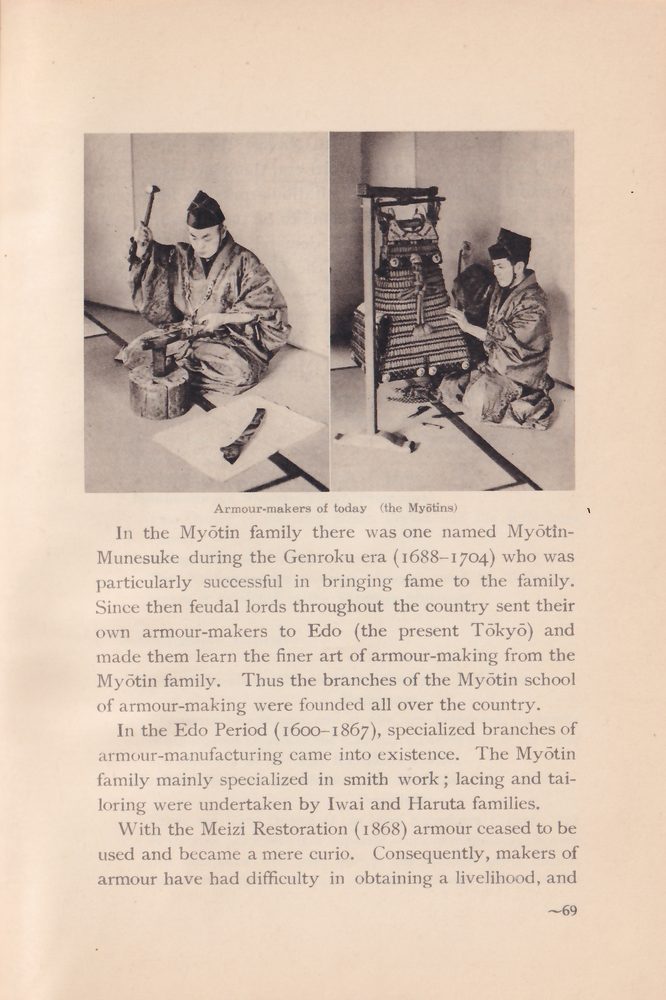
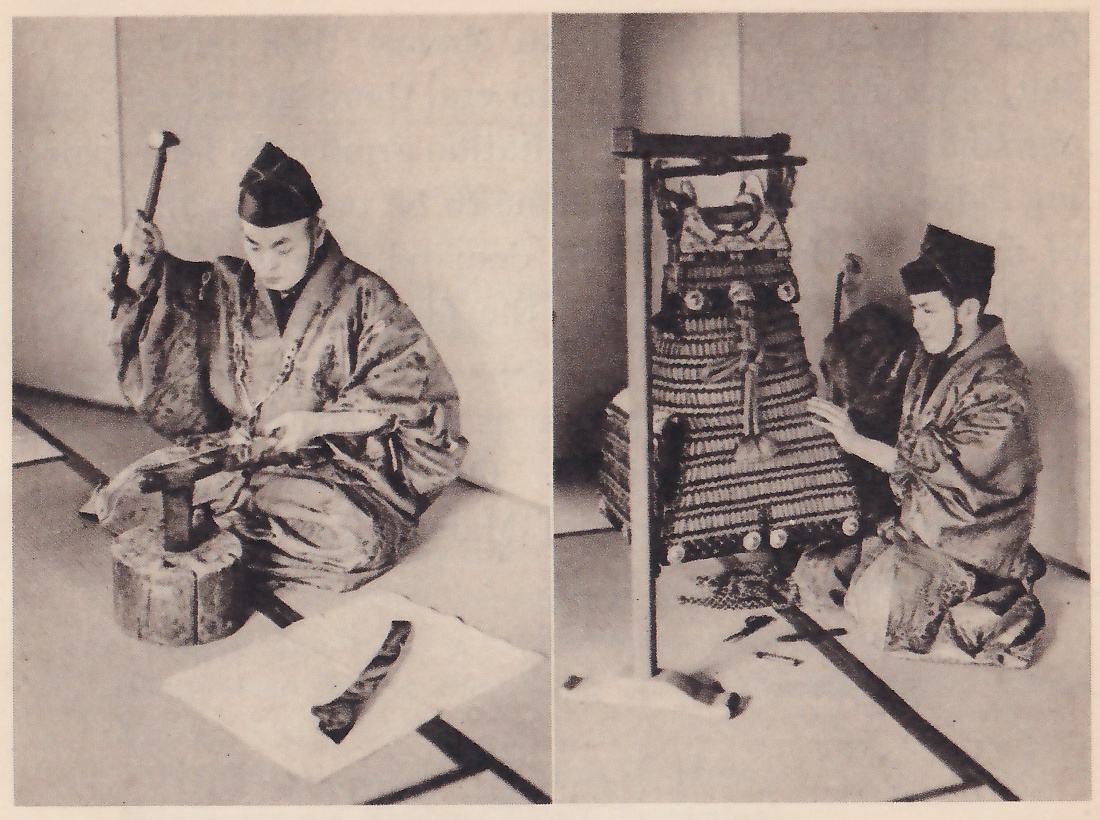
In the Myōtin family there was one named Myōtin-Munesuke during the Genroku era (1688–1704) who was particularly successful in bringing fame to the family. Since then feudal lords throughout the country sent their own armour-makers to Edo (the present Tōkyō) and made them learn the finer art of armour-making from the Myōtin family. Thus the branches of the Myōtin school of armour-making were founded all over the country.
In the Edo Period (1600–1867), specialized branches of armour-manufacturing came into existence. The Myōtin family mainly specialized in smith work; lacing and tailoring were undertaken by Iwai and Haruta families.
With the Meizi Restoration (1868) armour ceased to be used and became a mere curio. Consequently, makers of armour have had difficulty in obtaining a livelihood, and
most of them were forced to change their occupation. But, since the end of the Meizi era, there has risen a new demand for the making of imitation armour or for repairing old armour, for armour came to be prized as an article of fine art. Because of this demand, Myōtin-Muneyosi (1882– ), descendant of the famous Myōtin family, and his son Muneyuki (1917– ) find it possible to engage in the same occupation as their fathers, and have produced many masterpieces. One of them, the Ōyoroi presented to the Emperor of Manchoukuo, is shown in the frontispiece.