
III CONSTRUCTION OF JAPANESE ARMOUR
The important parts of the Japanese armour are the following:
1. Kozane (small scales); 2. Odosige (lacing braid); 3. Kanagumawari (metal parts); 4. Kanamono (metal accessories); 5. Kawadokoro (leather parts); 6. Odokoro (cord parts); 7. Iezi (fabric parts); 8. Itadokoro (iron plates); 9. Kusari (chain mail).
1. Kozane (small scales)
Kozane is one of the most important parts of armour. Originally small oblong scales were used. They are put together like scales of fish to form the main parts of the armour. They are almost all of cow-hide or iron; in some either cow-hide or iron is used exclusively while in others both cow-hide and iron are used. The manner in which the scales are put together again differs according to the periods in which armour was made. In the later Heian Period (12th century) when the battles of the Minamoto and Taira clans were fought, the scales were largest (1 × 2½ inches) and very loosely joined. But in the later Muromati Period (end of the 15th century), extremely narrow scales (⅓ × 2⅛ inches) were used.
The holes bored in the scales also varied in number. Generally, thirteen holes are made in two rows, and of the thirteen the lower eight holes are used for joining scales
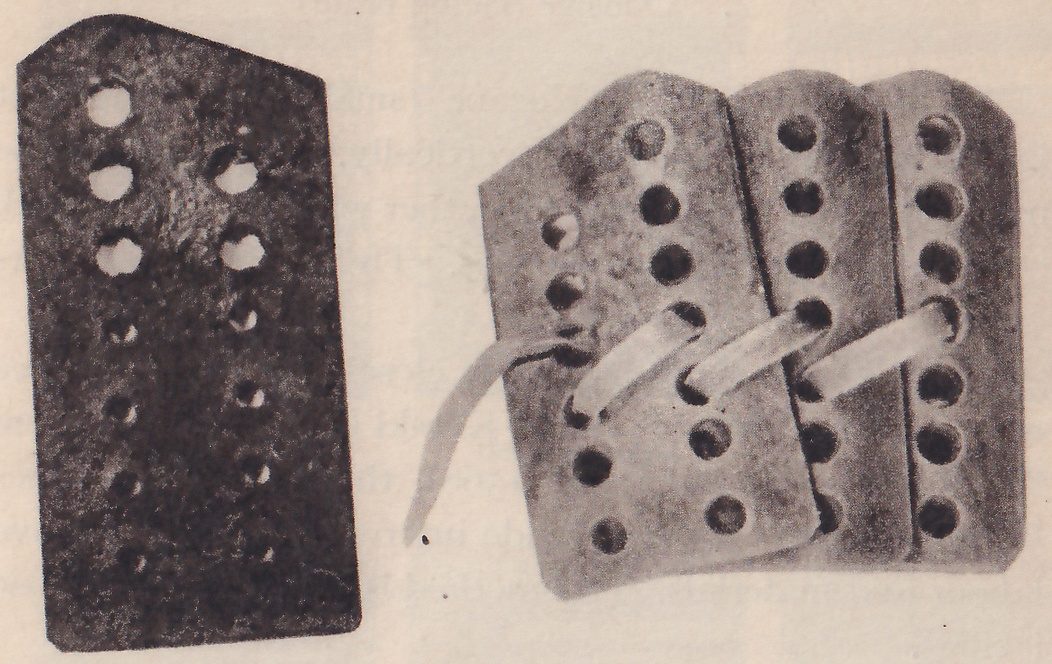
horizontally, and the upper five holes, which are slightly larger in diameter than others, are for joining them vertically. This joining or lacing of Kozane is called Odosi. Kozane is generally black-lacquered, but since the middle of the Muromati Period (15th century) some have been painted gold, silver, or red.
There are two methods of painting the Kozane. The first is by painting each Kozane before joining them. The second is that of painting them after they have been joined. In the 16th century which is called the Period of Civil Wars, some armour was made of large boards, each of which was made to look like small scales joined together. The toughness of the armour depended on the strength of its Kozane, and all armour-makers did their best to produce the best and strongest Kozane, for on the quality of the Kozane depended their reputation.
2. Odosige (lacing braid)
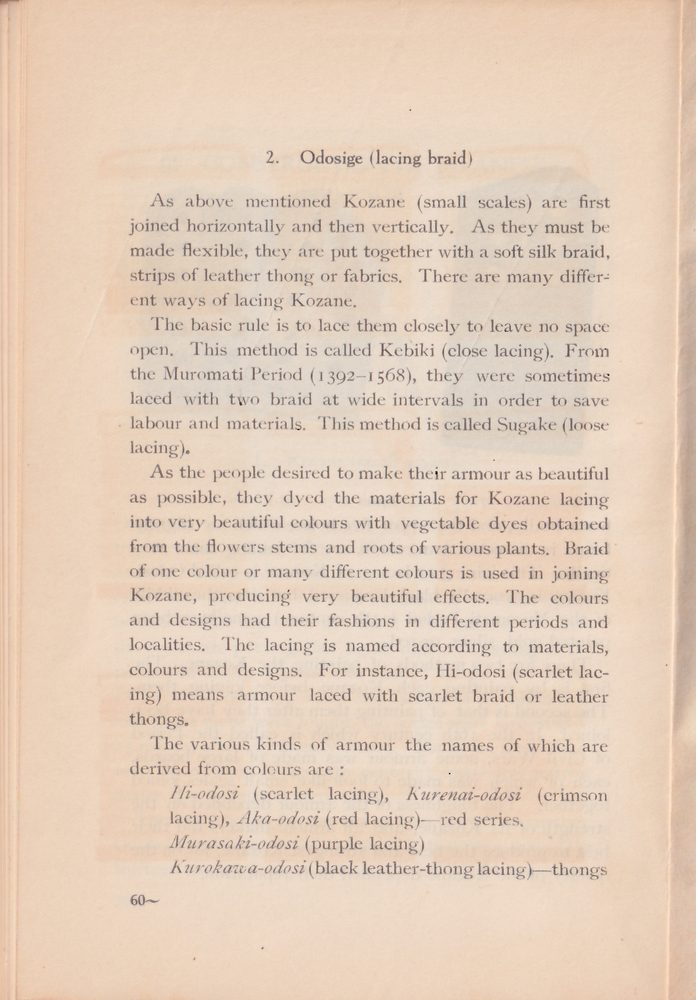
As above mentioned Kozane (small scales) are first joined horizontally and then vertically. As they must be made flexible, they are put together with a soft silk braid, strips of leather thong or fabrics. There are many different ways of lacing Kozane.
The basic rule is to lace them closely to leave no space open. This method is called Kebiki (close lacing). From the Muromati Period (1392–1568), they were sometimes laced with two braid at wide intervals in order to save labour and materials. This method is called Sugake (loose lacing).
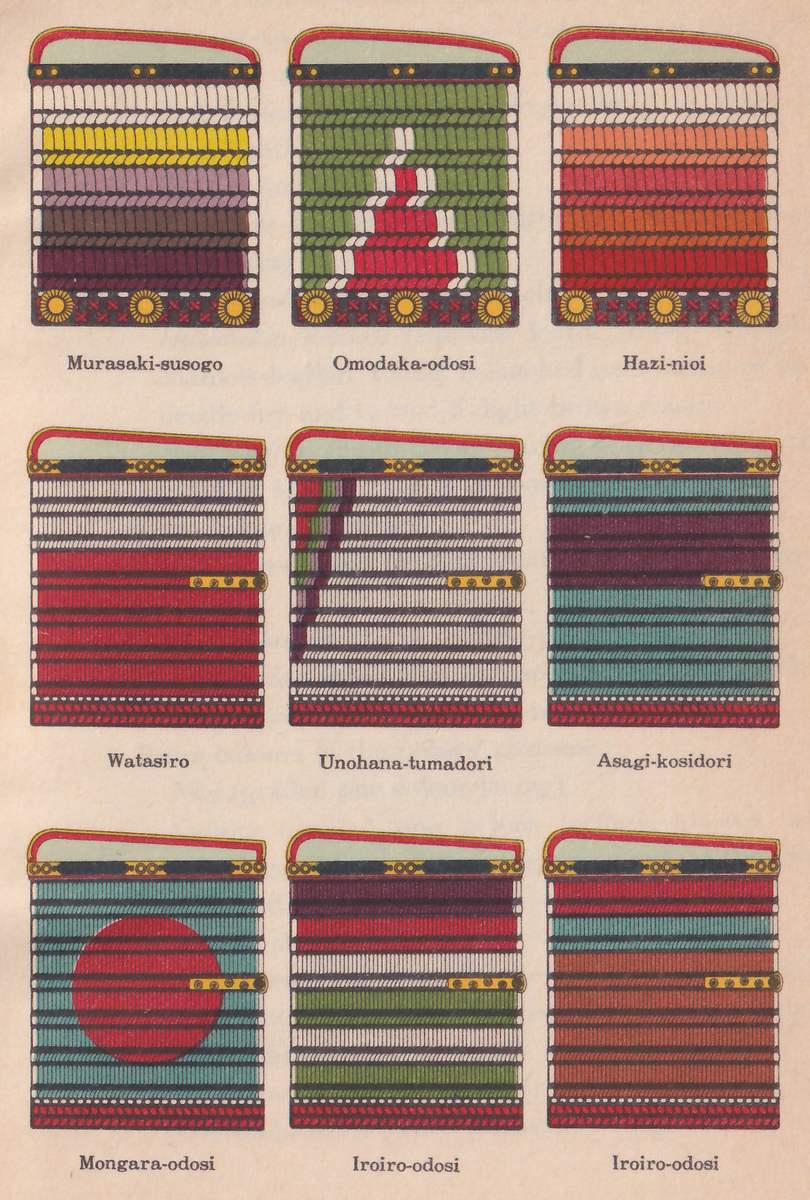
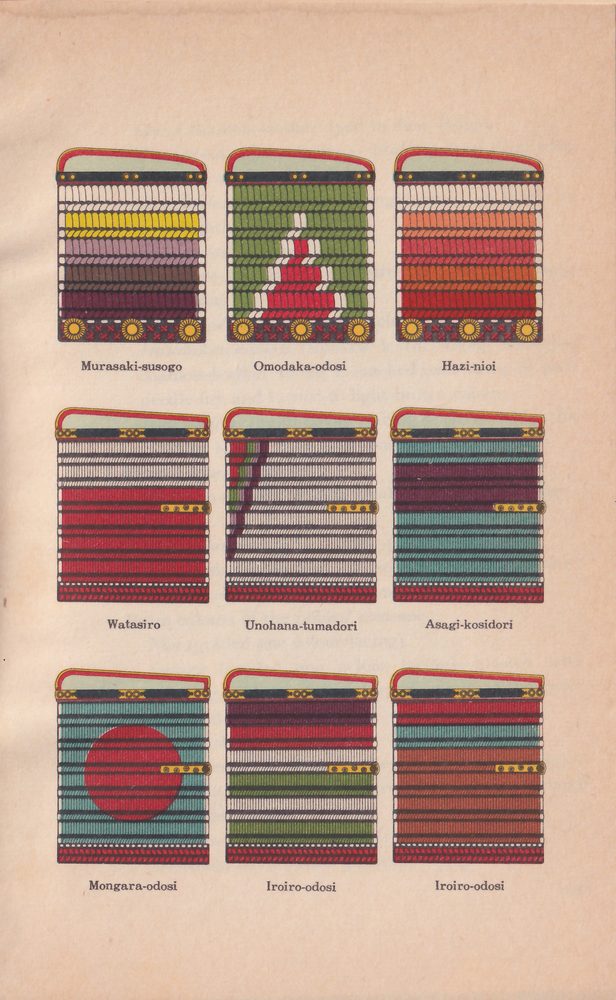
As the people desired to make their armour as beautiful as possible, they dyed the materials for Kozane lacing into very beautiful colours with vegetable dyes obtained from the flowers stems and roots of various plants. Braid of one colour or many different colours is used in joining Kozane, producingPrinted: prcducing very beautiful effects. The colours and designs had their fashions in different periods and localities. The lacing is named according to materials, colours and designs. For instance, Hi-odosi (scarlet lacing) means armour laced with scarlet braid or leather thongs.
The various kinds of armour the names of which are derived from colours are:
Hi-odosi (scarlet lacing), Kurenai-odosi (crimson lacing), Aka-odosi (red lacing)—red series.
Murasaki-odosi (purple lacing)
Kurokawa-odosi (black leather-thong lacing)—thongs
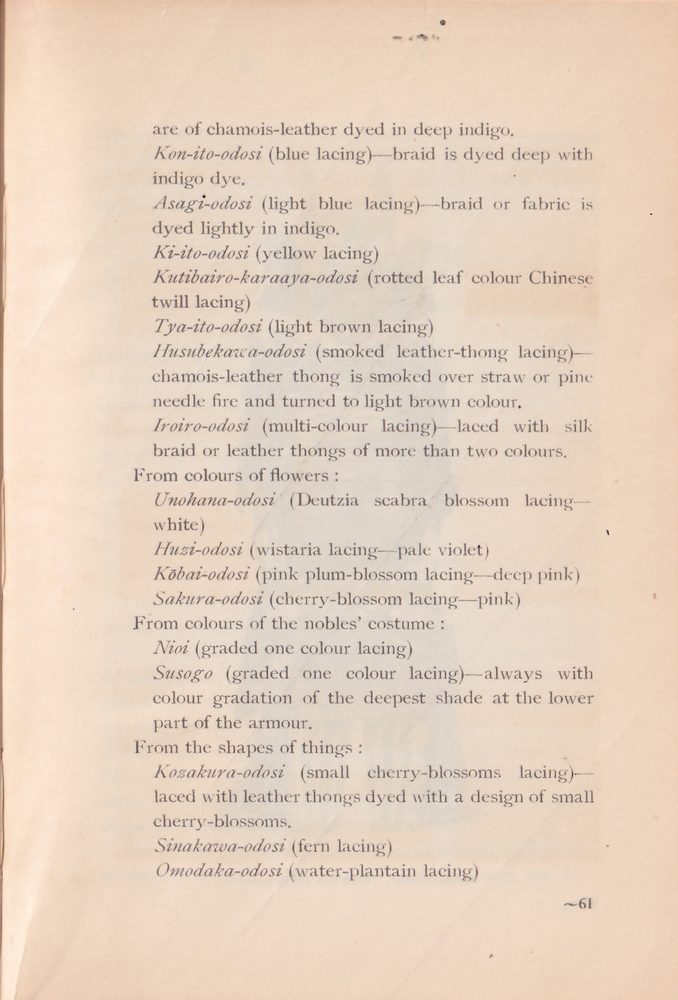
are of chamois-leather dyed in deep indigo.
Kon-ito-odosi (blue lacing)—braid is dyed deep with indigo dye.
Asagi-odosi (light blue lacing)—braid or fabric is dyed lightly in indigo.
Ki-ito-odosi (yellow lacing)
Kutibairo-karaaya-odosi (rotted leaf colour Chinese twill lacing)
Tya-ito-odosi (light brown lacing)
Husubekawa-odosi (smoked leather-thong lacing)—chamois-leather thong is smoked over straw or pine needle fire and turned to light brown colour.
Iroiro-odosi (multi-colour lacing)—laced with silk braid or leather thongs of more than two colours.
From colours of flowers:
Unohana-odosi (Deutzia scabra blossom lacing—white)
Huzi-odosi (wistaria lacing—pale violet)
Kōbai-odosi (pink plum-blossom lacing—deep pink)
Sakura-odosi (cherry-blossom lacing—pink)
From colours of the nobles’ costume:
Nioi (graded one colour lacing)
Susogo (graded one colour lacing)—always with colour gradation of the deepest shade at the lower part of the armour.
From the shapes of things:
Kozakura-odosi (small cherry-blossoms lacing)—laced with leather thongs dyed with a design of small cherry-blossoms.
Sinakawa-odosi (fern lacing)
Omodaka-odosi (water-plantain lacing)
Kasidori-odosi (jay-bird’s feather lacing)
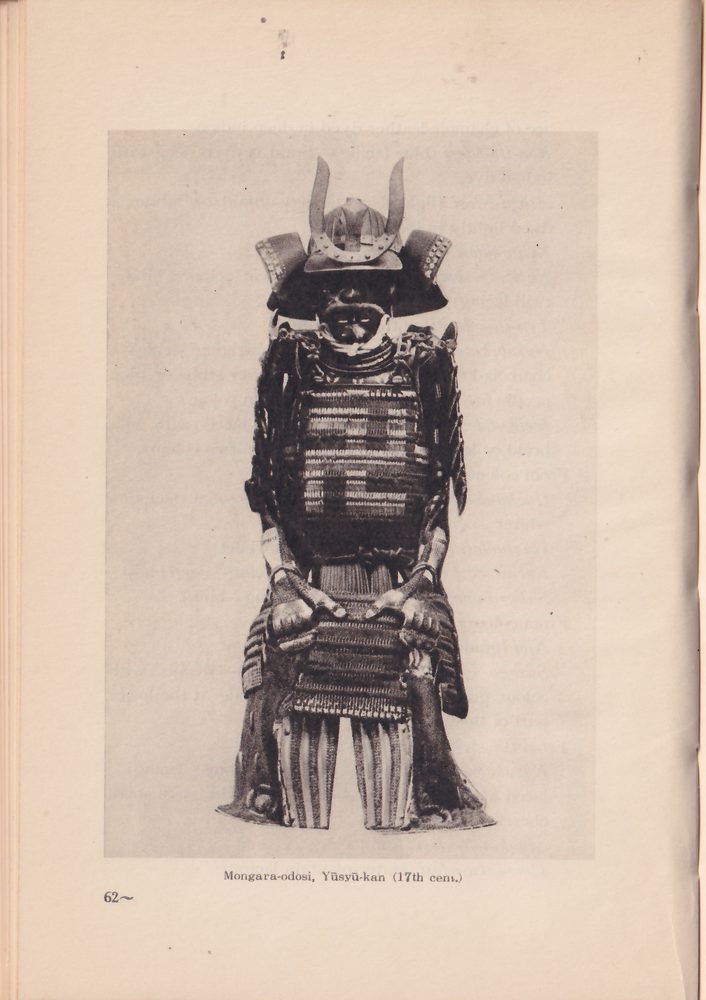
There are also some named after family crests (Mon-gara-odosi), colour combinations (Watasiro-odosi, Tumadori-odosi) and other features of armour.
3. Kanagumawari (metal parts)
Kanagumawari is the general term used to indicate all iron parts except Kozane (small scales), the most important part. Iron parts are mostly covered with chamois or tanned horse-leather on both sides, and their edges are bordered with narrow gold-plated copper strips to protect them against sharp contact with hard objects. They come in various shapes and they are given names according to their uses and also the positions where they are used.
4. Kanamono (metal accessories)
This means metal accessories used for practical or ornamental purposes. The main material is copper which is mostly gold- or silver-plated. For low-grade armour, unrefined copper is used. In the Edo days, Syakudō or a gold-copper alloy was fashionably used on high-grade armour. It has beautiful black lustre.
The main items included in Kanamono are rivets for joining pieces, borders for iron plates, rings for attaching cords, Kohaze or clasps for fastening two cords and metal edges for purely ornamental purposes.
The design most widely used on Kanamono is the flower of chrysanthemum, which is the symbol of long life in
China and is regarded as the noblest of flowers and adopted as the Imperial emblem in Japan. From the end of the Kamakura Period (1185–1392), family crests were used as already explained. Also since the Kamakura Period, as the art of engraving progressed, beautiful relief or openwork engraving has come to be carved on such metal accessories.
5. Kawadokoro (leather parts)
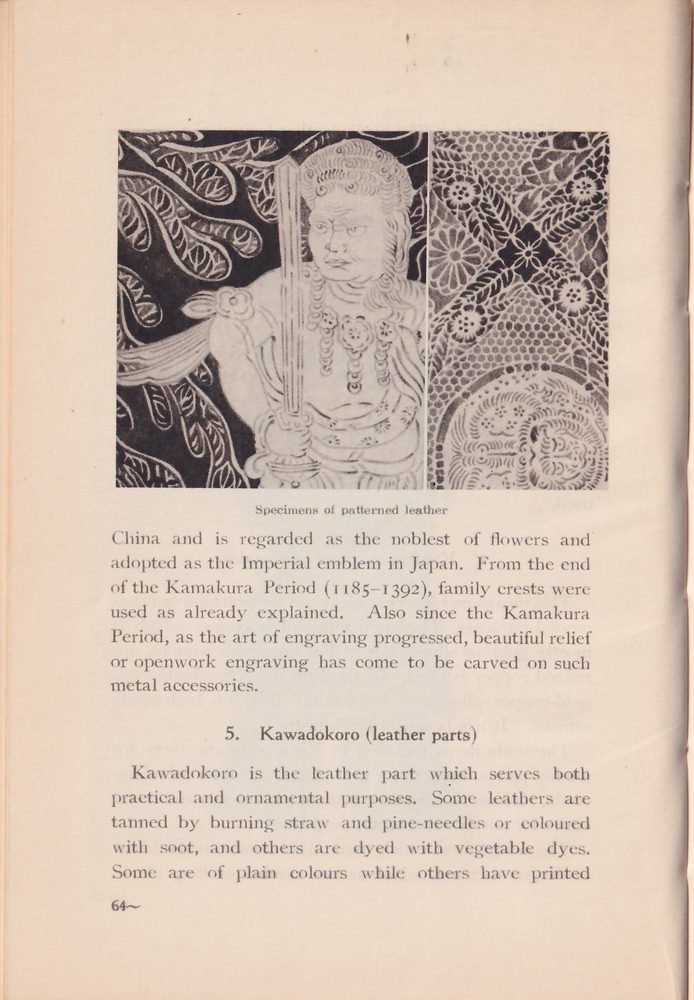
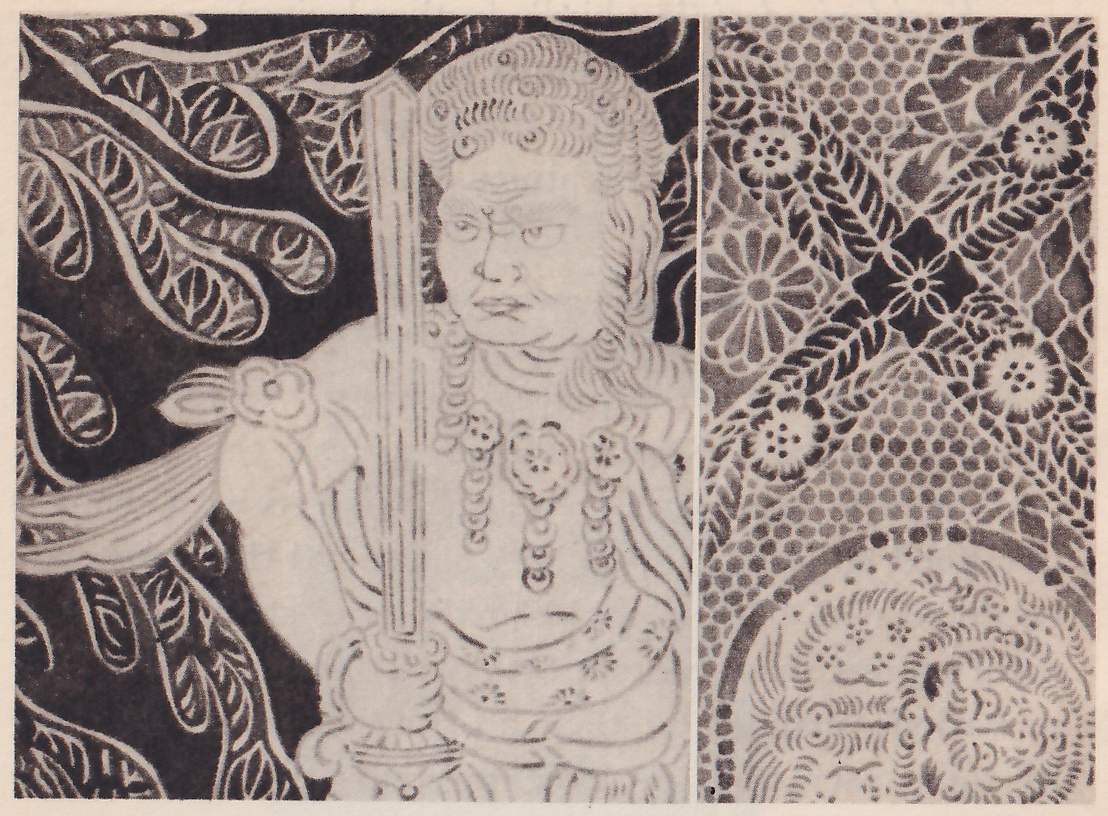
Kawadokoro is the leather part which serves both practical and ornamental purposes. Some leathers are tanned by burning straw and pine-needles or coloured with soot, and others are dyed with vegetable dyes. Some are of plain colours while others have printed
designs. The design theme most commonly used in the ancient Heian Period (794–1185) is that of lions. In the Kamakura Period were largely used the designs of Acara and his two attendants. Syōbugawa (iris stencilled leather), dyed in indigo and having a design of iris flowers, was also very popular.
6. Odokoro (cord parts)
Odokoro are the cords used for fastening separate parts or sometimes simply as ornaments. For cords plaited leather is also used, but silken cords are most common.
7. Iezi (fabric parts)
Iezi is a general term to indicate all fabrics used in making a suit of armour. Fabrics are always used for Kote (sleeves) and Hizayoroi (thigh protectors), and also Suneate (greaves) of later periods. In some cases different fabrics are used for the surface and the lining, and strong hemp cloths are placed between them. For the surface fabric, hemp cloths were used in old days, but in the Edo Period (1600–1867) brocades, gold brocades, damasks and other high-grade fabrics came to be used. At first such rich materials were brought from China, but later superior domestic goods came to be produced.
8. Itadokoro (iron plates)
This includes all iron plates used. Many changes were made in iron plates. In old days, iron plates were
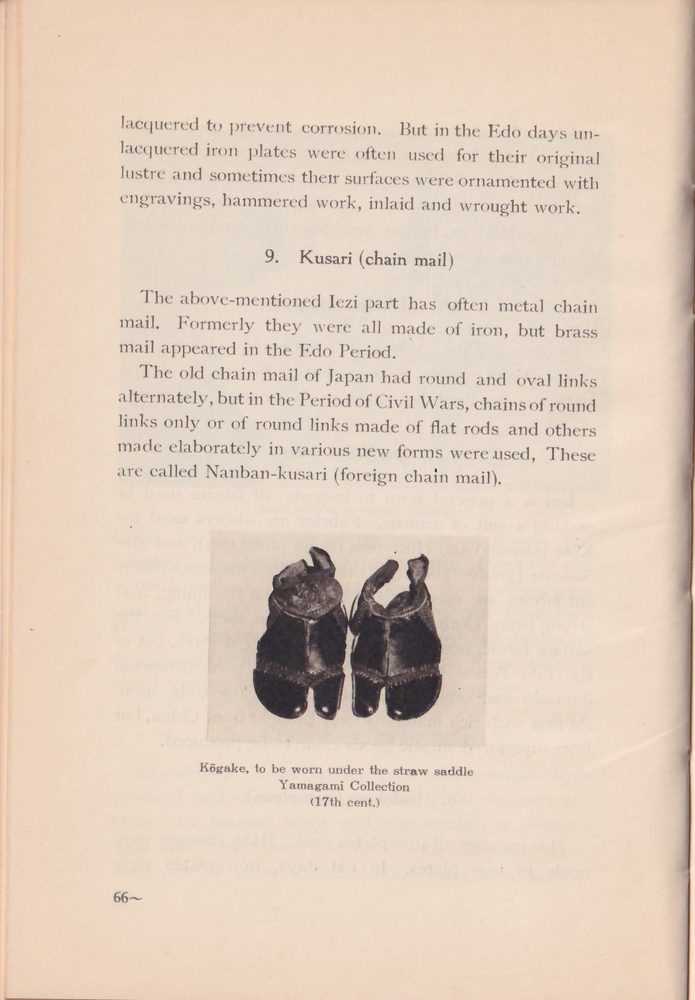
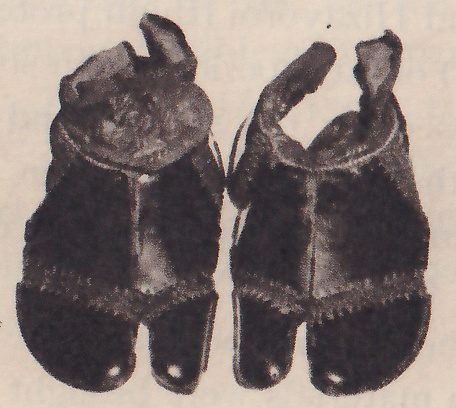
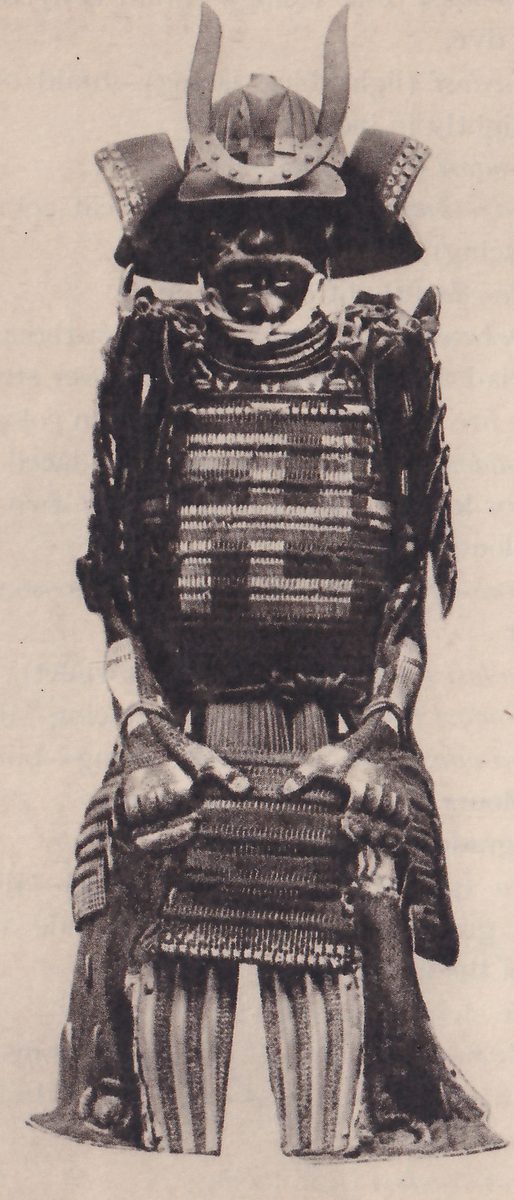
Yamagami Collection
(17th cent.)
lacquered to prevent corrosion. But in the Edo days unlacquered iron plates were often used for their original lustre and sometimes their surfaces were ornamented with engravings, hammered work, inlaid and wrought work.
9. Kusari (chain mail)
The above-mentioned Iezi part has often metal chain mail. Formerly they were all made of iron, but brass mail appeared in the Edo Period.
The old chain mail of Japan had round and oval links alternately, but in the Period of Civil Wars, chains of round links only or of round links made of flat rods and others made elaborately in various new forms were used, These are called Nanban-kusari (foreign chain mail).