
UKIYO-E (GENRE PICTURE) AND PRINTS
The technical development of Japanese wood-cuts so far described was entirely due to Buddhist influence, so that most of the representative products had been religious or sacred pictures. Wood-cuts produced in the Edo period (1600–1867), on the other hand, were frankly intended for aesthetic appreciation, not as a sort of accessory to religion. And it was natural that wood-cuts serving sacred purposes, and those meant for solely artistic appreciation, should have altogether different subjects for portrayal. It was this latter type of print which developed in connection with genre pictures by hand. They were called ukiyo-e prints.
Ukiyo-e prints, properly so called, should be considered in contradistinction to ukiyo-e or genre pictures done by hand with soft brushes. The former were in vogue from the earliest to the last subdivision of the Edo period, and were the popular wood-cuts of that period. Wood-cuts produced during and since the Meizi era (1867–1912) are different from those made in the Edo period, and should, therefore, be clearly distinguished from ukiyo-e prints. Japanese prints of the present age have, of course, special qualities of their own.
A few words of explanation are here in place concerning the term ukiyo-e. Ukiyo-e is not a very old word. It occurs first in a book entitled “Kōsyoku Itidai Otoko,” by the celebrated author Ihara-Saikaku, published in 1682
(2nd year of Tenna). Genre pictures that by their nature might well have been called ukiyo-e, had been in circulation before that date, and indeed such pictures may have been actually so called by the people, with the result that Saikaku employed the term in his novel as a current neoterism. And as such genre pictures became more and more popular, the term ukiyo-e came more and more into general use.
In those days the expression was applied to pictures depicting the ephemeral worldly pleasures of gay life, so that their themes were taken from the gay quarters, the theatres, and their neighbourhood, which were the most popular places of public resort. All through the Edo period the themes were taken from these same sources. The ukiyo-e painters thus chiefly portrayed gay girls and actors, but they also painted waitresses in the so-called “tea-houses” attached to theatres, and geisya girls. Those who ventured to represent the domestic life of daimyō, hatamoto (immediate feudatories of the Syōgun), and other members of the military class, did so at the risk of incurring the ire of the Syōgunate and thus being thrown into prison. For this reason the warrior caste afforded the painters but few themes for their pictures. Even the domestic life of the more sober tradespeople was not much represented in ukiyo-e. So the ukiyo-e painters at first contented themselves with objective representations of scenes in the gay quarters and in theatre streets; they then depicted their indoor life; and finally went on to the portrayal of gay women and actors with all their individual characteristics and peculiarities. In this respect, i. e., in the choice of subjects, both hand-painted genre pictures and
wood-cuts went through a very similar series of changes.
From the foregoing it will be obvious that one would fall into a serious error if one were to form an idea of the general manners and customs of the Edo period solely from the genre pictures of the ukiyo-e type, particularly from those which are known as nisiki-e. The reader is, therefore, once more warned against the impression he might get from ukiyo-e of a highly colourful metropolis full of lovely women strolling through its thoroughfares. He is asked to bear constantly in mind the extremely narrow sphere to which the manners and customs shown in such detail in ukiyo-e were really confined. Let him remember that the Edo period was one dominated by the sombre samurai.
Since the formal position of ukiyo-e in the history of Japanese art depended on the straightforward representation of prosaic urban manners and customs, it was inevitable that they should have catered to the taste of the common citizen by depicting scenes in the gay quarters and theatrical circles. Indeed, the ukiyo-e painters far surpassed all other schools of graphic art in the representation of life in such circles.
Extremely limited as was the social sphere from which the ukiyo-e artists at first obtained their themes, the general conception of the term ukiyo-e (the fleeting world or mundane life) was gradually extended to cover all phases of life, with the result that the spheres of life represented by ukiyo-e became correspondingly enlarged. Ukiyo-e painters, moreover, sought to meet popular demands for other kinds of pictures, such as those of wrestlers, warriors, dolls, children, etc., and pictures to adorn
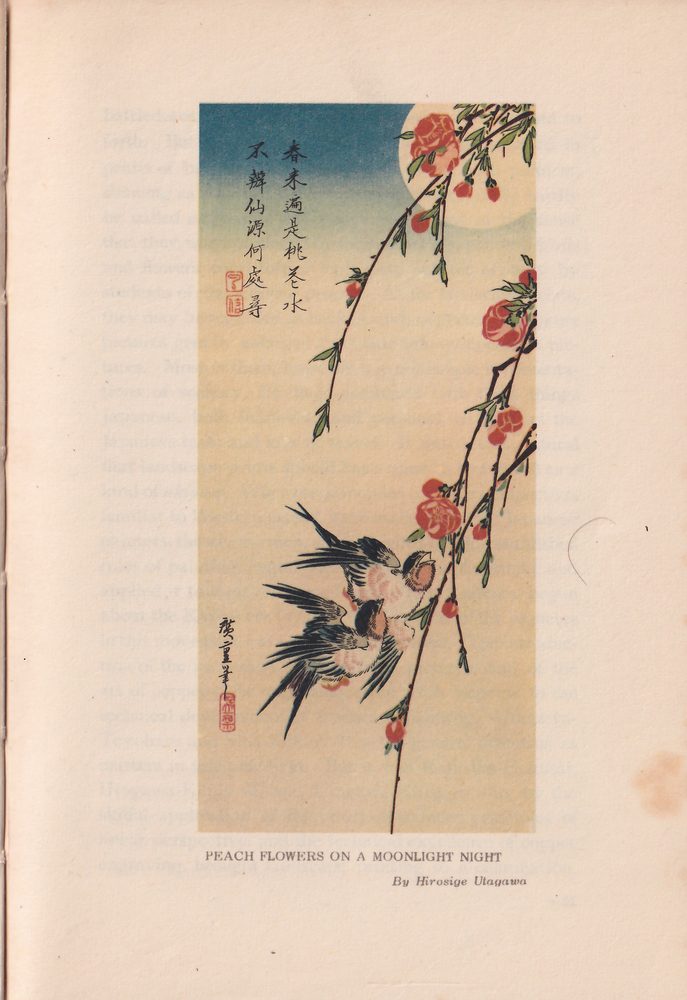
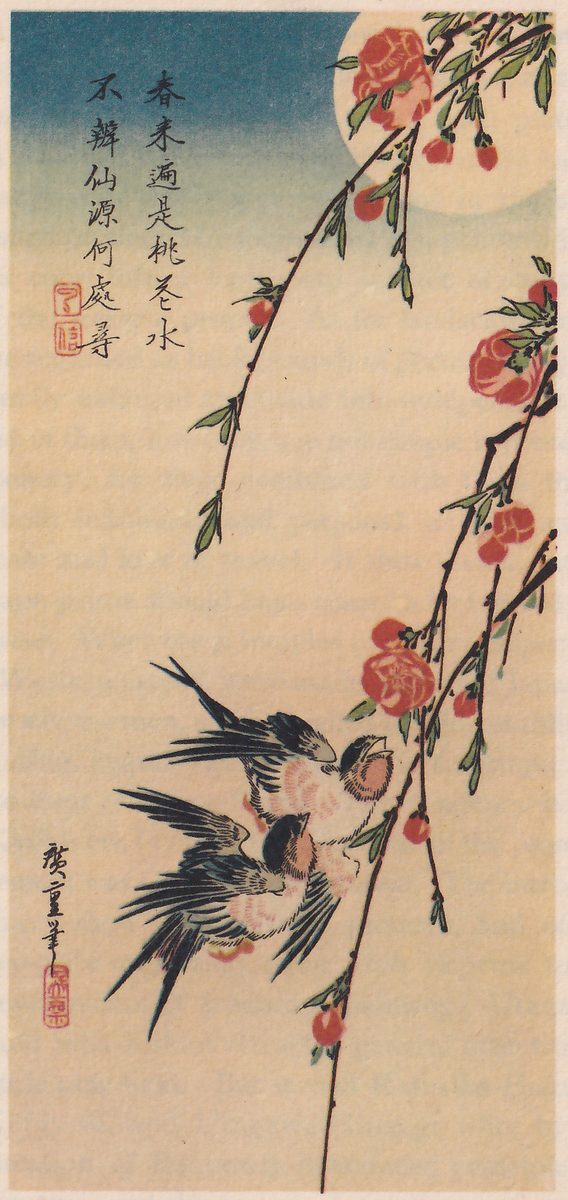
By Hirosige Utagawa
battledores, picture-books, illustrations for novels, and so forth. But the most artistic developments occurred in prints of landscapes, flowers, birds, etc. Such pictures, showing as they did the beauties of Nature, could hardly be called ukiyo-e in the proper sense; but in the sense that they were produced by ukiyo-e artists, prints of birds and flowers constitute a legitimate subject of study by students of the ukiyo-e proper. As for landscape prints, they may be regarded as backgrounds of portraits or genre pictures greatly enlarged and made into independent pictures. Most of them, however, are not simple representations of scenery, for they combined with them things Japanese, both inanimate and personal, as well as the Japanese taste and love of travel. It thus seems natural that landscape prints should have come to be treated as a kind of ukiyo-e. When the principles of linear perspective, familiar to Western artists, were made known to Japanese painters, the ukiyo-e men, untrammelled by old-established rules of painting, eagerly learned the new technique and applied it to their own wood-cuts. This tendency began about the Kyōho era (1716–1735), and one of the pioneers in this movement was Okumura-Masanobu. The introduction of the peep-show with suitable pictures, and of the art of copper-plate engraving, gave fresh impetus to the technical development of landscape painting. Utagawa-Toyoharu and Siba-Kōkan attracted general attention as masters in this new field. But it was Katusika-Hokusai, Utagawa-Kuniyosi, and Utagawa-Hirosige who, by the skilful application of the newly-introduced principles of linear perspective, and the technical excellence of copper engraving, brought landscape printing to a culmination.
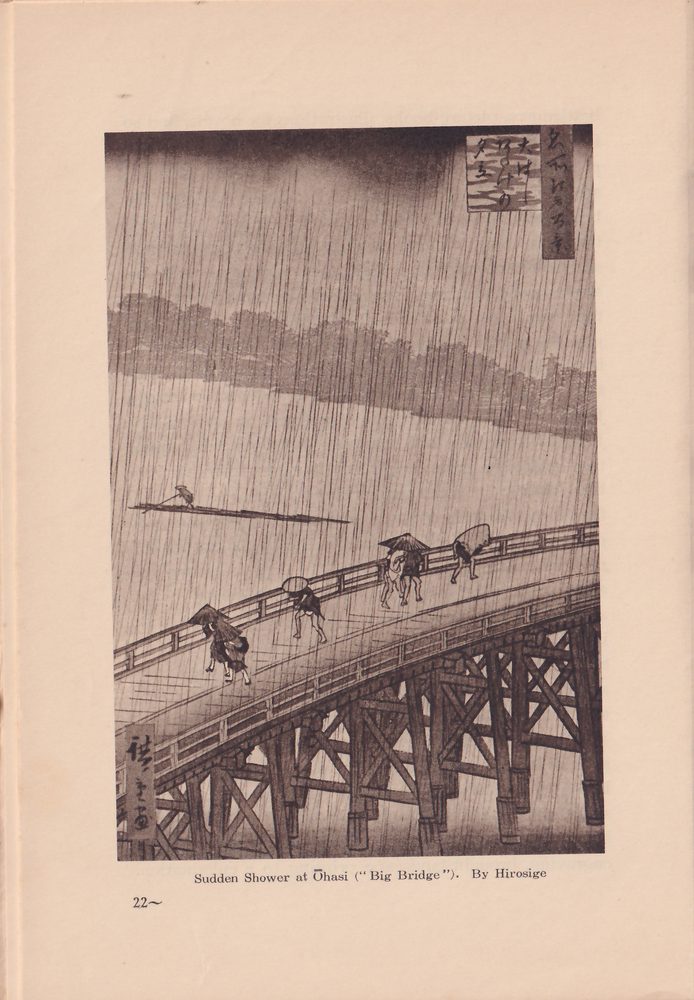
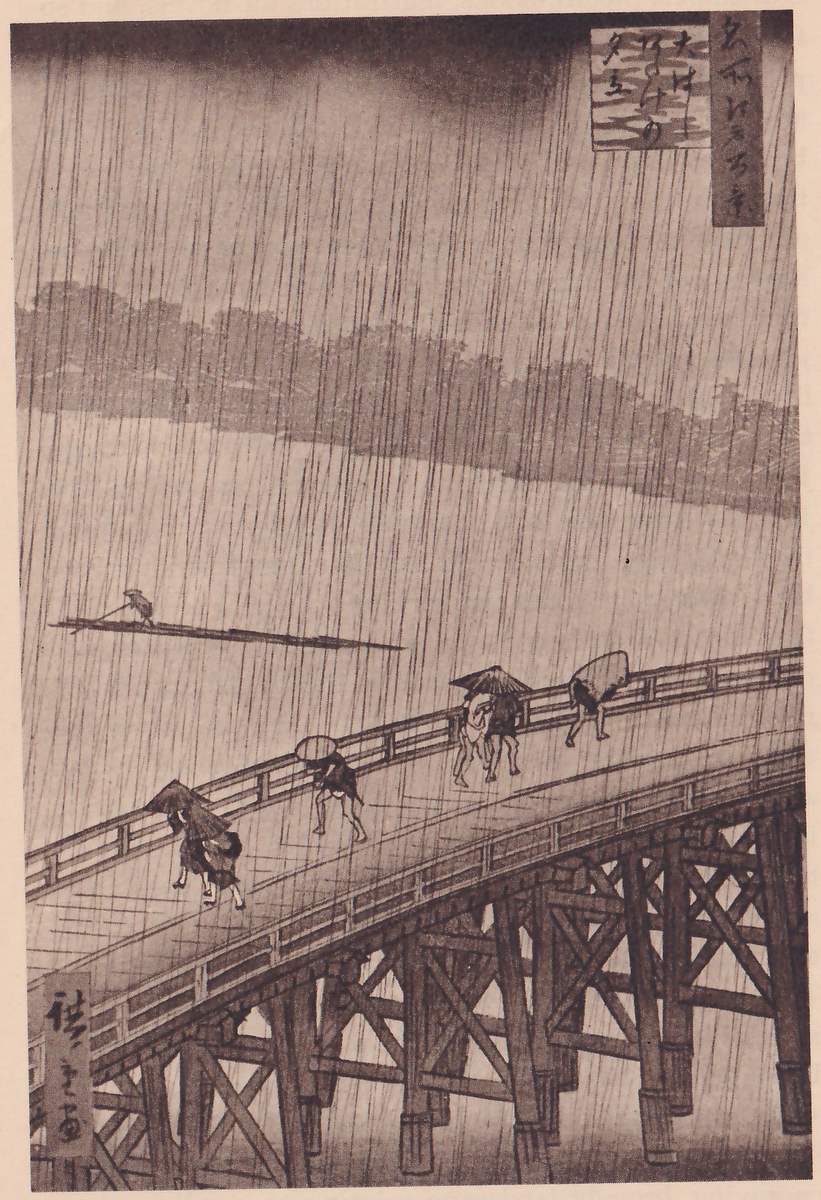
The impasse to which the art of xylography had come, near the end of the Edo period (1600–1867), owing to the impossibility of further progress in the portrayal of lovely women and actors, was forced open, as it were, by the triumph of these artists in landscape wood-block printing. Landscape prints, moreover, appealed strongly to the popular taste because just about that time, the inhabitants of the larger towns had become much interested in travel, and travel literature was in great vogue. And of the three artists above-mentioned, Hirosige was perhaps the most Japanese in his attitude, for he not only did justice to the various local features of rural Japan, but gave objective pictures of its climate and weather in all their varied aspects.
There are traceable in Hokusai’s landscapes a good many elements of Chinese taste, and he is more subjective than objective. Kuniyosi’s pictures are mainly Occidental in expression, and strike me as too realistic. Each of the three masters perfected an artistic style of his own, and they have thus won the admiration of European and American connoisseurs, with the result that they have exerted an important influence on the Western art of painting.
To summarize what has been said in this chapter: various as were the subjects treated of by ukiyo-e painters, all served as artistic expressions of the uneventful everyday life of the common people as seen through the eyes of those popular artists. And it is worthy of remark that their mode of representation was peculiarly adapted to their subject-matter.