
WOOD-CUTS AS AN ART FOR POPULAR APPRECIATION
Let us now see how picture-prints developed during the Edo period (1600–1867). We find that as wood-cuts began to be produced as a plebeian art forming part of the newly-risen plebeian culture, they showed signs of sudden and striking progress.
Down to the middle of the 17th century the fine arts had been the province of only the warriors, the nobility, and the priests. From about that time the common people grew steadily in importance, and they created and developed a culture of their own. Ukiyo-e, painted by hand, were admired and treasured at first only by wealthy tradesmen in the towns, but the further development of plebeian culture taught people of the middle and lower classes to demand and appreciate works of art. It was thus with the idea of enabling such people to enjoy inexpensive works of art that the popular art of picture-printing was brought into being. It was, therefore, necessary that such prints should be of a sufficiently high quality to be appreciated as excellent art products rivalling the entirely hand-made ukiyo-e. Their very size or shape was such as to render them suitable for appreciation. Some were large enough to be made into kakemono or hanging scrolls, or into gakumen or framed pictures; some could be collected into pictorial albums; while others were of a size adapted for pasting promiscuously on walls, husuma
(paper sliding-doors or screens), and byōbu (paper folding-screens). In most cases each picture was complete in itself, but sometimes several wood-cuts formed one set or series. Of those prints which formed albums, usually a dozen constituted a series. All these facts go to prove what has already been said, viz., that these prints were meant to be democratic substitutes for the hand-painted pictures treasured in aristocratic circles.
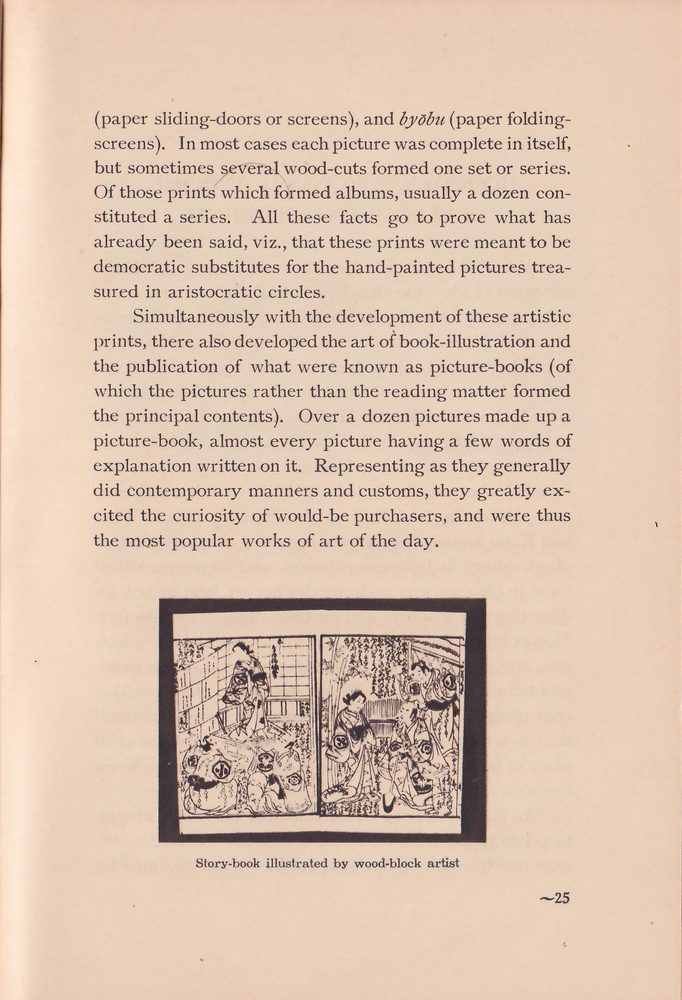
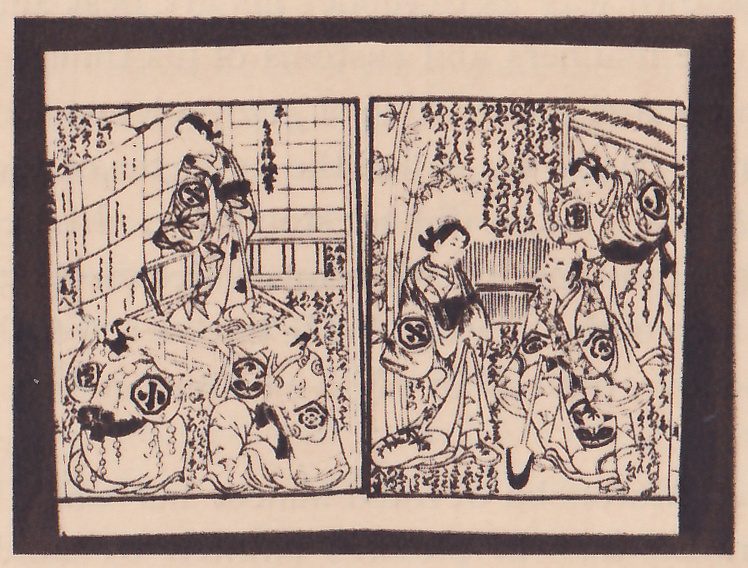
Simultaneously with the development of these artistic prints, there also developed the art of book-illustration and the publication of what were known as picture-books (of which the pictures rather than the reading matter formed the principal contents). Over a dozen pictures made up a picture-book, almost every picture having a few words of explanation written on it. Representing as they generally did contemporary manners and customs, they greatly excited the curiosity of would-be purchasers, and were thus the most popular works of art of the day.