
COPPER-PLATE PRINTS DUE TO WESTERN INFLUENCE (At the end of the 16th Century)
When discussing Japanese prints of the 16th century, one must not omit mention of those produced in this country which show unmistakably the influence of the Western art of copper-plate printing. In 1548, a Portuguese vessel came to Japan, followed a little later by the Spaniards, with the well-known result that Christianity was introduced into our country and, as the number of Japanese converts steadily increased, there arose a great demand for Christian pictures. Hence the importation of such sacred pictures from the West, and the introduction of the Occidental methods of painting and drawing. A considerable number of Christian pictures were thus produced by Japanese artists, and at the same time the process of copper-plate printing was introduced and practised by Christian artists. From the latter half of the 16th to the beginning of the 17th century, a fairly large number of Christian pictures were produced both by oil-painters and by copper-plate artists. As representative of these, we may mention those published (a) in 1591 at Kazusa, (b) in 1596 at Ari-ie, and (c) in 1607 at Nagasaki (all in Kyūsyū). In 1637, however, Christianity was put under strict official ban in consequence of the Christian revolt, so that most pictures of Christian origin were destroyed, and only a very few produced in those days have been kept intact to our own day.
It was a matter for regret that so soon after copper-plate printing was acquired by Japanese engravers it should have been nipped in the bud, owing to its association with Christianity.
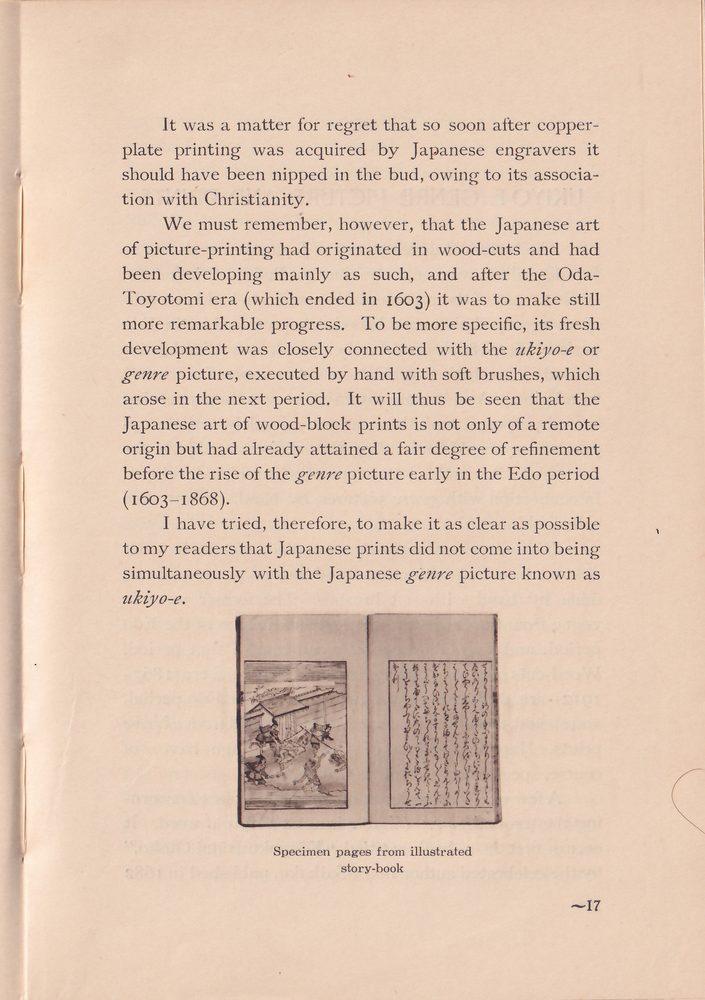
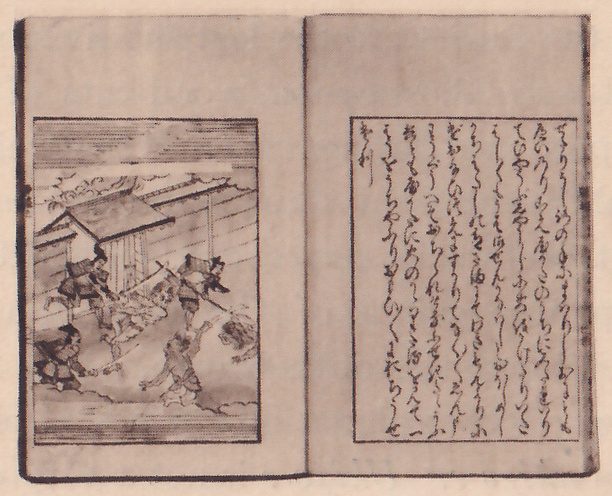
We must remember, however, that the Japanese art of picture-printing had originated in wood-cuts and had been developing mainly as such, and after the Oda-Toyotomi era (which ended in 1603) it was to make still more remarkable progress. To be more specific, its fresh development was closely connected with the ukiyo-e or genre picture, executed by hand with soft brushes, which arose in the next period. It will thus be seen that the Japanese art of wood-block prints is not only of a remote origin but had already attained a fair degree of refinement before the rise of the genre picture early in the Edo period (1603–1868).
I have tried, therefore, to make it as clear as possible to my readers that Japanese prints did not come into being simultaneously with the Japanese genre picture known as ukiyo-e.