
NISIKI-E, A JAPANESQUE ART
The nisiki-e was a development of great significance in the history of Japanese prints. The following are the main reasons:
Although one cannot ignore the influence of Chinese wood-cuts on the development of our own colour prints, yet it should be remembered that the Chinese art of printing had only reached the stage represented in Japan by our beni-zuri-e, from which began a period of gradual deterioration. In Japan, on the other hand, the art had made steady progress, until there suddenly appeared those highly artistic chromoxylographs which we call nisiki-e. Our art of pictorial printing thus surpassed its rival of the Asiatic mainland when it attained the nisiki-e stage, after which it pursued its own unique course of development. In other terms, it not only outdid its Chinese rival, but produced prints unparalleled in any country of the West. The world-wide fame which our artistic picture-prints have acquired by their unrivalled qualities is not primarily attributable to the purely technical skill which they reveal, but rather to the aesthetic man of letters working in intimate spiritual harmony with the painter, engraver, and printer, as if he were himself painting with the painter, engraving with the engraver, and printing with the printer.
It is to this creative attitude of all who were engaged in the work that we are inclined to attach supreme significance; for, though I do not wish to belittle the Chinese
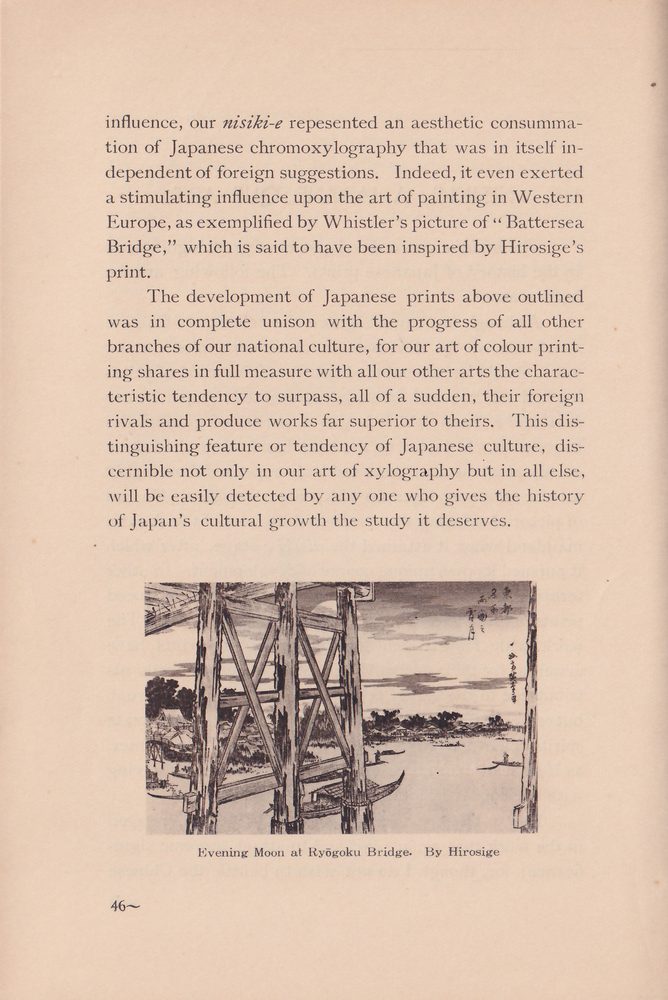
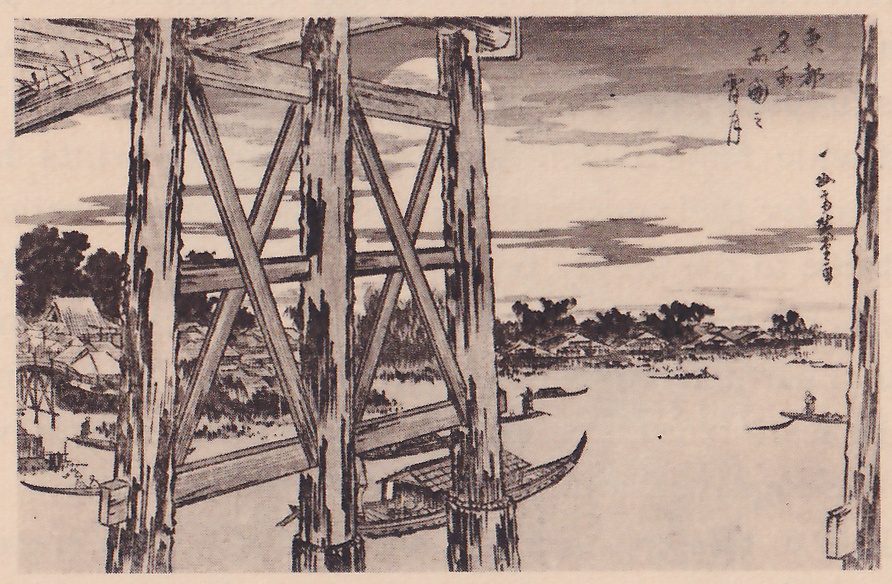
influence, our nisiki-e representedPrinted: repesented an aesthetic consummation of Japanese chromoxylography that was in itself independent of foreign suggestions. Indeed, it even exerted a stimulating influence upon the art of painting in Western Europe, as exemplified by Whistler’s picture of “Battersea Bridge,” which is said to have been inspired by Hirosige’s print.
The development of Japanese prints above outlined was in complete unison with the progress of all other branches of our national culture, for our art of colour printing shares in full measure with all our other arts the characteristic tendency to surpass, all of a sudden, their foreign rivals and produce works far superior to theirs. This distinguishing feature or tendency of Japanese culture, discernible not only in our art of xylography but in all else, will be easily detected by any one who gives the history of Japan’s cultural growth the study it deserves.