Fine Japanese Calligraphy

The Art of Master Japanese Calligrapher Eri Takase

[p. 47]

THE GOLDEN AGE OF JAPANESE PRINTS

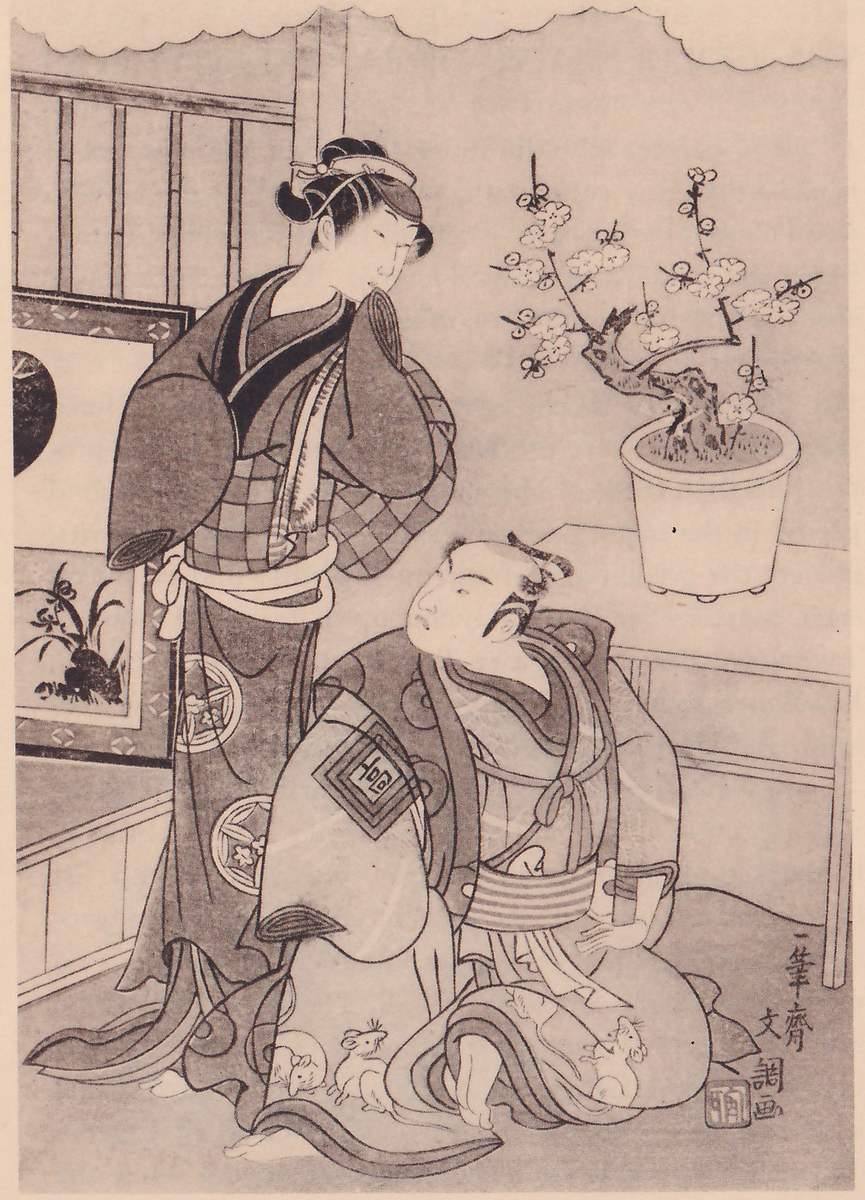
The painter who did more to create the new art of nisiki-e than any other man, was Suzuki-Harunobu, who was followed by Ippitusai-Buntyō, Isoda-Koryūsai, Kitao-Sigemasa, and Katukawa-Syunsyō. These artists flourished in the first period of nisiki-e development (1765–1780).

The nisiki-e thence advanced to a still more refined stage, in which were produced prints of even larger proportions than those of Harunobu. This we call the second period in the history of the nisiki-e (1781–1800). It was, indeed, the golden age of Japanese prints, and produced such masters as Torii-Kiyonaga, Kitagawa-Utamaro, Tyōbunsai-Eisi, Utagawa-Toyoharu, Kubo-Syunman, Katukawa-Syuntyō, Tōsyūsai-Syaraku, Utagawa-Toyokuni, and Utagawa-Toyohiro.

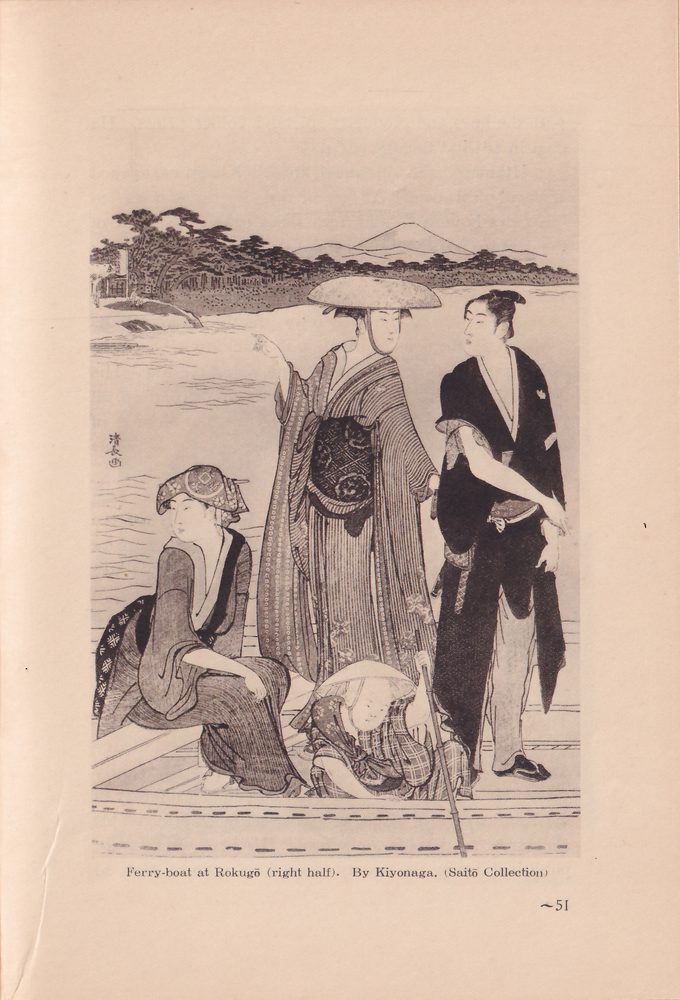
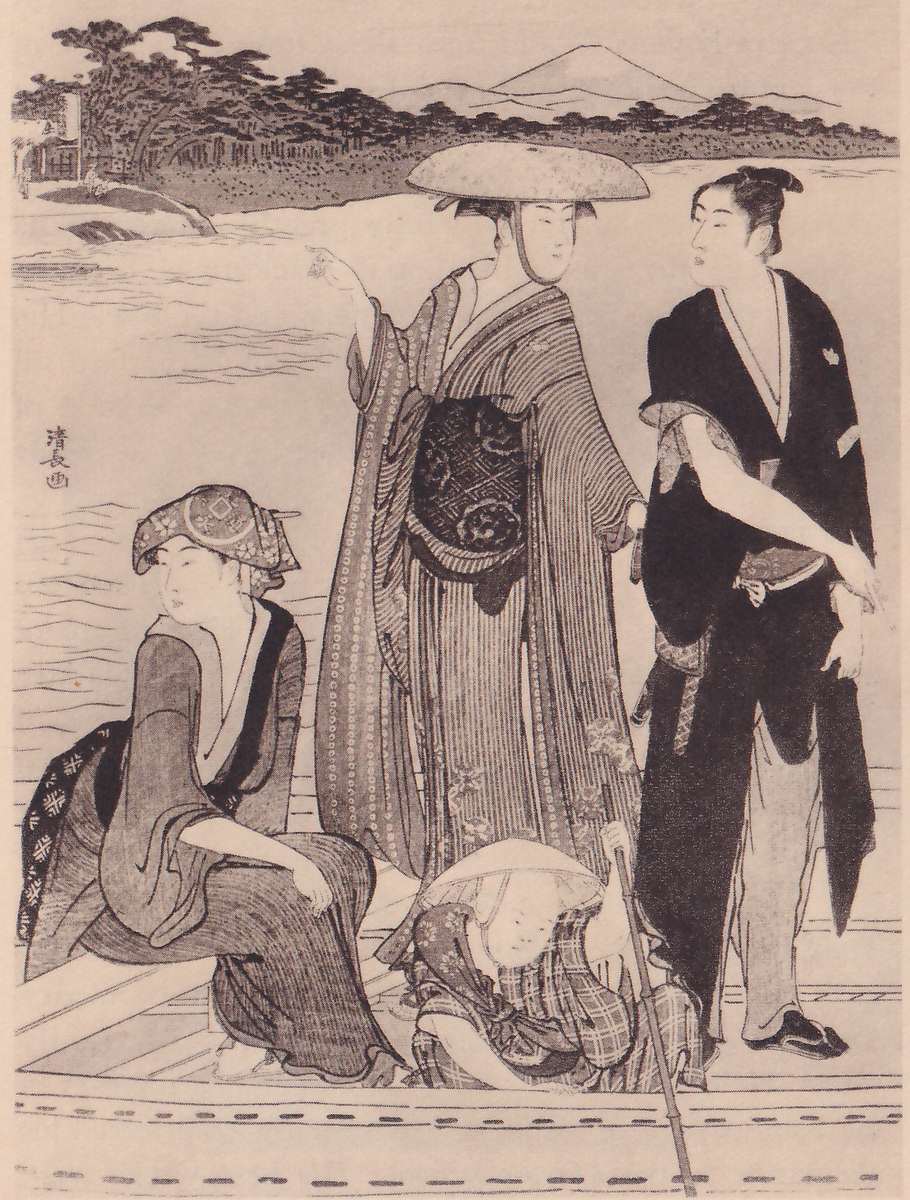
Kiyonaga, who belonged to the Torii school of artists, was a disciple of Kiyomitu. As a painter with soft brushes he painted placards for the theatres, and as a nisiki-e artist he specialized in portraits of beautiful women. He produced a great number of prints, none of which was of a mediocre sort carelessly executed. He was a realist of a sound type, for he tempered his realism with something of idealism. In his pictures Kiyonaga employed graceful lines and curves by means of which the effect of a three-dimensional world was successfully achieved, while the relatively simple or elementary colours used harmonized
[p. 48]

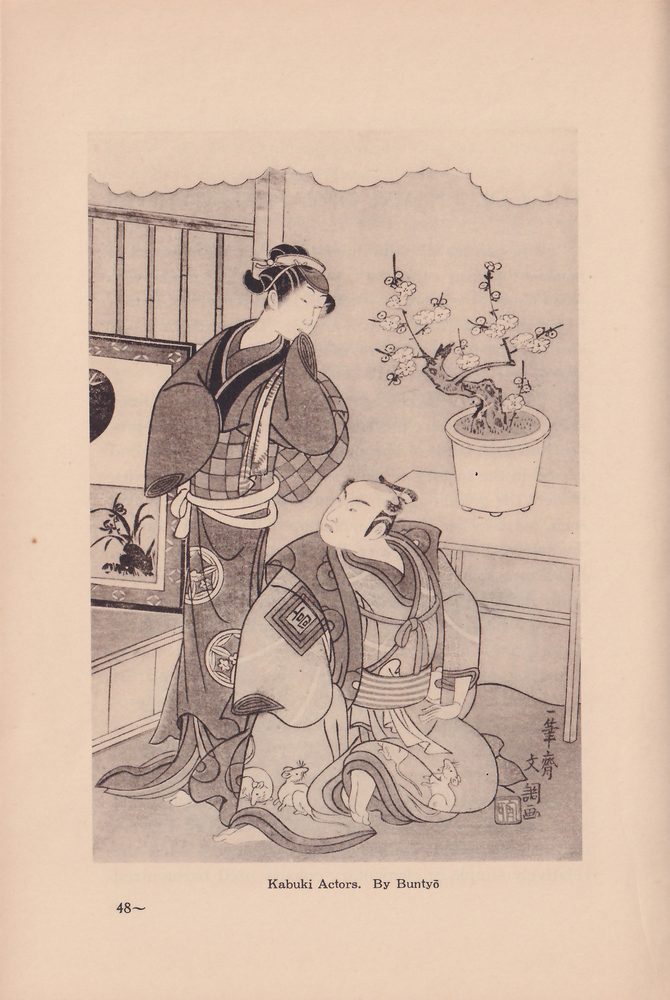
Black-and-white print of two figures in a room. One stands at the left in a checked robe, the head tilted and one hand raised to the chin. The other kneels at the lower center in a robe with a square crest on the sleeve and round crests, looking up and to the left, with small animals drawn along the hem. Behind them a low table at the right holds a pot with a flowering branch, a framed picture stands at the left behind a railing, and a scalloped edge runs along the top. A signature column and a seal stand at the lower right.
Kabuki Actors. By Buntyō

[p. 49]

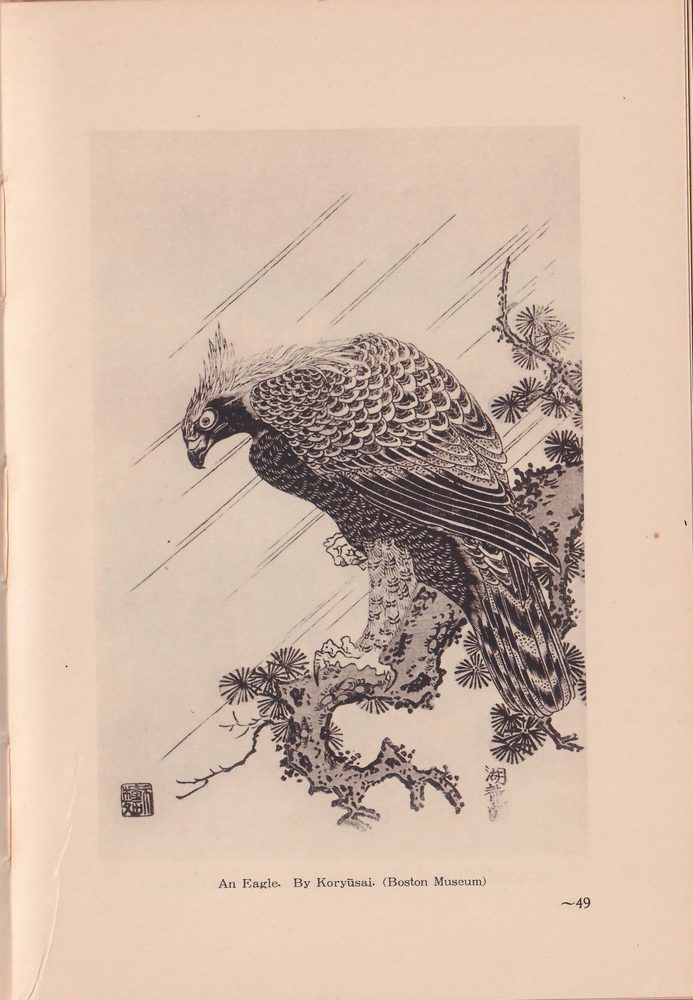
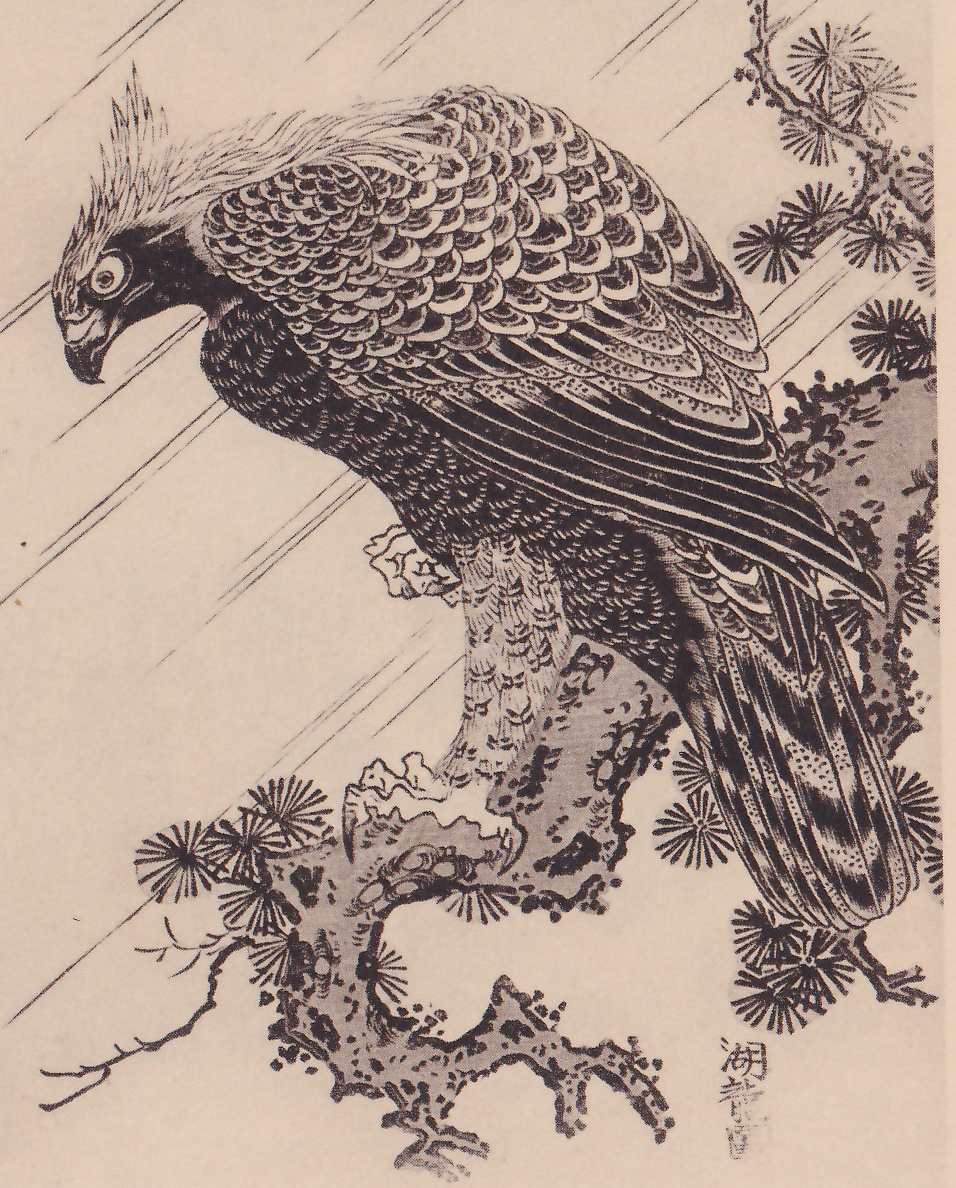
Black-and-white print of a large bird with a crest of feathers and a hooked beak, perched on a gnarled pine branch and facing left with the head turned down. Its wing and back feathers are drawn as rows of scales, and its long tail hangs down at the right. Clusters of pine needles surround the branch, and straight lines slant across the background. A signature column stands at the lower right.
An Eagle. By Koryūsai. (Boston Museum)

[p. 50]

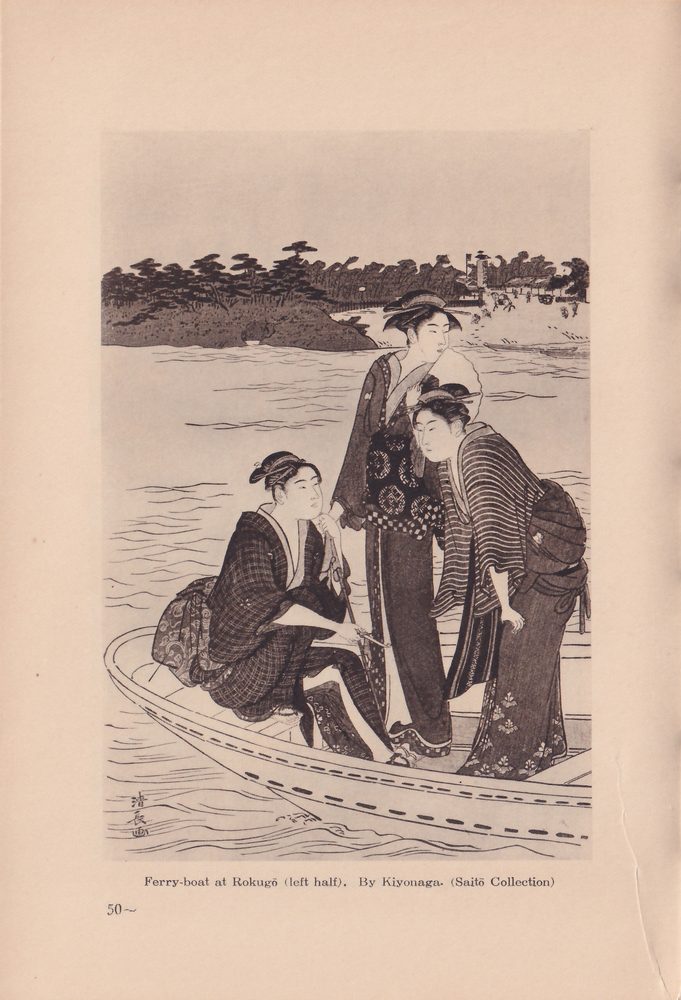
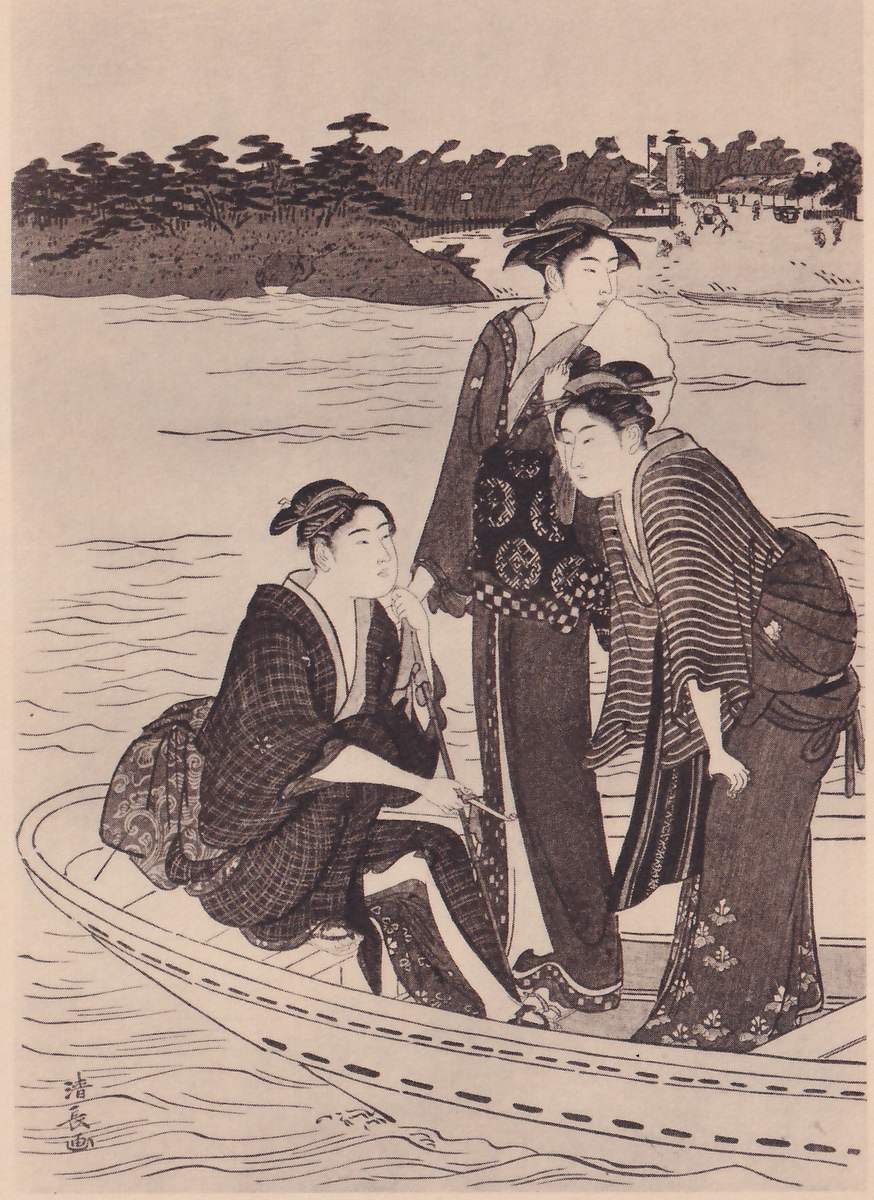
Black-and-white print of three figures in a long boat on a river. One sits at the left in a checked robe, the chin resting on one hand and a long thin pipe in the other. A second stands at the center behind, the head turned to the right, with a pale rounded shape at the shoulder. A third at the right leans forward in a striped jacket. Across the water a tree-covered point of land fills the upper left, with small figures and a tall post on the shore at the upper right. A signature column stands at the lower left.
Ferry-boat at Rokugō (left half). By Kiyonaga. (Saitō Collection)

[p. 51]

Black-and-white print of four figures in a boat on a wide river. At the left a figure with a patterned head cloth sits on the edge of the boat, looking out to the left. Behind and to the right of it a figure in a wide flat hat and a long striped robe stands with one hand raised, pointing to the left, and at the right a figure in a dark jacket with the hair in a top knot stands with one arm out. At the bottom center a smaller figure in a conical hat and a checked wrap crouches, holding a long pole. A tree-covered shore with the outline of a mountain behind it fills the top, and a signature column stands at the left.
Ferry-boat at Rokugō (right half). By Kiyonaga. (Saitō Collection)

[p. 52]

with the lines and produced splendid colour prints. He died in 1816 at the age of 64.

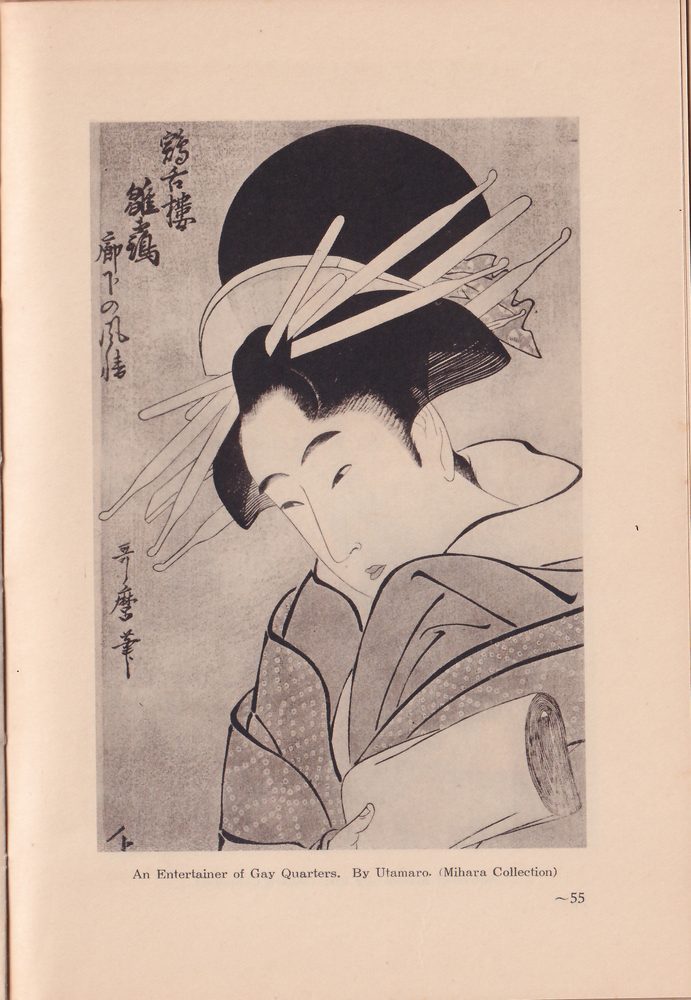
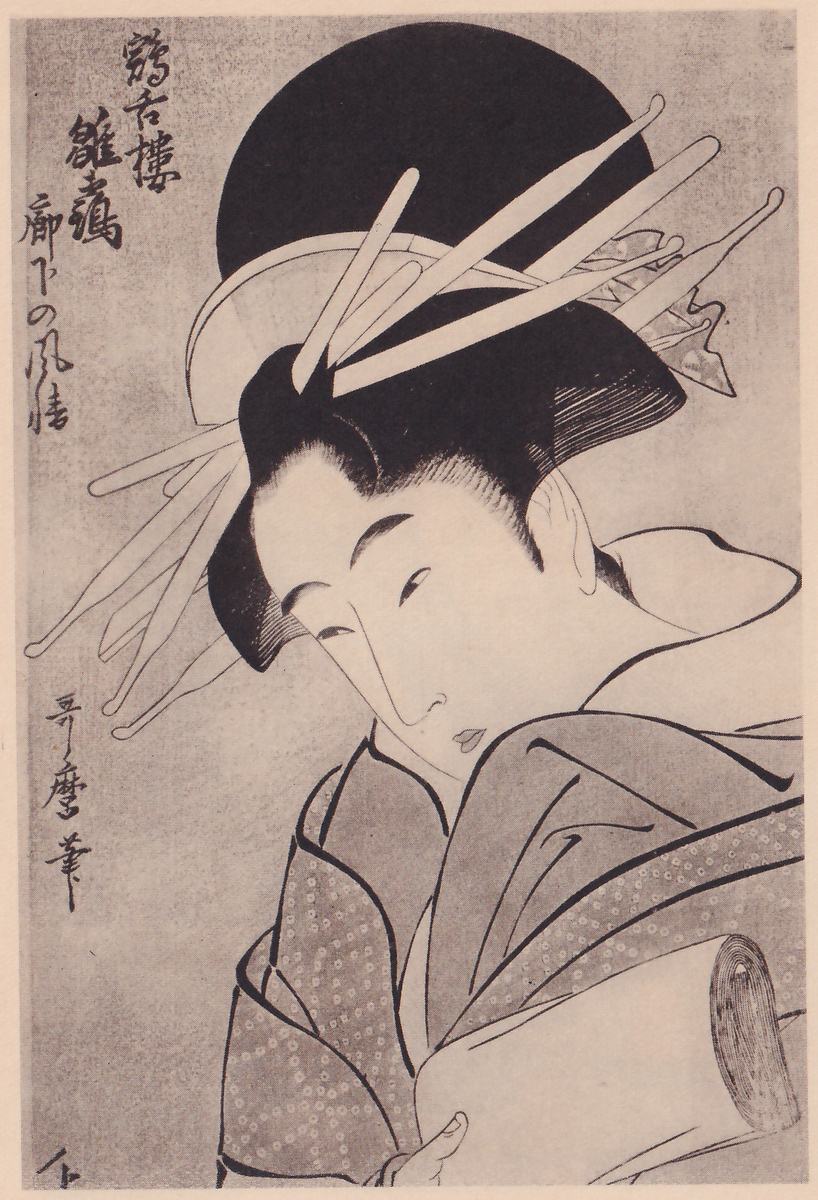
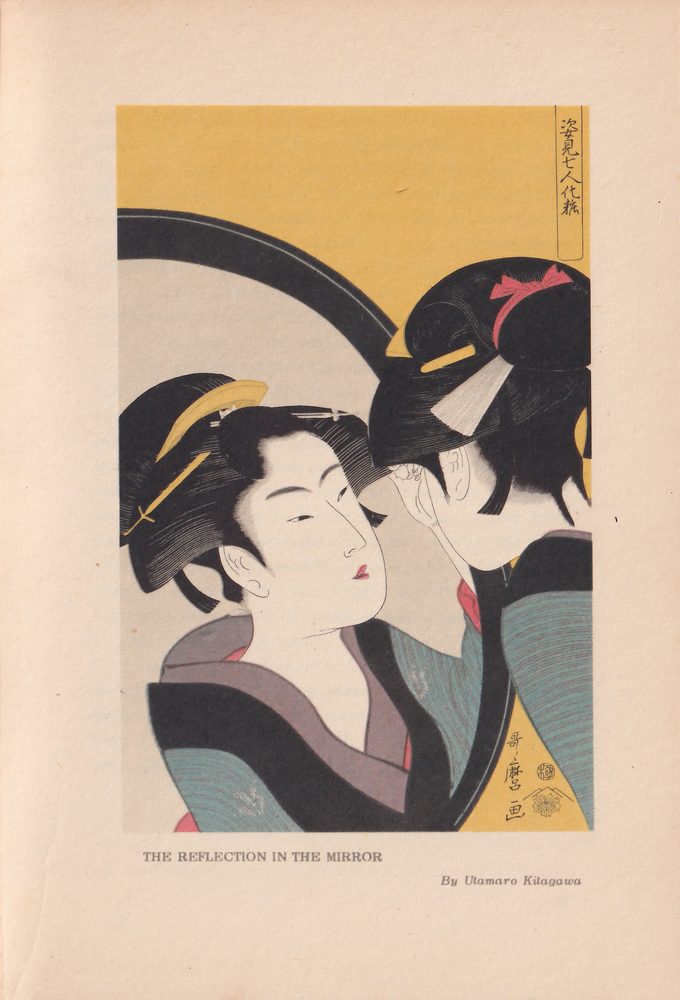
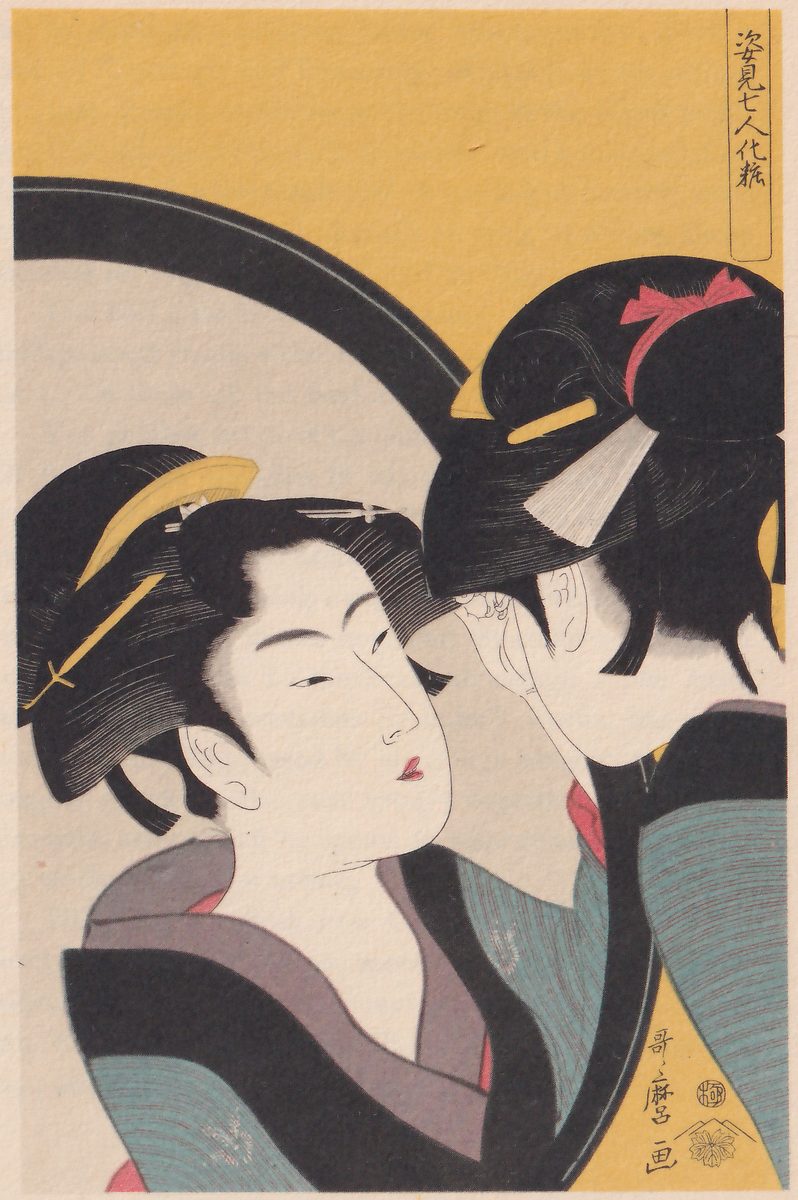
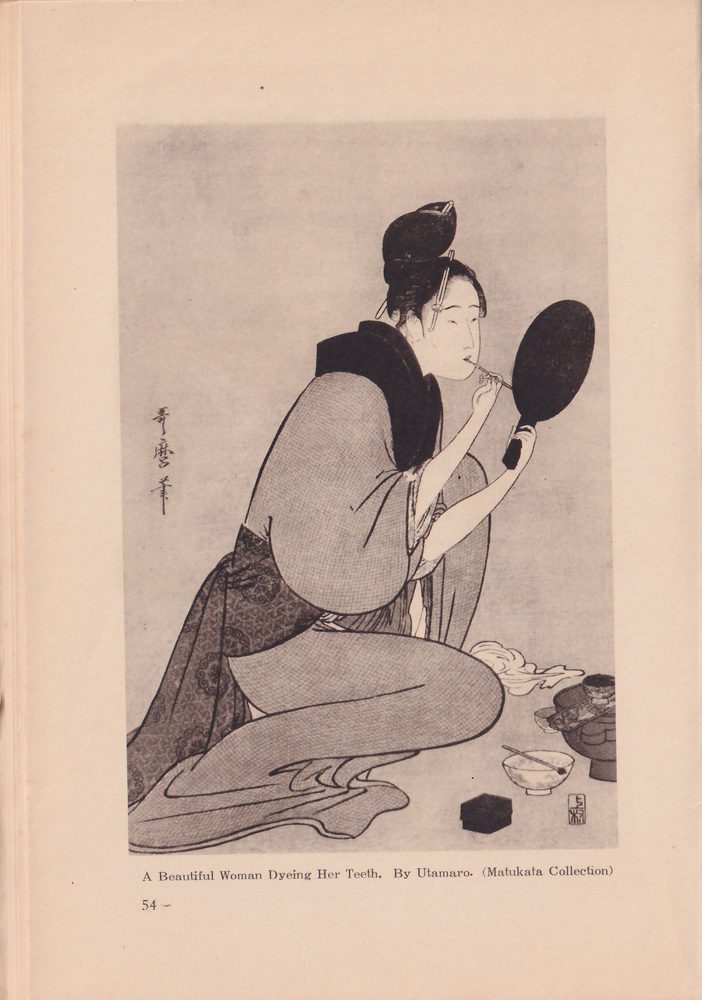
Utamaro, who surnamed himself Kitagawa, opened a school of his own. At first he was much under the influence of Kiyonaga, and from about 1780 to the close of the century he produced brilliant works in succession. As a chromoxylographic painter he hit upon many novel devices in technique which brought into bold relief the figures of people in the picture, thereby greatly enhancing its graphic effect. Thus, in painting the background he chose such pigments as yellow, indigo, mica, and the like. His pictures of lovely women were such that he carried all before him in this field; but he also excelled in pictures of flowers, birds and insects, and published them as colour prints.

Utamaro, as a painter of beautiful women, won his high reputation after Kiyonaga, but alas! he died ten years before the latter, namely in 1806. He had many disciples, so that his tendencies and methods as a painter were followed by a wide circle of artists.

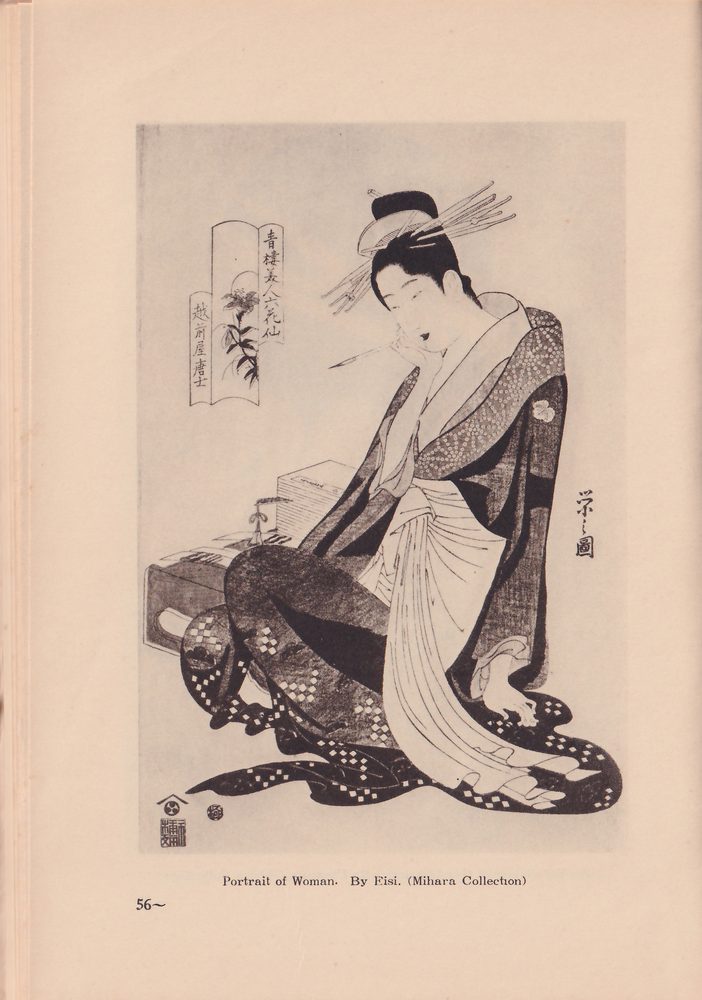
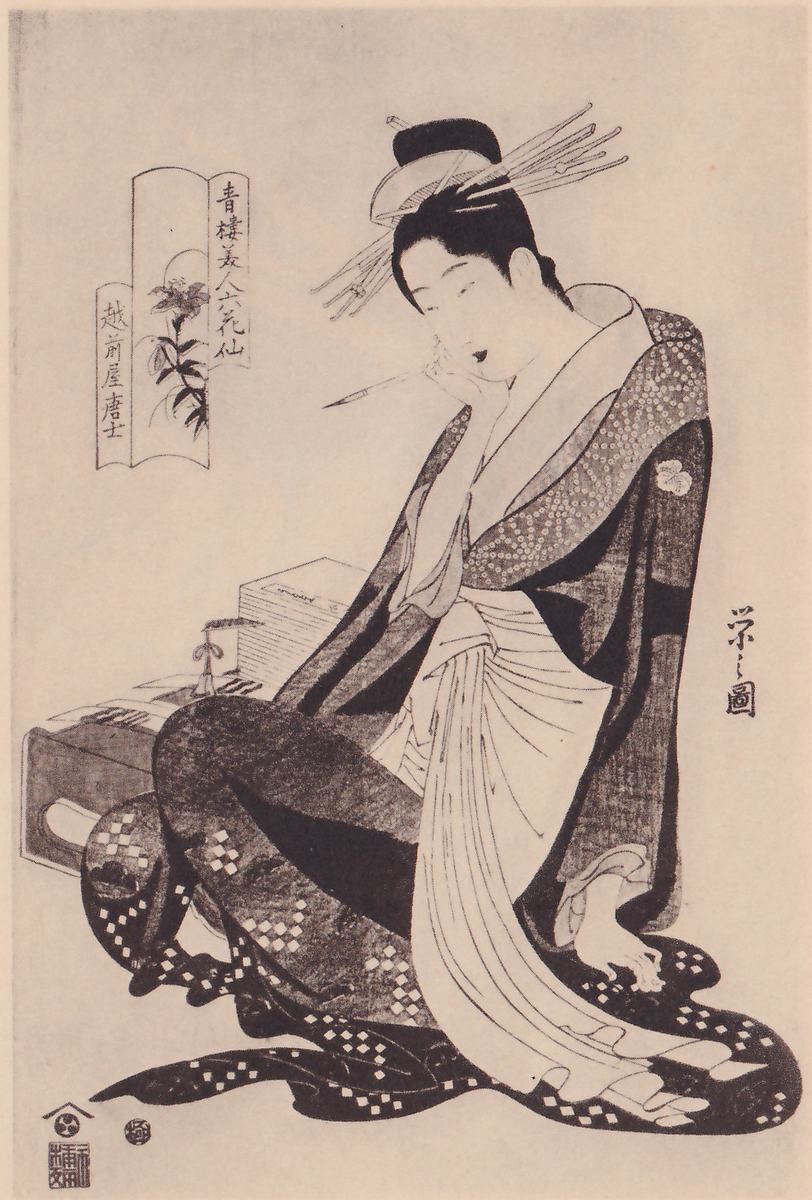
Next to Kiyonaga and Utamaro, Tyōbunsai-Eisi became most celebrated as a nisiki-e painter. Now, most ukiyo-e painters were tradesmen, but Eisi was one of the exceptions, for he was a direct retainer of the Syogunate. That meant that he belonged to the military class, intermediate in rank between the daimyō and the ordinary samurai. He was, moreover, a man of fairly high family rank. He entered upon his artistic career as a follower of the Kanō school of painters, but later on transferred his allegiance to the ukiyo-e school. His best works were published during the twenty years from 1780 to 1800, so
[after-52-face]

Colour print of two heads close together. At the left a face seen nearly from the front, turned slightly to the right, has black hair piled up and held with a yellow comb and a yellow pin, above a robe with a black collar and a mauve collar and a blue-green sleeve. At the right a head turned away shows black hair with a red ribbon and a white tassel, one hand raised to the cheek, and a blue-green sleeve. A large pale round shape with a thick black rim curves behind them, and a flat yellow ground fills the top. A column of Japanese characters in a narrow frame stands at the upper right, and a signature column with seals at the lower right.
THE REFLECTION IN THE MIRROR
By Utamaro Kitagawa

[p. 53]

that he shone as a brilliant junior contemporary, if not a rival, of Kiyonaga and Utamaro. And it is worth adding here that, thanks to his early training in the Kanō tradition, Eisi was exceptionally dexterous in the manipulation of the brush, with the result that he has left us masterpieces among his hand-painted pictures as well as among those intended for engraving. He died in 1829.

Eisi had a fairly large following. Among his more distinguished pupils were Eisyō, Gokyō, Eiri, Eisui, and Eisin. Of them all, the best artist was Eisyō.

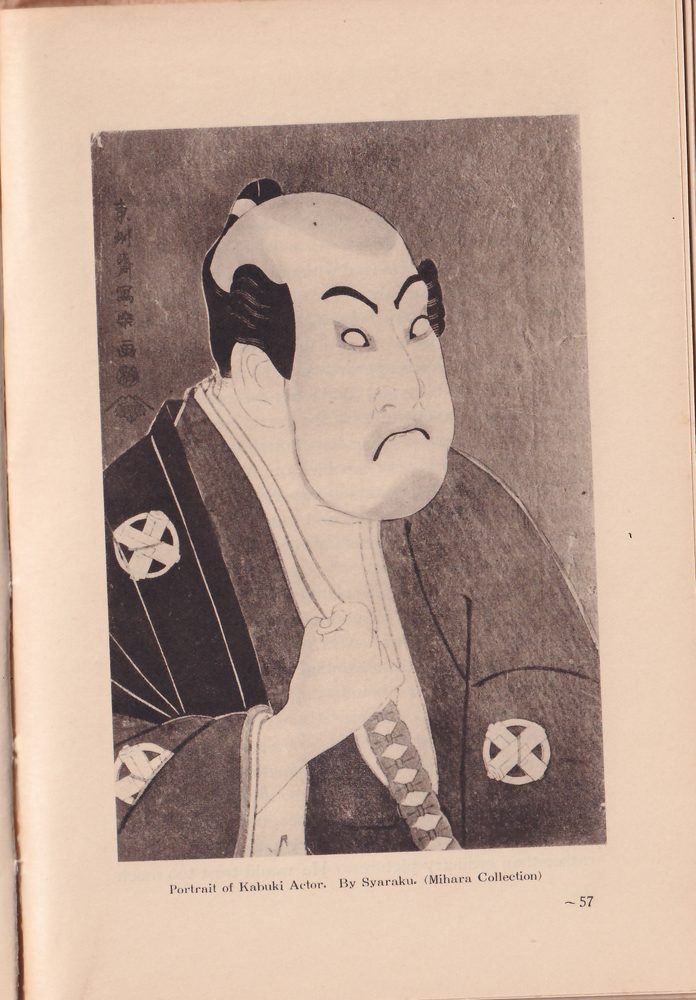
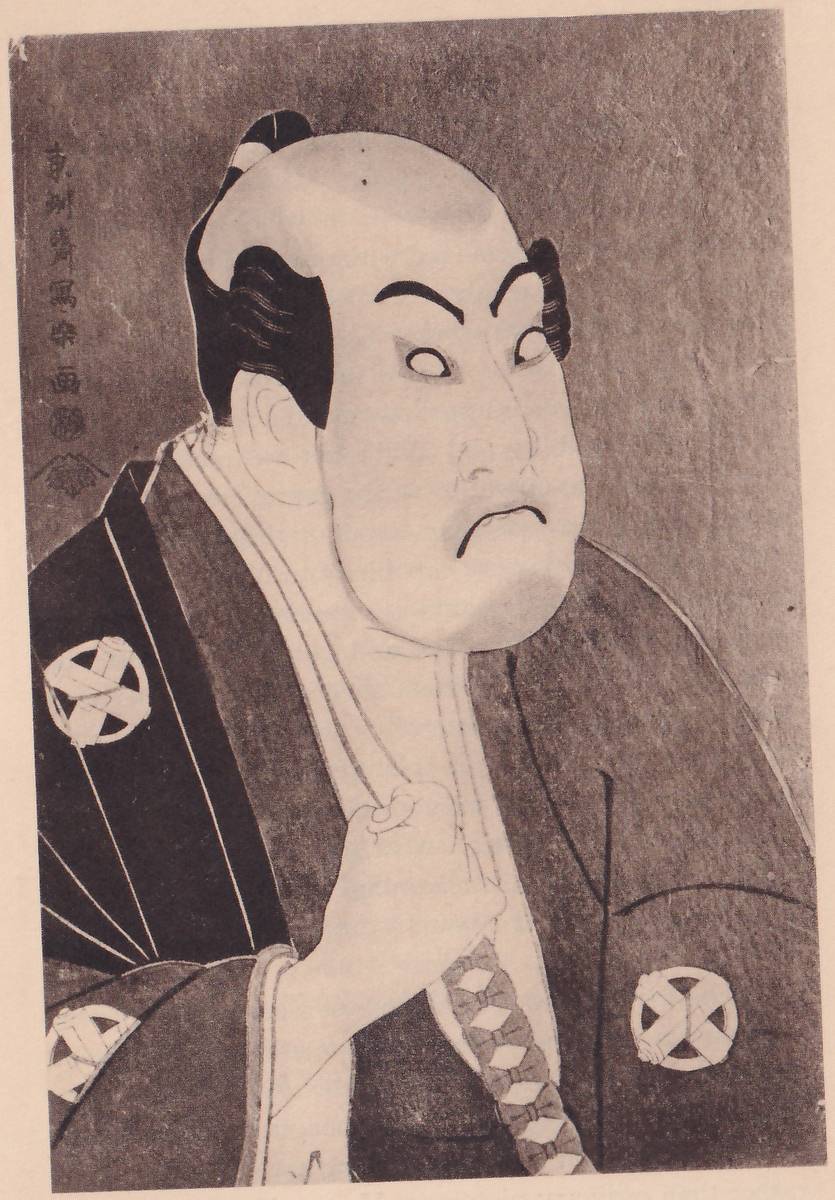
Yet another artist of the time who distinguished himself by special qualities in his products was Tōsyūsai-Syaraku. He endeavoured to delineate the dramatic expressions of celebrated actors and their individual characteristics, and in so doing exaggerated histrionic idiosyncrasies. However, it was here that Syaraku’s inimitable technique was seen to the best advantage. The more one studies and appreciates Syaraku’s works, the more strongly is one impressed by their high artistic qualities. Roughly speaking, the year 1794–5 constituted his annus mirabilis, after which he seems to have ceased producing any works worthy of notice.

This chapter must now be brought to an end by merely mentioning three more well-known wood-cut painters of the period under review, namely, Kubo-Syunman, Kitao-Masanobu, and Kitao-Masayosi (who, by the way, afterwards re-named himself Kuwagata-Keisai).
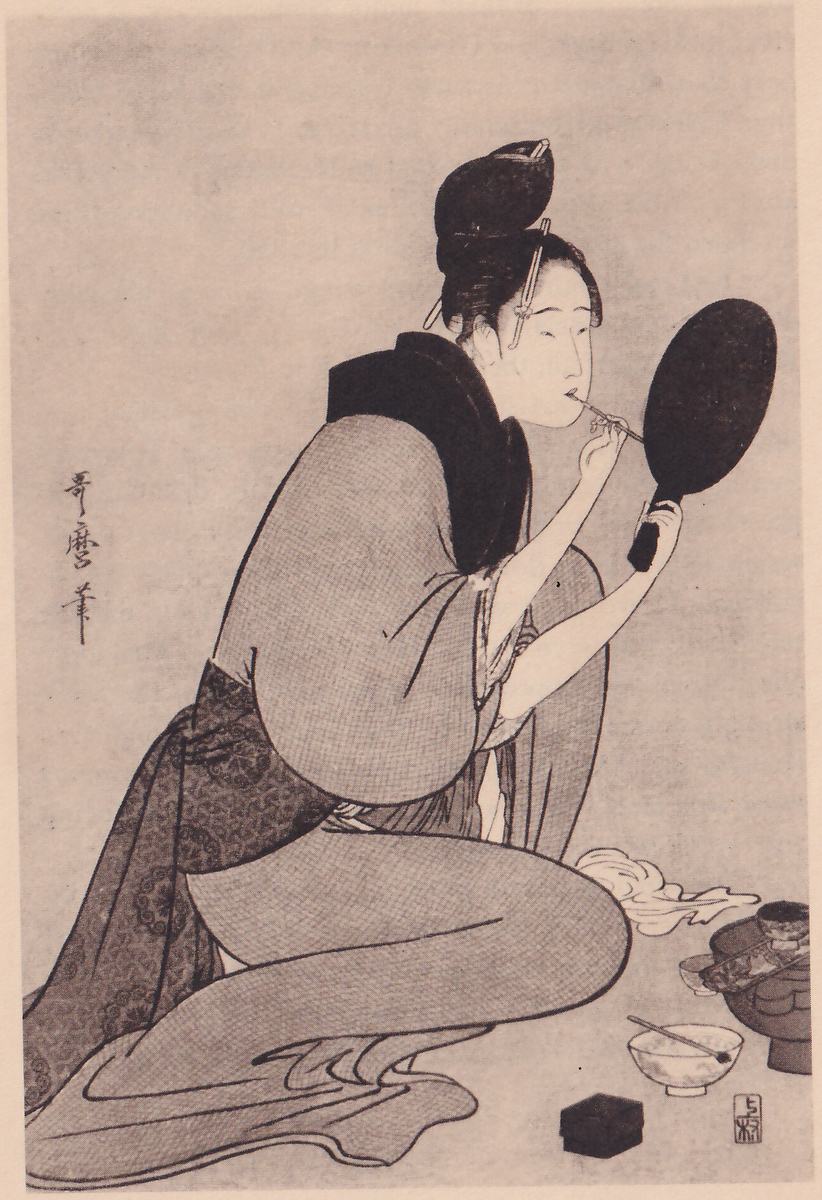
[p. 54]

Black-and-white print of a figure kneeling, bent forward, filling most of the picture, the hair in a high knot with pins, holding a round hand mirror in one hand and a thin stick at the lips with the other. The figure wears a wide dark collar, a loose robe and a dark patterned sash. On the floor at the lower right are a small tiered stand with bowls, a bowl with a stick laid across it, a small square box and a crumpled pale cloth. A signature column stands at the left and a seal at the lower right.
A Beautiful Woman Dyeing Her Teeth. By Utamaro. (Matukata Collection)

[p. 55]

Black-and-white print of a large head and shoulders, the face tilted down and to the left with the eyes lowered. Dark hair is swept up, with many long pale pins fanning out around a large dark disc behind the head. The robe has a small dotted pattern, and a rolled pale sheet is held in the hand at the lower right. Columns of Japanese characters stand at the upper left, and a signature column at the lower left.
An Entertainer of Gay Quarters. By Utamaro. (Mihara Collection)

[p. 56]

Black-and-white print of a seated figure turned three-quarters to the left, the head resting on one hand with a thin pale stick held at the lips. The hair is in a high knot with many long pins fanning out. The robe is dark with a dotted collar, a long pale sash hangs down the front, and a checked pattern runs along the hem. At the left a stack of flat pale pieces stands on a low box. A frame with a flower and columns of Japanese characters stands at the upper left, a signature column at the right, and seals at the lower left.
Portrait of Woman. By Eisi. (Mihara Collection)

[p. 57]

Close black-and-white print of the head and upper body of a figure with a broad face turned to the right, the brows thick and arched, the eyes turned sideways so that the whites show, and the mouth turned sharply down. The head is shaved at the top with a small knot at the back. The jacket has wide shoulders with round crests, and a fist is held in front of the chest, gripping a pale band. The background is plain and dark. A column of Japanese characters stands at the upper left, with a seal below it.
Portrait of Kabuki Actor. By Syaraku. (Mihara Collection)