
II. A STUDY OF MUSICAL FORMS
Several of the musical forms that were developed among the various classes of people during the changing period of Japan’s musical history, as narrated in the previous chapter, survive to this day, and maintain their general popularity. These musical forms have of course their own peculiar national character, differing widely from those of Europe and America. It is also true that they differ widely among themselves. To make therefore sweeping or general statements regarding Japan’s music would be altogether too abstract, and might give quite a false impression. It, therefore, seems better to present to the reader, in regular order, a rather detailed description of such musical forms as are widely used today.
1. GAGAKU
Gagaku, as previously indicated, is the music of the Court. It is also performed at such Shintō shrines and Buddhist temples as have ancient traditions. Japanese people themselves rarely have the privilege of enjoying this music. Because of the fact that even music lovers have so little opportunity to enjoy thisPrinted: enjoy. this historic and artistic musical treat, it has become the custom, of recent years, to offer public performances of this music and dancing, perhaps two or three times each year.
Gagaku is the special form of music performed in the ceremonies of the Imperial Court, as well as music
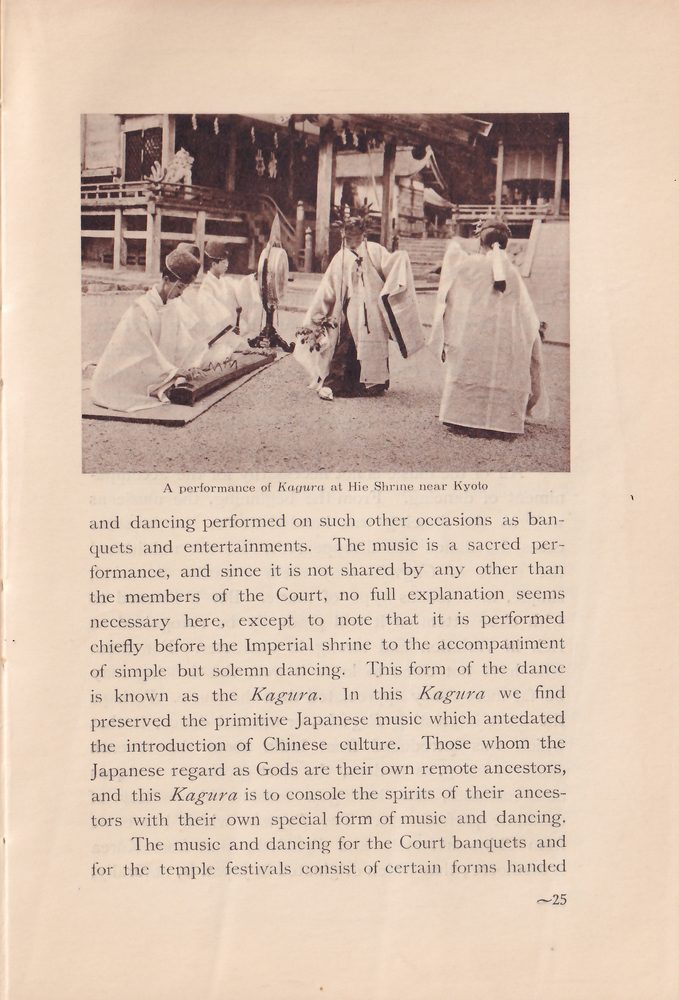
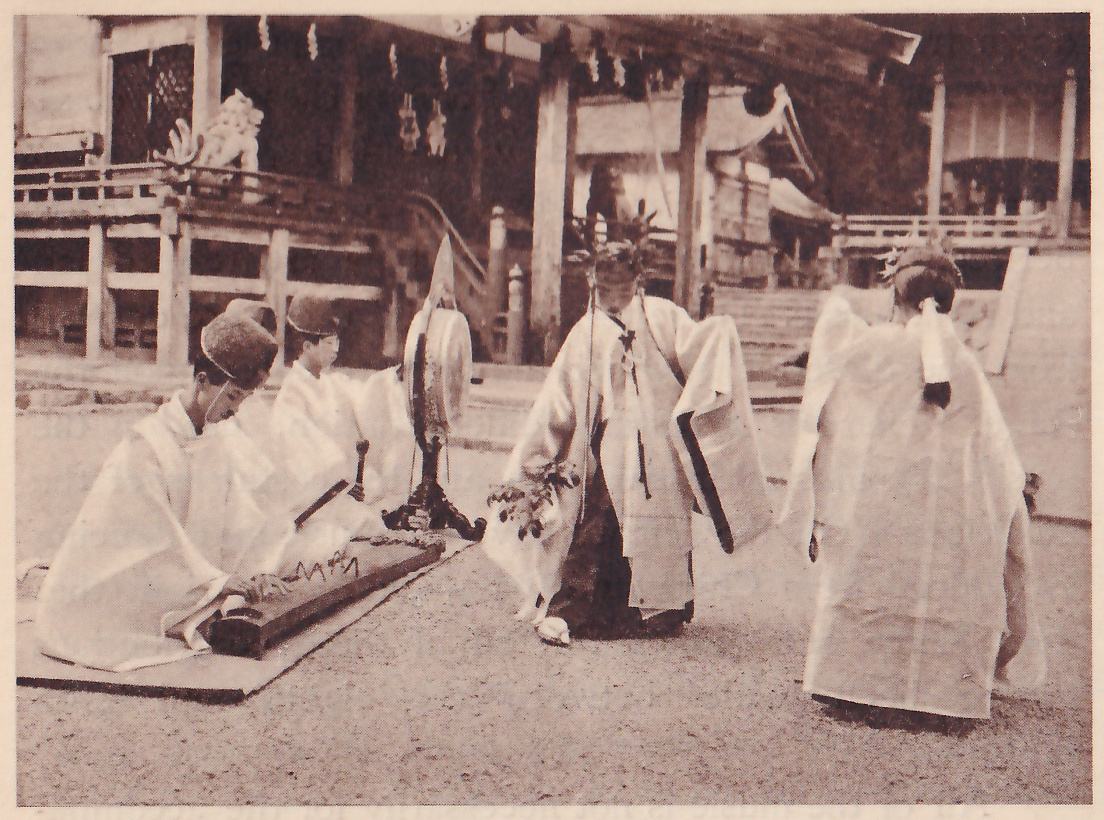
and dancing performed on such other occasions as banquets and entertainments. The music is a sacred performance, and since it is not shared by any other than the members of the Court, no full explanation seems necessary here, except to note that it is performed chiefly before the Imperial shrine to the accompaniment of simple but solemn dancing. This form of the dance is known as the Kagura. In this Kagura we find preserved the primitive Japanese music which antedated the introduction of Chinese culture. Those whom the Japanese regard as Gods are their own remote ancestors, and this Kagura is to console the spirits of their ancestors with their own special form of music and dancing.
The music and dancing for the Court banquets and for the temple festivals consist of certain forms handed
down from the past, as well as those composed in more recent times in similar style. Some of these have come down to us from China and ancient India, others from Korea and Manchuria. There is a clear distinction between these two groupings, and they are termed left and right music. These terms, left and right, are derived from the direction in which the dancers enter upon the stage. There is a distinct differentiation, also, in the music, the musical instruments, and the costumes of the musicians. On the left we have the music and dancing introduced from China and India, and on the right that from Korea and Manchuria, all of these contributions having been made between the eighth and tenth centuries.
All of the music is not necessarily for the accompaniment of dancing. From the beginning, the music as well as the dancing was handed down, and in some cases the dance has disappeared. To the uninitiated the music of Gagaku may seem a rather unvaried, simple, monotonous type of music. But if listened to with close attention it will gradually be recognized as rich in variation and strong in character. For those who have not come to know it well, the dancing may be far more easily appreciated than the music. Perhaps the most interesting Bugaku, or musical dance, is that which was introduced from India about the seventh century, using, as it does, the most grotesque masques and costumes, and having a considerable variety of dramatic performance. The Bugaku which has come from China is stately and dignified; that from Korea is mediocre; that which originated in Japan is, naturally,
more characteristic of the Japanese people.
The instruments used in Gagaku consist of the wood wind, stringed and percussion varieties. Wind instruments of brass are never used. The wood wind instruments are of three kinds, ōteki, hichiriki (or shichiriki) and shō, as they are called. The ōteki is a simple transverse flute, having no keys such as would be found in a Western model. The hichiriki is an oboe, likewise without keys, but with double reed, and capable of giving a very shrill tone. The shō is an instrument of which there seems to be no equivalent outside Oriental music, though it is sometimes spoken of as a mouth organ. It has seventeen slender bamboo pipes arranged in a semi-circle, rising above an air box, each pipe having a reed. The music is produced by the blowing in and out of the instrument. There is a small hole at the base of each pipe, and by stopping the hole with the finger the proper sound is produced.
The stringed instruments are of two kinds, namely biwa and koto. The biwa is an instrument like the Arabian lute of the Middle Ages, flat and with four strings, and is struck with a plectrum. As for the koto, this is an instrument coming down from the early days of Japan, and is called wa-gon, or yamato-goto. Another style is the sō or sō-no-koto, which has come down from China, differing from the wa-gon in the simplicity of its construction and in the number of its strings. The wa-gon has six strings with a narrow case, and the sō-no-koto has thirteen strings and a broad case. Neither of them has its counterpart in the West. The koto has a long, slender wooden case, curved somewhat like
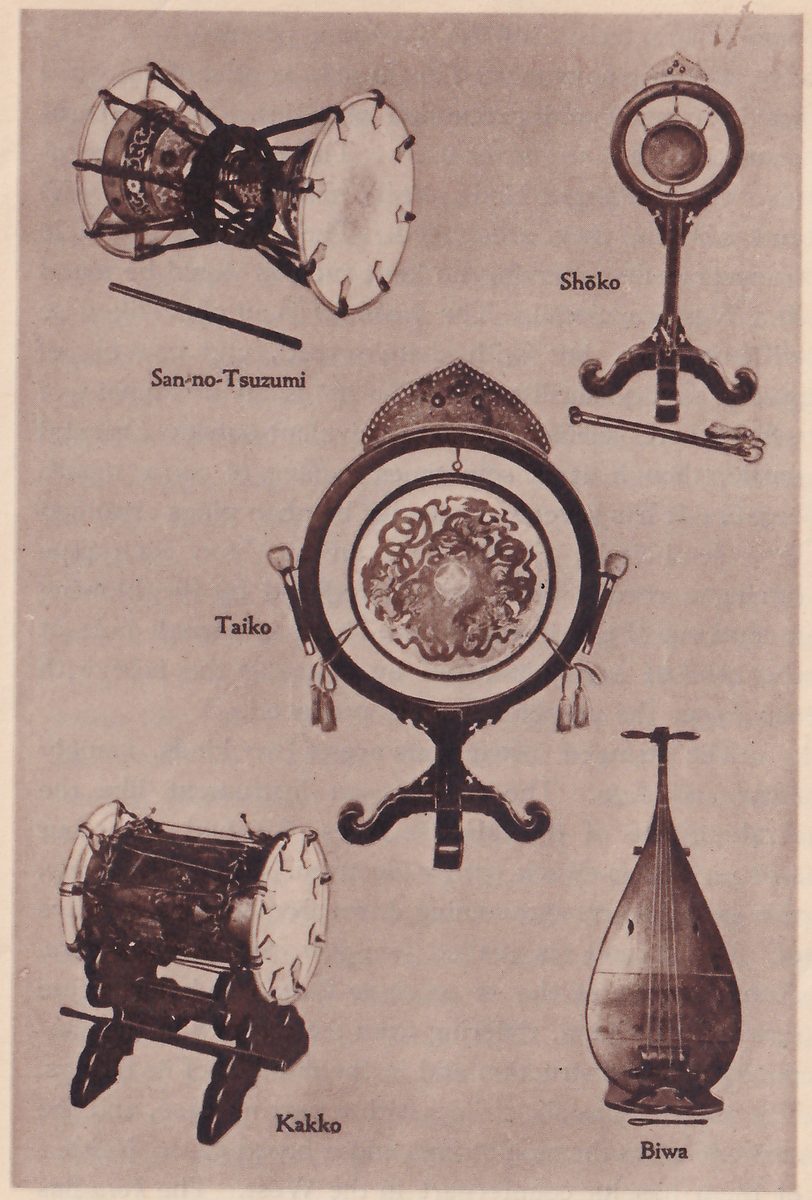
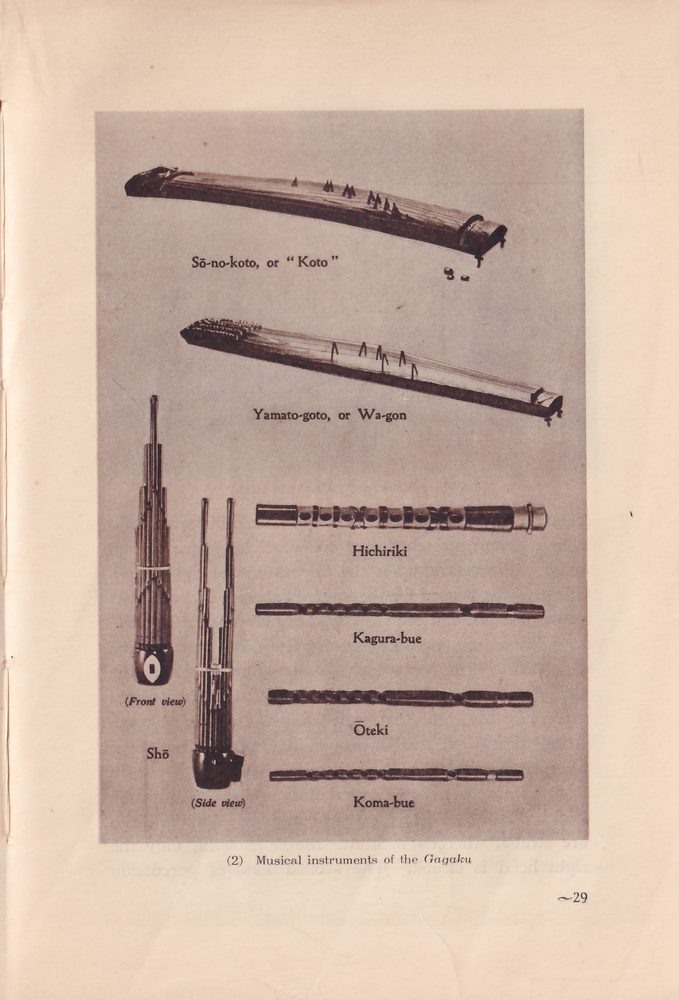
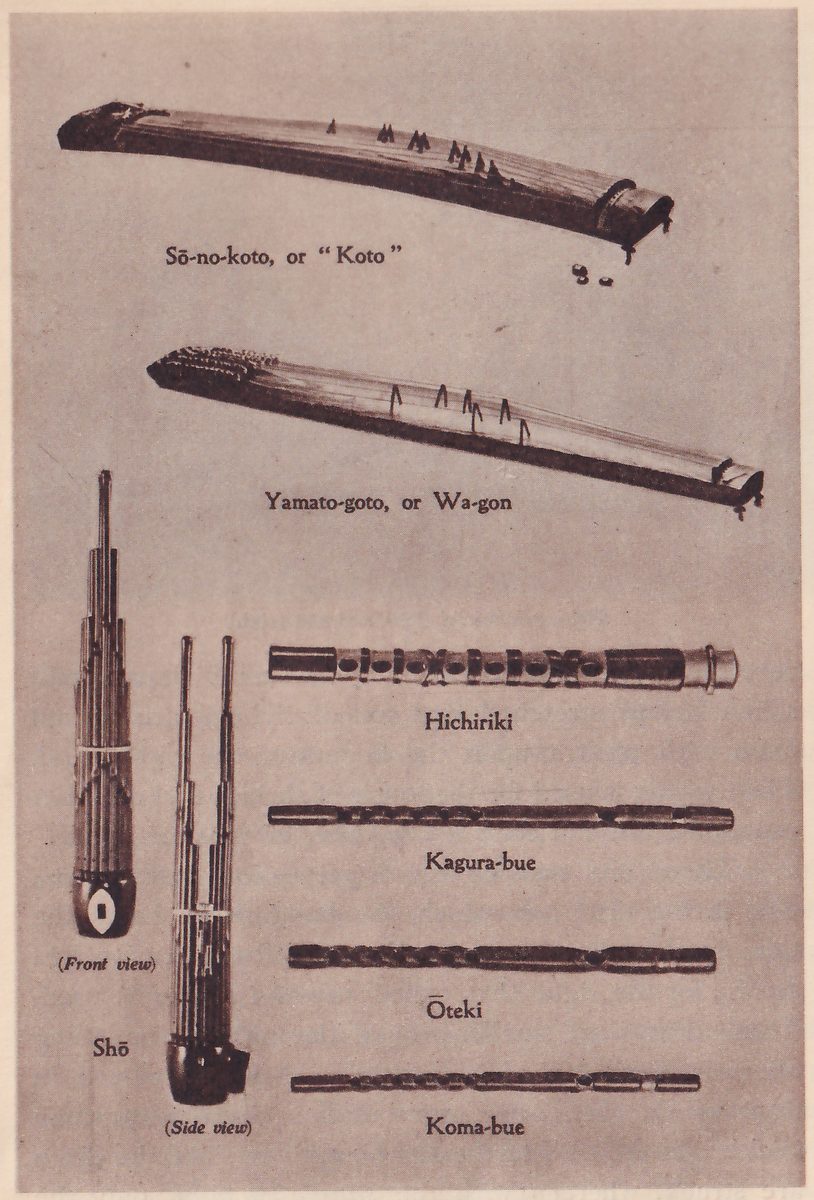
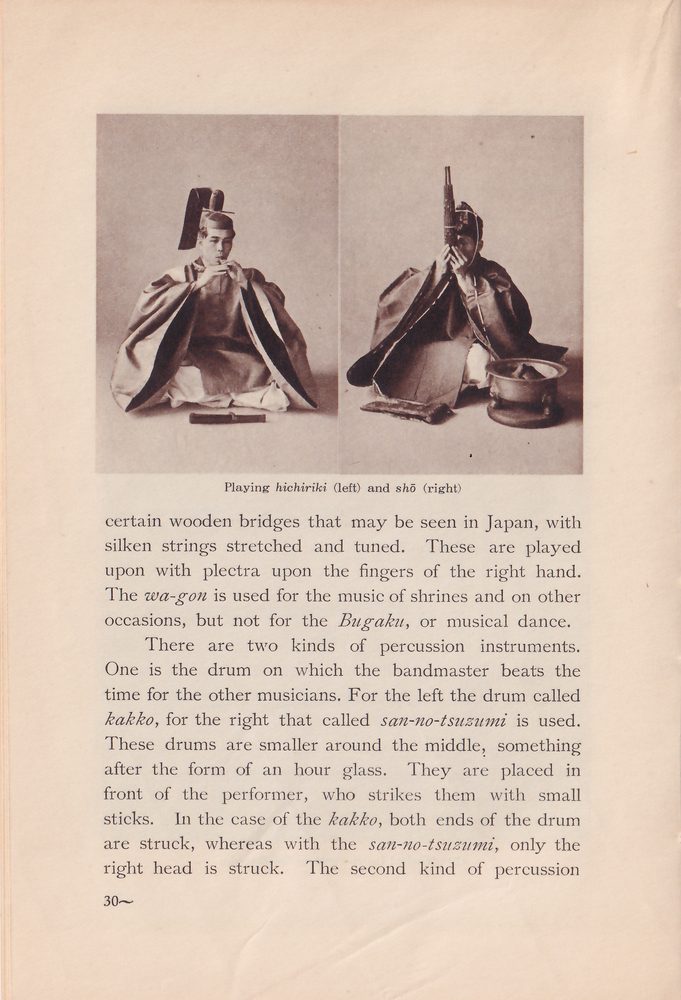
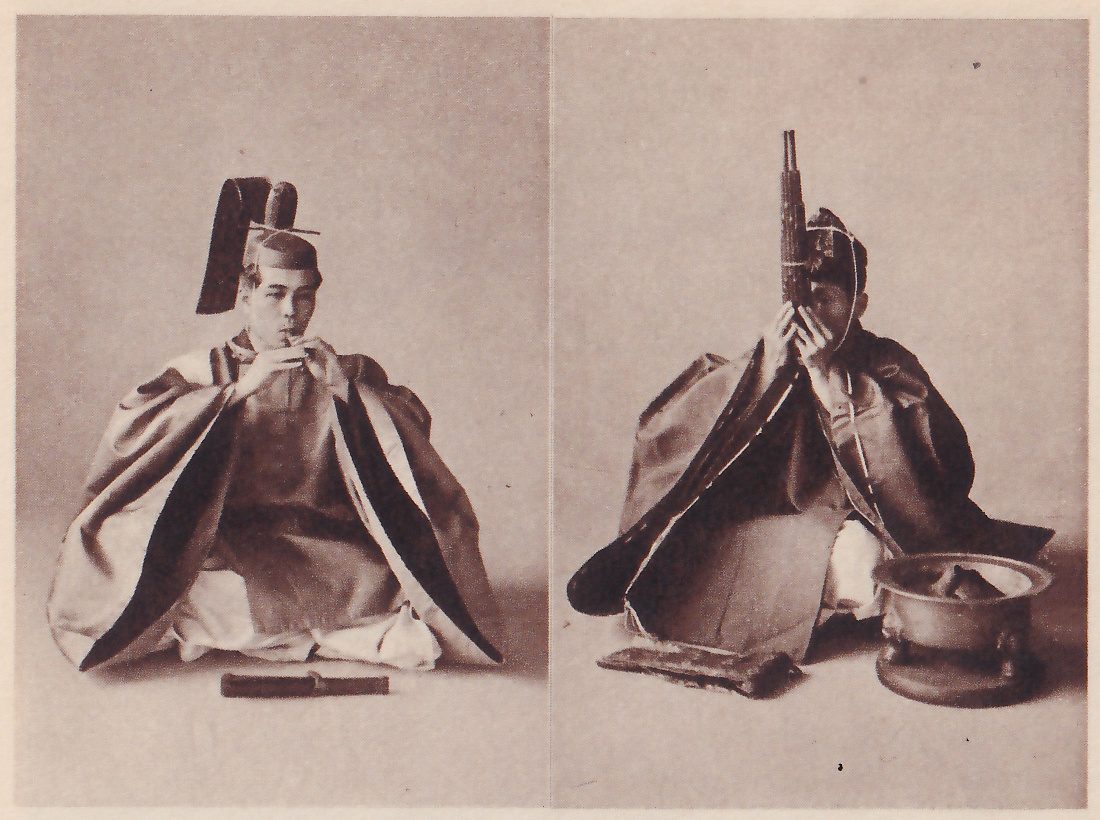
certain wooden bridges that may be seen in Japan, with silken strings stretched and tuned. These are played upon with plectra upon the fingers of the right hand. The wa-gon is used for the music of shrines and on other occasions, but not for the Bugaku, or musical dance.
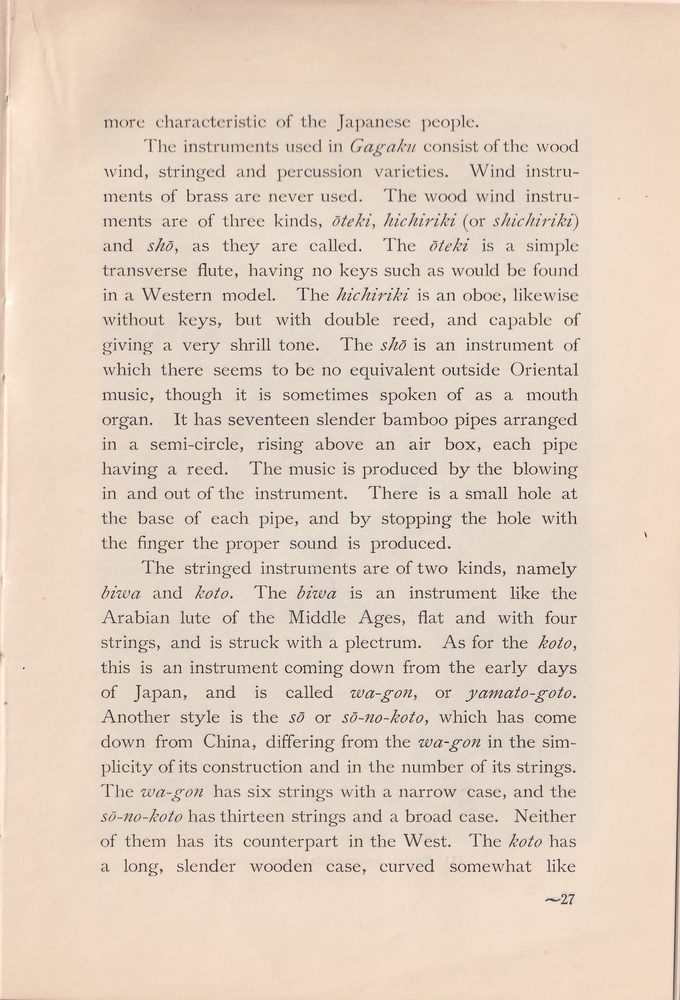
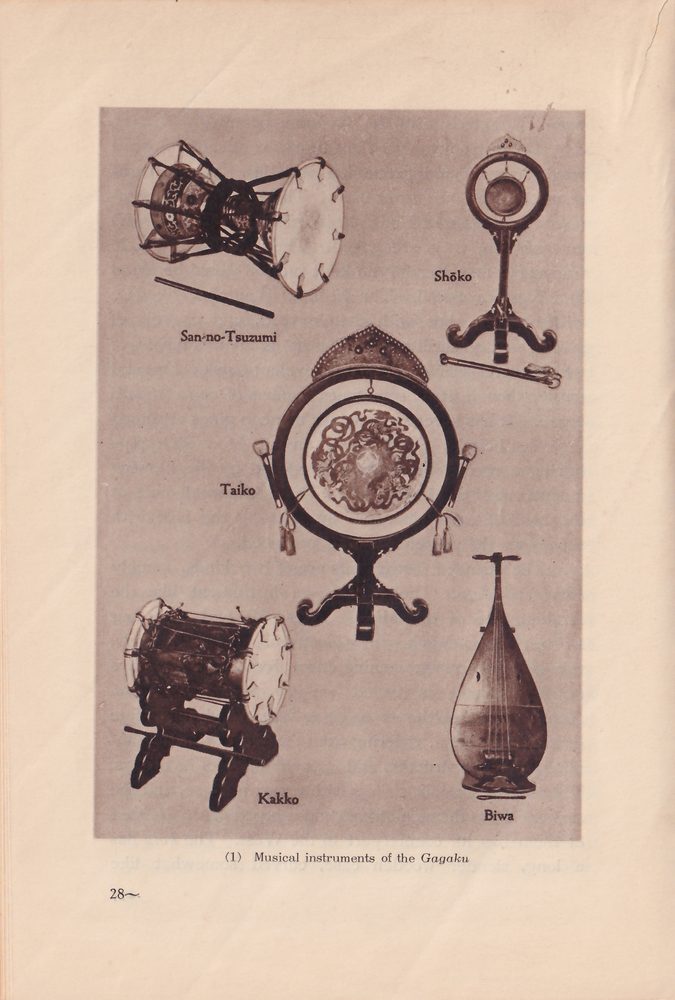
There are two kinds of percussion instruments. One is the drum on which the bandmaster beats the time for the other musicians. For the left the drum called kakko, for the right that called san-no-tsuzumi is used. These drums are smaller around the middle, something after the form of an hour glass. They are placed in front of the performer, who strikes them with small sticks. In the case of the kakko, both ends of the drum are struck, whereas with the san-no-tsuzumi, only the right head is struck. The second kind of percussion
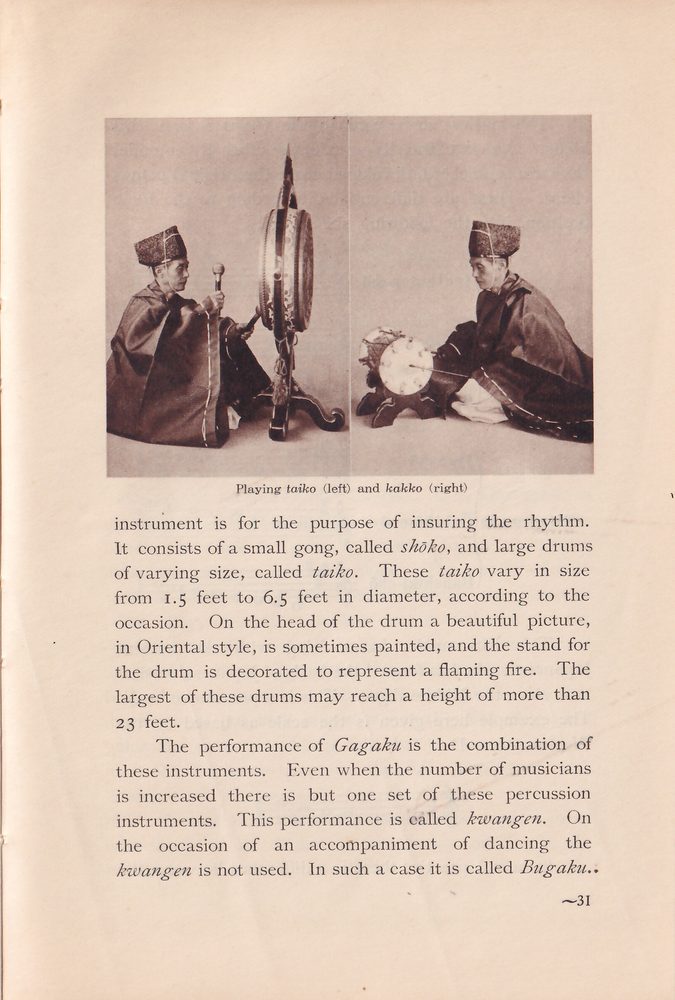
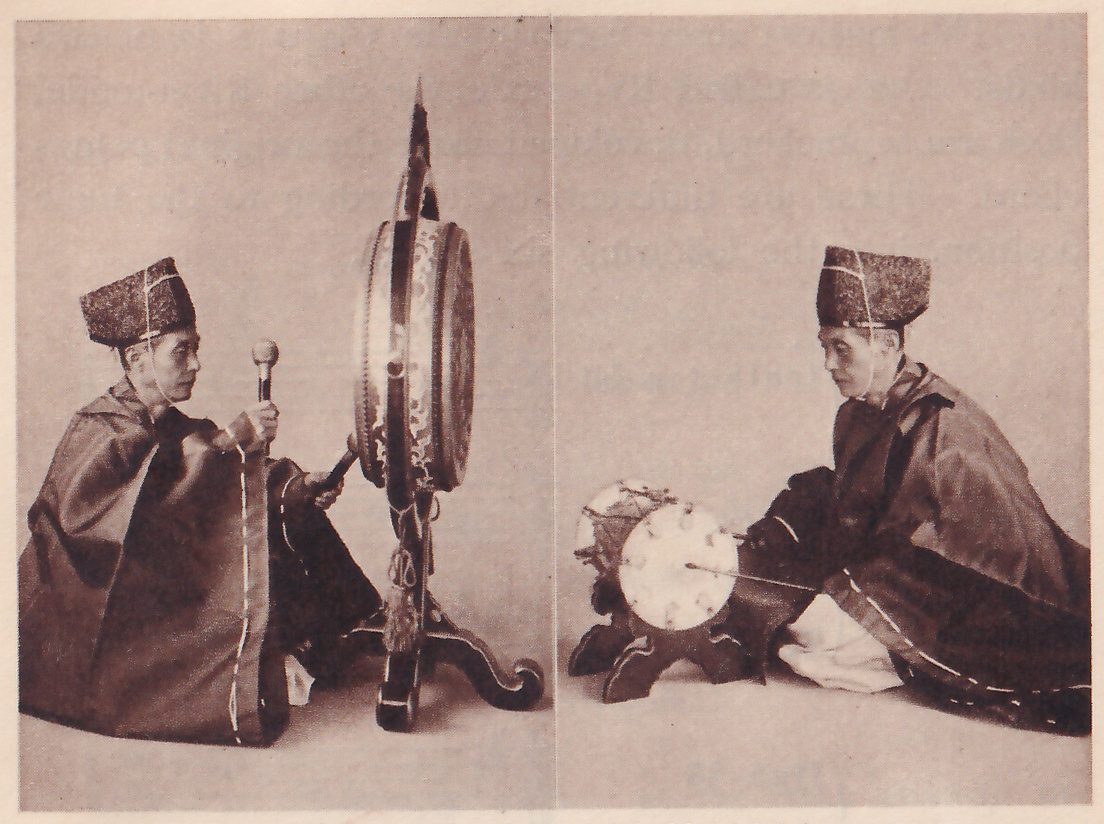
instrument is for the purpose of insuring the rhythm. It consists of a small gong, called shōko, and large drums of varying size, called taiko. These taiko vary in size from 1.5 feet to 6.5 feet in diameter, according to the occasion. On the head of the drum a beautiful picture, in Oriental style, is sometimes painted, and the stand for the drum is decorated to represent a flaming fire. The largest of these drums may reach a height of more than 23 feet.
The performance of Gagaku is the combination of these instruments. Even when the number of musicians is increased there is but one set of these percussion instruments. This performance is called kwangen. On the occasion of an accompaniment of dancing the kwangen is not used. In such a case it is called Bugaku.Printed: ..
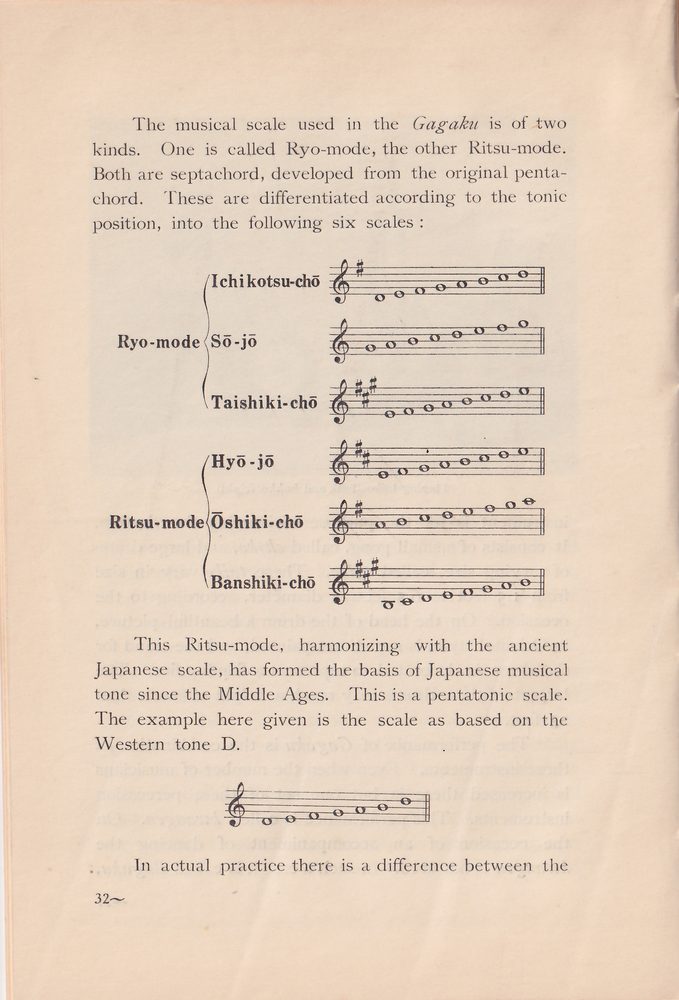
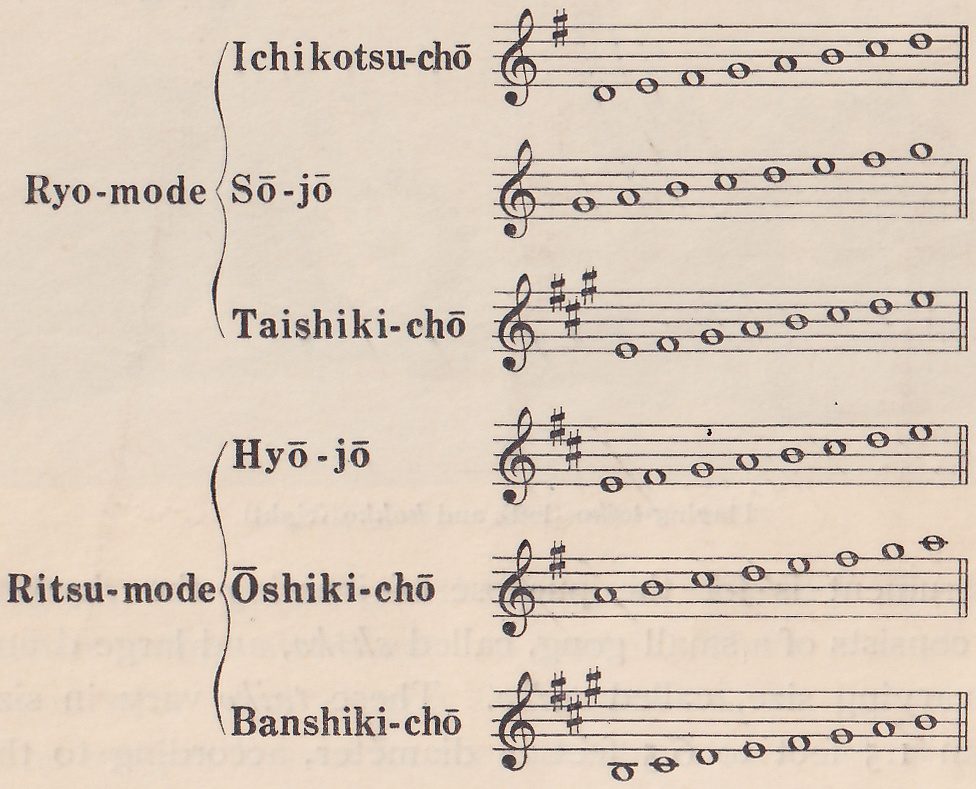
The musical scale used in the Gagaku is of two kinds. One is called Ryo-mode, the other Ritsu-mode. Both are septachord, developed from the original pentachord. These are differentiated according to the tonic position, into the following six scales:
This Ritsu-mode, harmonizing with the ancient Japanese scale, has formed the basis of Japanese musical tone since the Middle Ages. This is a pentatonic scale. The example here given is the scale as based on the Western tone D.
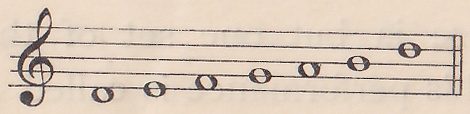
In actual practice there is a difference between the
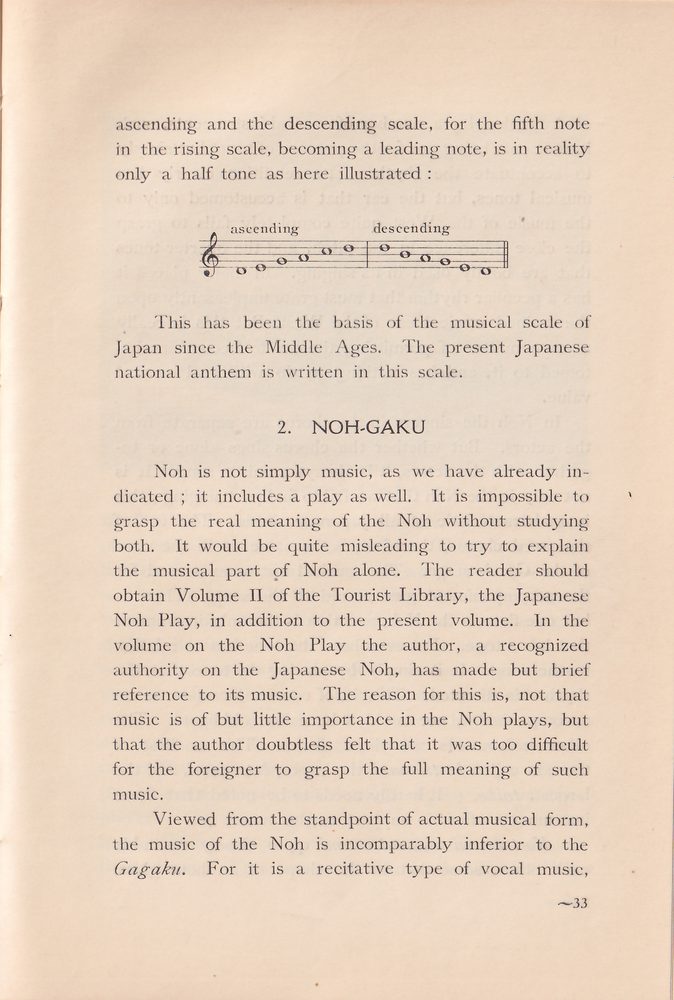
ascending and the descending scale, for the fifth note in the rising scale, becoming a leading note, is in reality only a half tone as here illustrated:
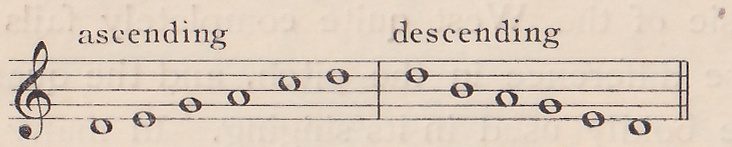
This has been the basis of the musical scale of Japan since the Middle Ages. The present Japanese national anthem is written in this scale.
2. NOH-GAKU
Noh is not simply music, as we have already indicated; it includes a play as well. It is impossible to grasp the real meaning of the Noh without studying both. It would be quite misleading to try to explain the musical part of Noh alone. The reader should obtain Volume II of the Tourist Library, the Japanese Noh Play, in addition to the present volume. In the volume on the Noh Play the author, a recognized authority on the Japanese Noh, has made but brief reference to its music. The reason for this is, not that music is of but little importance in the Noh plays, but that the author doubtless felt that it was too difficult for the foreigner to grasp the full meaning of such music.
Viewed from the standpoint of actual musical form, the music of the Noh is incomparably inferior to the Gagaku. For it is a recitative type of vocal music,
accompanied by a number of musical instruments, such instruments being not for the purpose of tone, but simply to accentuate the rhythm. Its rendition clearly has musical tones, but the ear that is accustomed only to the music of the West quite completely fails to grasp the close difference in the pitch, and the quarter tones that are boldly used in its singing. In many places it has a peculiar rhythm that must grate unpleasantly upon the trained musical ear of the West. But this is really a mere matter of permitting the ear to become accustomed to it, and has nothing to do with real musical value.
In Noh the singers in the chorus are separate from the actors. But whether the chorus sings alone or together with the actors, it is always a unison song. It is not only in the Noh that we fail to find part singing; this is a characteristic of all Japanese music. The use of the word chorus, therefore, is the same as in the case of the Greek stage. The musical instruments used for the accompaniment give no aid to the song. There is but one flute in the Noh, and that is the only instrument that has a tone. But even here the tone has no relation to the song. It is simply by placing the tone that the rhythm is directed. This is, of course, in no sense an accompaniment, nor could it be called obbligato. The other instruments are three drums. The smallest of these is called ko-tsuzumi, the larger, ō-tsuzumi, and the largest, taiko. It hardly needs to be noted that these instruments offer no support to the tune.
Ko-tsuzumi and ō-tsuzumi quite closely resemble each other, somewhat in the shape of an hour glass,
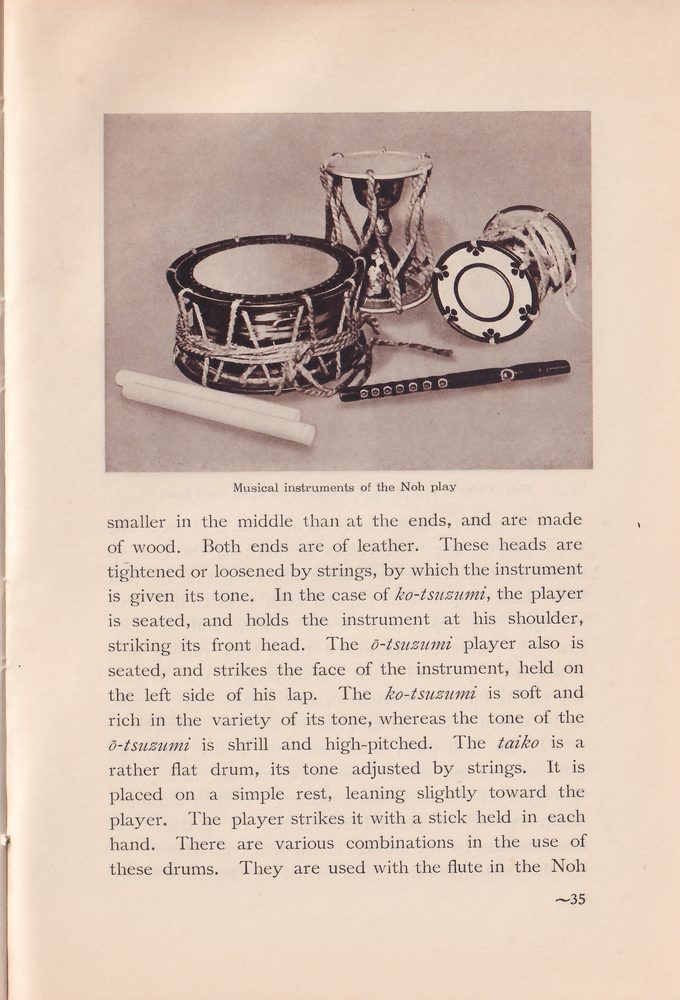
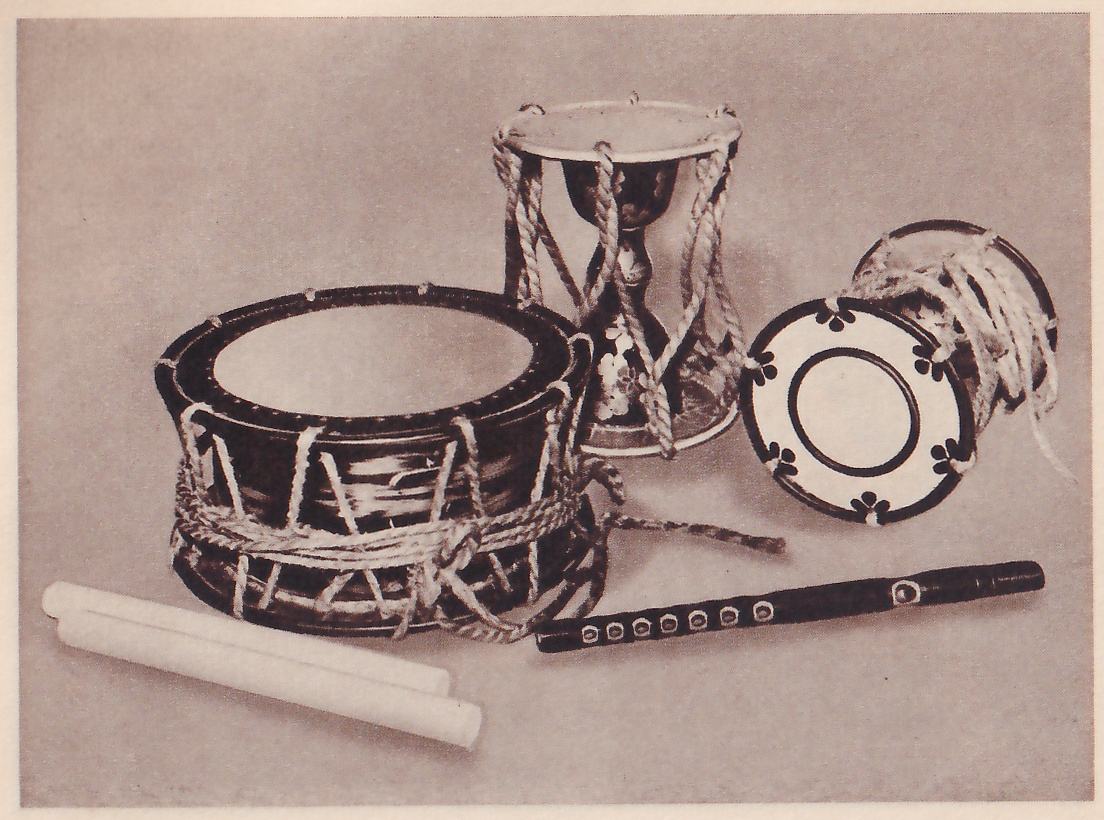
smaller in the middle than at the ends, and are made of wood. Both ends are of leather. These heads are tightened or loosened by strings, by which the instrument is given its tone. In the case of ko-tsuzumi, the player is seated, and holds the instrument at his shoulder, striking its front head. The ō-tsuzumi player also is seated, and strikes the face of the instrument, held on the left side of his lap. The ko-tsuzumi is soft and rich in the variety of its tone, whereas the tone of the ō-tsuzumi is shrill and high-pitched. The taiko is a rather flat drum, its tone adjusted by strings. It is placed on a simple rest, leaning slightly toward the player. The player strikes it with a stick held in each hand. There are various combinations in the use of these drums. They are used with the flute in the Noh
music to indicate more clearly its intricate rhythm. The drum players use their voices to mark off the beating of the drums. Sometimes those who hear it for the first time think it quite strange, and even wonder if it does not spoil the enjoyment of the music. But as they gradually become accustomed to it they realize how important a part it is. At first its purpose was to give the signal for the percussion, but it has finally come to be essential for the creation of musical atmosphere.
In the Noh play, throughout the entire play, the same actors and musical accompanists are used; but the order of the solos and choruses, and their arrangement, as well as the different kinds of rhythmic accompaniment by the musical instruments, are determined by the contents of the piece. It is, therefore, not really
so monotonous as it may seem. But the mere song, or utai, apart from the Noh performance itself, and without musical accompaniment, offers but little intelligent interest to the foreigner.
When its content is understood, and it is seen portrayed upon the stage, even though the language in which it is given may not be understood, the foreigner may catch the artistic intent of the play, depending of course upon the degree of his own artistic sensibility. To those lovers of art from abroad who are visiting Japan, as well as the foreigners who reside here, the Noh play is the favourite form of our art; through it they come to grasp the characteristics of the spirit of Japan and the very essence of Japanese art.
3. MUSIC OF KOTO
The music of the koto today is the music of the home. It is also the music of the individual. In certain circumstances it may be performed on the stage, but from its very nature it is an instrument for the pleasure of the one who plays it. Therefore, its construction is frail, and though its tone colour is beautiful it is seldom used upon a large stage. From the quality of its music it makes no aim at dramatic effect of any brilliant kind, but rather preserves its own intimate and delicate quality throughout. This is partly due to the fact that the composers of the koto music, as well as those who have handed it down, have for the most part been blind. It is also largely the case because it is the music of the home, more especially the music of women. The
women of old Japan were unsurpassed in their modesty and their retiring elegance of spirit.
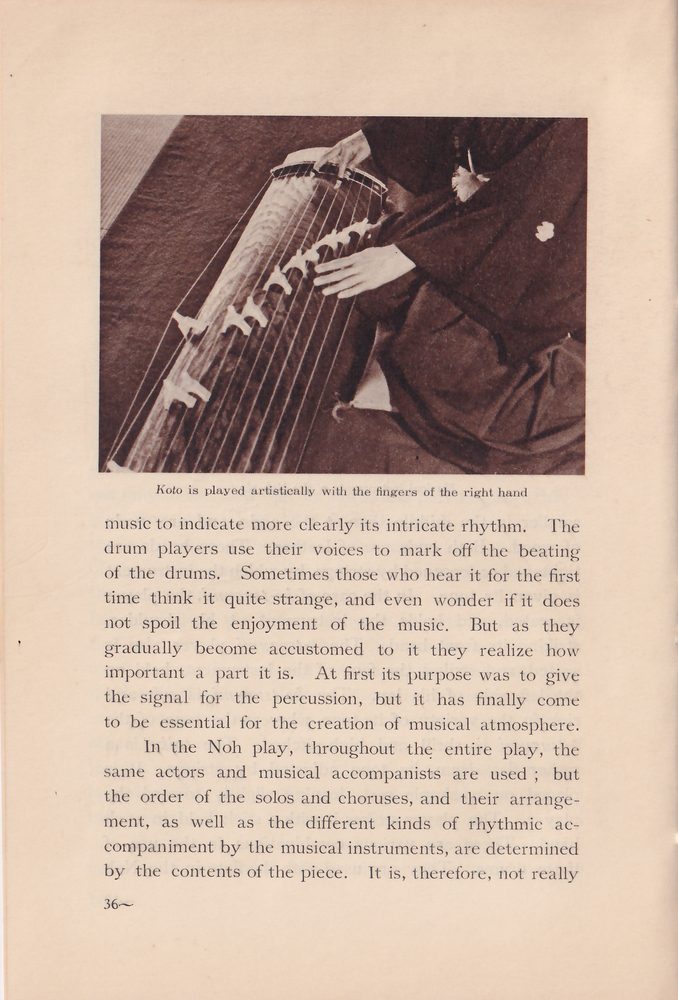
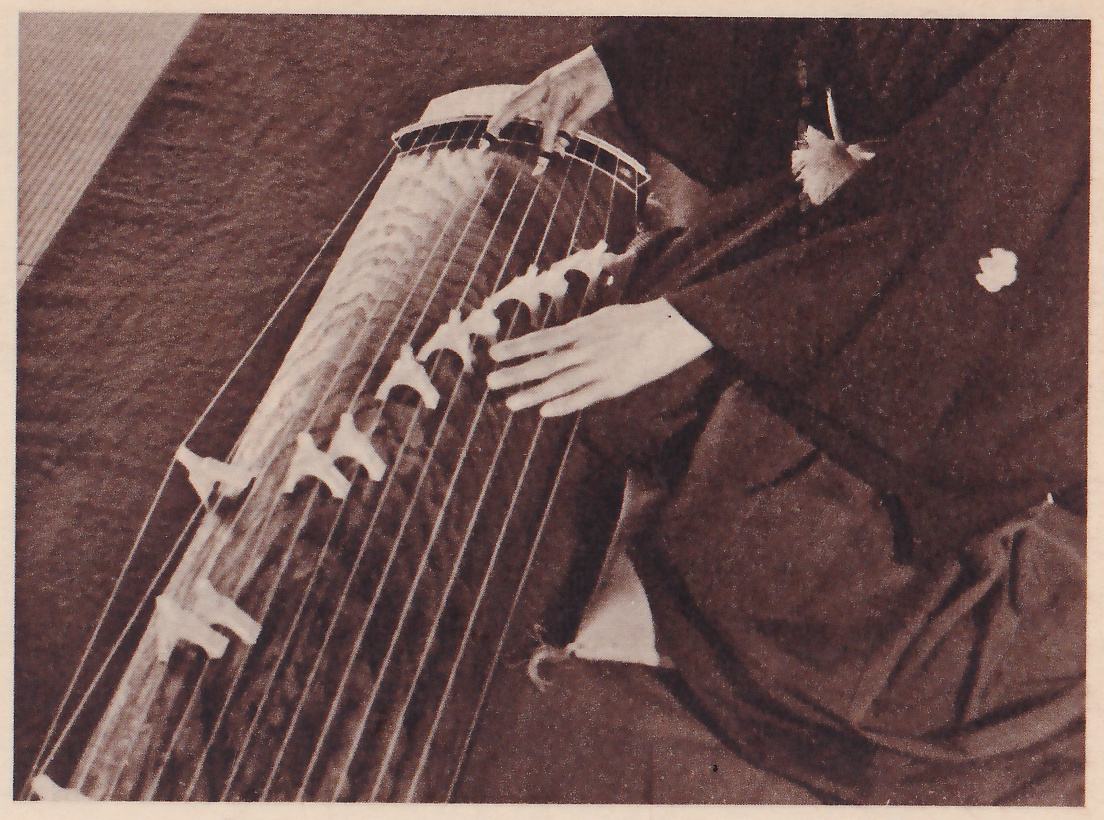
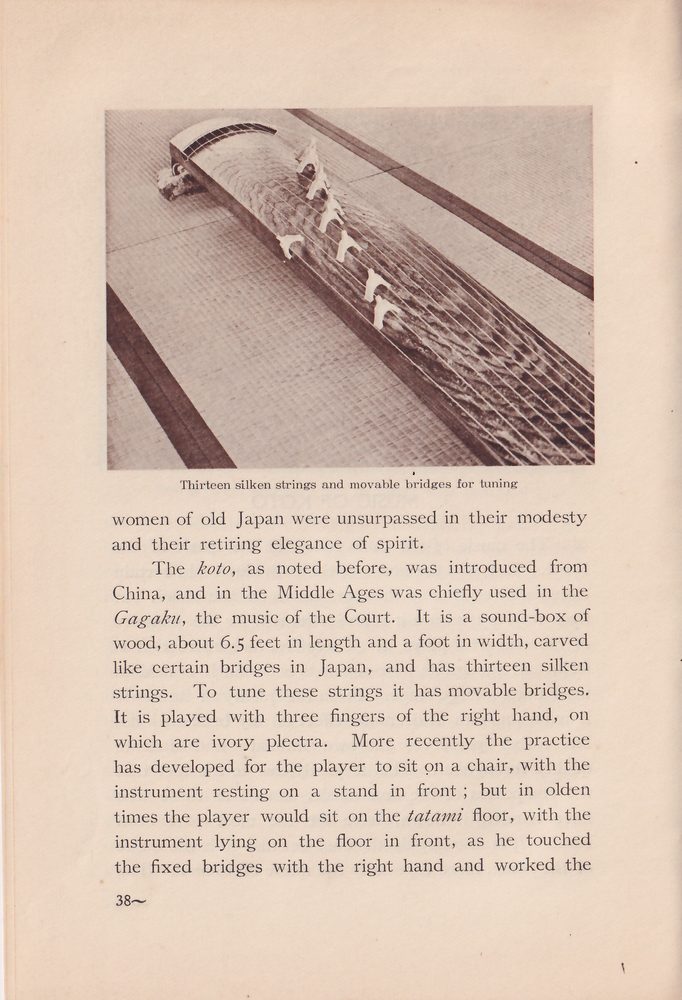
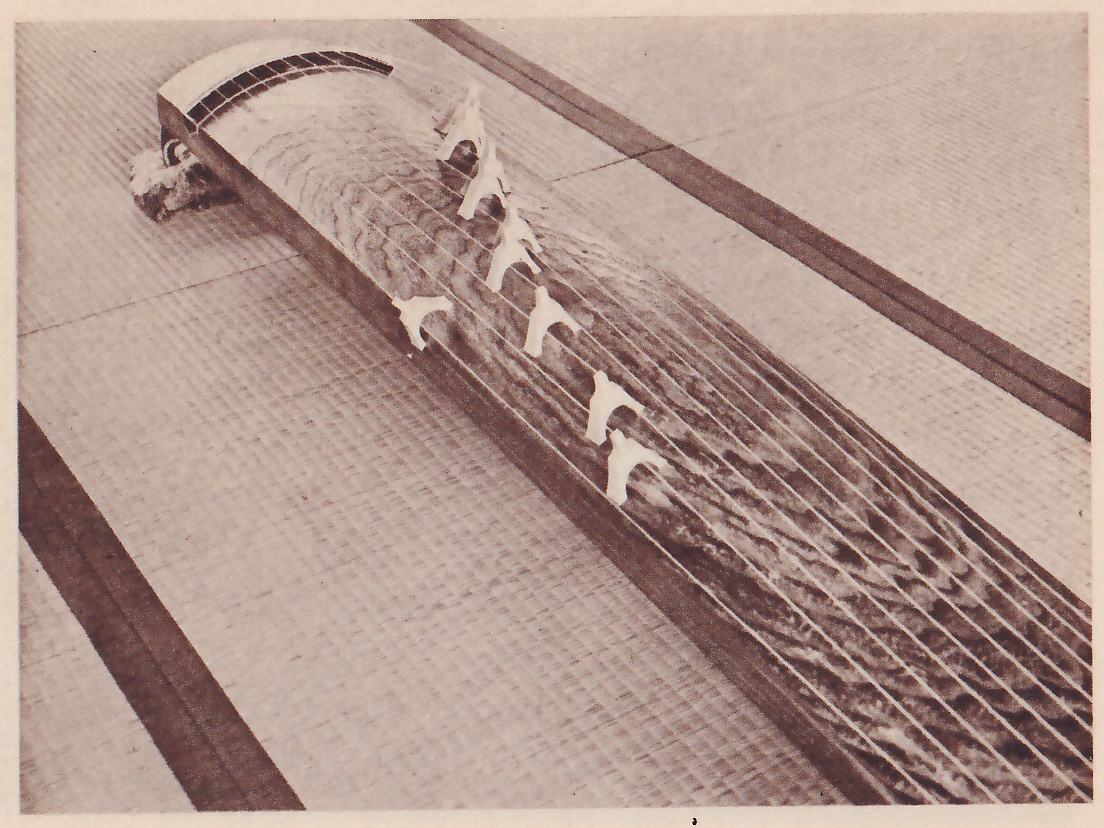
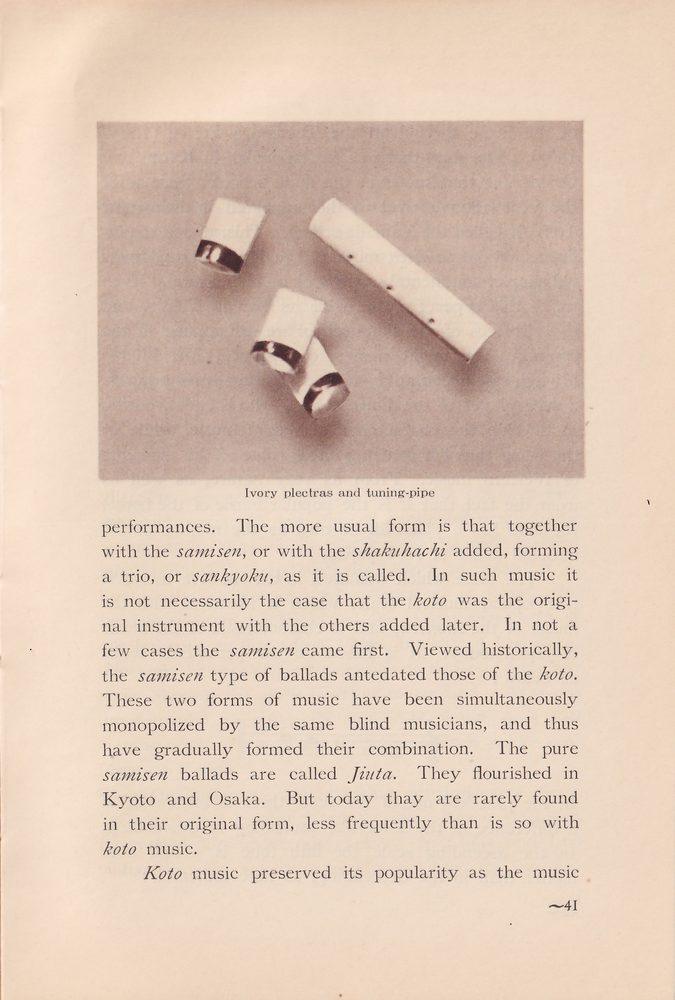
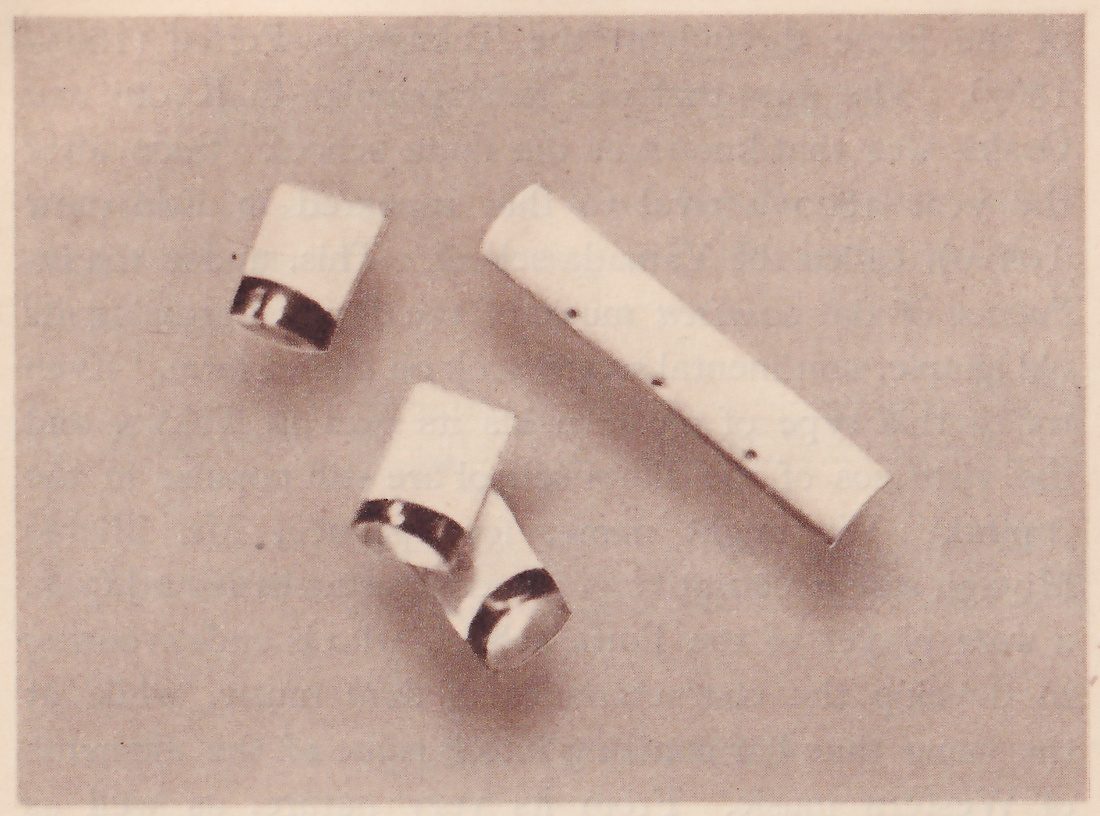
The koto, as noted before, was introduced from China, and in the Middle Ages was chiefly used in the Gagaku, the music of the Court. It is a sound-box of wood, about 6.5 feet in length and a foot in width, carved like certain bridges in Japan, and has thirteen silken strings. To tune these strings it has movable bridges. It is played with three fingers of the right hand, on which are ivory plectra. More recently the practice has developed for the player to sit on a chair, with the instrument resting on a stand in front; but in olden times the player would sit on the tatami floor, with the instrument lying on the floor in front, as he touched the fixed bridges with the right hand and worked the
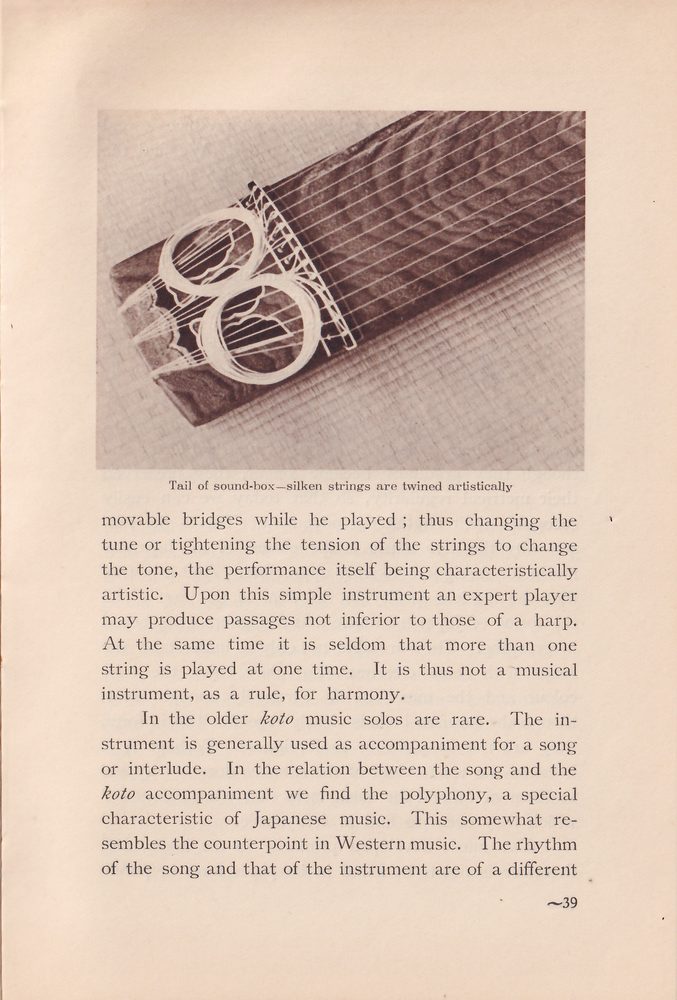
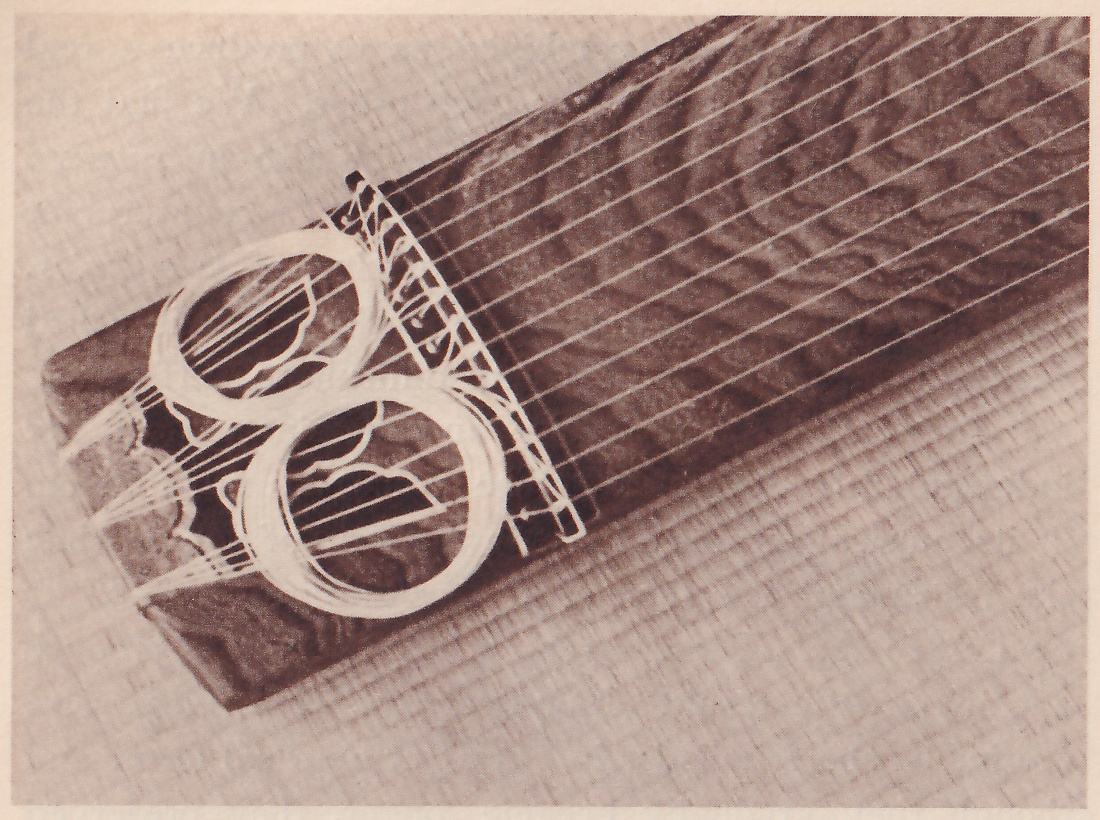
movable bridges while he played; thus changing the tune or tightening the tension of the strings to change the tone, the performance itself being characteristically artistic. Upon this simple instrument an expert player may produce passages not inferior to those of a harp. At the same time it is seldom that more than one string is played at one time. It is thus not a musical instrument, as a rule, for harmony.
In the older koto music solos are rare. The instrument is generally used as accompaniment for a song or interlude. In the relation between the song and the koto accompaniment we find the polyphony, a special characteristic of Japanese music. This somewhat resembles the counterpoint in Western music. The rhythm of the song and that of the instrument are of a different
character, but are so combined as to produce a real harmony in their support of each other. We find the counterpoint of voice and instrument also in samisen music, as we shall see later on. Such a counterpoint may also be found in the harmonizing of two kotos, where each has its own separate music. This is called kaede in Japanese, and is quite difficult to perform.
In koto music the voice and the instrument are independently developed. The voice has full freedom in its musical expression, as in the form of songs, while the instrument has developed music appropriate to its own character. These two may be combined to produce a truly artistic result. Moreover, the koto songs were originally short ballads, in a proper metrical form, and though they gradually became longer, they preserved their metrical regularity, so that today we can easily recognize their rhythmical movement. This is the reason why the koto music is the easiest of all Japanese music for foreigners to truly appreciate. And it is true that the musical quality of the koto is the first of all the forms of Japanese music that foreigners do succeed in grasping. They are able not only to understand the songs with some clearness, but they enjoy the tone colour and the music itself. Strangely enough, even though the samisen ballads closely resemble this in form, they are not so pleasing to foreigners. Perhaps it is because the tone colour of the samisen does not appeal to them at all and the music lacks that “intimateness” which they seem to find in koto music.
Koto music developed primarily in the home, and therefore is not to be found in its purer form in public
performances. The more usual form is that together with the samisen, or with the shakuhachi added, forming a trio, or sankyoku, as it is called. In such music it is not necessarily the case that the koto was the original instrument with the others added later. In not a few cases the samisen came first. Viewed historically, the samisen type of ballads antedated those of the koto. These two forms of music have been simultaneously monopolized by the same blind musicians, and thus have gradually formed their combination. The pure samisen ballads are called Jiuta. They flourished in Kyoto and Osaka. But today theyPrinted: thay are rarely found in their original form, less frequently than is so with koto music.
Koto music preserved its popularity as the music
of the home throughout the Tokugawa Period (1603–1867). The form that was most popular in Kyoto and Osaka was that known as the Ikuta school. Soon after the year 1800 a rival to this appeared in Edo (now Tokyo), called the Yamada school. This, under the influence of the samisen music of the day, outgrowing its old simple, sentimental songs, took on ballad form. Even today this type of music holds its own in Tokyo, and the virtuosos of the Ikuta school are still popular in the capital. We might name, for instance, Mr. Michio Miyagi, a representative of the composers of New Japan, a koto player of the Ikuta school, who is endeavouring to develop the characteristics of koto music, while at the same time harmonizing into it some of the elements of Western music. From its very nature, as well as from the fact that it is the popular music of the home, the koto has a place all its own as the mother of the national music of New Japan.
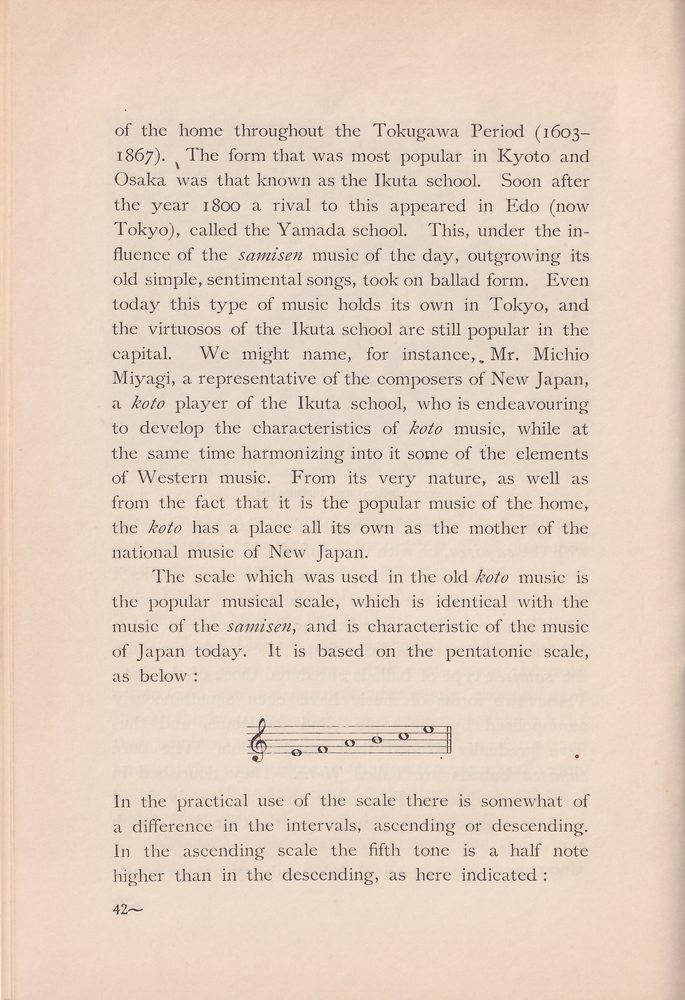
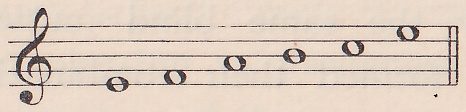
The scale which was used in the old koto music is the popular musical scale, which is identical with the music of the samisen, and is characteristic of the music of Japan today. It is based on the pentatonic scale, as below:
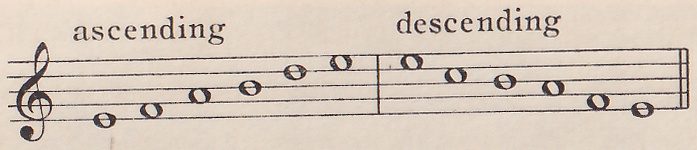
In the practical use of the scale there is somewhat of a difference in the intervals, ascending or descending. In the ascending scale the fifth tone is a half note higher than in the descending, as here indicated:
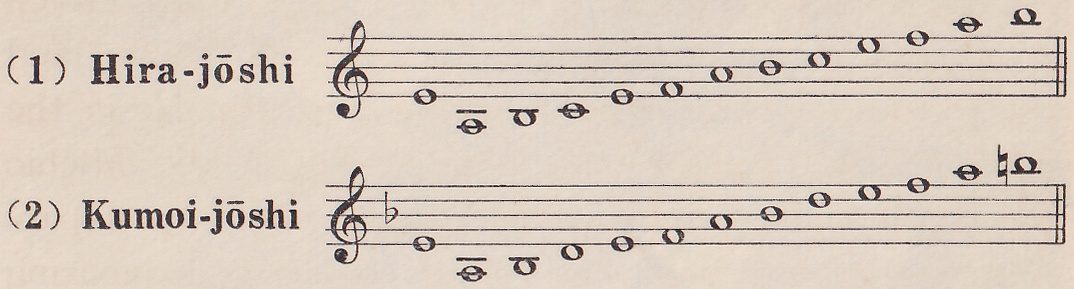
The thirteen strings of the koto may be tuned differently, but the two following are the most common formations:
4. MUSIC OF SAMISEN
The samisen is a musical instrument not over four hundred years old, but since it is the instrument most commonly used by the people, it would be quite natural for those unacquainted with its history to regard it as one of the ancient musical instruments of Japan. Its prototype is to be found on the Asiatic continent, it having come to Japan from China, by way of Loo Choo. However, it was the instrument alone that was imported from abroad, the music is native to our land. As might be supposed, therefore, the method of playing it as well as the construction of the instrument itself is the product of Japan.
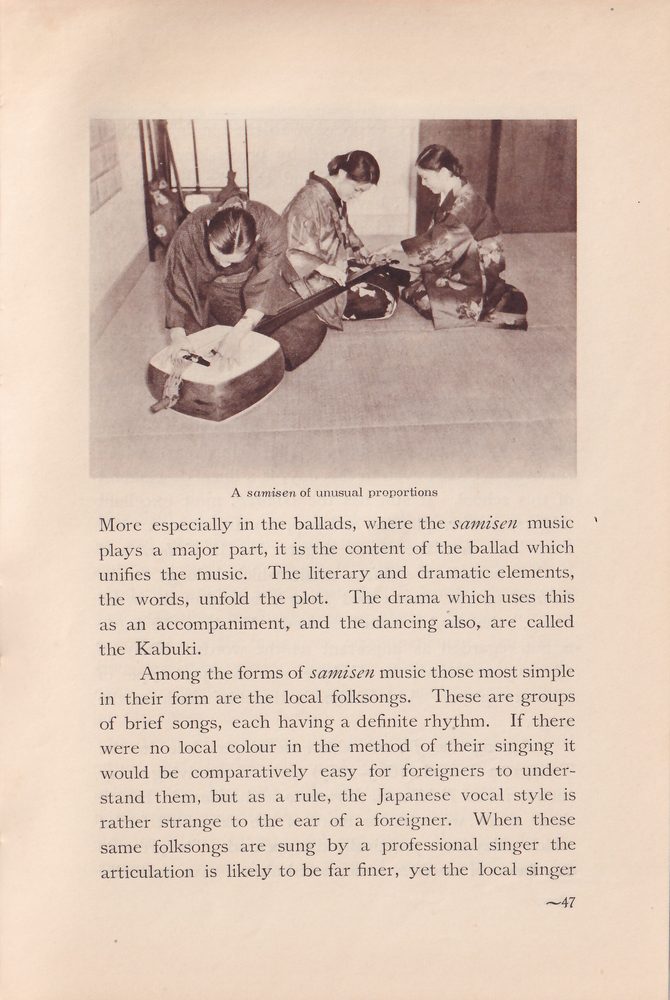
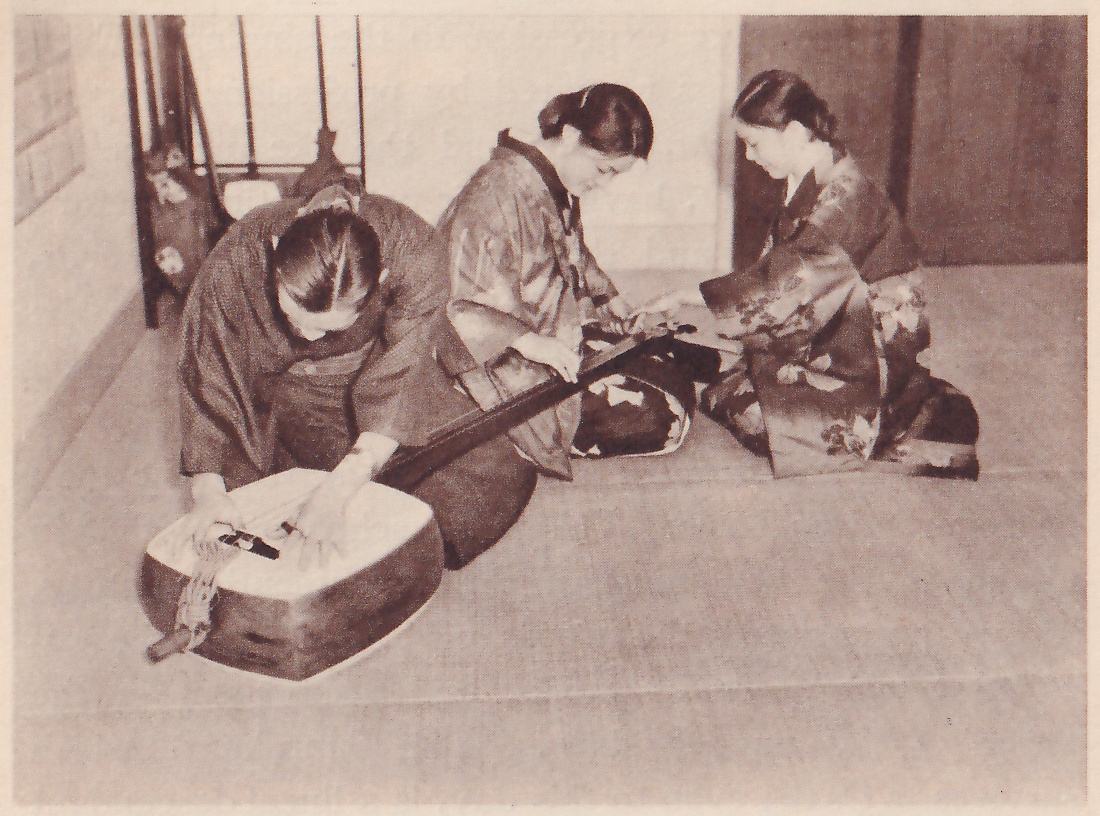
The samisen is a plucking instrument of three strings, with a long neck, whose square box is stretched with cat skin above and below. In China and Loo Choo the skin of a large serpent was used for the pur-
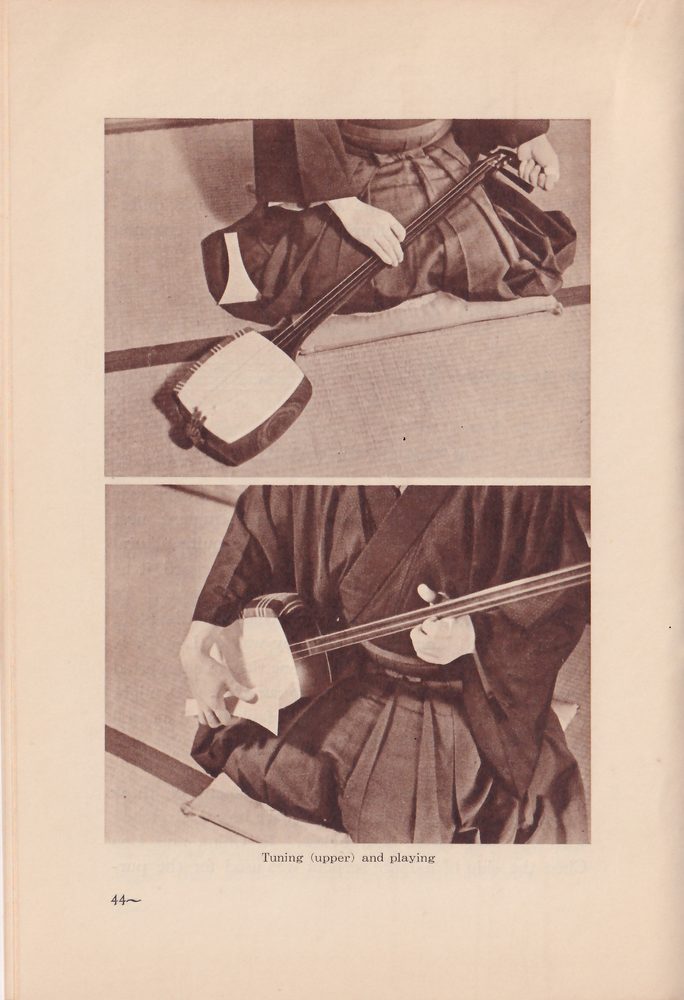
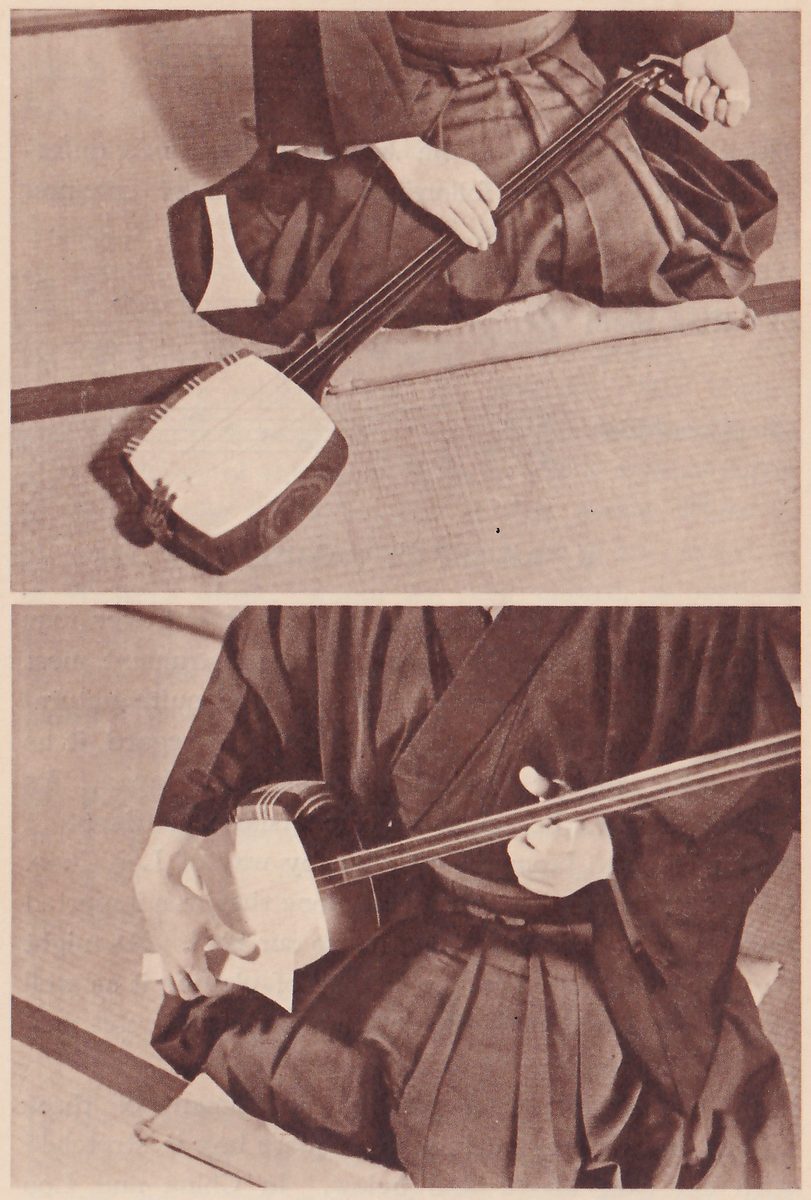
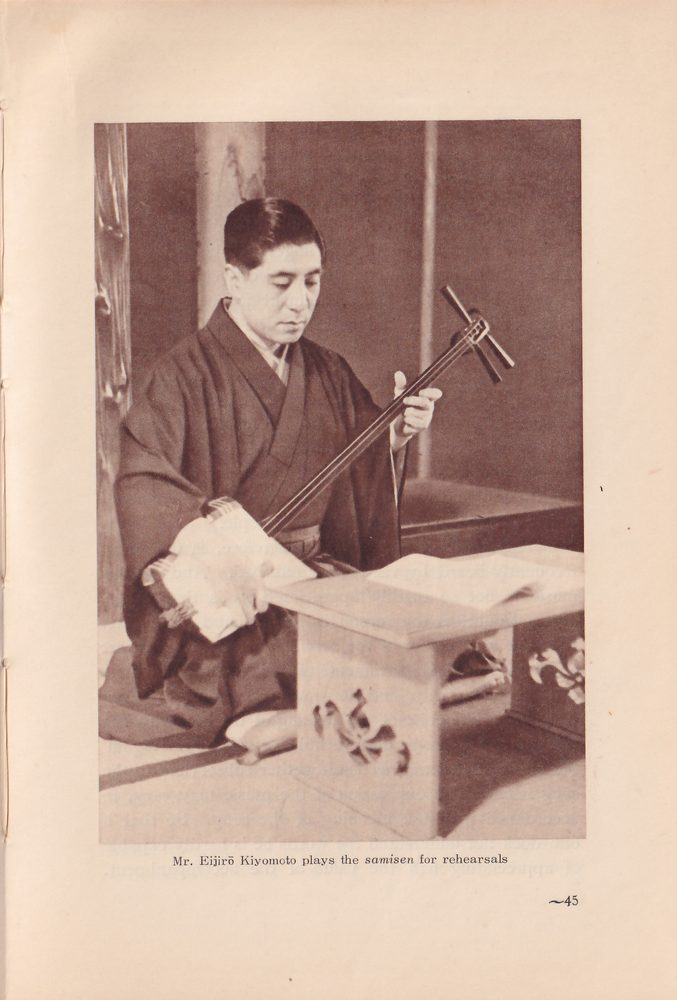
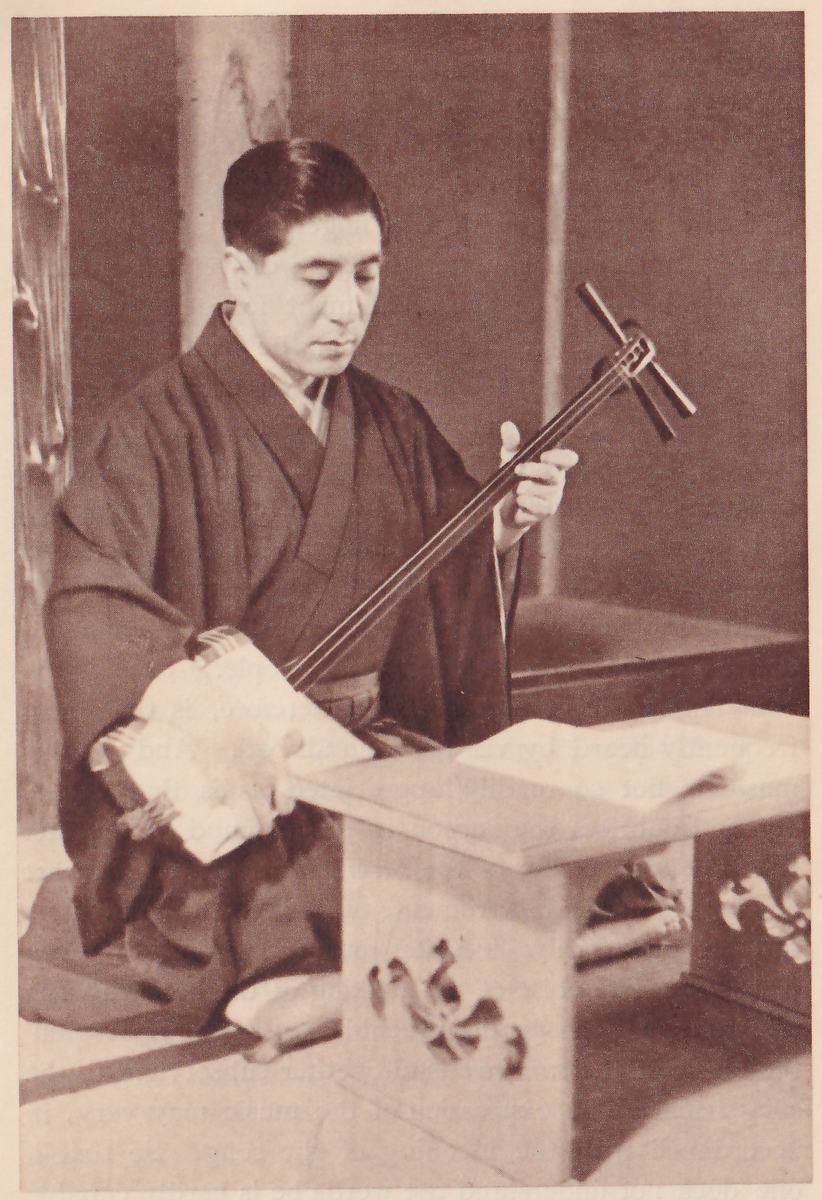
pose. The neck of the instrument has neither fingerboard nor fret. The player strikes it with a large plectrum held in his right hand. This plectrum is broad and thin at the striking end, but the part held in the hand is narrow and thick. The player also sometimes strikes the strings with the fingers of his left hand. The instrument is simple, small and convenient in size. It may be used as accompaniment for outdoor stage plays and dancing, and as it can be made to give a comparatively loud sound, it is often used as accompaniment to theatrical play and dance at the large theatres. As a solo instrument its scope is limited, because of the quality of its tone, but for accompaniment it is a most convenient instrument. It is well suited to the volume and register of the Japanese voice, so is most widely and variously used for vocal accompaniment, and is in wide favour among the people.
The music of the samisen, therefore, is that most frequently heard by visitors from abroad. And yet this music is not so readily appreciated as is that of the koto. Doubtless the reason is to be found in the fact that the tone colour of the samisen has no counterpart among the musical instruments of the West. Foreigners do not necessarily find its music beautiful or even pleasing. The noise of the striking of the box with the plectrum is perhaps disagreeable to the ear. Again the music of the samisen is altogether subservient to the song itself. The expression of the music may vary, in accordance with the meaning of the song. So that if one does not understand the words he is hardly capable of appreciating half the value of the accompaniment.
More especially in the ballads, where the samisen music plays a major part, it is the content of the ballad which unifies the music. The literary and dramatic elements, the words, unfold the plot. The drama which uses this as an accompaniment, and the dancing also, are called the Kabuki.
Among the forms of samisen music those most simple in their form are the local folksongs. These are groups of brief songs, each having a definite rhythm. If there were no local colour in the method of their singing it would be comparatively easy for foreigners to understand them, but as a rule, the Japanese vocal style is rather strange to the ear of a foreigner. When these same folksongs are sung by a professional singer the articulation is likely to be far finer, yet the local singer
would give far more expression to the singing. Even in the chanson songs rendered by professional singers, such songs as Hauta, Kouta and the like may be interpreted differently, having their own distinct literary or dramatic form, and thus may be difficult to comprehend. The most lofty of this type is known as the Utazawa. But those who gain pleasure from this, even among the Japanese, are few.
Among the samisen ballads the Gidayū music may be regarded as basic. This is the school originating in Osaka at the beginning of the seventeenth century. They appropriated the words of Chikamatsu, the so-called Shakespeare of Japan, and used them in the music of the puppet show. The Bunrakuza, which survives in Osaka even to this day, is a lineal descendant of this school. It still has the Gidayū, most excellent singers, samisen players, and puppet manipulators. We have here used the word, singers, but in Gidayū and in that branch of samisen music which belongs to the Gidayū and is often called Jōruri, instead of the word “sing,” the word “recite” is used. For here the music is not regarded as important as the words. Many of the puppet shows in Gidayū are the prototype of ordinary plays. And Gidayū is the chief music of the stage.
Among the Jōruri which developed late in the Tokugawa Period (1603–1867) we have surviving today such forms as Tokiwazu, Kiyomoto, and Shinnai. Beside these there were ten or more of the old-school forms, which today have practically disappeared. The present-day forms of samisen music, noted above, have naturally
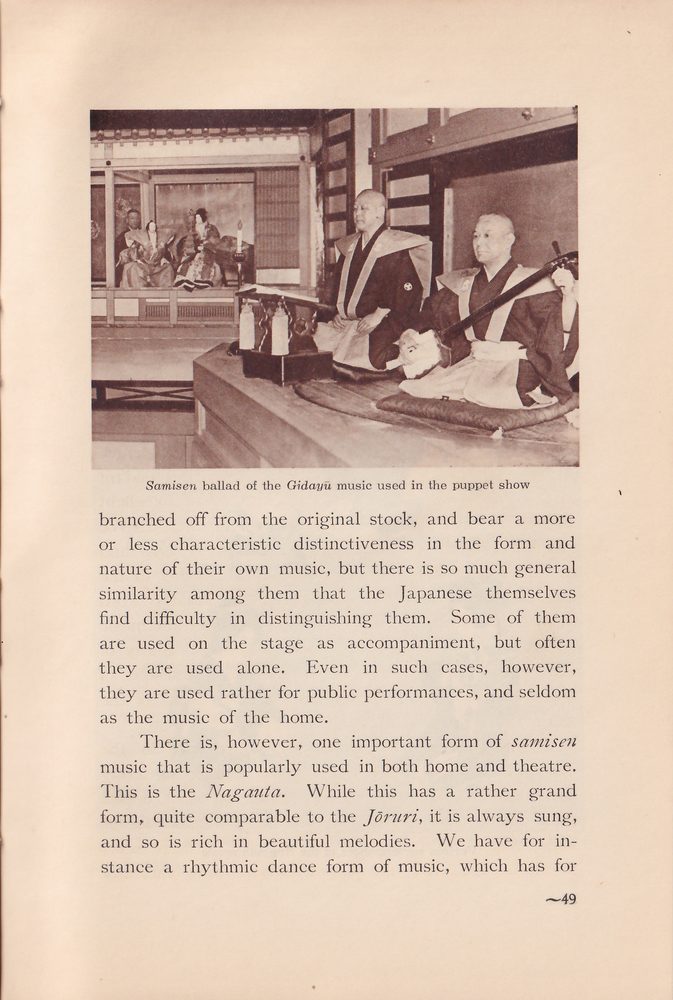
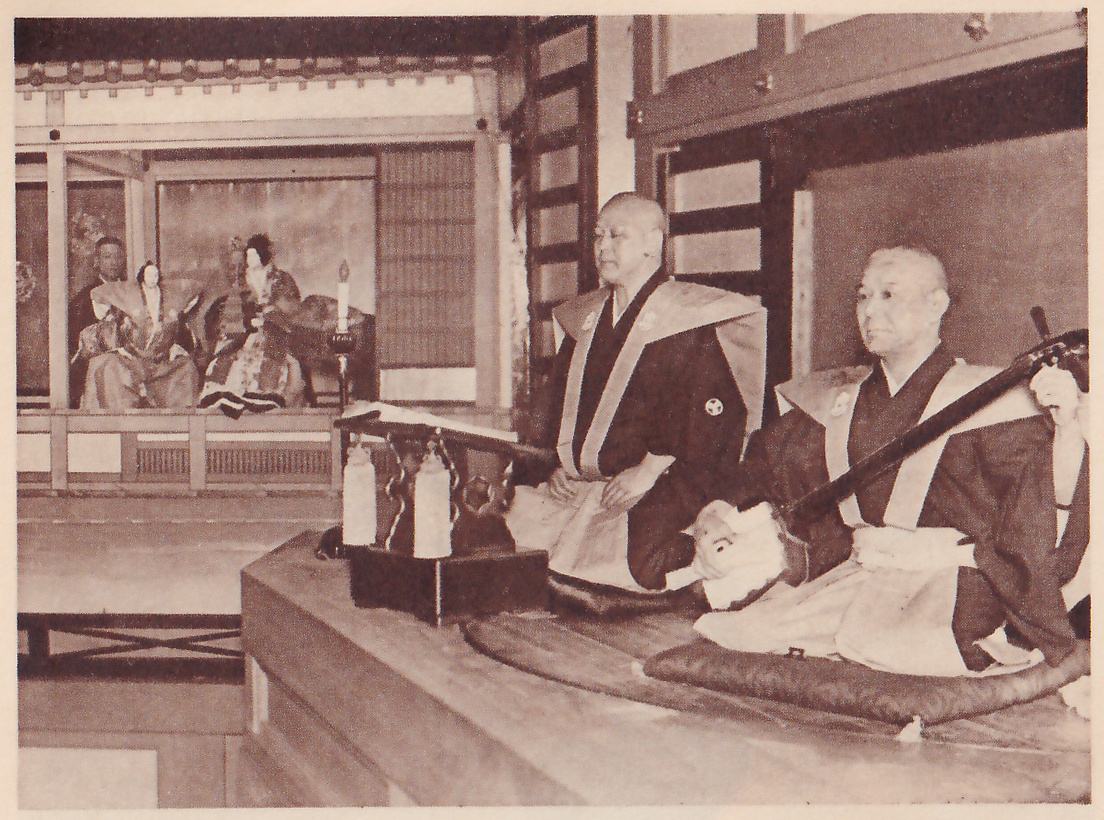
branched off from the original stock, and bear a more or less characteristic distinctiveness in the form and nature of their own music, but there is so much general similarity among them that the Japanese themselves find difficulty in distinguishing them. Some of them are used on the stage as accompaniment, but often they are used alone. Even in such cases, however, they are used rather for public performances, and seldom as the music of the home.
There is, however, one important form of samisen music that is popularly used in both home and theatre. This is the Nagauta. While this has a rather grand form, quite comparable to the Jōruri, it is always sung, and so is rich in beautiful melodies. We have for instance a rhythmic dance form of music, which has for
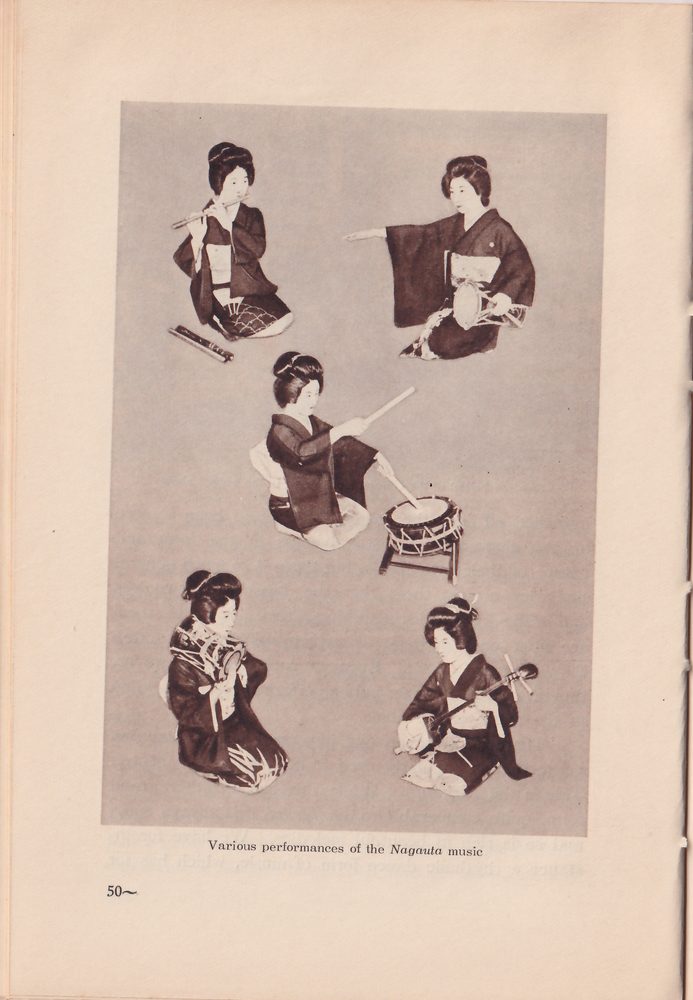
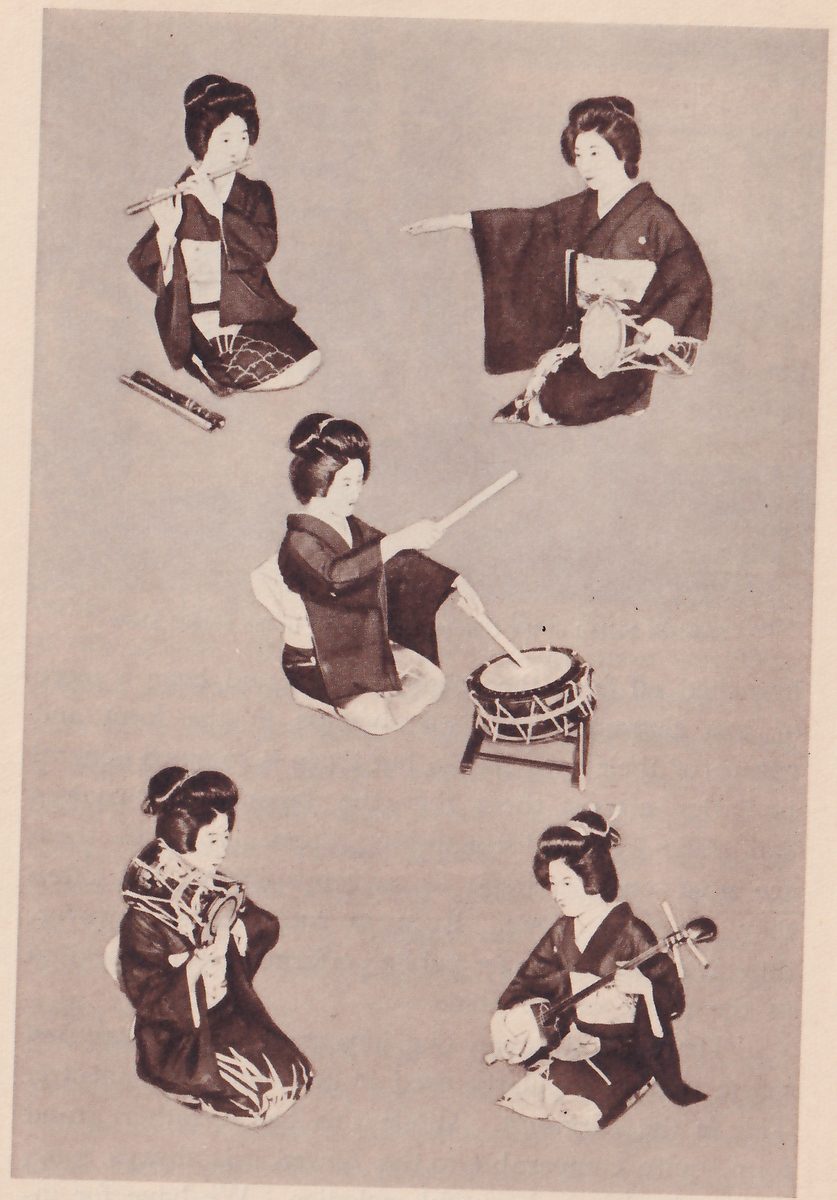
accompaniment what is known as hayashi, consisting of four kinds of percussion instruments, like the Noh, in addition to the samisen. Beside the flute, the number of drums may be increased, and the variety of instrumental arrangement goes far beyond that of the Noh. As for the flute, one in addition to the usual Noh flute is used. This is called the shino flute. This carries the obbligato part, giving the main rhythm. In the hayashi there is a considerable variety of instruments beside these, but not seen on the stage, and designed to imitate various natural sounds, producing such effects as a temple bell in the evening, festival excitement, the sound of the wind, of the waves, of the rain, and other similar sounds for the accompaniment of the play. These effects are not often required in the Nagauta, but are always used in the music of the stage.
The Nagauta is one of the forms of music that are endeavouring to survive the changes of the present day, by so revising their form as to keep their place as the music of the home. It is devising a new method of teaching, and trying to find its place as the music of the people. It is a question of considerable interest whether the samisen music which has become so widely popular in our day may be able to preserve its popularity in the next generation. Such a problem is difficult of solution so long as the samisen music contains elements which do not seem conformable to the modern musical taste.
The three strings of the samisen may be tuned in various ways, but among these the most common are as follows:
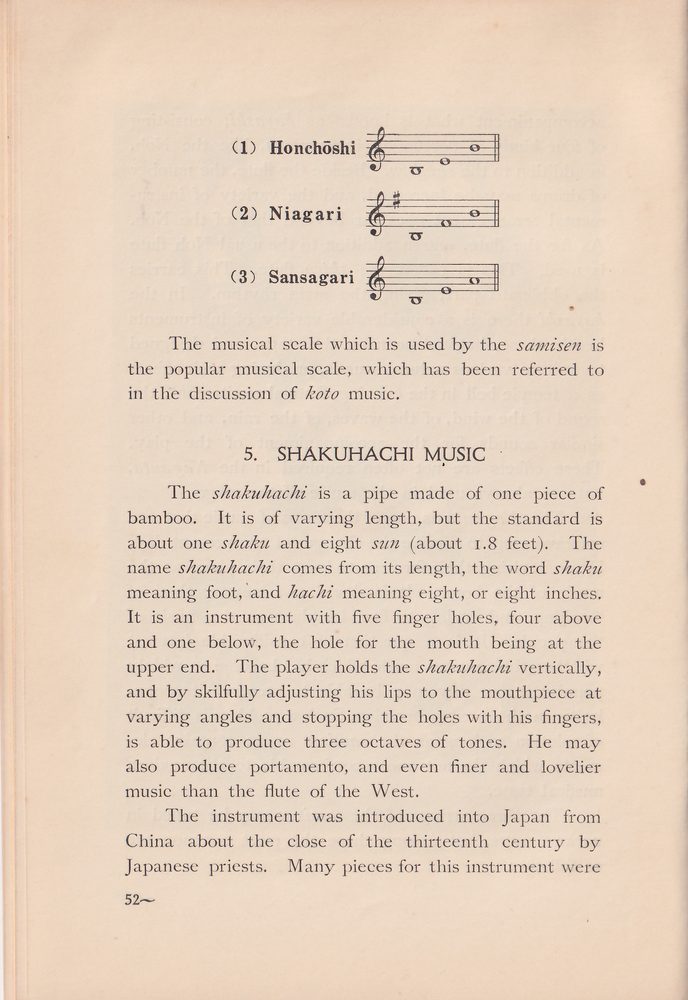
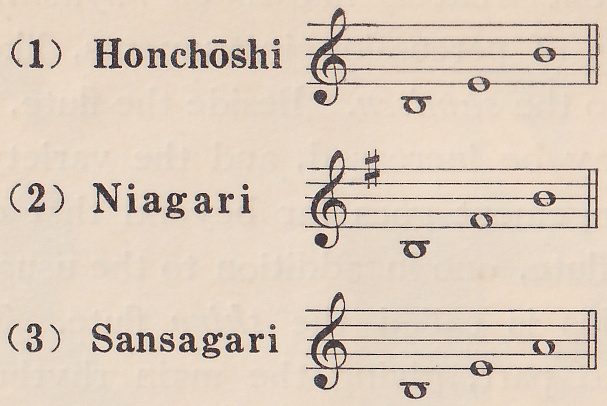
The musical scale which is used by the samisen is the popular musical scale, which has been referred to in the discussion of koto music.
5. SHAKUHACHI MUSIC
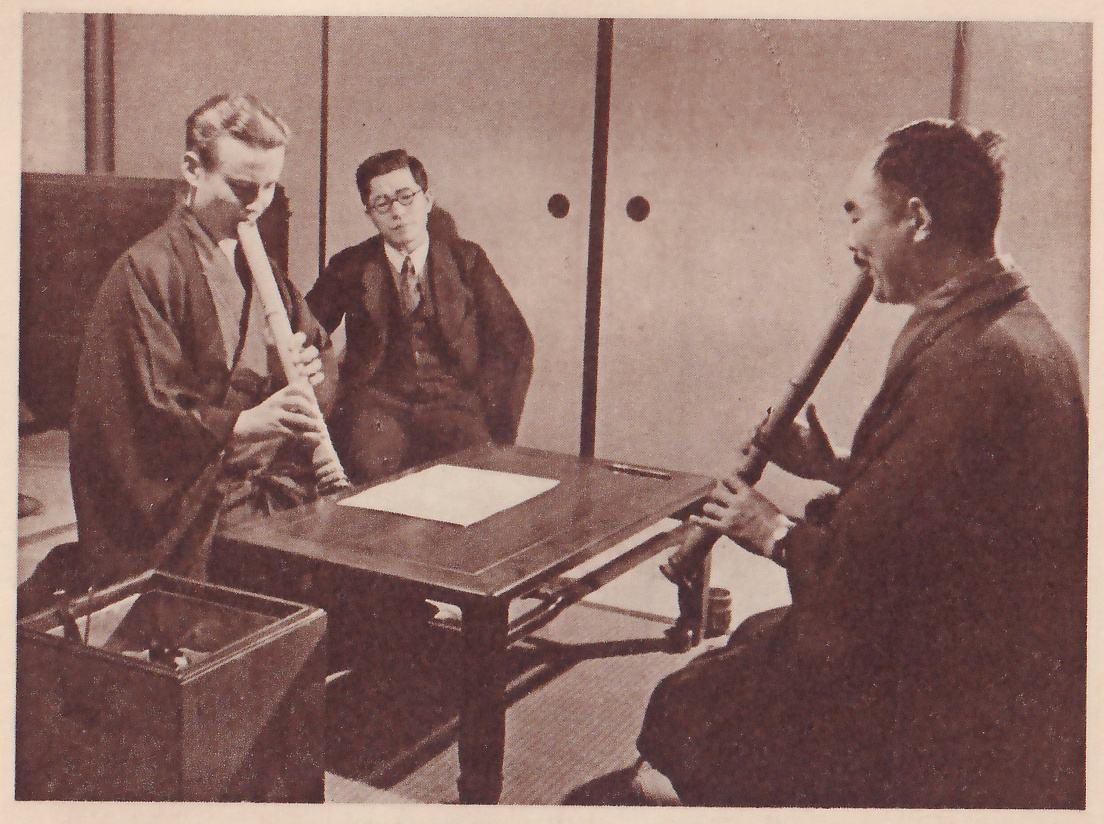
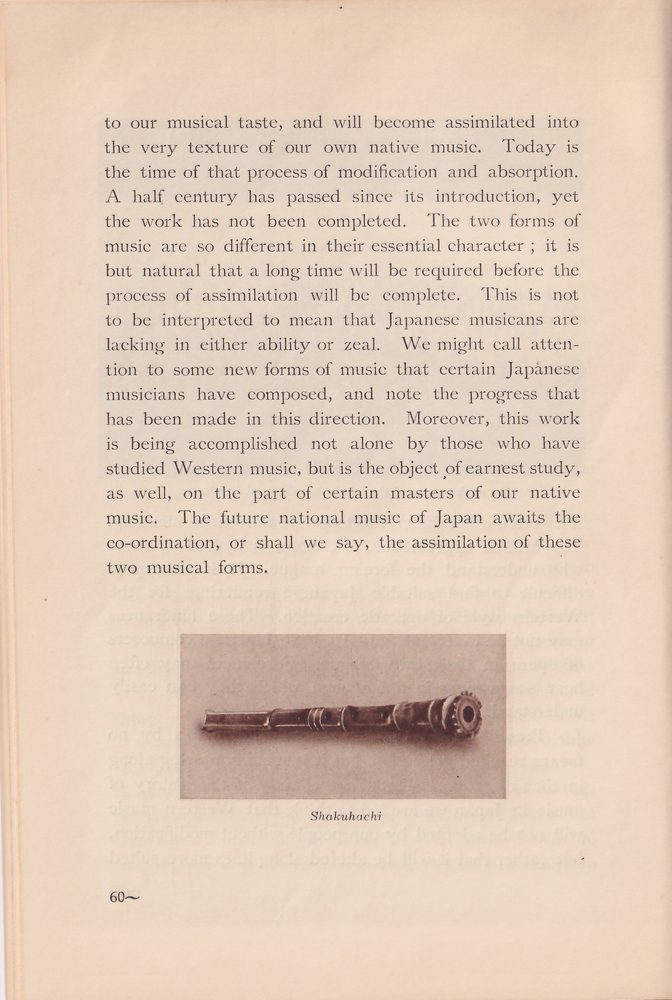
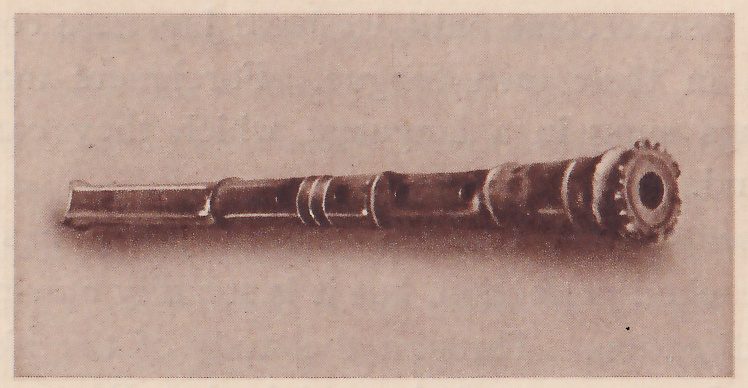
The shakuhachi is a pipe made of one piece of bamboo. It is of varying length, but the standard is about one shaku and eight sun (about 1.8 feet). The name shakuhachi comes from its length, the word shaku meaning foot, and hachi meaning eight, or eight inches. It is an instrument with five finger holes, four above and one below, the hole for the mouth being at the upper end. The player holds the shakuhachi vertically, and by skilfully adjusting his lips to the mouthpiece at varying angles and stopping the holes with his fingers, is able to produce three octaves of tones. He may also produce portamento, and even finer and lovelier music than the flute of the West.
The instrument was introduced into Japan from China about the close of the thirteenth century by Japanese priests. Many pieces for this instrument were
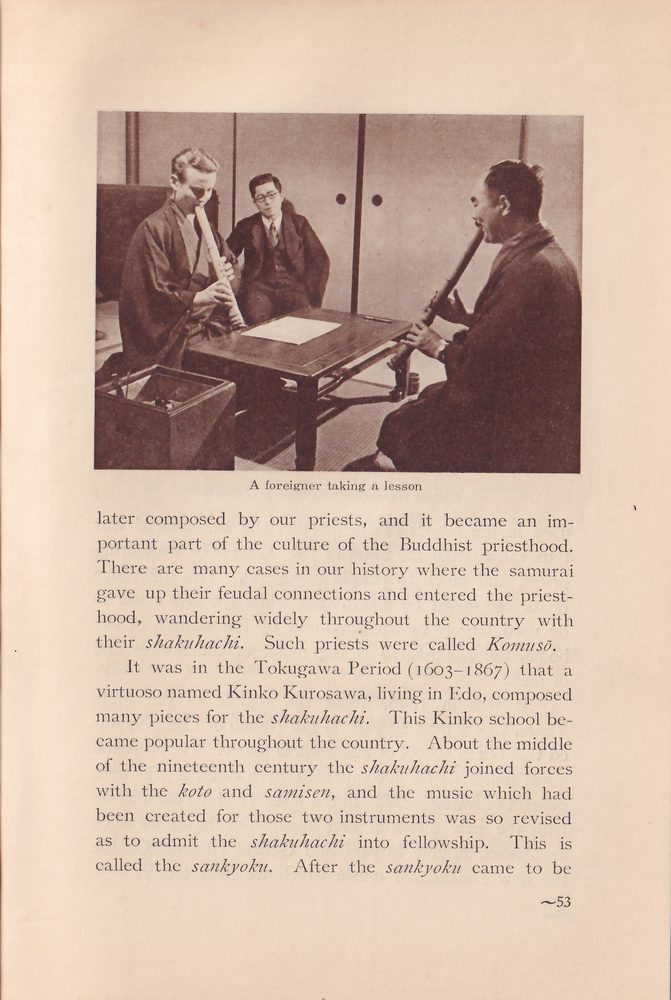
later composed by our priests, and it became an important part of the culture of the Buddhist priesthood. There are many cases in our history where the samurai gave up their feudal connections and entered the priesthood, wandering widely throughout the country with their shakuhachi. Such priests were called Komusō.
It was in the Tokugawa Period (1603–1867) that a virtuoso named Kinko Kurosawa, living in Edo, composed many pieces for the shakuhachi. This Kinko school became popular throughout the country. About the middle of the nineteenth century the shakuhachi joined forces with the koto and samisen, and the music which had been created for those two instruments was so revised as to admit the shakuhachi into fellowship. This is called the sankyoku. After the sankyoku came to be
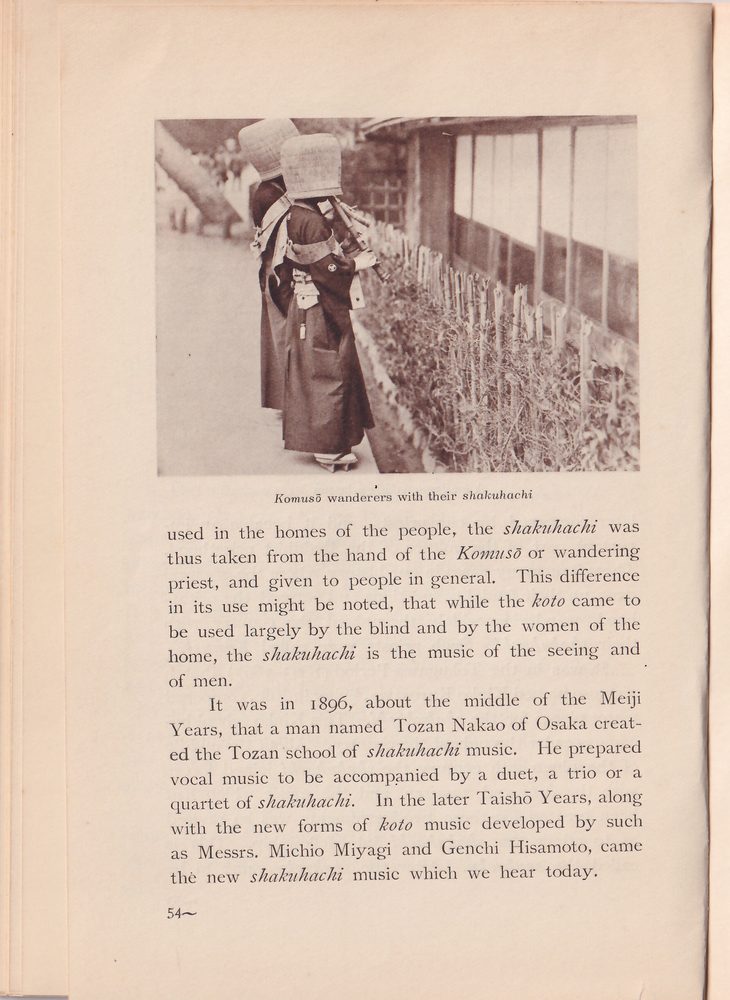
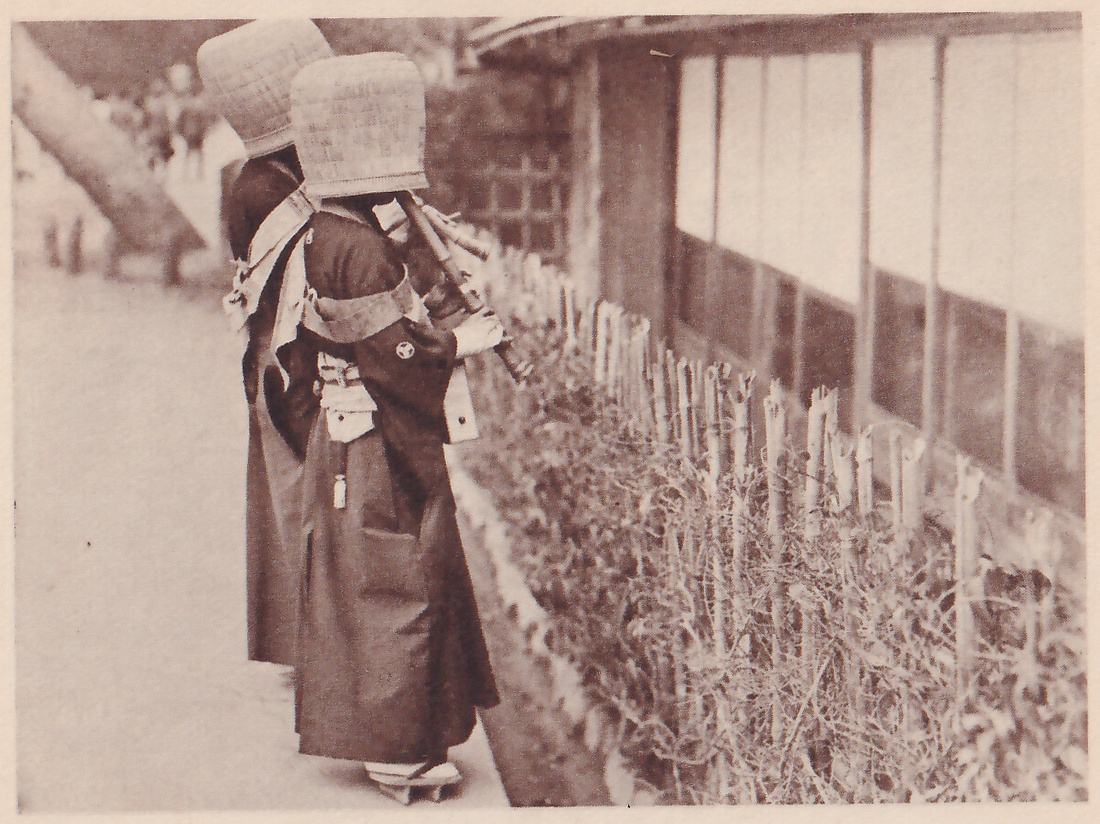
used in the homes of the people, the shakuhachi was thus taken from the hand of the Komusō or wandering priest, and given to people in general. This difference in its use might be noted, that while the koto came to be used largely by the blind and by the women of the home, the shakuhachi is the music of the seeing and of men.
It was in 1896, about the middle of the Meiji Years, that a man named Tozan Nakao of Osaka created the Tozan school of shakuhachi music. He prepared vocal music to be accompanied by a duet, a trio or a quartet of shakuhachi. In the later Taishō Years, along with the new forms of koto music developed by such as Messrs. Michio Miyagi and Genchi Hisamoto, came the new shakuhachi music which we hear today.
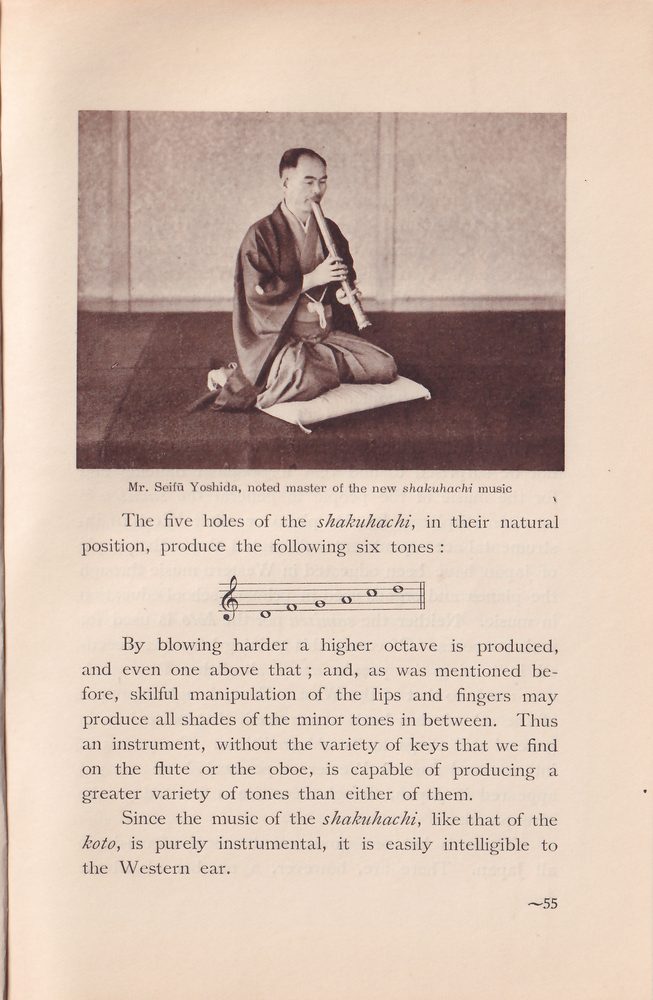
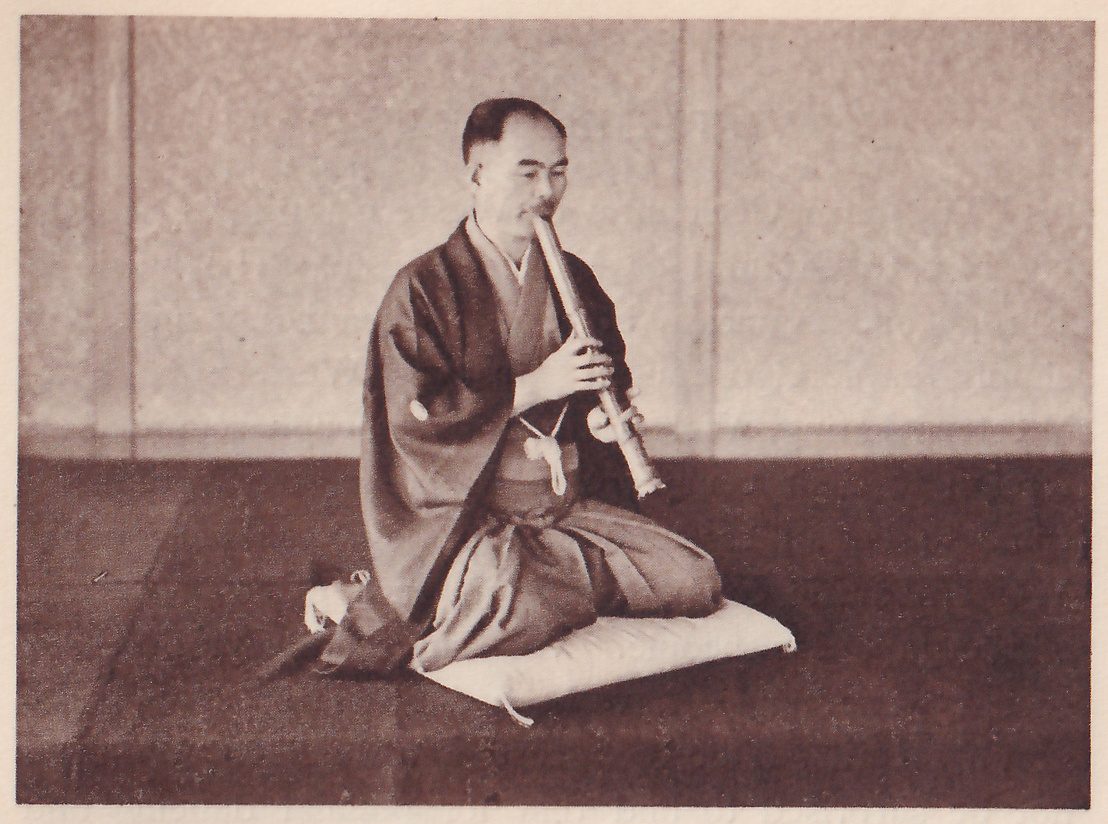
The five holes of the shakuhachi, in their natural position, produce the following six tones:
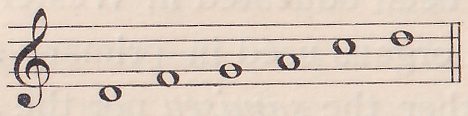
By blowing harder a higher octave is produced, and even one above that; and, as was mentioned before, skilful manipulation of the lips and fingers may produce all shades of the minor tones in between. Thus an instrument, without the variety of keys that we find on the flute or the oboe, is capable of producing a greater variety of tones than either of them.
Since the music of the shakuhachi, like that of the koto, is purely instrumental, it is easily intelligible to the Western ear.
6. WESTERN MUSIC IN JAPAN
The term Occidental or Western music is used in contrast to Oriental or Eastern music. The music of Europe and America, however, is commonly spoken of simply as foreign music. Just as Western clothing, Western eating, Western housing, though regarded as foreign to their counterparts in Japan, have gradually come to be an essential part of Japanese life, so has Western music come to take its sure place in the life of the Japanese people. We can readily realize how such types of music have been diffused through phonograph records, radio broadcasts and the like. We need not be surprised to find that for popular dancing and for the music of the people in general the samisen is so often displaced by the piano or other Western instrumental accompaniment. As stated above, the people of Japan have been educated in Western music through the pianos and organs used in primary school education in music. Neither the samisen nor the koto is used for such purposes. Of course this training has not succeeded in turning the people away altogether from their own music to that of the West. Even though the music of the schools has been westernized, that of society in general still clings to its old traditions. Composers of international fame in Western-type music have not yet appeared in Japan, though there are a few today who give promise.
There is but one government school of music in all Japan. There are, however, a number of private
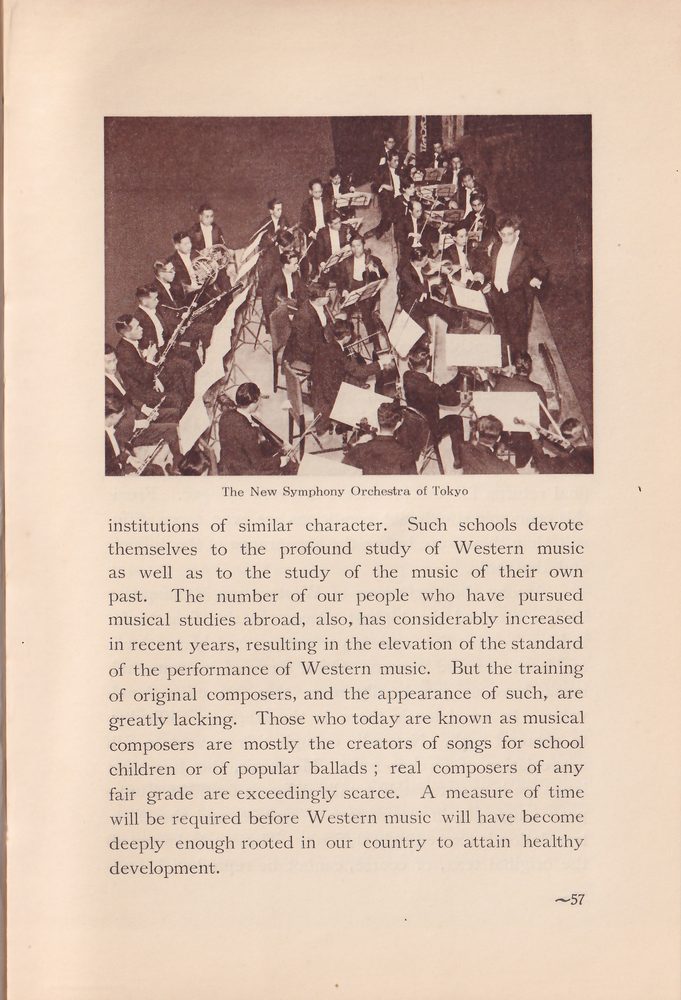
institutions of similar character. Such schools devote themselves to the profound study of Western music as well as to the study of the music of their own past. The number of our people who have pursued musical studies abroad, also, has considerably increased in recent years, resulting in the elevation of the standard of the performance of Western music. But the training of original composers, and the appearance of such, are greatly lacking. Those who today are known as musical composers are mostly the creators of songs for school children or of popular ballads; real composers of any fair grade are exceedingly scarce. A measure of time will be required before Western music will have become deeply enough rooted in our country to attain healthy development.
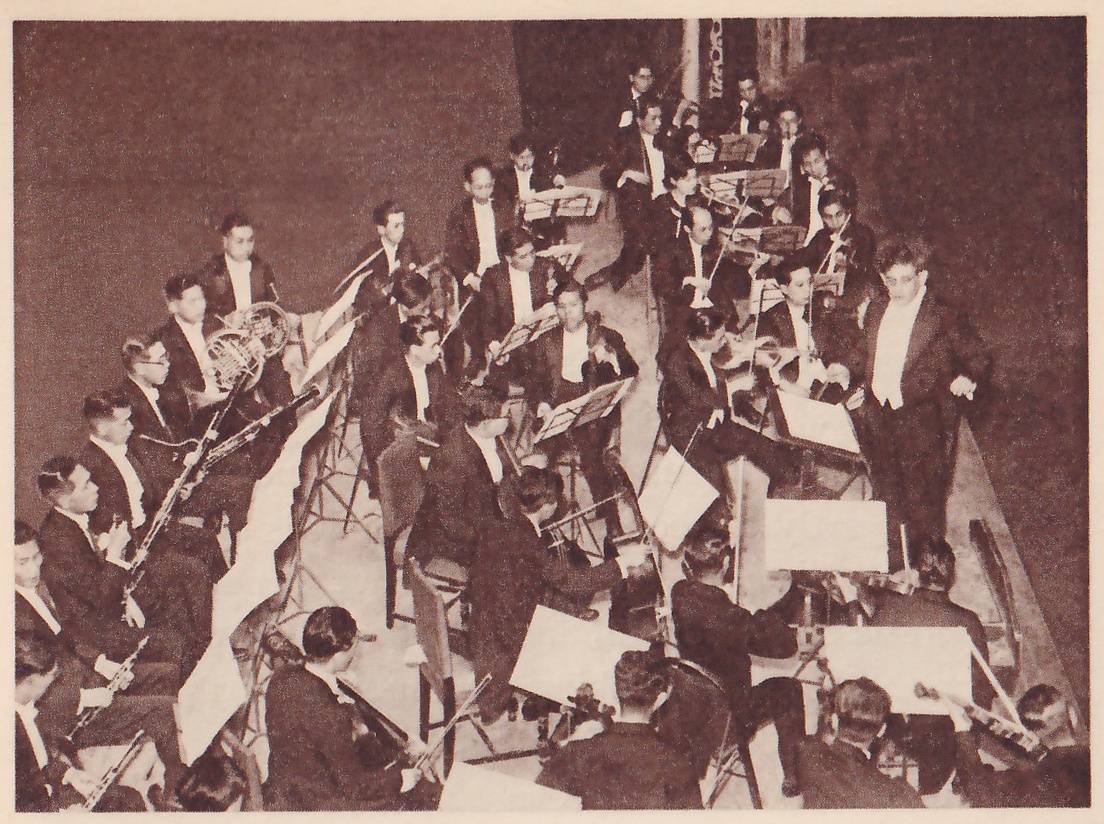
Both Tokyo and Osaka have their symphony orchestras. The New Symphony Orchestra of Tokyo, formerly conducted by Mr. Hidemaro Konoe, and patronized by the JOAK broadcasting station, is a representative Japanese orchestra. Whenever famous Western musicians come to Japan they are invited to take part in its performances. Japan is yet to have her first real Opera House. This is due partly to the fact that the popular taste in Japan for the opera has not yet developed, and partly to economic reasons. It is to be noted, however, that many of our artists have appeared upon the operatic stage abroad, and are eagerly awaiting its creation here, some making strenuous efforts in that direction. In all large cities, like Tokyo, nightly concerts are given during the concert season. But even here the final returns for the producers are very meagre. From this economic standpoint conditions are even more difficult than they were before the appearance of the talkies and the radio.
Among the performers of Western music the pianist has attained the highest place. In this field there is keen competition among performers, mostly youthful, and both men and women. Other forms of instrumental music have as yet hardly more than an educational value. In vocal music there is the language difficulty to contend with. Naturally enough, this prevents a full appreciation of foreign song. Moreover, the Japanese language is unfortunately totally different from the European languages in the matter of syntax, and therefore translation is exceedingly difficult. The musical form of the original text, of course, cannot be reproduced, and
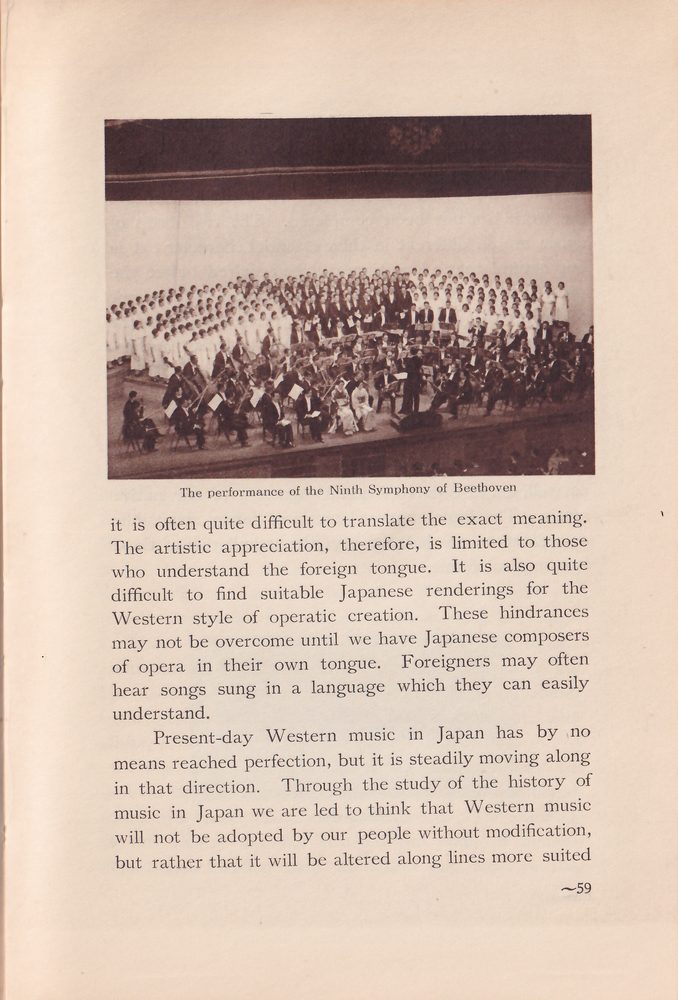
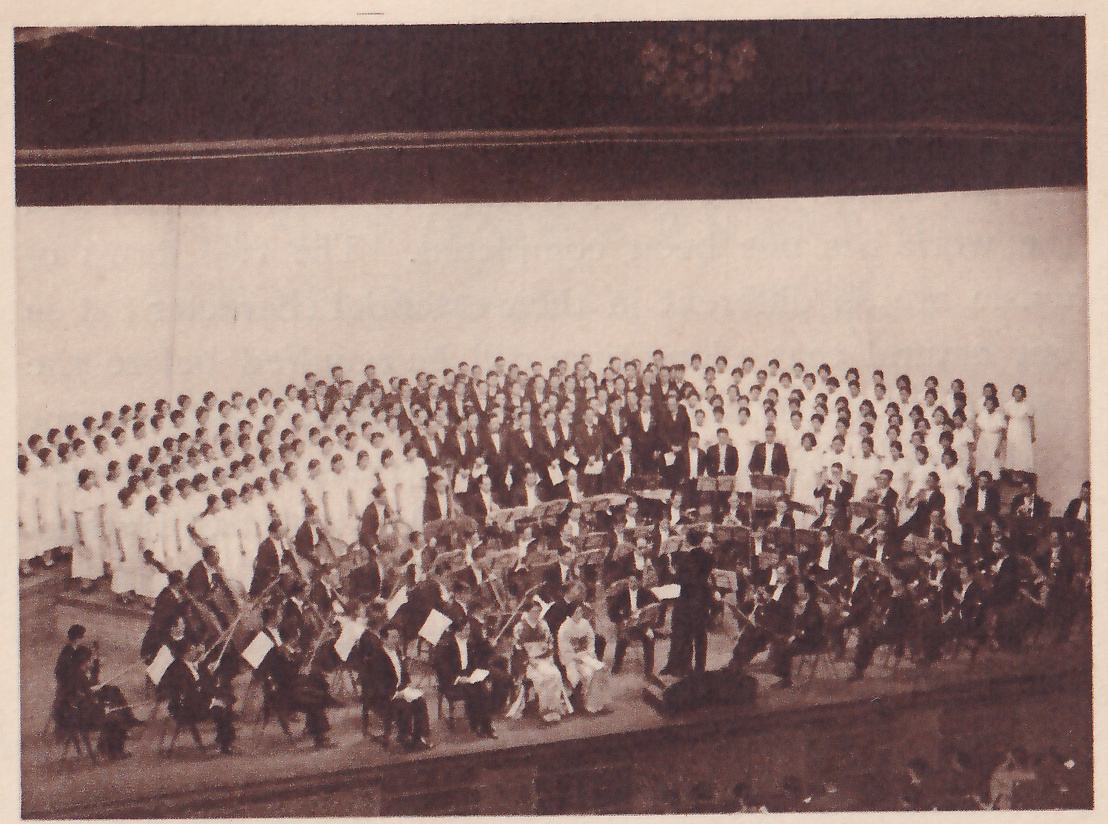
it is often quite difficult to translate the exact meaning. The artistic appreciation, therefore, is limited to those who understand the foreign tongue. It is also quite difficult to find suitable Japanese renderings for the Western style of operatic creation. These hindrances may not be overcome until we have Japanese composers of opera in their own tongue. Foreigners may often hear songs sung in a language which they can easily understand.
Present-day Western music in Japan has by no means reached perfection, but it is steadily moving along in that direction. Through the study of the history of music in Japan we are led to think that Western music will not be adopted by our people without modification, but rather that it will be altered along lines more suited
to our musical taste, and will become assimilated into the very texture of our own native music. Today is the time of that process of modification and absorption. A half century has passed since its introduction, yet the work has not been completed. The two forms of music are so different in their essential character; it is but natural that a long time will be required before the process of assimilation will be complete. This is not to be interpreted to mean that Japanese musiciansPrinted: musicans are lacking in either ability or zeal. We might call attention to some new forms of music that certain Japanese musicians have composed, and note the progress that has been made in this direction. Moreover, this work is being accomplished not alone by those who have studied Western music, but is the object of earnest study, as well, on the part of certain masters of our native music. The future national music of Japan awaits the co-ordination, or shall we say, the assimilation of these two musical forms.