
Japanese Music
Tourist Library 15
Japanese Music
by Katsumi Sunaga
Tourist Library 15
Board of Tourist Industry, Japanese Government Railways, 1936
TOURIST LIBRARY
Volumes already published
1. TEA CULT OF JAPAN By Y. Fukukita, A. B.
2. JAPANESE NOH PLAYS By Prof. T. Nogami
3. SAKURA (Japanese Cherry) By M. Miyoshi, D. Sc.
4. JAPANESE GARDENS By Prof. M. Tatsui
5. HIROSHIGE AND JAPANESE LANDSCAPES By Prof. Yone Noguchi
6. JAPANESE DRAMA By B. T. I.
7. JAPANESE ARCHITECTURE By Prof. H. Kishida, D. Sc.
8. WHAT IS SHINTŌ? By Prof. G. Katō, D. Litt.
9. CASTLES IN JAPAN By Prof. S. Ōrui D. Litt. and Prof. M. Toba.
10. HOT SPRINGS IN JAPAN By Prof. K. Fujinami, M. D.
11. FLORAL ART OF JAPAN By Issōtei Nishikawa
12. CHILDREN’S DAYS IN JAPAN By T. Iwadō, M. A.
13. KIMONO (Japanese Dress) By Kenichi Kawakatsu
14. JAPANESE FOOD By Prof. Kaneko Tezuka
15. JAPANESE MUSIC By Katsumi Sunaga
Volumes in preparation
WHAT IS JŪDŌ? By Dr. Jigorō Kanō
BUDDHISM IN JAPAN By Prof. K. Yabuki, D. Litt.
JAPANESE LANDSCAPES By T. Tamura, D. Sc.
FLORAL CALENDAR IN JAPAN By T. Makino, D. Sc. and Genjirō Oka
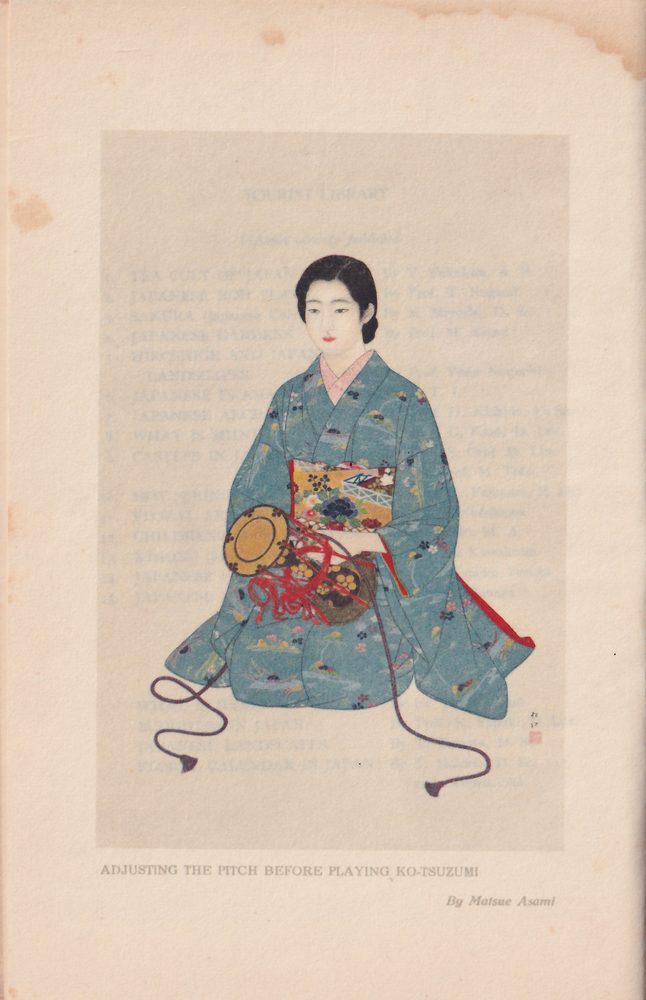
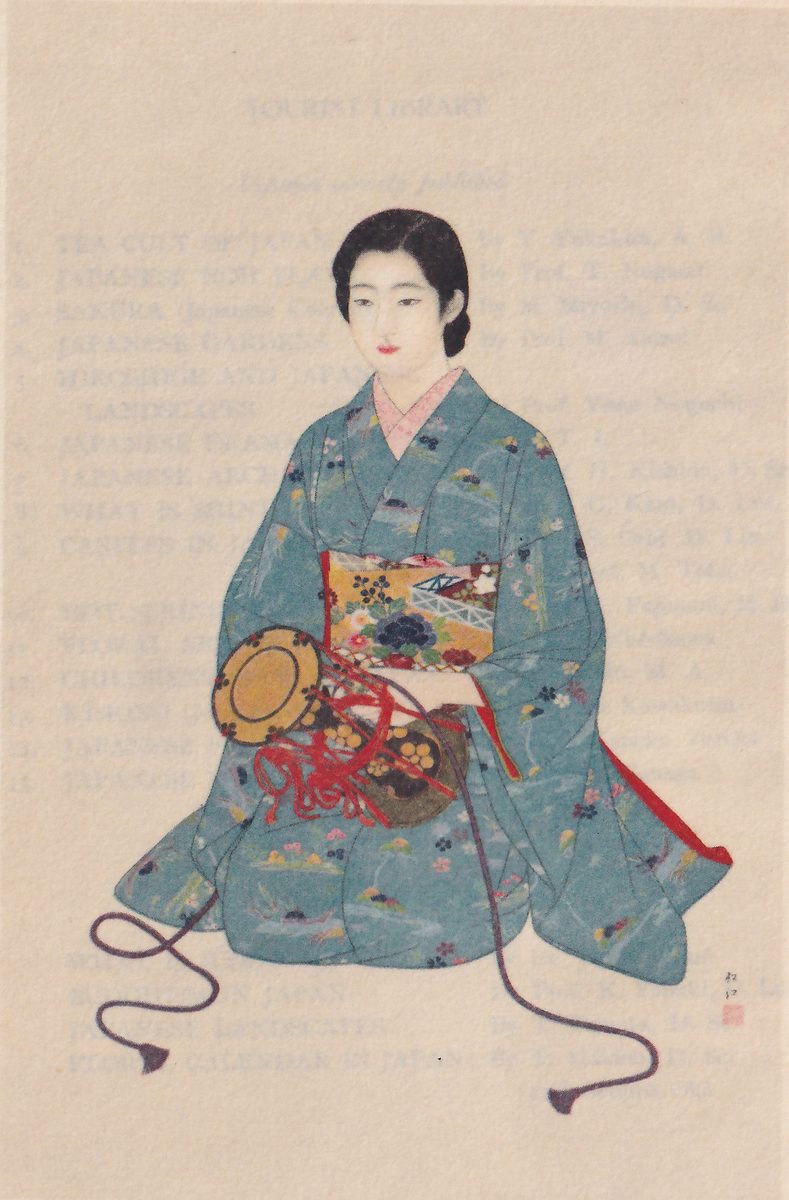
By Matsue Asami
JAPANESE MUSIC
BY
KATSUMI SUNAGA
BOARD OF TOURIST INDUSTRY
JAPANESE GOVERNMENT RAILWAYS
COPYRIGHT 1936
It is a common desire among tourists to learn something of the culture of the countries they visit, as well as to see their beautiful scenery. To see is naturally easier than to learn, but flying visits merely for sightseeing furnish neither the time nor opportunity for more than a passing acquaintance with the culture of any foreign people. This is specially true of Japan and her people.
The Board of Tourist Industry recognizes both the obligation and the difficulty of providing foreign tourists with accurate information regarding the various phases of Japan’s culture. It is therefore endeavouring to meet this obligation, as far as possible, by publishing this series of brochures.
The present series will, when completed, consist of more than a hundred volumes, each dealing with a different subject, but all co-ordinated. By studying the entire series, the foreign student of Japan will gain an adequate knowledge of the unique culture that has evolved in this country through the ages.
For those who wish to follow up these studies with a closer investigation of more erudite works, we append bibliographies, which we can recommend as authoritative guides for study.
Board of Tourist Industry,
Japanese Government Railways
The manuscript of this brochure was prepared in the spring of 1935 by Katsumi Sunaga, to take its place in the present series. Later, at the suggestion of the editors, two or three additions were agreed to by him, but as he was planning to make certain emendations, he suddenly died in September of the same year.
Before the end came, this matter was often in his thoughts, and he was very anxious to bring the work to its completion. Because of his severe illness, however, he found himself unable to do so.
After his death his family undertook to carry out his last wish, and therefore requested his teacher, Mr. Hisao Tanabe, lecturer at the Tokyo Imperial University, to complete the manuscript. This he was kind enough to do.
On the publication of this brief study this simple reference is made, with profound respect, to the deceased author.
The translation into English has been made by Professors I. Matsuhara and E. T. Iglehart, of Aoyama Gakuin.
Board of Tourist Industry
September, 1936
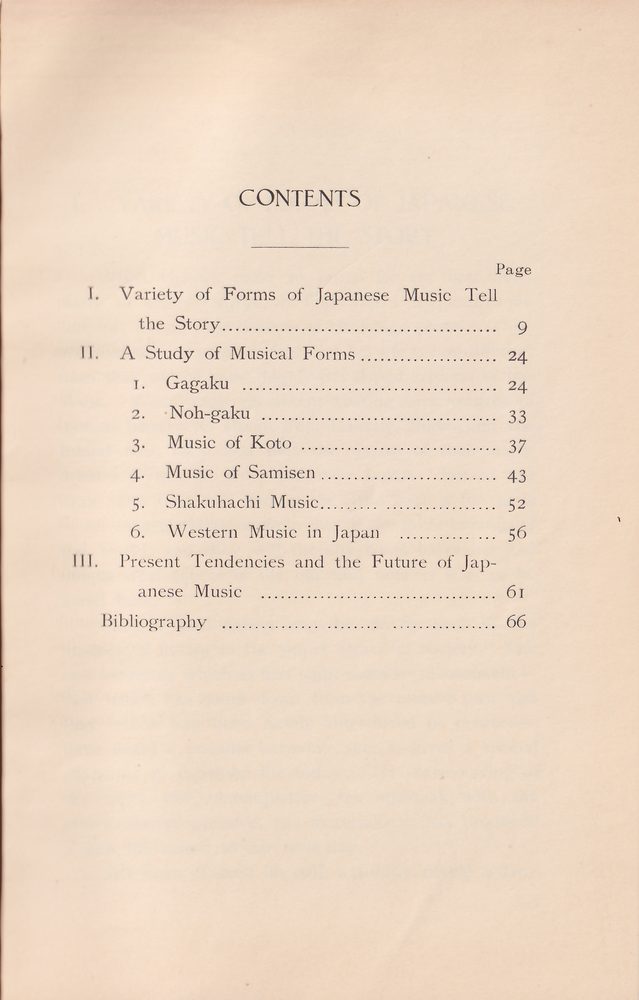
CONTENTS
Page
I. Variety of Forms of Japanese Music Tell the Story............................................ 9
II. A Study of Musical Forms ..................... 24
1. Gagaku ....................................... 24
2. Noh-gaku .................................... 33
3. Music of Koto .............................. 37
4. Music of Samisen ........................... 43
5. Shakuhachi Music........................... 52
6. Western Music in Japan ............... 56
III. Present Tendencies and the Future of Japanese Music ........ 61
Bibliography ............................. 66