
I. VARIETY OF FORMS OF JAPANESE MUSIC TELL THE STORY
When visitors come to Japan for the first time, many of them expect to find Japan a picturesque country, a real reproduction of Hiroshige prints. They are, therefore, amazed to find that her life is not different from that of the most highly-developed nations of the West. When they go about, visiting such centres of natural beauty as Mount Fuji, Hakone, Nikko, and the Inland Sea, they find that the Japan of their early dreams is not far from the true Japan. But at the same time they will find in the cities such a life as is in no respect different from that of the great capitals of the world, and they will thereby come to realize the unique dual aspect of the old and new as it is to be found here.
Such a dual aspect may be clearly seen in the manner of living, in the upper strata of society. The two elements which at first sight seem so inconsistent—that which has come down from the remote past and that which has been newly introduced or created—have found a peculiar harmony, such as gives a special character to Japanese life today. This harmonizing of the quiet, the contemplative, the spiritual, with the active, the progressive, the materialistic, has produced a new life suited to our new day.
Art born of such life will naturally reveal a two-
fold nature. Music, the subject of the present study, clearly shows its dual nature. The native music of the past may be found side by side with Western music, quite recently introduced into our country. And these two, while exerting a mutual influence, at the same time preserve their own individual character and form.
Travellers sailing across the Western sea, as they approach Japan, are watching for the appearance of the summit of Mount Fuji above the clouds. But before it has appeared they have already received news through the ether from Japan’s broadcasting stations. And if they should turn on their radio they would hear an evening of music and drama. The foremost broadcasting station of Japan is JOAK of Tokyo, and a stranger would be surprised to learn of the extent
and variety of musical and other forms of entertainment that make up its programme. If he continued to listen in he would hear such instrumental and chamber music as he could readily appreciate, then perhaps a series of songs whose language was strange to him, perhaps a recitation accompanied by some simple instrument producing a tone colour that was altogether strange to him. The variety of this radio programme reflects the varied character of present-day Japanese music. And the various forms of Japanese music also tell their own history. It is well, therefore, to give some consideration to the history of our music if we are to understand it as it is today.
Even those who have been in Japan long enough to study its historic buildings and sculpture, much of them well preserved for twelve hundred years, are sometimes sceptical when told that we still have music of as great an age. Music is not such an object as can be preserved in museum or library like other works of art. Musical instruments and musical scores may be preserved, it is true, but it is exceedingly difficult to hand down the living music itself. However, the ceremonies of which this music is a part have come down through the ages, and are still performed today.
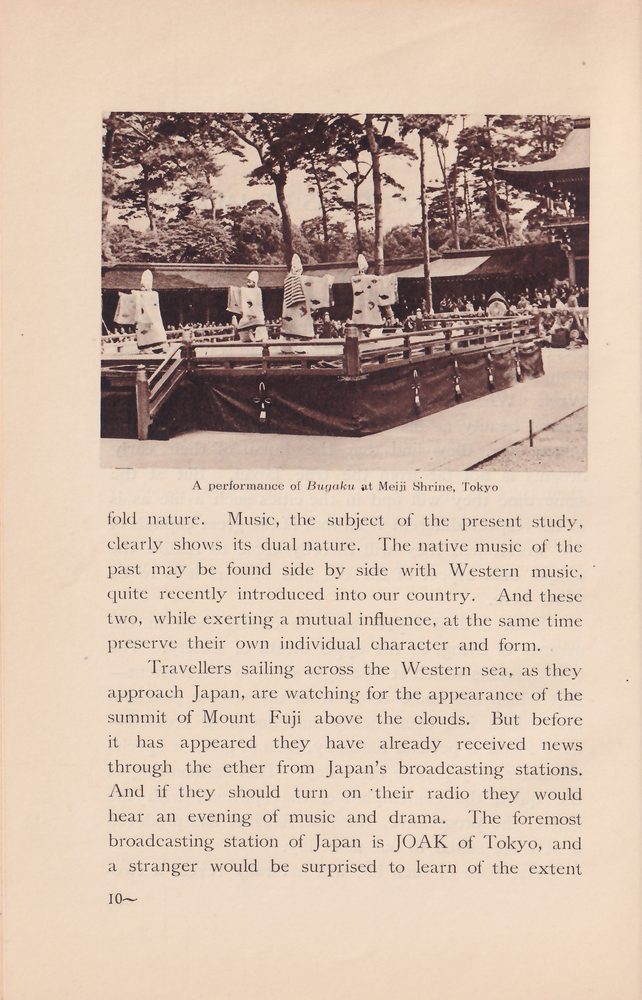
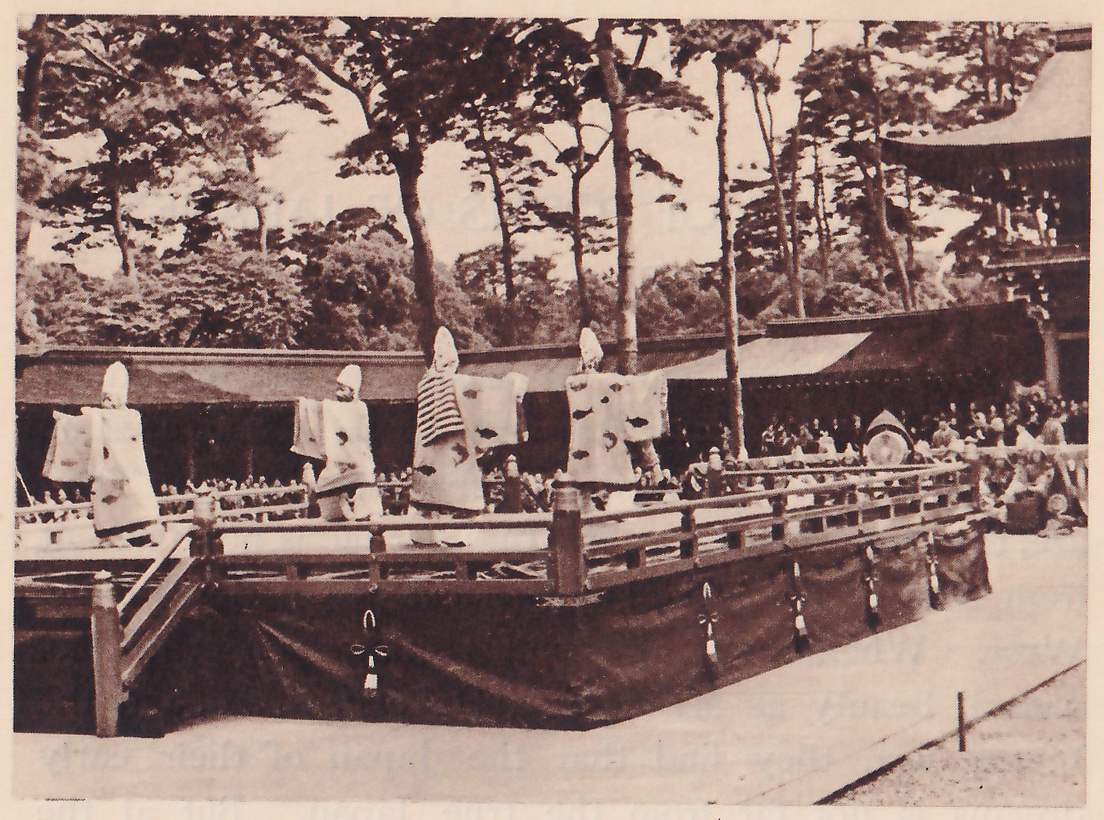
The oldest music of Japan has been protected and preserved by the Imperial Household, in one unbroken line through the ages. This music is known as Gagaku, or Graceful Music. In former days this music was played only within the Imperial Palace, but in recent times it has been performed in public on special occasions, so that people in general have been able to enjoy the music
that their ancestors have handed down to them. This music of the Court is of two kinds, that which has its definitely assigned part in the Imperial ceremonies, and that which serves to accompany the dance in the entertainments of the Imperial Household.
These ancient musical forms, as was true of most forms of ancient Japanese art, had their beginnings in China. Most of them were imported as the Court music of the Tang Dynasty. Although some modifications must have been made, it may be affirmed that they have truly preserved the idealistic music of the Orient, from the dim past. In China, the place of their birth, these forms of music long since ceased to exist. But in Japan, in which they were transplanted, they have persisted until today. It is not strange that to the people of China this should appear as a miracle.
The earliest importation of this music was about the year 453 A. D., when it came to Japan by way of Korea. By 700 A. D. its development had been completed. Later on, perhaps about the year 1000, the final adjustment was made, and there has been but little change until today, a truly remarkable chapter in the history of music. Certain families were appointed by the Imperial Court to conduct the musical ceremonies, and their duties were handed down from father to son through many generations. There were ten of these special families assigned to this service.
Just as the Christian church, at its beginning, had her ancient hymns, so the Buddhist sects of Japan also had their own music. And just as these sects themselves had been introduced from India by way of China, their
music also came in from the same source and by the same route. Thus it is not possible for us to declare with certainty how closely they resemble their Indian origin. The oldest form handed down was the so-called Bombai, or Indian Sacred Hymn, in a recitative form, sung in Sanskrit. Its nearest analogy is perhaps the Psalm-singing among Christians.
In addition to the Buddhistic music thus imported into Japan, musical forms were gradually created, and they were enriched as time went on. This was due to the fact that the priesthood of the thirteenth and fourteenth centuries represented the highest standard of the culture and scholarship of the age. As Buddhism split into various sects there came to be variations in its music, which persist to this day. As this music finds
its field of expression in Buddhistic ceremonies, tourists have but little opportunity to become acquainted with it. Gagaku, the Court music, had little influence upon the music of the common people. On the contrary, however, the music of Buddhism might fitly be termed the mother of the music of the common people.
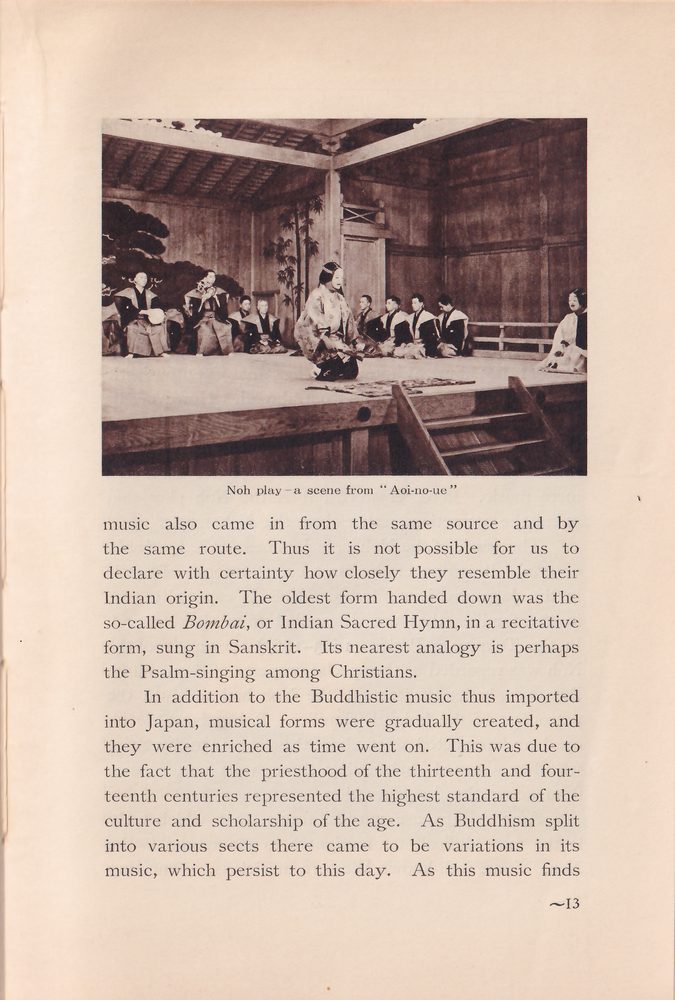
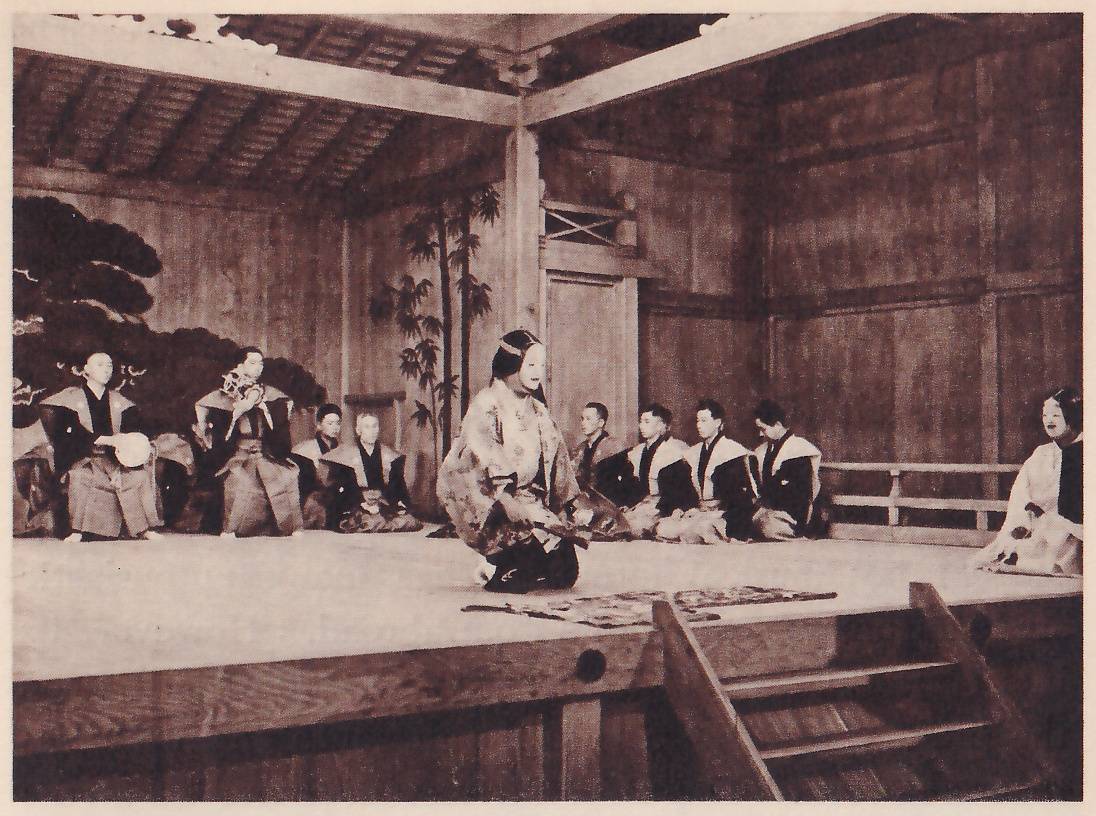
What may be regarded as the direct offspring of the Gagaku was the music of the Noh play, which arose at the close of the fourteenth century. This is the music which is of chief interest to foreigners among present-day musical forms. It has many enthusiastic students among our guests from abroad. However, its interest lies largely in the song or recitation based upon the literary text, as also in the masques and costumes that are worn. The chief interest does not lie in the mere music. In other words, it is the Noh play that offers the attraction, rather than the Noh music.
The music of the Noh is, in Japanese, called yōkyoku or utai. It is one of the most common forms of music in the Japanese home today. This is especially true in the families that are descended from the samurai. In the Tokugawa Period (1603–1867) the music of the Noh was regarded as the special property of the samurai. But even in its earliest age the Noh had received the patronage of the knightly families. It has been developed and perfected since about the year 1450, by those who have earned their living through its performance from generation to generation.
Among Japanese musical forms, that which truly is the most difficult for foreigners to understand is the Noh. Some well-known Western musicians, witnessing
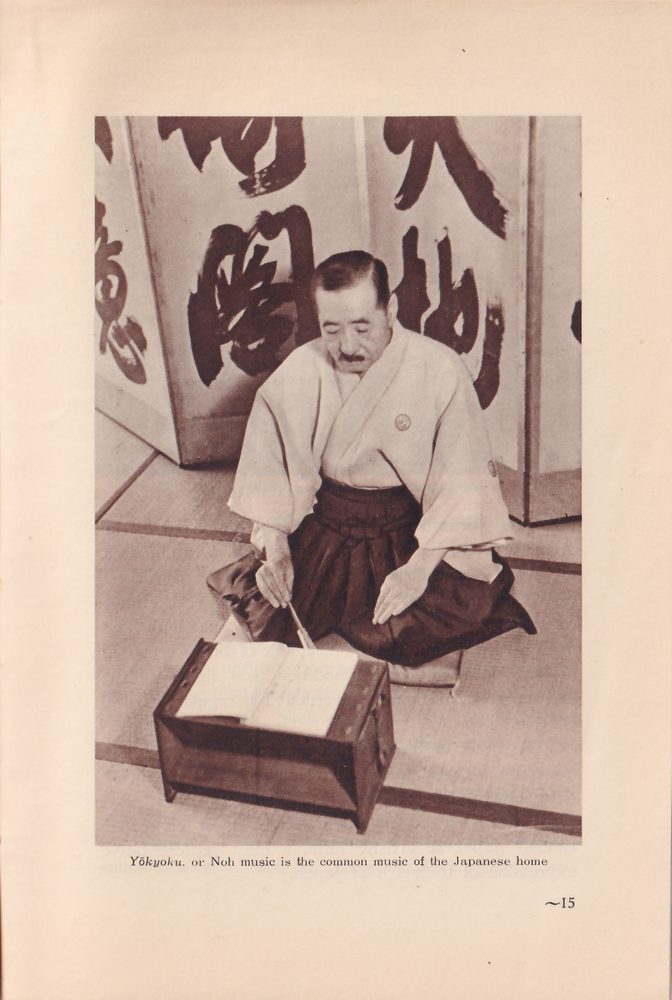
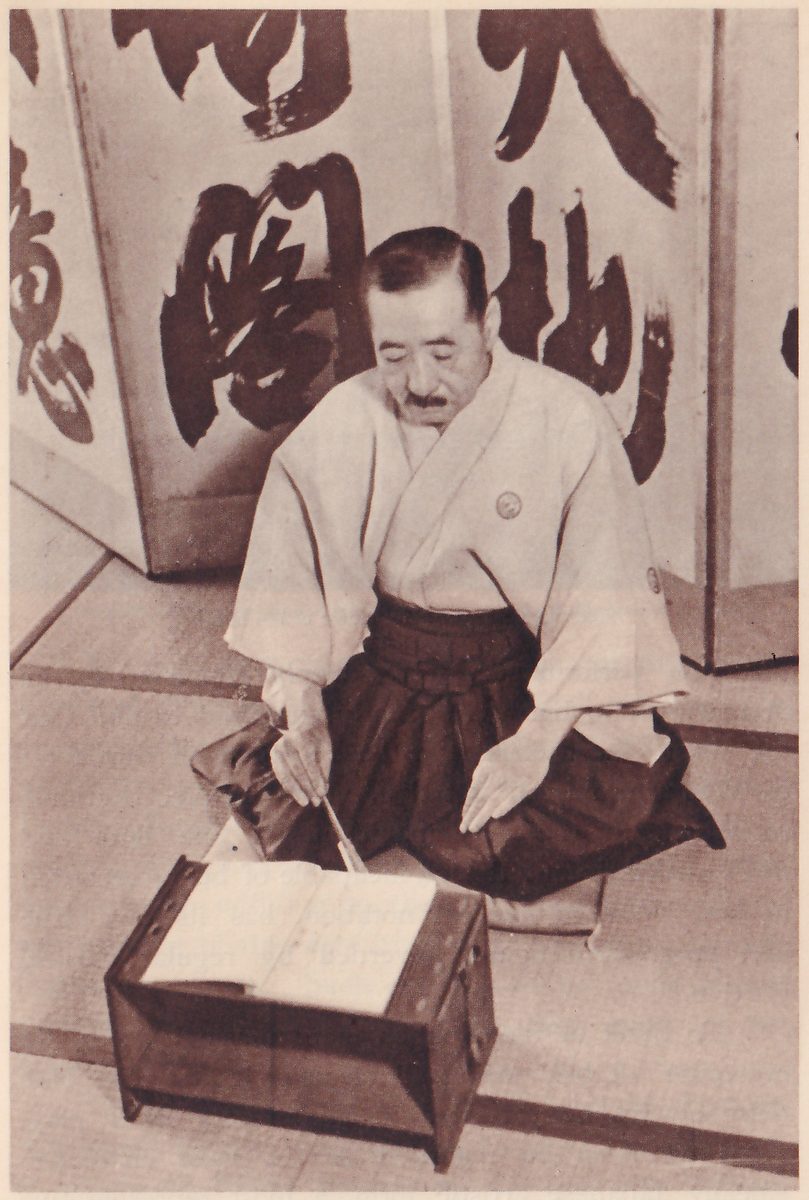
the Noh performance, were deeply impressed by its dramatic form, but were greatly surprised to find that the music itself could not be recorded in any form of Western musical notation. This simple, rhythmic recitation, to the accompaniment of one flute and three varied drums, though incapable of being recorded in any Western musical notation, has its own true and progressive figure, governed by regular musical rhythm.
To think of the Noh as mere music is to fail to recognize all but one small element in it. The Noh must always be regarded in its entirety as a play. And this must be regarded as the most characteristically Japanese artistic form, a most representative expression of the spirit of Japan.
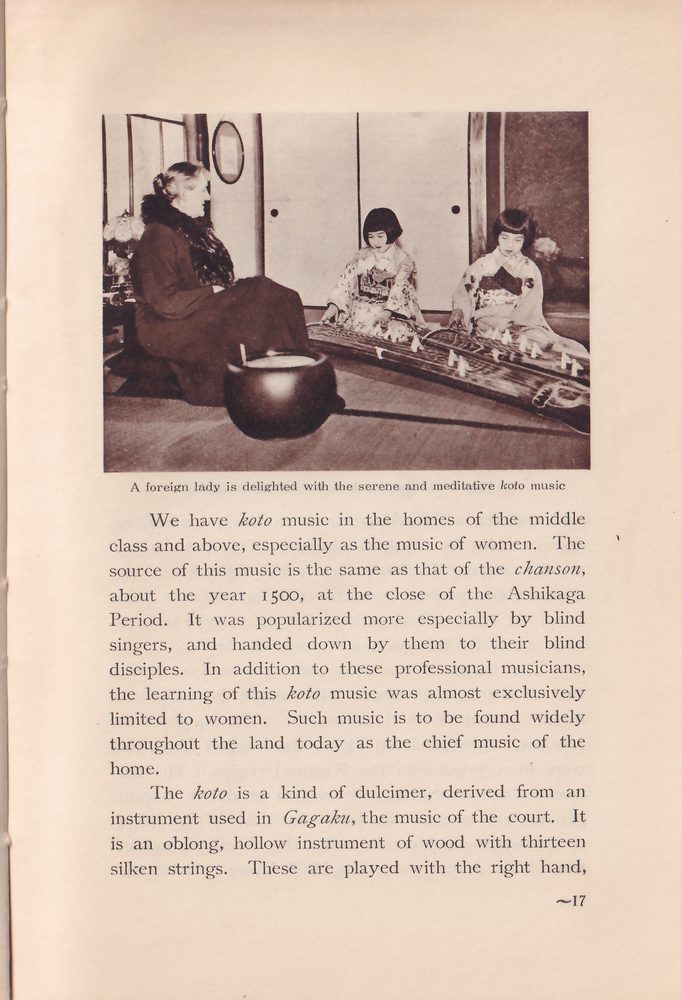
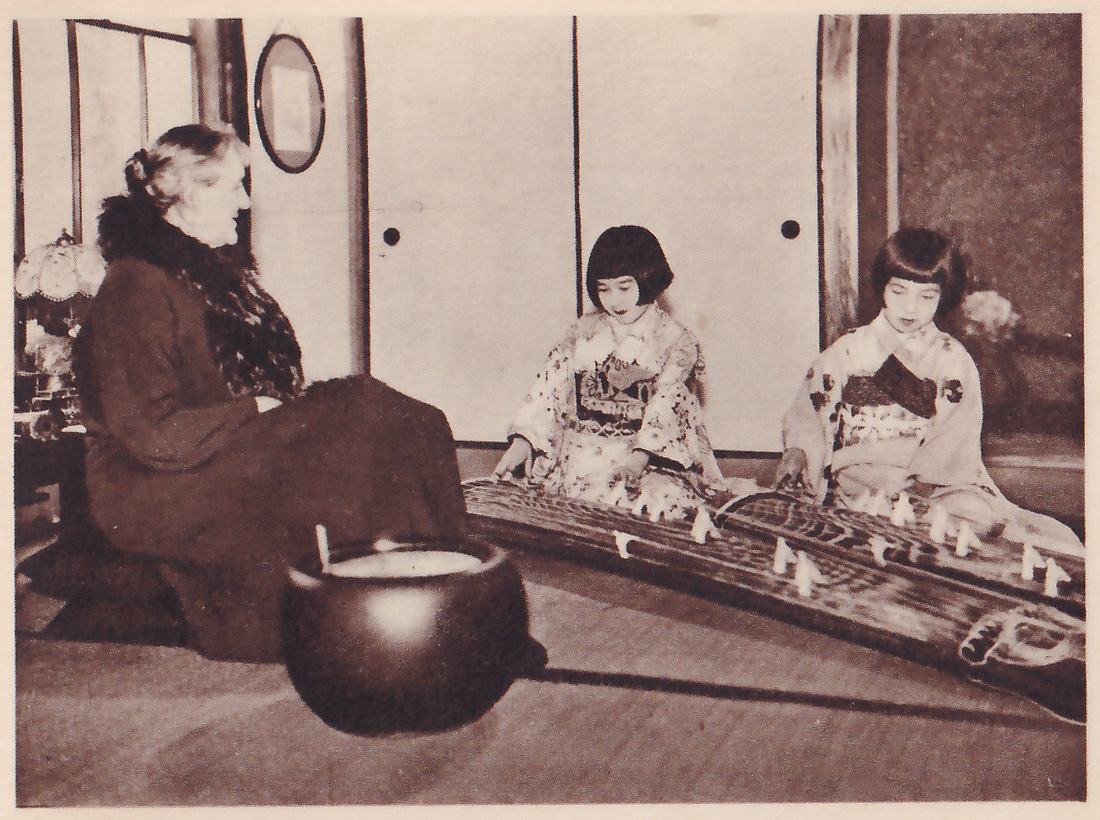
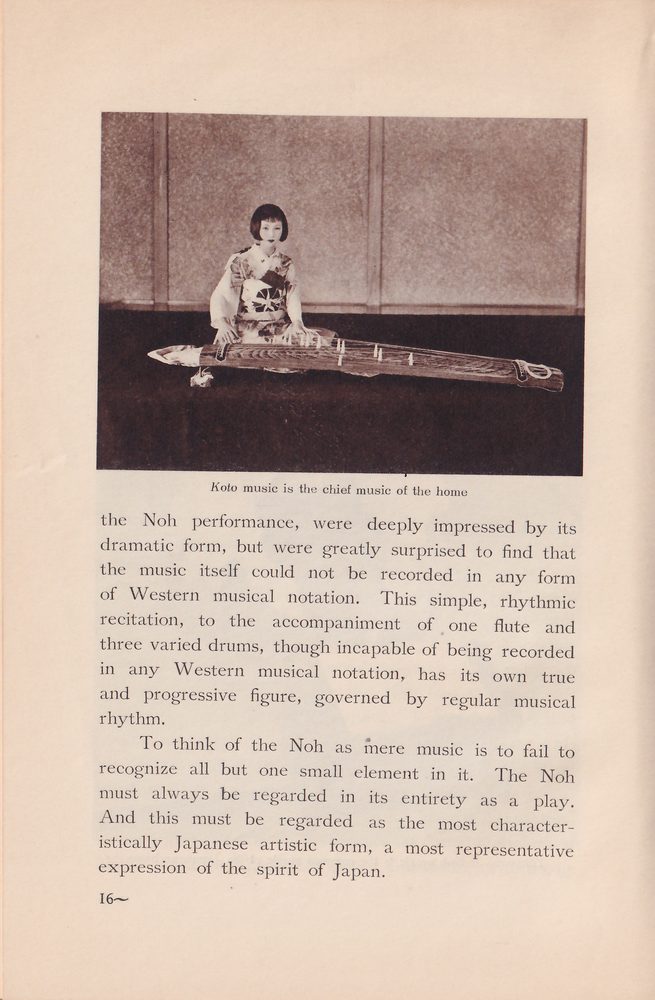
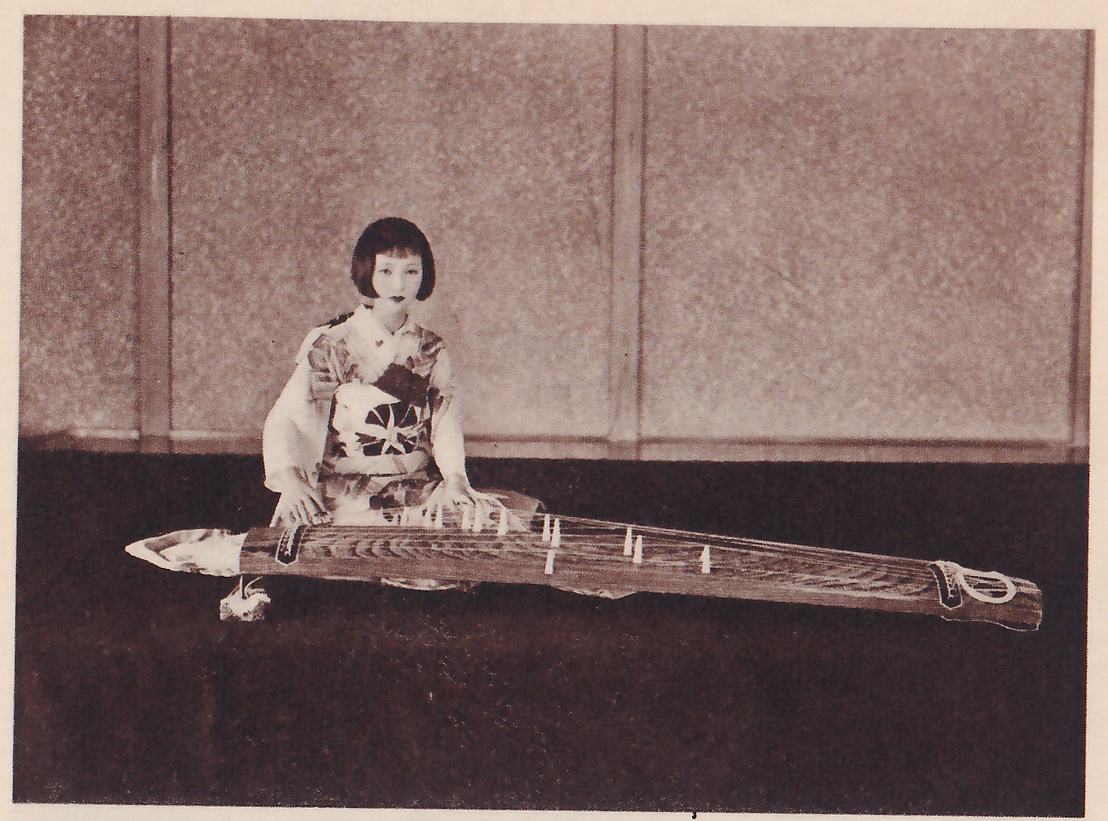
We have koto music in the homes of the middle class and above, especially as the music of women. The source of this music is the same as that of the chanson, about the year 1500, at the close of the Ashikaga Period. It was popularized more especially by blind singers, and handed down by them to their blind disciples. In addition to these professional musicians, the learning of this koto music was almost exclusively limited to women. Such music is to be found widely throughout the land today as the chief music of the home.
The koto is a kind of dulcimer, derived from an instrument used in Gagaku, the music of the court. It is an oblong, hollow instrument of wood with thirteen silken strings. These are played with the right hand,
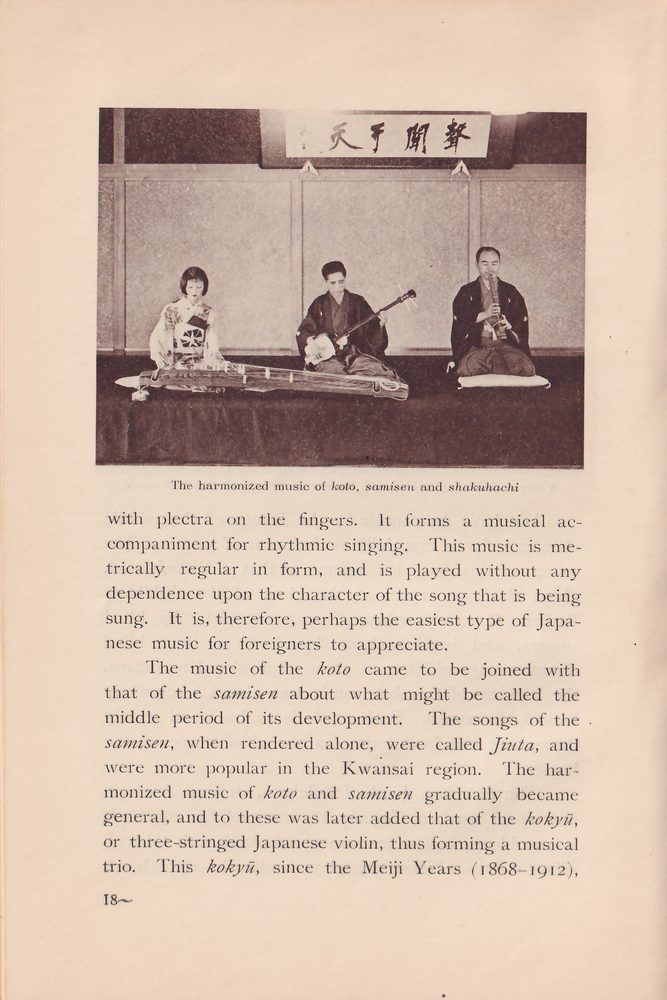
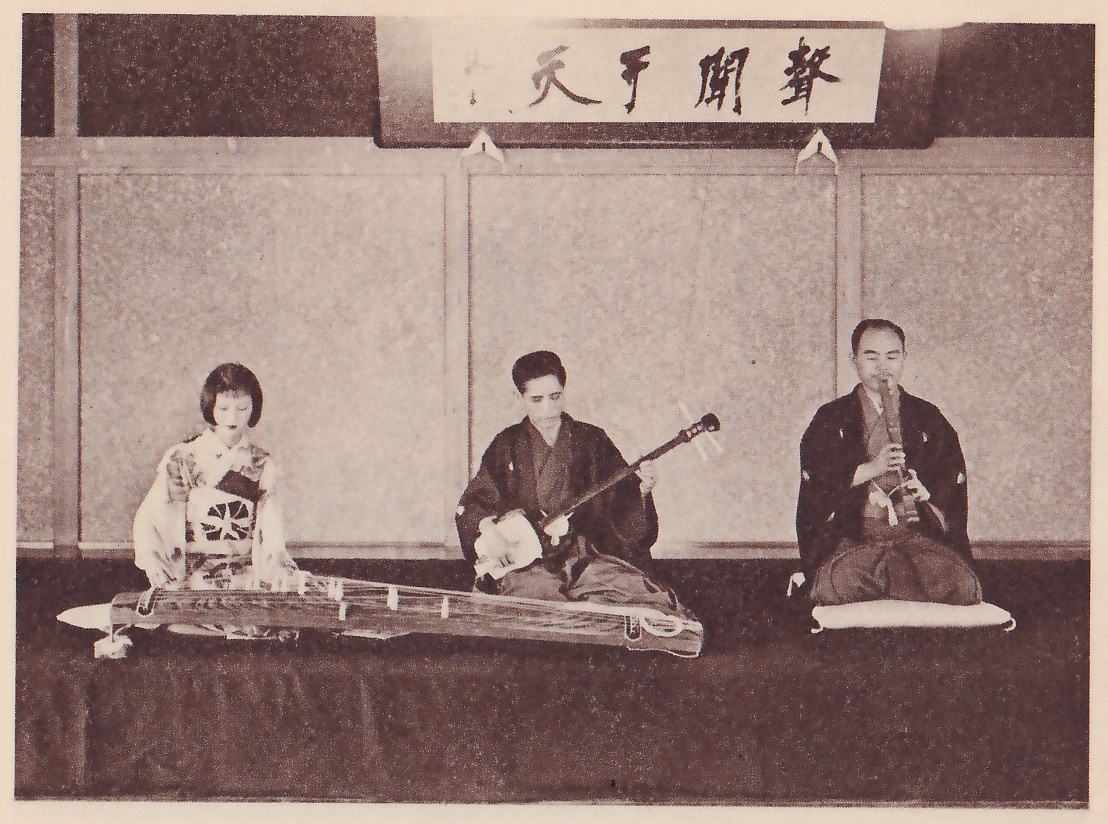
with plectra on the fingers. It forms a musical accompaniment for rhythmic singing. This music is metrically regular in form, and is played without any dependence upon the character of the song that is being sung. It is, therefore, perhaps the easiest type of Japanese music for foreigners to appreciate.
The music of the koto came to be joined with that of the samisen about what might be called the middle period of its development. The songs of the samisen, when rendered alone, were called Jiuta, and were more popular in the Kwansai region. The harmonized music of koto and samisen gradually became general, and to these was later added that of the kokyū, or three-stringed Japanese violin, thus forming a musical trio. This kokyū, since the Meiji Years (1868–1912),
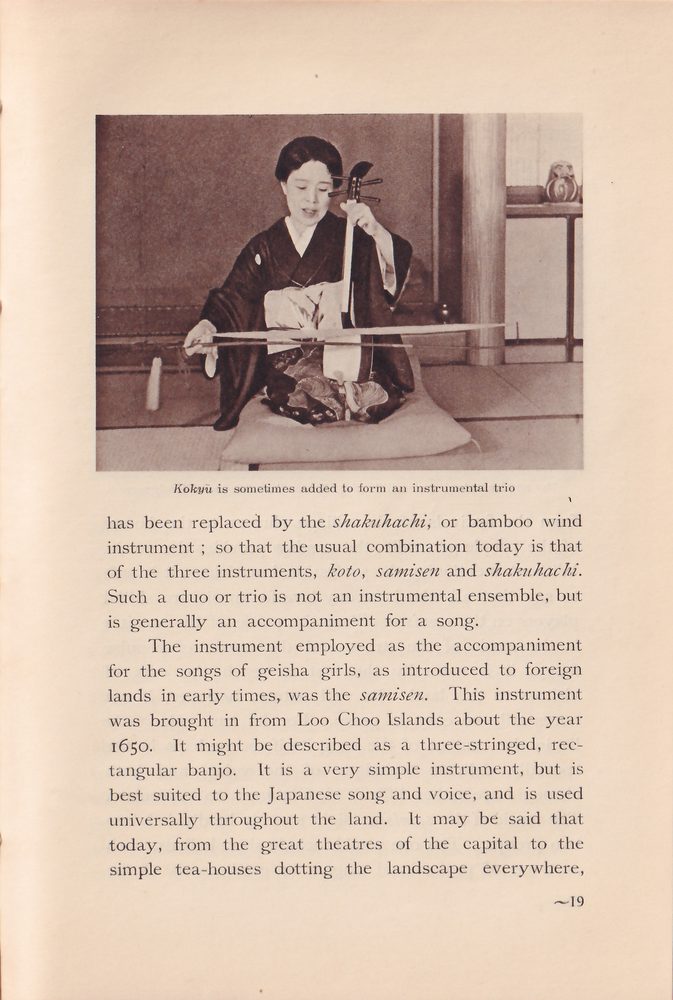
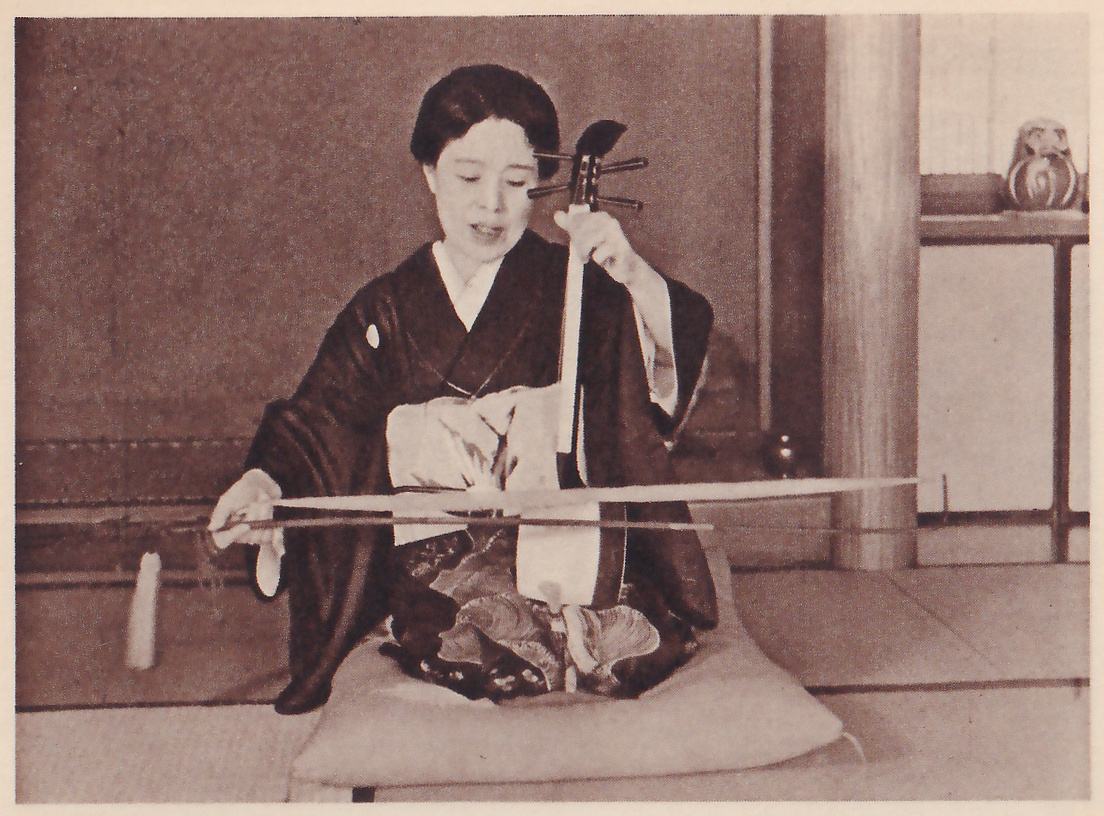
has been replaced by the shakuhachi, or bamboo wind instrument; so that the usual combination today is that of the three instruments, koto, samisen and shakuhachi. Such a duo or trio is not an instrumental ensemble, but is generally an accompaniment for a song.
The instrument employed as the accompaniment for the songs of geisha girls, as introduced to foreign lands in early times, was the samisen. This instrument was brought in from Loo Choo Islands about the year 1650. It might be described as a three-stringed, rectangular banjo. It is a very simple instrument, but is best suited to the Japanese song and voice, and is used universally throughout the land. It may be said that today, from the great theatres of the capital to the simple tea-houses dotting the landscape everywhere,
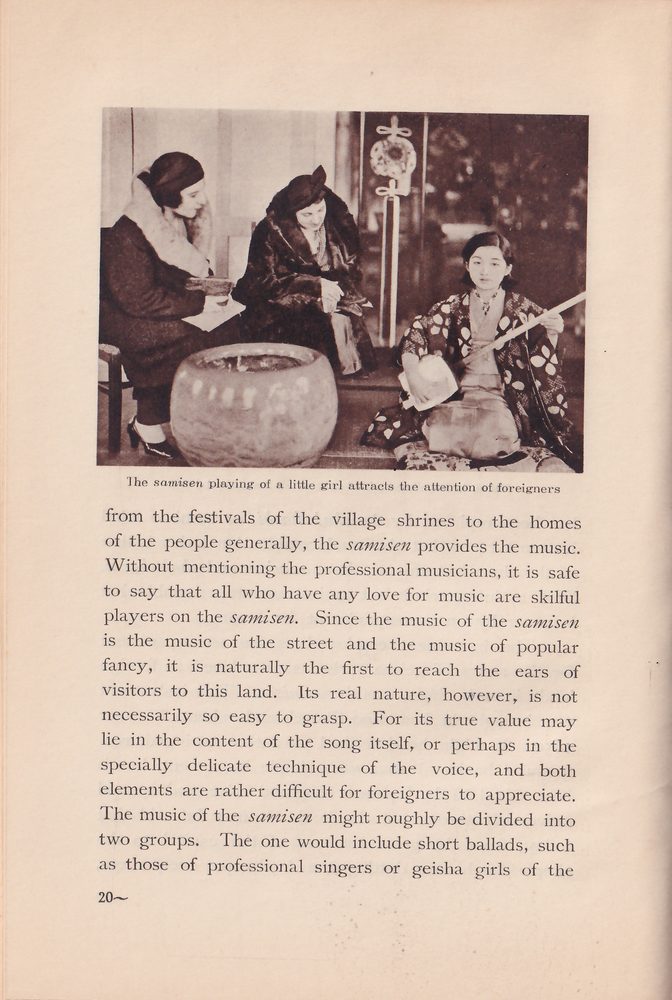
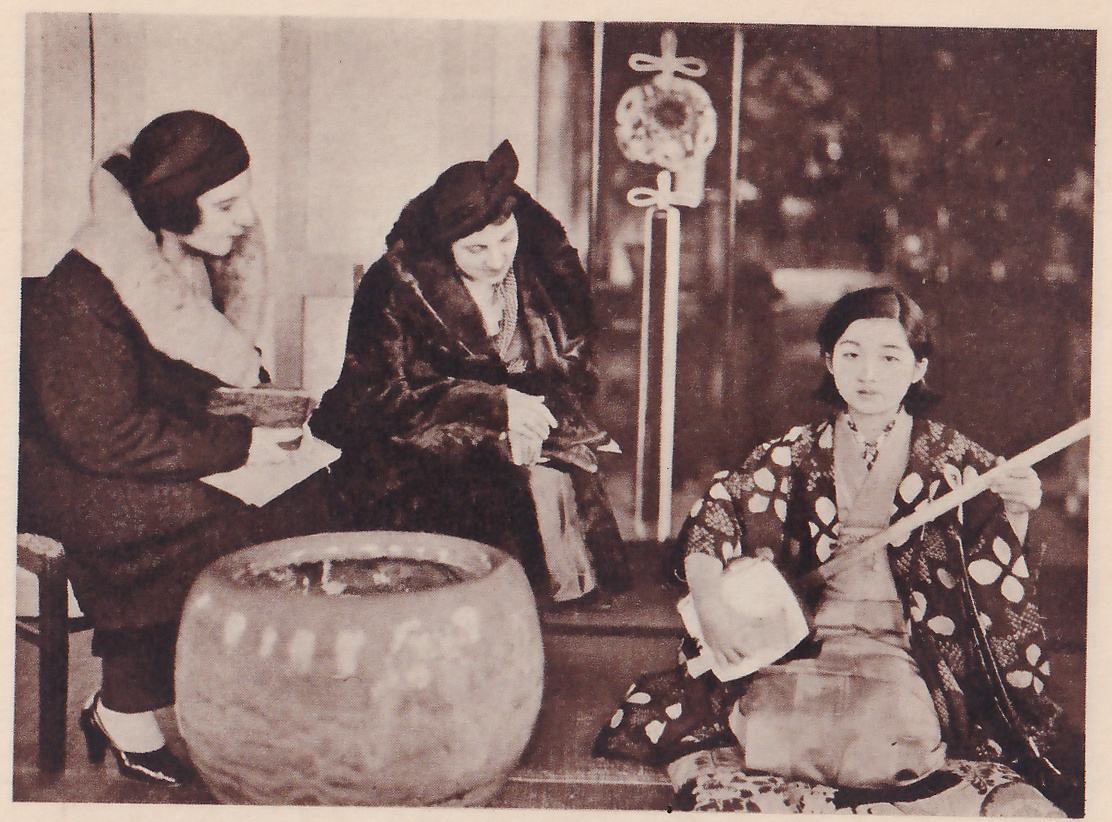
from the festivals of the village shrines to the homes of the people generally, the samisen provides the music. Without mentioning the professional musicians, it is safe to say that all who have any love for music are skilful players on the samisen. Since the music of the samisen is the music of the street and the music of popular fancy, it is naturally the first to reach the ears of visitors to this land. Its real nature, however, is not necessarily so easy to grasp. For its true value may lie in the content of the song itself, or perhaps in the specially delicate technique of the voice, and both elements are rather difficult for foreigners to appreciate. The music of the samisen might roughly be divided into two groups. The one would include short ballads, such as those of professional singers or geisha girls of the
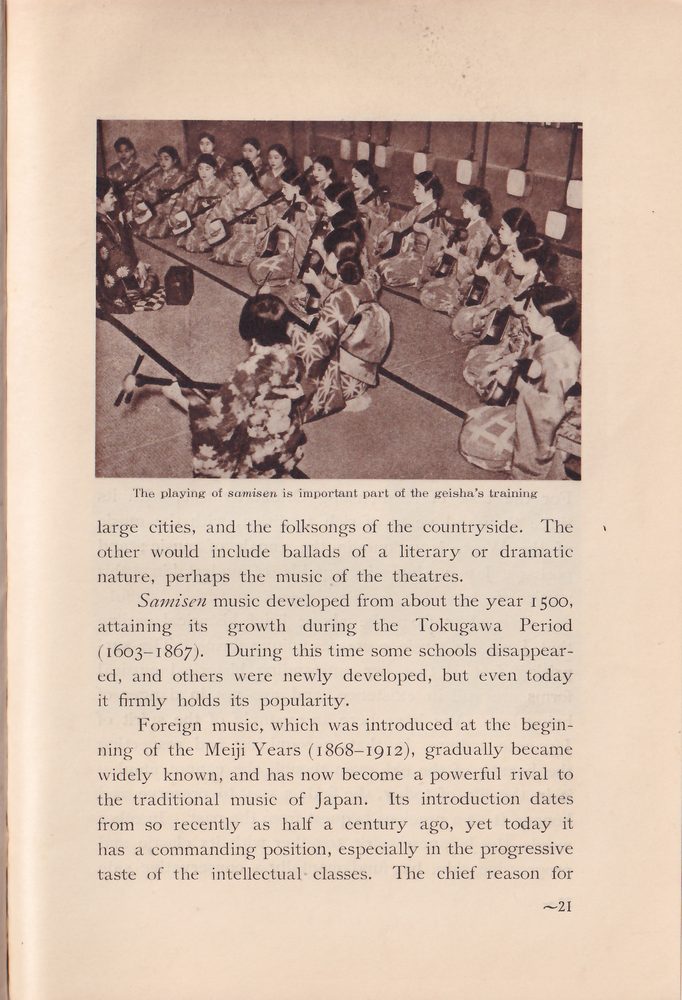
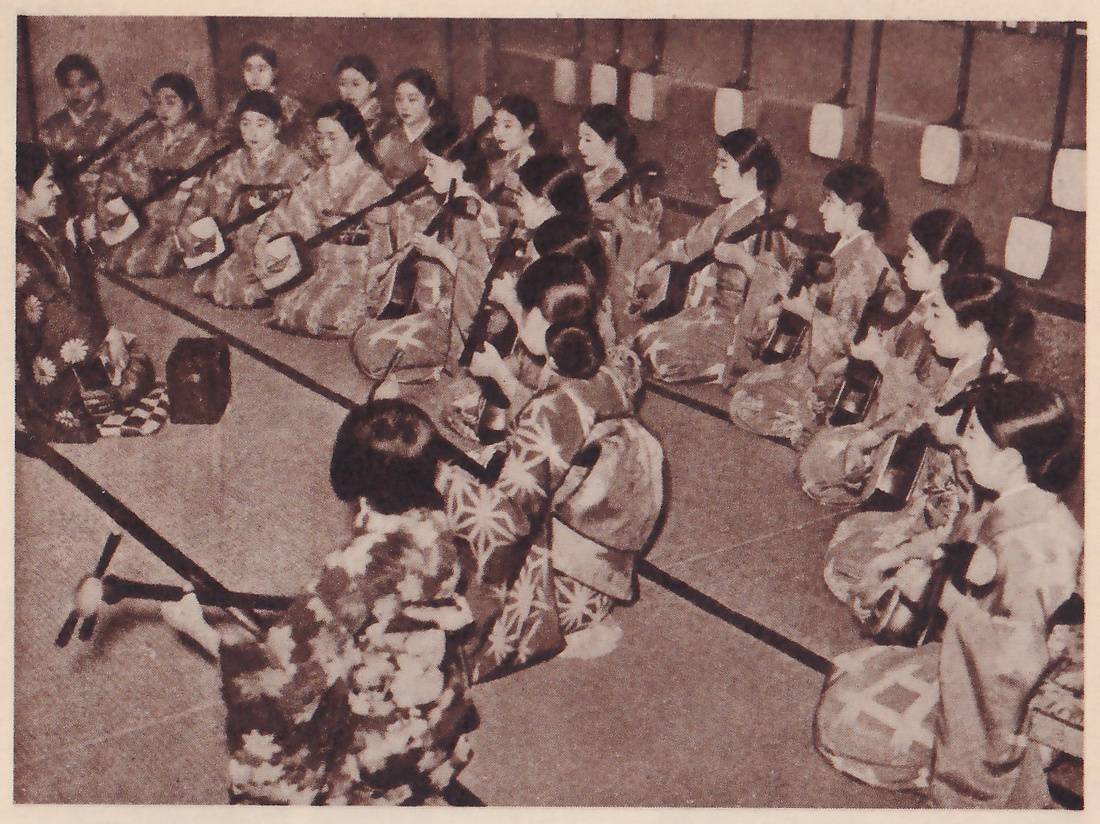
large cities, and the folksongs of the countryside. The other would include ballads of a literary or dramatic nature, perhaps the music of the theatres.
Samisen music developed from about the year 1500, attaining its growth during the Tokugawa Period (1603–1867). During this time some schools disappeared, and others were newly developed, but even today it firmly holds its popularity.
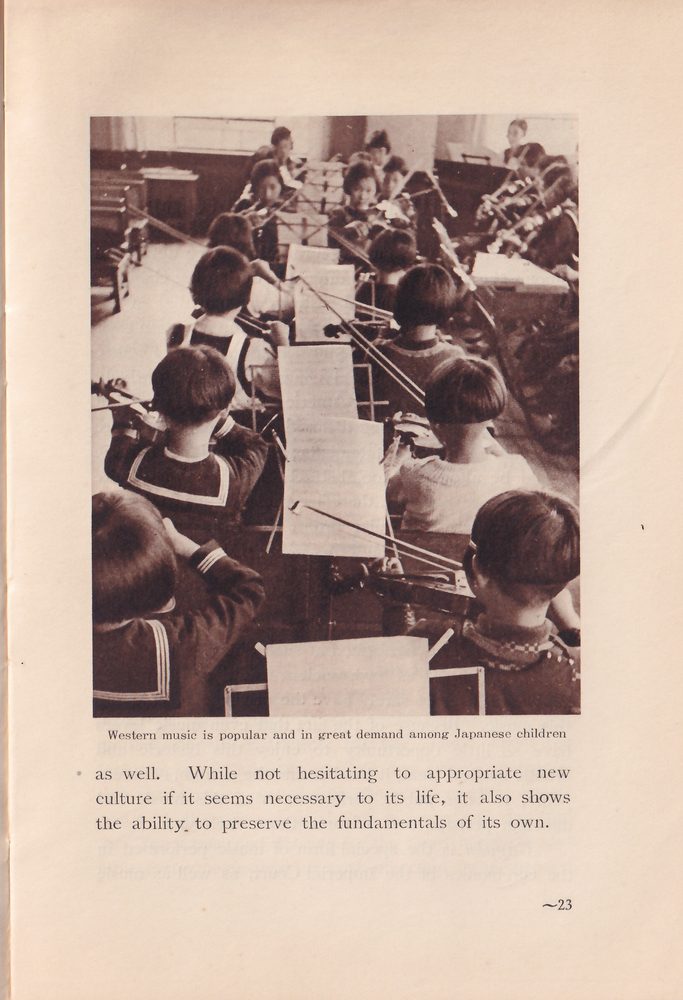
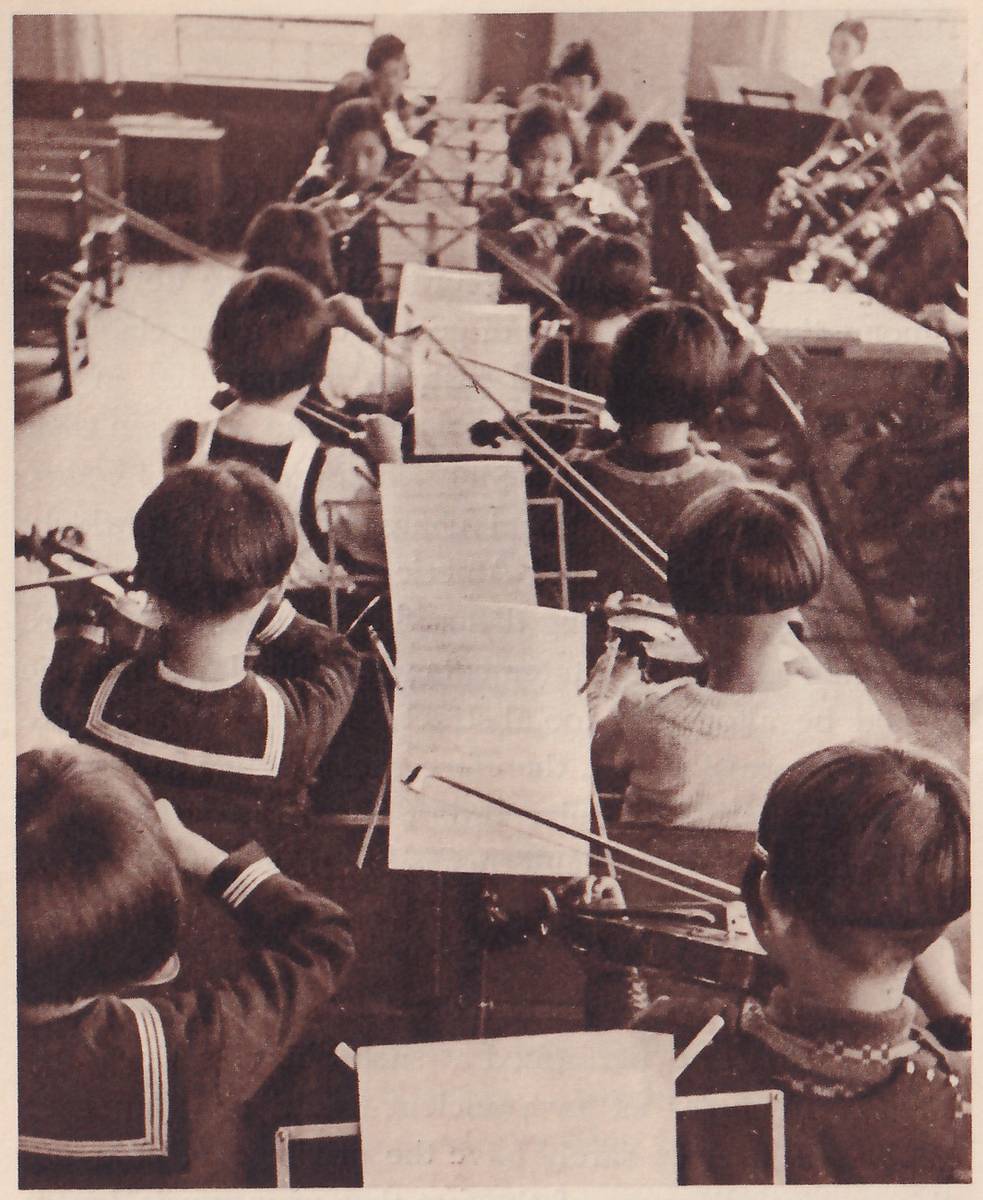
Foreign music, which was introduced at the beginning of the Meiji Years (1868–1912), gradually became widely known, and has now become a powerful rival to the traditional music of Japan. Its introduction dates from so recently as half a century ago, yet today it has a commanding position, especially in the progressive taste of the intellectual classes. The chief reason for
this rapid advance is to be found in the adoption of Western musical forms by the framers of the public educational system, and also in the use of Western music by military and naval bands.
We would hardly expect, however, that our entire people might appreciate music in its Western forms, so we may note that on radio programmes both styles of music are regularly included—our native music and that from abroad. There is just now evidence of an effort to harmonize these two forms of music to some extent. As a result of such effort we already have some musical creations worthy of our consideration. If this should succeed, Japan may produce a new type of national music, in which case she would, at the same time, be making a real contribution to the music of the world. For the task of harmonizing Oriental music, with its three thousand years of rich tradition, with the music of the West, is unique in the annals of music; and perhaps Japan alone is capable of undertaking this musical feat.
It is clear from the above brief historical outline that Japanese music possesses unique forms. The surprising fact is that her outstanding historical musical forms are still in existence, and are not in danger of being lost. We have here an example of the spirit of Japanese culture, in that, recognizing and respecting the beauty of the old, even though she cannot employ it in the life of today, she finds a way to preserve and honour it as a precious bequest from the past. In other words, the Japanese spirit, together with its elastic and progressive side, has fundamentally a conservative side
as well. While not hesitating to appropriate new culture if it seems necessary to its life, it also shows the ability to preserve the fundamentals of its own.