
THE MID-SUMMER HOLIDAY OF BON
With but a fortnight before schools close for the summer vacation, children get a brief foretaste of the holidays when the Bon festival opens on the 13th of July. Though primarily religious, this July holiday is not without interest to children, who are in a mood to feel—
“There’s never a need to worry,
There’s never a lesson to learn,
There’s never a bell to hurry,
There’s never a duty to spurn.”
Bon is a holiday second in importance only to the New Year in many households. The name “Bon” is a contraction of “Urabon,” which is in turn a corruption of the Sanskrit term ullambana, meaning “to salvage souls from the agony of being hanged head down.” “A hundred kinds of food and five kinds of fruit” are offered to the souls of ancestors that return to their respective worldly homes during the three days of Bon. Through the offerings made on these days to Buddha and his disciples, the souls of one’s ancestors are saved from their miseries in the world beyond. In order to merit such salvation, the ancestors of seven generations back return home during the days of Bon.
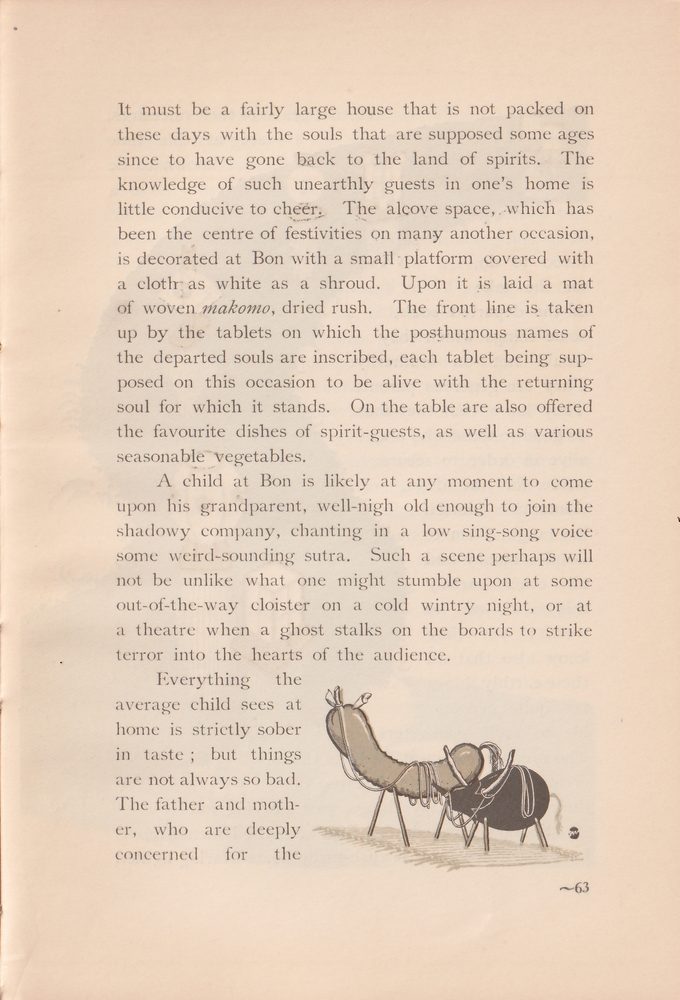
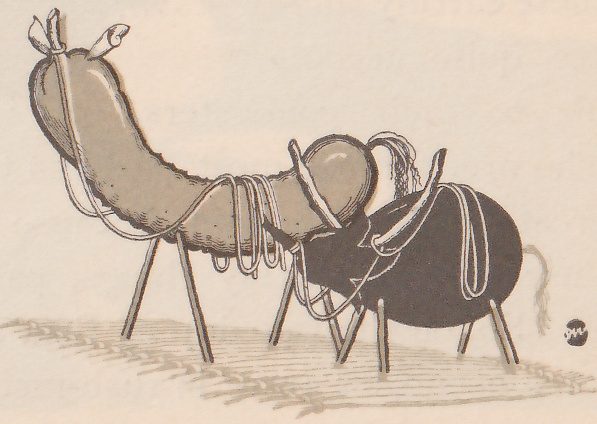
It must be a fairly large house that is not packed on these days with the souls that are supposed some ages since to have gone back to the land of spirits. The knowledge of such unearthly guests in one’s home is little conducive to cheer. The alcove space, which has been the centre of festivities on many another occasion, is decorated at Bon with a small platform covered with a cloth as white as a shroud. Upon it is laid a mat of woven makomo, dried rush. The front line is taken up by the tablets on which the posthumous names of the departed souls are inscribed, each tablet being supposed on this occasion to be alive with the returning soul for which it stands. On the table are also offered the favourite dishes of spirit-guests, as well as various seasonable vegetables.
A child at Bon is likely at any moment to come upon his grandparent, well-nigh old enough to join the shadowy company, chanting in a low sing-song voice some weird-sounding sutra. Such a scene perhaps will not be unlike what one might stumble upon at some out-of-the-way cloister on a cold wintry night, or at a theatre when a ghost stalks on the boards to strike terror into the hearts of the audience.
Everything the average child sees at home is strictly sober in taste; but things are not always so bad. The father and mother, who are deeply concerned for the
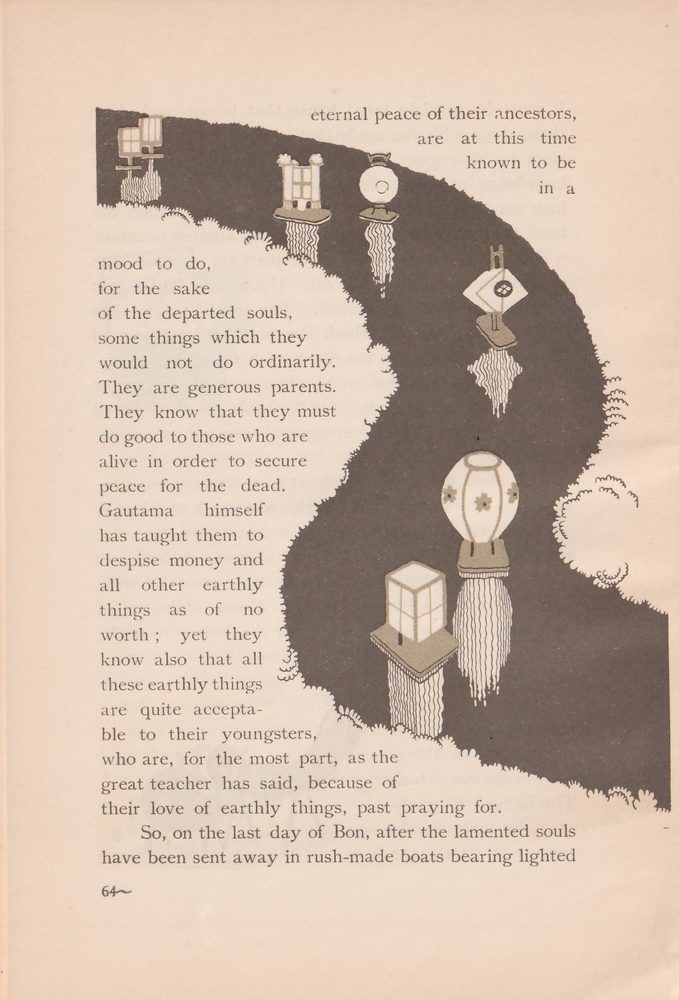
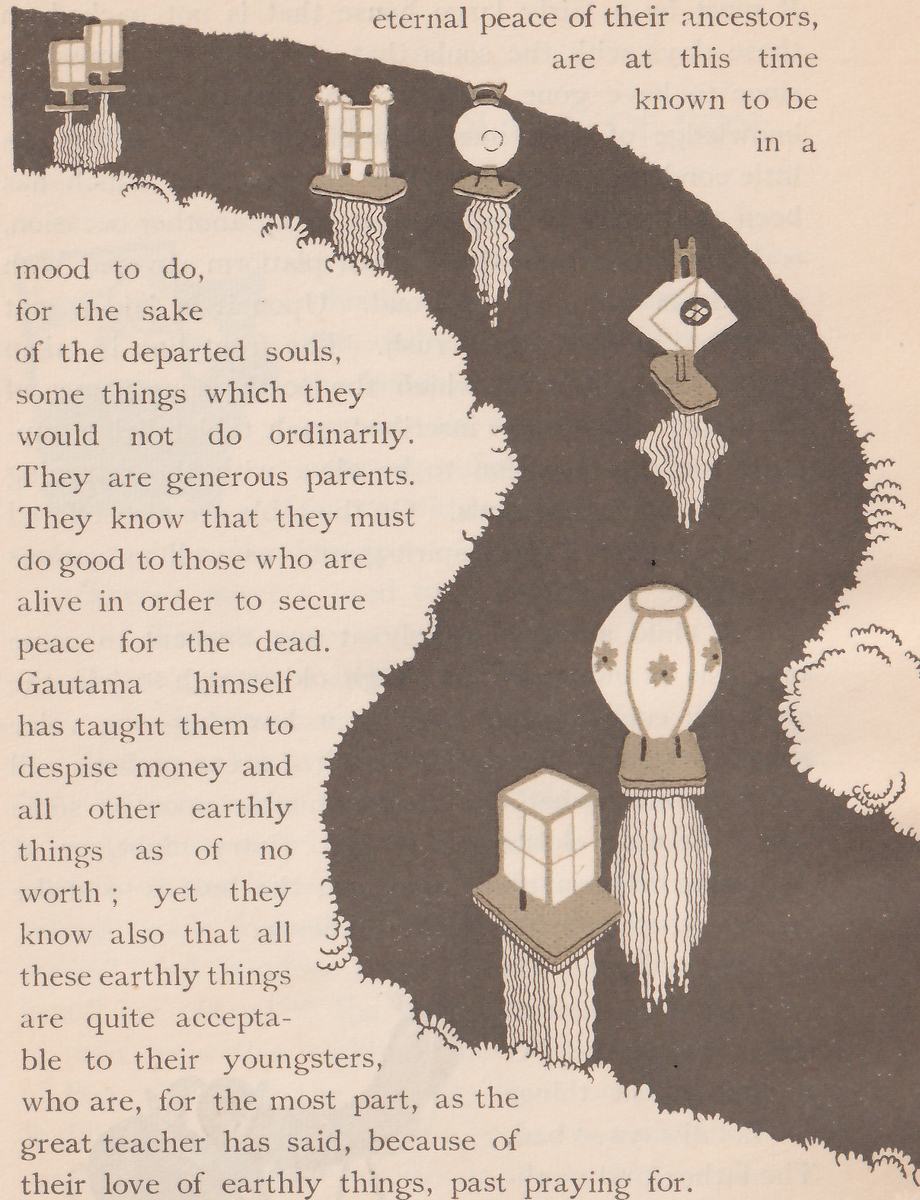
eternal peace of their ancestors, are at this time known to be in a mood to do, for the sake of the departed souls, some things which they would not do ordinarily. They are generous parents. They know that they must do good to those who are alive in order to secure peace for the dead. Gautama himself has taught them to despise money and all other earthly things as of no worth; yet they know also that all these earthly things are quite acceptable to their youngsters, who are, for the most part, as the great teacher has said, because of their love of earthly things, past praying for.
So, on the last day of Bon, after the lamented souls have been sent away in rush-made boats bearing lighted
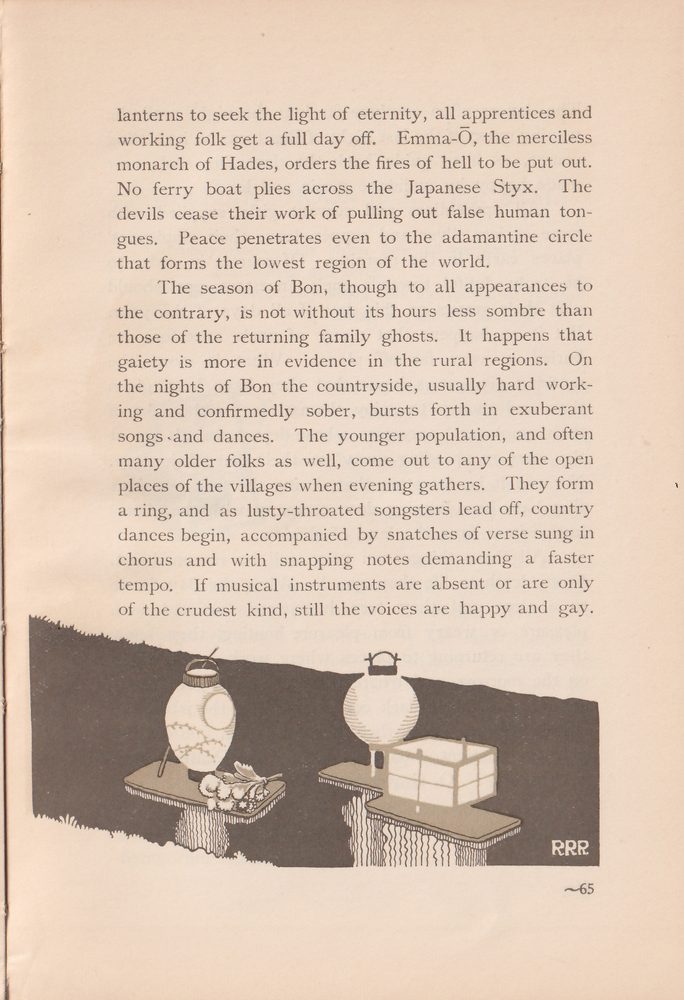
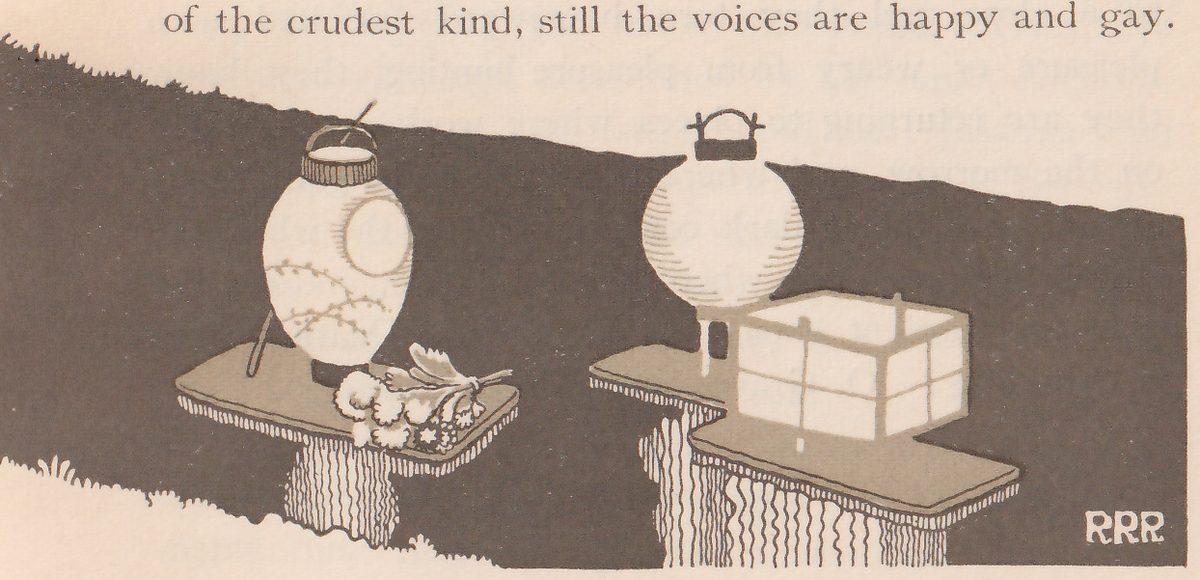
lanterns to seek the light of eternity, all apprentices and working folk get a full day off. Emma-Ō, the merciless monarch of Hades, orders the fires of hell to be put out. No ferry boat plies across the Japanese Styx. The devils cease their work of pulling out false human tongues. Peace penetrates even to the adamantine circle that forms the lowest region of the world.
The season of Bon, though to all appearances to the contrary, is not without its hours less sombre than those of the returning family ghosts. It happens that gaiety is more in evidence in the rural regions. On the nights of Bon the countryside, usually hard working and confirmedly sober, bursts forth in exuberant songs and dances. The younger population, and often many older folks as well, come out to any of the open places of the villages when evening gathers. They form a ring, and as lusty-throated songsters lead off, country dances begin, accompanied by snatches of verse sung in chorus and with snapping notes demanding a faster tempo. If musical instruments are absent or are only of the crudest kind, still the voices are happy and gay.
The dances often continue far into the night until the waning moon of the last night of Bon turns on its setting course, as if to guide back the departing souls now made happy by mundane music and love.
All apprentices and servant girls, supplied with more or less silver and copper, leave their employers’ places early in the morning. Of course, in order to be truly dutiful towards one’s ancestors, one should visit their graves on this day of all days of the year. But it so happens that many of one’s ancestors are buried in very far off places. What is more, the working youngsters know that they have been given time and money to enjoy themselves for the sake of their employers’ ancestors, whose departed souls are at the moment speeding away on their eternal journey. Nor can it be forgotten that during the past few days they have been keeping close company with the cheerless visitors from the land of shadow.
All these things can very well be reasoned out. From death to life they speed. When the day draws to a close and they turn homeward surfeited with pleasure or weary from pleasure-hunting, they know they are returning to places where work awaits them on the morrow, and where there are no longer ghostly ancestors to haunt dark corners. So on the whole the youngsters are happy when they get home, and for the time are insolent enough to ask: “O, Death, where is thy sting? O, Grave, where is thy victory?”