
THE STAR FESTIVAL
“Oh, ferryman, make speed across the stream!
—my lord is not one who can come and go twice in a year!”
—From the Mannyōshū (translated by Lafcadio Hearn)
Of all the legends that have given rise to popular customs in Japan, the most romantic is the one generally known as Tanabata, the Weaving Maid. It was brought over from Cathay many centuries ago and seems at once to have caught the fancy of our ancestors. It gave birth to an annual custom with which another legend, of native origin, was in course of time interwoven. This custom, which threatened some years ago to fall out of public favour, has now been revived, and is being even encouraged at schools from sentiments which are no doubt foreign to the people who originally learned to observe a day in honour of the Weaving Maid and her lover-star.
The celebration of Tanabata began in ancient Cathay as a festival in honour of the Weaving Maid, the star Vega in Lyra, and the Herdsman, the star Altair in Aquila. A story was told of their love. “On the east side of the River of Heaven, the Milky
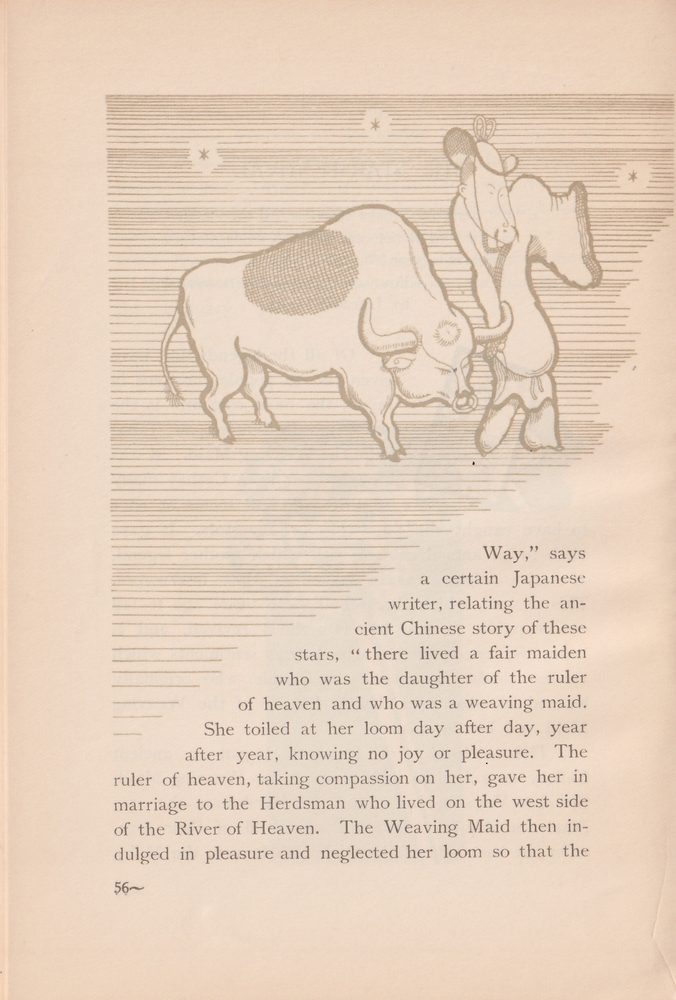
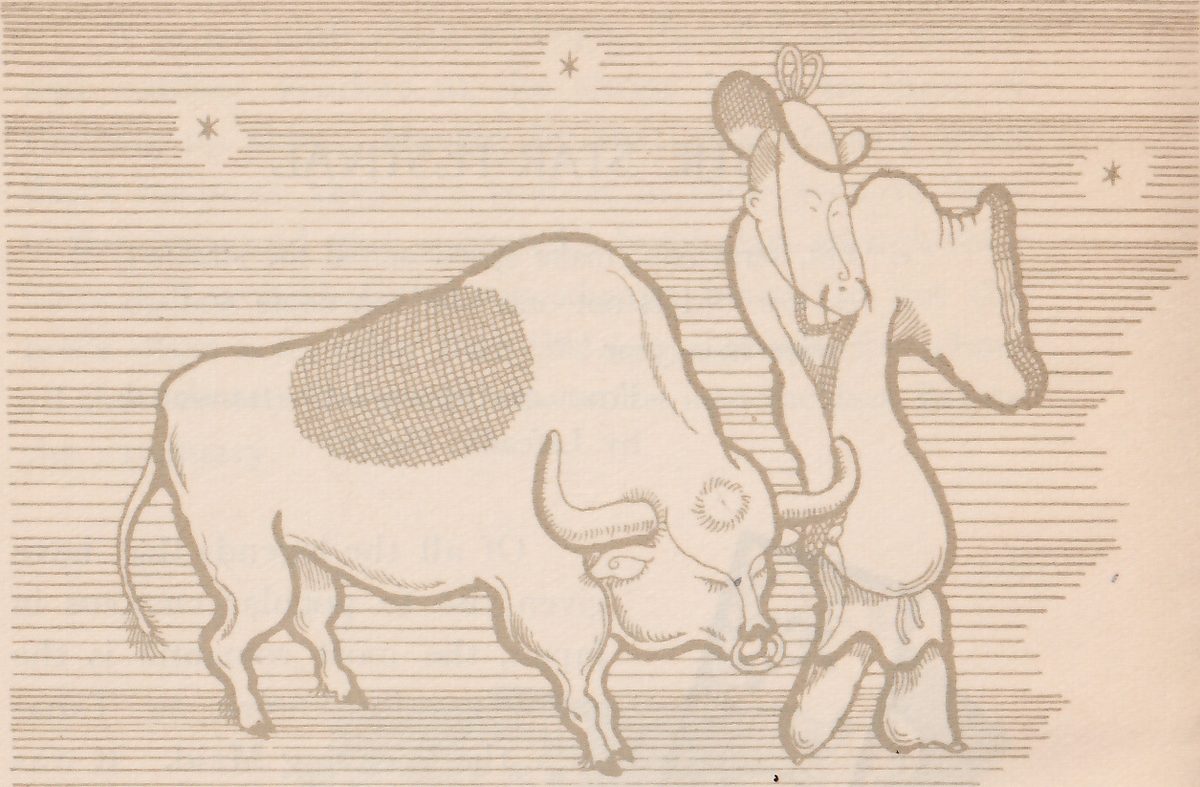
Way,” says a certain Japanese writer, relating the ancient Chinese story of these stars, “there lived a fair maiden who was the daughter of the ruler of heaven and who was a weaving maid. She toiled at her loom day after day, year after year, knowing no joy or pleasure. The ruler of heaven, taking compassion on her, gave her in marriage to the Herdsman who lived on the west side of the River of Heaven. The Weaving Maid then indulged in pleasure and neglected her loom so that the
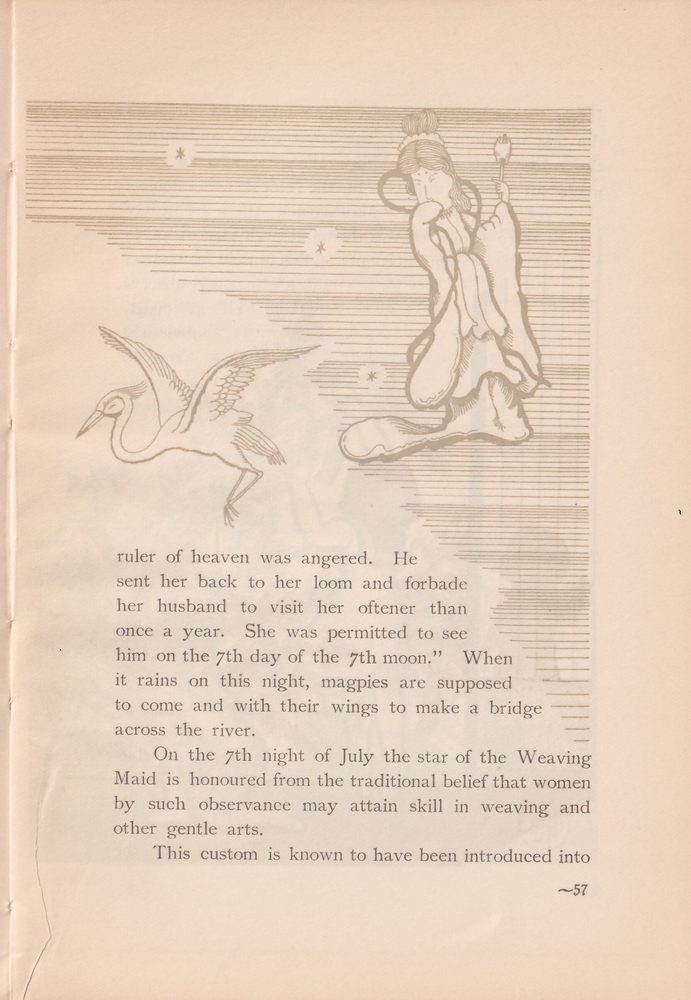
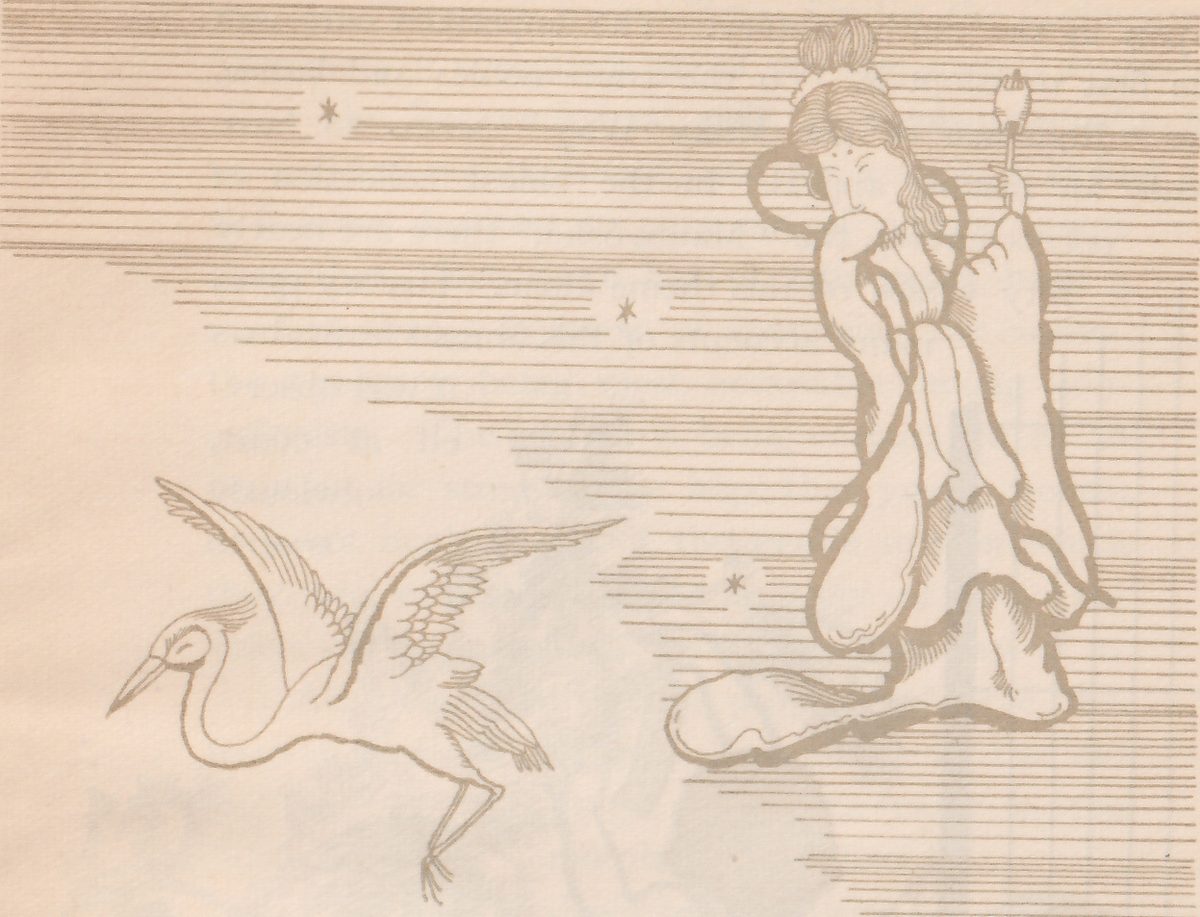
ruler of heaven was angered. He sent her back to her loom and forbade her husband to visit her oftener than once a year. She was permitted to see him on the 7th day of the 7th moon.” When it rains on this night, magpies are supposed to come and with their wings to make a bridge across the river.
On the 7th night of July the star of the Weaving Maid is honoured from the traditional belief that women by such observance may attain skill in weaving and other gentle arts.
This custom is known to have been introduced into
Japan in the ninth century. The Imperial Court was the first to adopt it. To the court nobles and ladies, the “Romance of the Milky Way” seems to have made an instant appeal. In the oldest collection of poems extant, the “Mannyōshū,” there are nearly fifty verses on this theme alone. History gives many accounts of this annual festival as it was observed at court, obviously true to
the form learned from China. Under the Tokugawa Shogunate it was made one of the five annual festivals. After the Restoration of 1868, it seems gradually to have fallen out of favour, and for a time it looked as if it were destined to pass out of popular usage altogether. But there has of late years been a marked change in favour of continuing the custom, the tendency being most noticeable among educationists. The festival is being encouraged as an occasion for stressing the hope that young women may not neglect any of the gentle arts in which they are expected to attain more or less proficiency. Some schools make a special day of it.
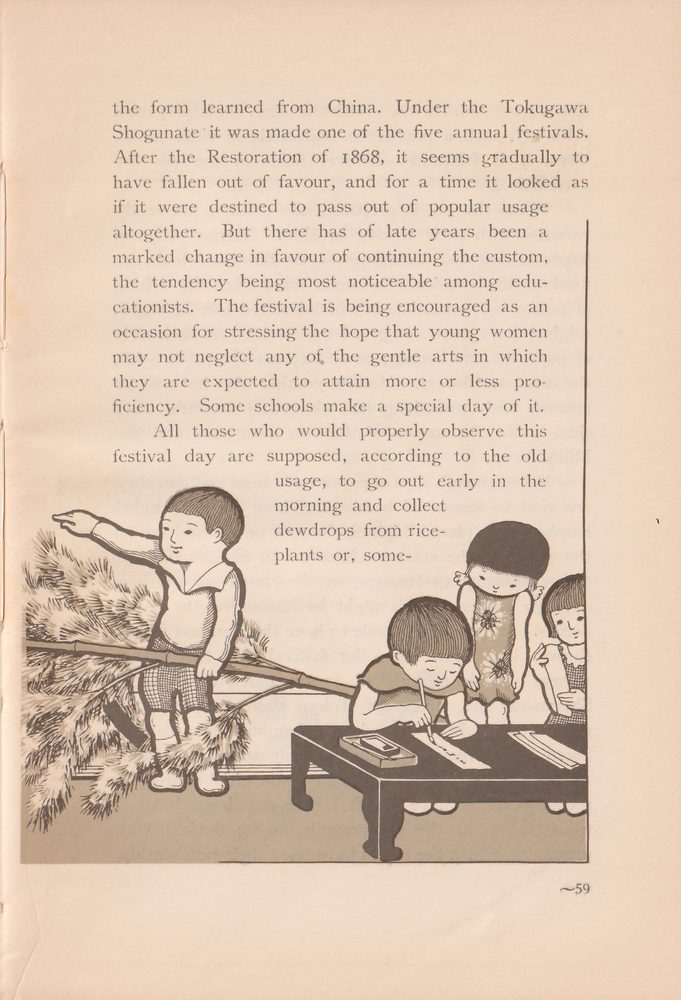
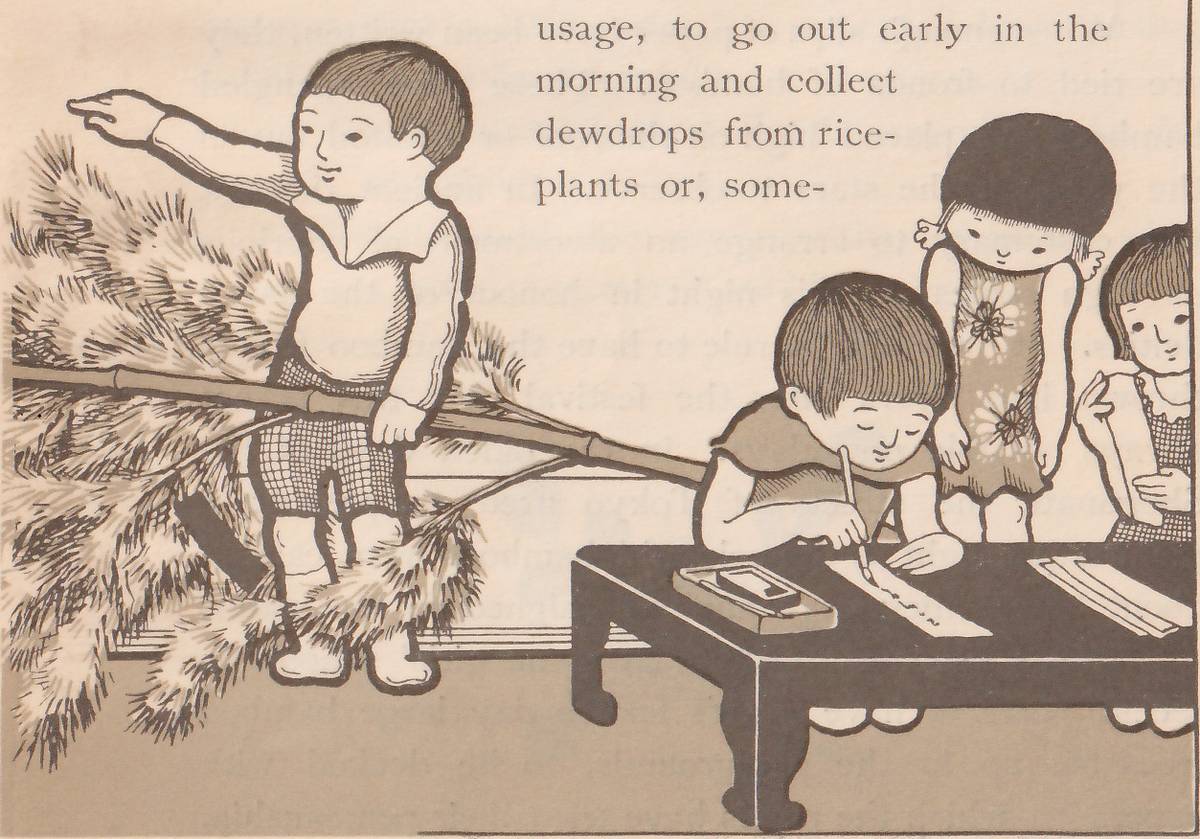
All those who would properly observe this festival day are supposed, according to the old usage, to go out early in the morning and collect dewdrops from rice-plants or, some-
times, from yam leaves. With this dew, ink is prepared. Although such a practice is impossible in cities nowadays, it is followed wherever fields or gardens are accessible.
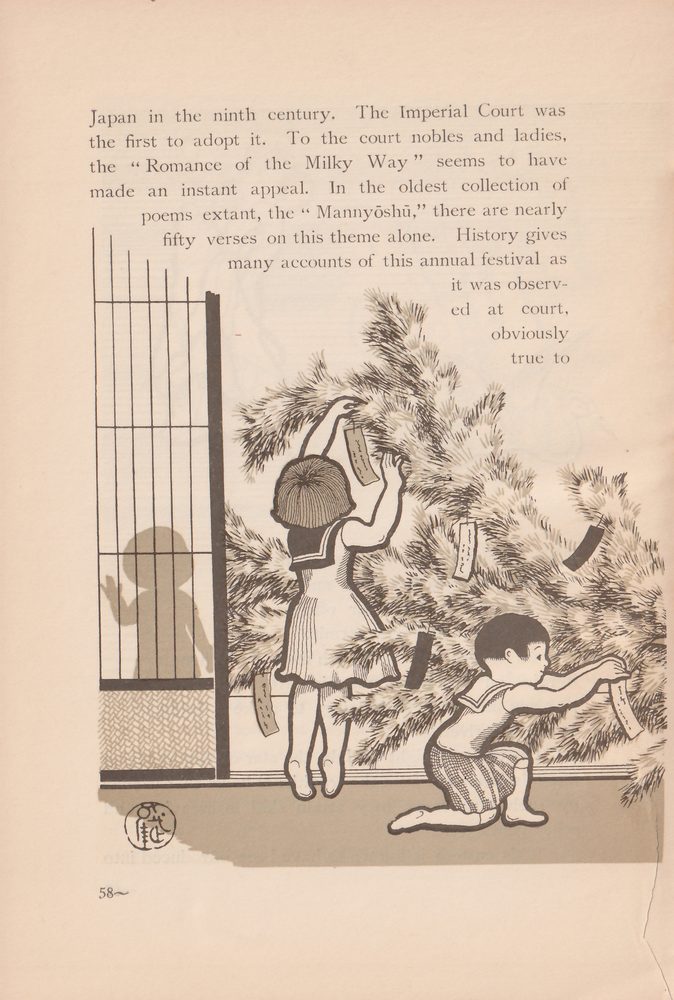
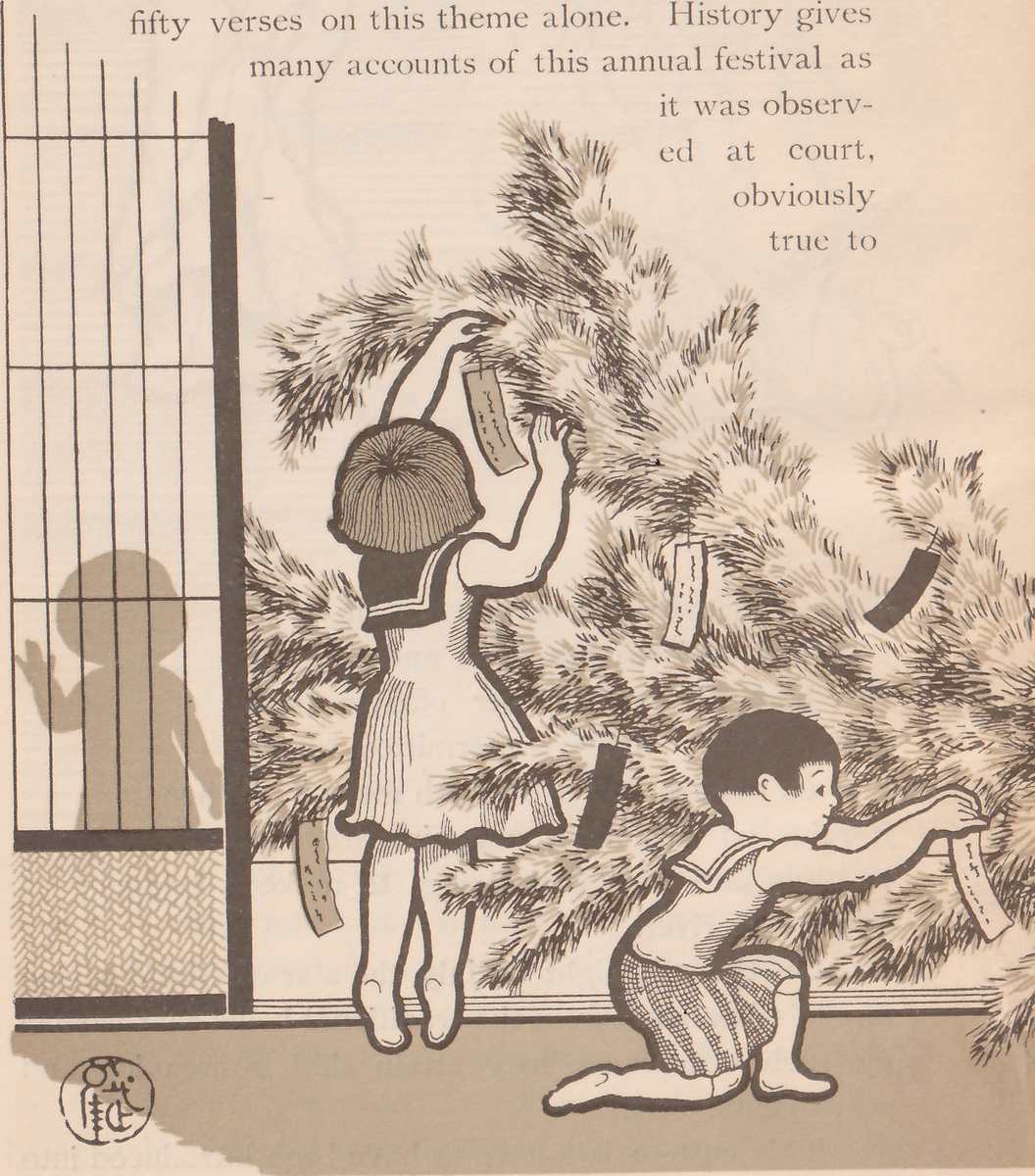
When the ink is prepared, the children are ready to write with their writing brushes. Narrow strips of paper in five and sometimes seven different colours are used on this occasion. In former times when the writing of poetry was a pastime in which lettered folk indulged, original lines were composed and written on each strip of paper to pay homage to or express sympathy with, the two astral lovers. Modern youths, who have to be content with something less elaborate, do little more than write the names of the two lover-stars and the Milky Way.
When enough slips of paper have been written, they are tied to fronds of bamboo. These paper-spangled bamboos are placed high on the roof or planted out in the yard for the stars to observe. In ancient times it was customary to arrange an assortment of offerings on high tables on this night in honour of the astral deities. It was also a rule to have the bamboo fronds thrown into rivers after the festival, but this is not always possible nowadays. In the olden days of the Shogunate the streets of Tokyo used to present a picturesque sight as the colourful bamboos were carried about before they were finally consigned to the water.
It has become a custom at some girls’ schools in recent years to have on this festive day large bamboo trees set up in the playgrounds, to be decked with papers on which the pupils have tried their penmanship.
The children form a ring around the tree and sing songs appropriate to the occasion.
In some rural places these gala trees are planted in fields and gardens in the belief that they will have the power to protect the crops from harmful insects.
Some girls’ schools have been encouraging the celebration, not as an expression of female sympathy for the stars that are to meet after a year’s separation, but as an occasion on which once a year the young women may in humbleness of mind pray that they may attain skill or proficiency in all the accomplishments that should be found in good women. And it is no doubt for the same reason that the custom is being gradually restored to home life.
It is a picture of congenial home life on such an occasion that a haiku poet has presented by depicting a father in the least enviable of situations.
“On the stars’ festival day I compose verses for my children to copy;
What would they say were they to realize what a poor poetaster I am!”