
WHEN THE MOON IS AT HER BEST
“Lady Moon, Lady Moon, how old are you?”
“I’m thirteen and seven.”
“Lady Moon, Lady Moon, you are indeed so young.”
—From a Japanese Lullaby
“Snow, moon and flowers” are the three things at the sight of which Japanese poets are supposed to be inevitably moved. Autumn, when the sky is said to be clear to its zenith, brings its moon, the fairest of the year, as certainly as winter brings its snow, and spring its floral glory. So it has been a custom from very ancient times to hold a special party for enjoying the moon in autumn. There are two moon-viewings, determined by the lunar calendar, the “Jūgoya” on 15th August, and the “Jūsanya” on 13th September. It is a superstition that if the “Jūgoya” is observed it is also necessary to observe the “Jūsanya” in order to avoid bad luck. By the Gregorian calendar these moon-viewings are about a month later, varying somewhat every year.
On the night of the full moon in September, new calendar, families hold little parties to enjoy what lunar sights they may, though the clouds are said to be
very jealous and often come to veil the fair moon from sight.
“Month after month many a moon appears, but no moon to be compared with the moon of this evening,” sings an ancient Japanese poet.
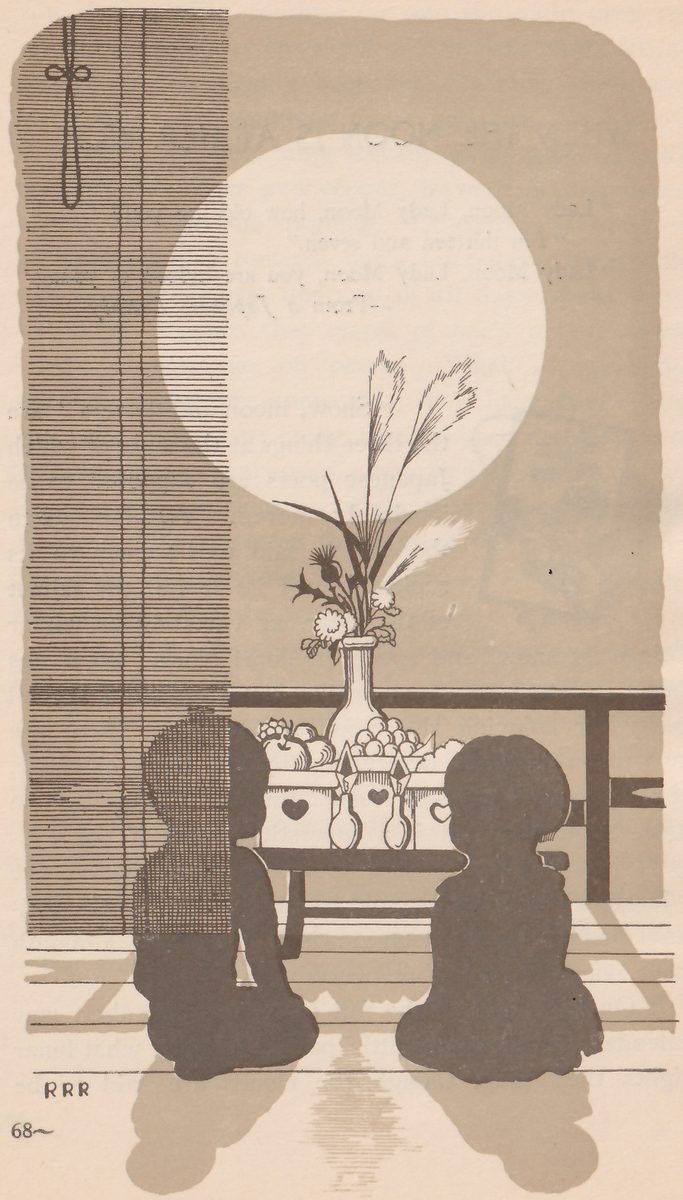
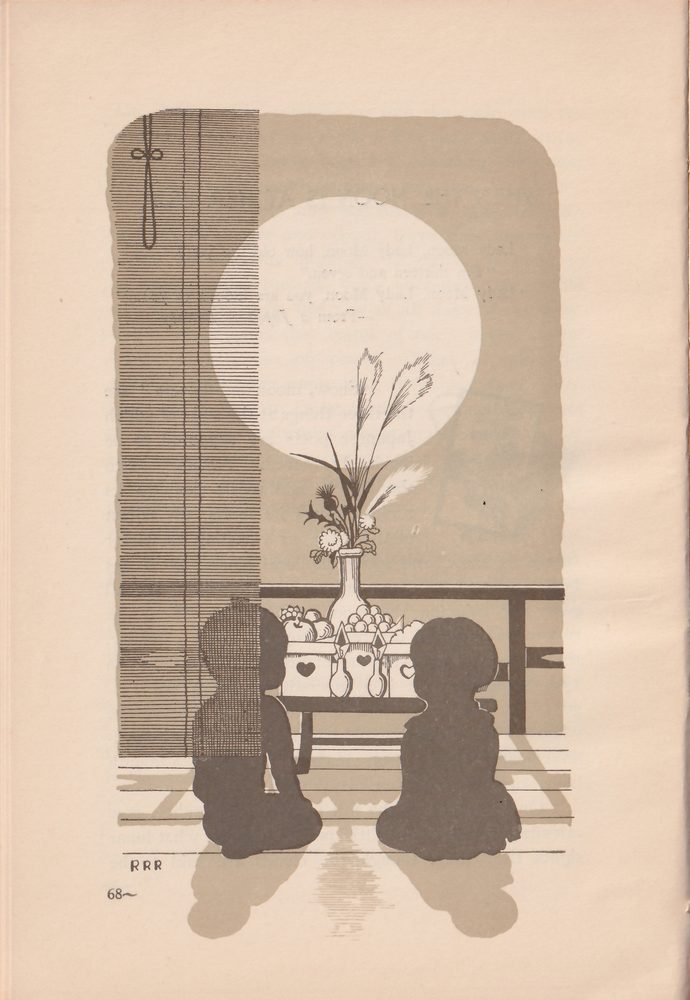
On the night of viewing the harvest moon, a small oblong-shaped table is placed either on the verandah open to the south, or on places where the moon is likely to shine. The offerings of the night consist of fifteen round rice-dumplings, a symbol of the fifteenth-night moon, and fruits and vegetables of the season, such as persimmons, chestnuts, grapes, taros, boiled green soy-beans, etc. These things are placed decorously on the sanbō, or offering trays, and arranged as if before the family shrine or at the temple of the most potent of deities. In addition, two candles are lighted close to the table. A bundle of grass plumes is placed in a vase. As on all other ceremonial occasions, rice-wine is offered in a pair of small bottles.
Before such an arrangement of food and drink, the family and visiting friends sit down. They apply themselves to whatever they fancy most; some to improvising poems, naturally on the moon, some to singing of one sort or another, and some to the good eatables arranged before them.
Loud voices arise from housetops here and there when “Jūgoya Otsukisama”—Lady Moon of the fifteenth night—slowly emerges into view. The young folks clap their hands in the sheer joy of greeting the moon. Then follow moments of silence, as everybody gazes at the moon who rises in her full glory. Again there
are hurrahs and more hand clapping, when the silver moon has come out in full, perfectly round and bright.
The moon on which so many Japanese poets and writers of romances have loved to dwell can never be viewed without deep emotion.
Children learn early to look on the moon with a sentiment they will carry with them throughout their lives.
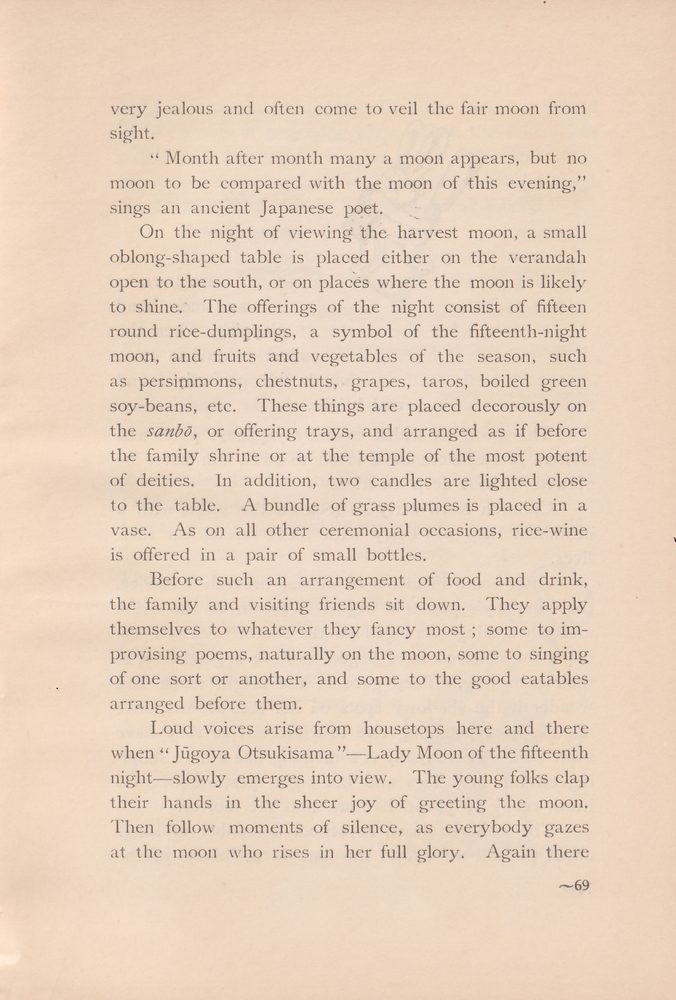
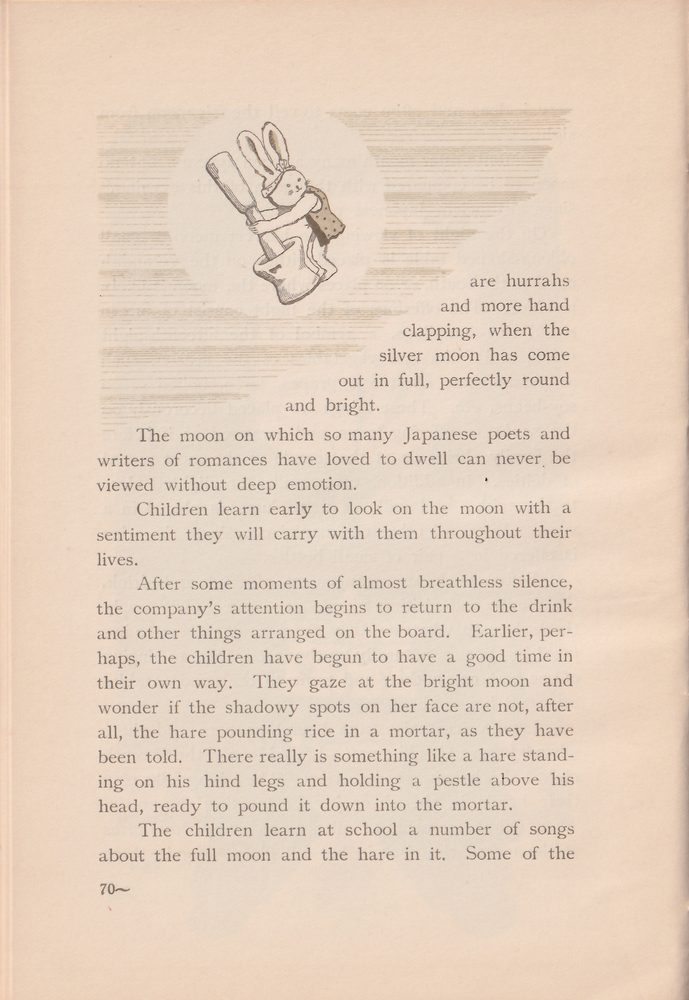
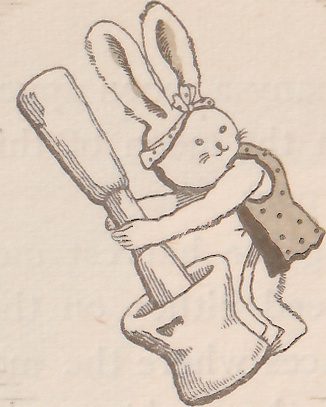
After some moments of almost breathless silence, the company’s attention begins to return to the drink and other things arranged on the board. Earlier, perhaps, the children have begun to have a good time in their own way. They gaze at the bright moon and wonder if the shadowy spots on her face are not, after all, the hare pounding rice in a mortar, as they have been told. There really is something like a hare standing on his hind legs and holding a pestle above his head, ready to pound it down into the mortar.
The children learn at school a number of songs about the full moon and the hare in it. Some of the
little ones dance, mimicking the hare, their hands held up like a pair of projecting ears. Then the others join hands and, forming a ring, go round and round singing songs, one after another. One of the popular songs taught at school may be paraphrased as follows:
Pettan—pottan, pound away!
Thou hare of the moon, so high in heaven,
Pound the rice in the mortar of pure gold.
See that thy cakes are thirteen and seven;
The Moon is twenty—she’ll ne’er grow old—
Pettan—pottan, pound away!
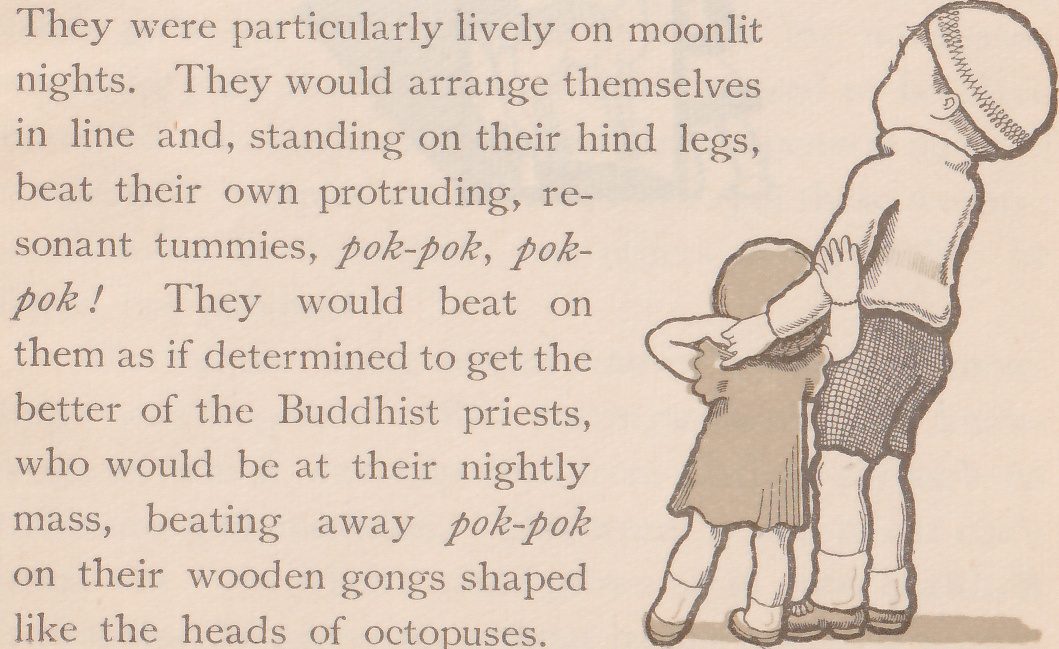
In the country, where man lives closer to nature, young people are almost always reminded on this night of those old days when wild beasts could talk like men, and when the badgers, who were credited with magic powers, delighted in strolling forth on moonlit nights. These funny badgers generally lived in the woods or temple grounds, and liked very much to assume the figures of tonsured Buddhist monks. They were particularly lively on moonlit nights. They would arrange themselves in line and, standing on their hind legs, beat their own protruding, resonant tummies, pok-pok, pok-pok! They would beat on them as if determined to get the better of the Buddhist priests, who would be at their nightly mass, beating away pok-pok on their wooden gongs shaped like the heads of octopuses.
Children in the country feel that on the night when the moon is at her best and fairest, there must be some badgers out in far-away places, tripping along on light fantastic toes. So boys and girls go on singing their songs as if never to be beaten by the musical badgers, even mimicking in their dances those alcohol-loving, pot-bellied beasts who love to dance ever on to the unending strain of pok-pok, pok-pok!