
CHILDREN AT SHRINE FESTIVALS
“Cheerily then, my little man,
Live and laugh, as boyhood can.”
—Whittier
There is in Japan no town or village, however small, that does not possess its tutelary deity. In such great cities as Tokyo and Osaka, there are divine protectors whose names are legion. Wards, districts and streets are divided among a number of deities so that divine grace may be distributed impartially among the inhabitants. A child is born under the benign influence of the deity who happens to protect its birthplace, and grows up under the same divine grace. So when this deity is honoured with a feast once a year at the shrine, it is an affair not to be lightly treated. But as far as children are concerned, such a celebration consists for the most part in matters of reflection. It is perhaps for this reason that more festivals are held in autumn when the sea offers more luscious fish, and the farm and garden yield a greater variety of products.
In Tokyo, the season of shrine festivals begins in May and continues into the autumn months. The
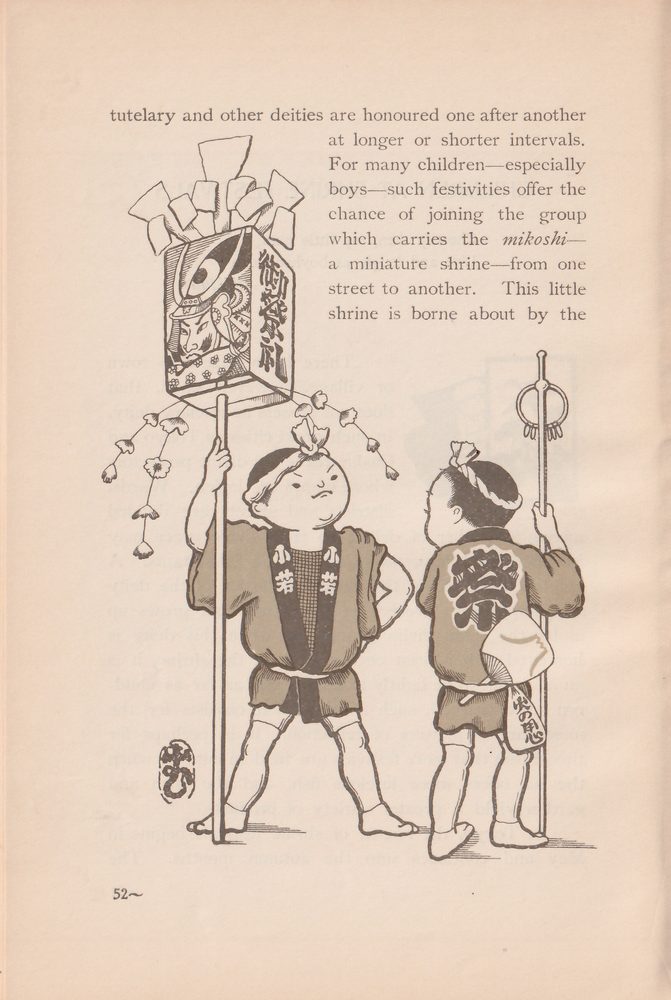
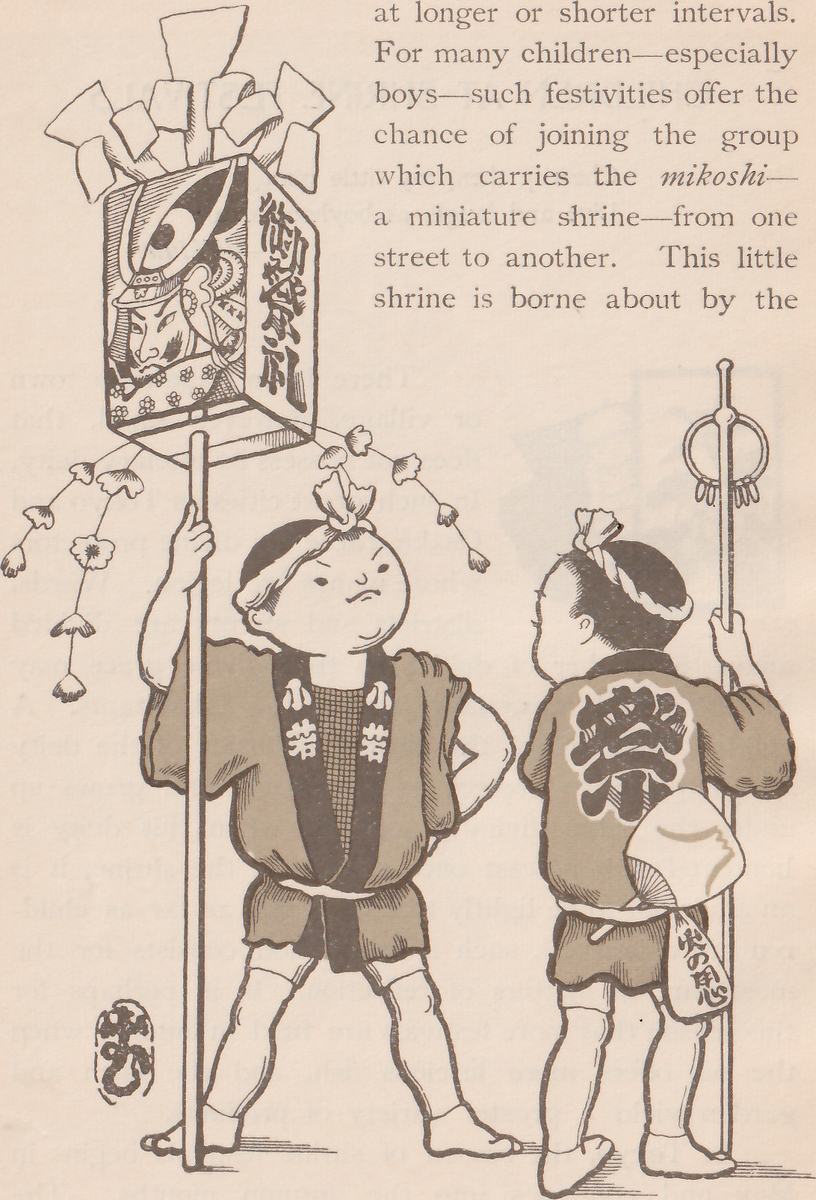
tutelary and other deities are honoured one after another at longer or shorter intervals. For many children—especially boys—such festivities offer the chance of joining the group which carries the mikoshi—a miniature shrine—from one street to another. This little shrine is borne about by the
children very much as the larger and heavier shrines are carried by the men.
The children, sharing in this part of the celebration, are furnished with uniform kimono paid for out of a fund collected in the part of the town connected with the celebration. They are each provided with a piece of cloth or a towel to be worn around the head in the fashion of those who labour at heavy tasks.
These bravely-attired boys place themselves under the pair of poles on which the miniature shrine is perched. With the poles on their shoulders, they move on and on, advancing and falling back, swaying from side to side, as if the little shrine were a ton in weight. All this is done in imitation of the young men, who have sometimes to bear a shrine weighing as much as eight hundred pounds. The children are nowadays given cakes or sweetmeats when they have amused themselves by carrying the little shrine around all day.
In many country places, such a gala day is the only occasion for seeing shows of any kind. There is sure to be a circus, however poor. Also, there are likely to be dog and monkey shows. Peep-shows may be found, too.
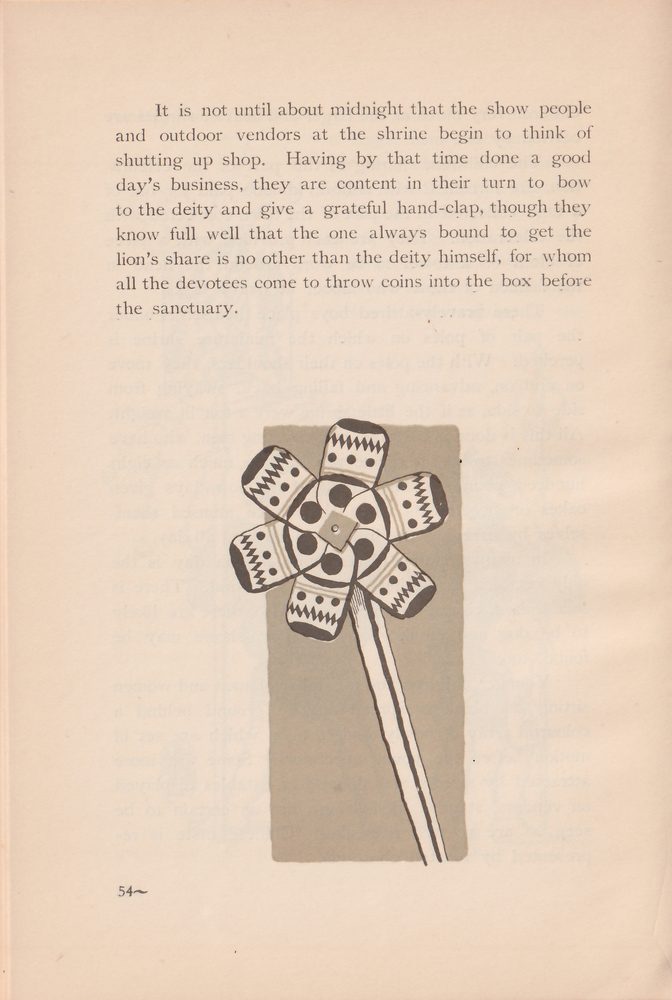
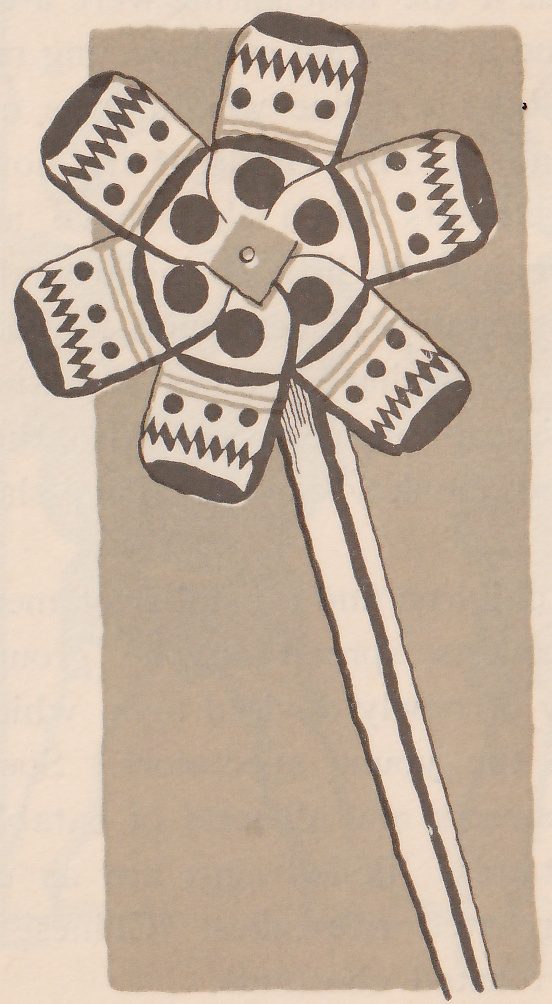
Younger children find a number of men and women sitting on blankets spread on the ground behind a colourful array of newly devised toys, which are set in motion before the young spectators. Some are more attracted by sweets and all sorts of eatables displayed on vendors’ stands. Boiled eggs are as certain to be seen as are roasted rice-cakes. Chinese taste is represented by roasted chestnuts.
It is not until about midnight that the show people and outdoor vendors at the shrine begin to think of shutting up shop. Having by that time done a good day’s business, they are content in their turn to bow to the deity and give a grateful hand-clap, though they know full well that the one always bound to get the lion’s share is no other than the deity himself, for whom all the devotees come to throw coins into the box before the sanctuary.